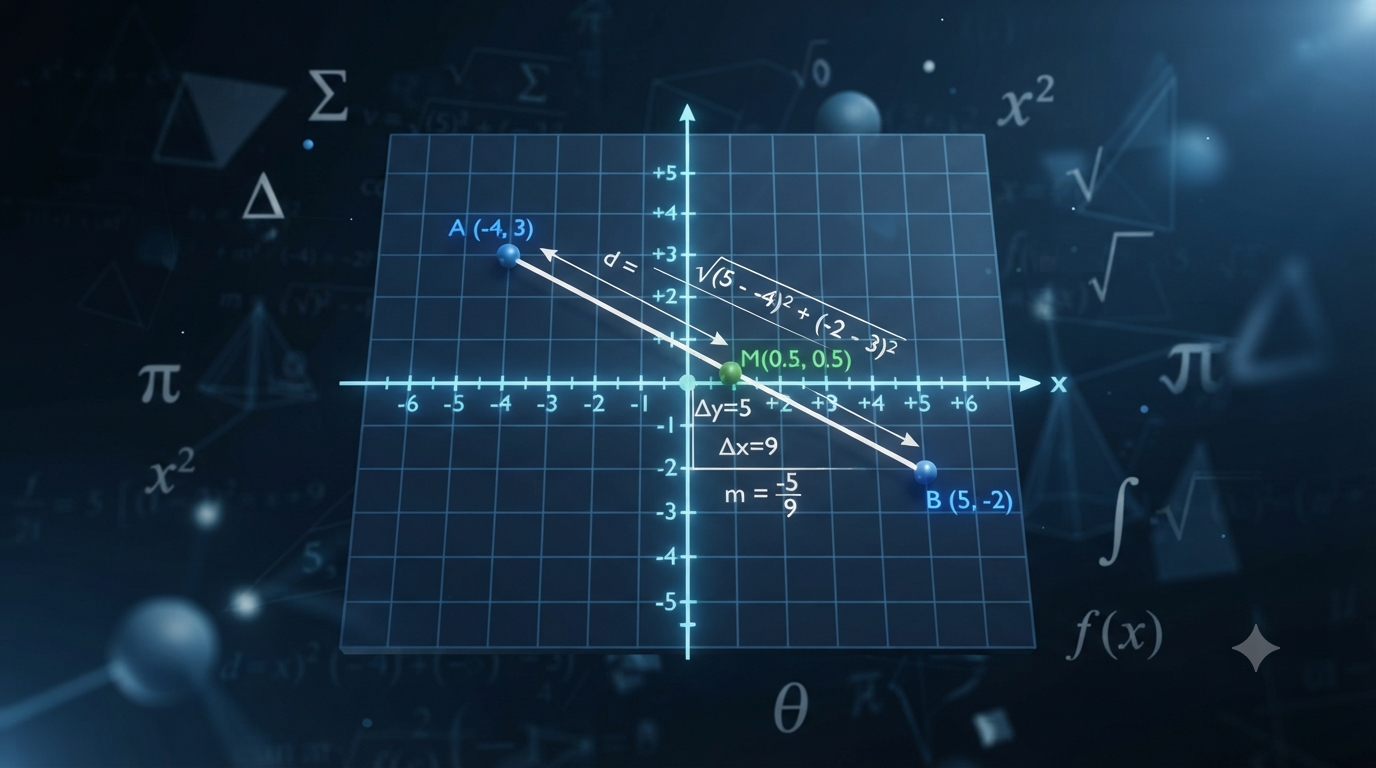
Coordinate geometry is a branch of mathematics that connects algebra with geometry. It helps us describe points, lines, shapes, and their positions using numbers and coordinates. Instead of depending only on diagrams, coordinate geometry allows us to calculate distances, slopes, midpoints, areas, and other geometric properties using formulas.
The foundation of coordinate geometry is the Cartesian coordinate plane, which consists of a horizontal x-axis and a vertical y-axis. Every point on this plane can be represented by an ordered pair such as (x, y). Once you understand how coordinates work, several important formulas can be used to solve geometric problems quickly and accurately.
For beginners, learning the formulas is not enough. It is equally important to understand what each formula means, when to use it, and how the values are substituted. This article explains the essential coordinate geometry formulas that form the foundation for further study.
1. Coordinates of a Point
A point in a two-dimensional coordinate plane is represented by an ordered pair:
P(x, y)
Here:
x represents the horizontal position of the point.
y represents the vertical position of the point.
The x-coordinate is called the abscissa, while the y-coordinate is called the ordinate.
For example, consider the point:
P(4, 3)
This means that the point is 4 units to the right of the y-axis and 3 units above the x-axis.
Similarly, the point Q(-2, 5) is 2 units to the left of the y-axis and 5 units above the x-axis.
Understanding the signs of coordinates is important because positive and negative values determine the position of a point.
2. Quadrants of the Coordinate Plane
The x-axis and y-axis divide the coordinate plane into four regions called quadrants.
The signs of x and y in each quadrant are:
| Quadrant | x-coordinate | y-coordinate |
|---|---|---|
| I | Positive | Positive |
| II | Negative | Positive |
| III | Negative | Negative |
| IV | Positive | Negative |
For example:
(3, 4) lies in Quadrant I.
(-3, 4) lies in Quadrant II.
(-3, -4) lies in Quadrant III.
(3, -4) lies in Quadrant IV.
Points located directly on either axis do not belong to any quadrant.
3. Distance Formula
The distance formula is used to find the distance between two points in a coordinate plane.
Suppose the two points are:
A(x₁, y₁) and B(x₂, y₂)
The distance between them is:
d = √[(x₂ − x₁)² + (y₂ − y₁)²]
This formula comes from the Pythagorean theorem. The horizontal difference between the points forms one side of a right triangle, while the vertical difference forms the other side.
For example, consider:
A(2, 3) and B(6, 6)
The horizontal difference is:
6 − 2 = 4
The vertical difference is:
6 − 3 = 3
Therefore:
d = √(4² + 3²)
d = √(16 + 9)
d = √25 = 5 units
The distance formula is one of the most frequently used formulas in coordinate geometry.
4. Midpoint Formula
The midpoint formula is used to find the point exactly halfway between two given points.
For points:
A(x₁, y₁) and B(x₂, y₂)
the midpoint is:
M = ((x₁ + x₂)/2, (y₁ + y₂)/2)
In simple terms, you find the average of the two x-coordinates and the average of the two y-coordinates.
For example, if:
A(2, 4) and B(8, 10)
then:
M = ((2 + 8)/2, (4 + 10)/2)
M = (5, 7)
Therefore, the midpoint of AB is (5, 7).
The midpoint formula is useful when dividing a line segment into two equal parts.
5. Section Formula
The section formula is used to find the coordinates of a point that divides a line segment in a given ratio.
Suppose a point P divides the line joining:
A(x₁, y₁) and B(x₂, y₂)
internally in the ratio m.
The coordinates of P are:
P = ((mx₂ + nx₁)/(m + n), (my₂ + ny₁)/(m + n))
This formula is an extension of the midpoint concept.
When the ratio is 1:1, the section formula becomes the midpoint formula.
For example, if P divides the line joining A(2, 3) and B(8, 9) in the ratio 1:2, then:
P = ((1 × 8 + 2 × 2)/(1 + 2), (1 × 9 + 2 × 3)/(1 + 2))
P = (12/3, 15/3)
P = (4, 5)
Thus, P is located at (4, 5).
6. Slope of a Line
The slope describes the steepness and direction of a straight line.
For two points:
A(x₁, y₁) and B(x₂, y₂)
the slope is:
m = (y₂ − y₁)/(x₂ − x₁)
The numerator represents the change in y, while the denominator represents the change in x.
This can also be remembered as:
Slope = Rise / Run
For example, consider the points:
A(2, 3) and B(6, 11)
Then:
m = (11 − 3)/(6 − 2)
m = 8/4 = 2
Therefore, the slope of the line is 2.
A positive slope means that the line generally rises from left to right, while a negative slope means that it falls from left to right.
7. Special Cases of Slope
Some lines have special slopes.
Horizontal Line
A horizontal line has the same y-coordinate for every point.
Therefore:
m = 0
For example, the line passing through (2, 5) and (8, 5) has slope:
m = (5 − 5)/(8 − 2) = 0
Vertical Line
A vertical line has the same x-coordinate for every point.
Its slope is undefined because the denominator in the slope formula becomes zero.
For example, the line passing through (4, 2) and (4, 9) has:
m = (9 − 2)/(4 − 4) = 7/0
Division by zero is undefined, so the slope is undefined.
8. Equation of a Straight Line
The equation of a straight line can be written in several forms. One of the most useful forms for beginners is the slope-intercept form:
y = mx + c
Here:
m is the slope of the line.
c is the y-intercept.
The y-intercept is the point where the line crosses the y-axis.
For example:
y = 2x + 3
has a slope of 2 and a y-intercept of 3.
This means that the line crosses the y-axis at:
(0, 3)
9. Point-Slope Form
When the slope and one point on the line are known, the point-slope form is useful.
The formula is:
y − y₁ = m(x − x₁)
Here:
m is the slope.
(x₁, y₁) is a known point on the line.
For example, if a line has slope 3 and passes through (2, 5), then:
y − 5 = 3(x − 2)
This form can then be simplified into another form of the line equation if required.
10. Two-Point Form of a Line
When two points on a line are known, the two-point form can be used.
For points:
(x₁, y₁) and (x₂, y₂)
the equation is:
(y − y₁)/(y₂ − y₁) = (x − x₁)/(x₂ − x₁)
This formula is particularly useful when the slope is not given directly but two points are available.
For example, if a line passes through (1, 2) and (4, 8), the coordinates can be substituted into the two-point form to obtain its equation.
11. Intercept Form of a Line
If a line crosses the x-axis at a and the y-axis at b, its equation can be written in intercept form:
x/a + y/b = 1
Here:
a is the x-intercept.
b is the y-intercept.
For example, if a line has an x-intercept of 4 and a y-intercept of 6, its equation is:
x/4 + y/6 = 1
This form is especially useful when the intercepts are directly given in a problem.
12. Conditions for Parallel Lines
Two non-vertical lines are parallel if they have the same slope.
If the slopes of two lines are m₁ and m₂, then:
m₁ = m₂
For example, a line with slope 3 is parallel to another line with slope 3, provided the two lines are distinct.
Parallel lines never meet when extended indefinitely in the same plane.
13. Conditions for Perpendicular Lines
Two non-vertical lines are perpendicular when their slopes are negative reciprocals of each other.
The condition is:
m₁m₂ = −1
For example, if one line has slope:
m₁ = 2
then a perpendicular line has slope:
m₂ = −1/2
because:
2 × (−1/2) = −1
This relationship is frequently used in geometry and coordinate geometry problems.
14. Area of a Triangle Using Coordinates
The area of a triangle can be calculated when the coordinates of its three vertices are known.
Suppose the vertices are:
A(x₁, y₁), B(x₂, y₂), C(x₃, y₃)
The area is:
Area = 1/2 |x₁(y₂ − y₃) + x₂(y₃ − y₁) + x₃(y₁ − y₂)|
The vertical bars indicate that the absolute value should be taken, so the final area is positive.
For example, consider the points:
A(1, 1), B(5, 1), C(1, 4)
Using the formula:
Area = 1/2 |1(1 − 4) + 5(4 − 1) + 1(1 − 1)|
Area = 1/2 |−3 + 15 + 0|
Area = 1/2 × 12
Area = 6 square units
This formula is especially useful when a triangle is not conveniently positioned on the coordinate axes.
15. Area of a Rectangle Using Coordinates
If the sides of a rectangle are parallel to the coordinate axes, its area can be found using:
Area = Length × Width
The length and width can be obtained from the differences between the relevant x- and y-coordinates.
For example, suppose a rectangle extends from x = 2 to x = 8 and from y = 3 to y = 7.
Its length is:
8 − 2 = 6 units
Its width is:
7 − 3 = 4 units
Therefore:
Area = 6 × 4 = 24 square units
For rectangles in other orientations, the distance formula can be used to determine side lengths.
16. Distance of a Point from the Origin
The origin is the point:
O(0, 0)
For a point:
P(x, y)
the distance from the origin is:
OP = √(x² + y²)
This is a special case of the distance formula.
For example, for the point:
P(3, 4)
the distance from the origin is:
OP = √(3² + 4²)
OP = √(9 + 16)
OP = √25 = 5 units
This is another application of the Pythagorean theorem.
17. Distance Between a Point and a Line
The perpendicular distance from a point (x₁, y₁) to a line written as:
Ax + By + C = 0
is:
d = |Ax₁ + By₁ + C| / √(A² + B²)
This formula is useful when the shortest distance between a point and a straight line needs to be determined.
The numerator gives the absolute value of the expression after substituting the coordinates of the point, while the denominator normalizes the result.
18. Collinearity of Three Points
Three points are collinear if they lie on the same straight line.
One way to check this is by comparing slopes.
For points A, B, and C to be collinear:
Slope of AB = Slope of BC
Another method is to use the coordinate area formula. If the area of the triangle formed by the three points is zero, the points are collinear.
Therefore:
Area = 0
indicates that the three points lie on one straight line.
19. Equation of a Line Parallel to an Axis
Coordinate geometry also includes simple equations for horizontal and vertical lines.
A horizontal line has the form:
y = k
where k is a constant.
For example:
y = 4
represents a horizontal line passing through all points whose y-coordinate is 4.
A vertical line has the form:
x = k
For example:
x = −3
represents a vertical line passing through all points whose x-coordinate is −3.
These equations are among the simplest examples of straight-line equations.
20. Important Coordinate Geometry Formulas at a Glance
For quick revision, the most important beginner-level formulas are:
Coordinates of a point:
P(x, y)
Distance between two points:
d = √[(x₂ − x₁)² + (y₂ − y₁)²]
Midpoint:
M = ((x₁ + x₂)/2, (y₁ + y₂)/2)
Section formula:
P = ((mx₂ + nx₁)/(m + n), (my₂ + ny₁)/(m + n))
Slope:
m = (y₂ − y₁)/(x₂ − x₁)
Slope-intercept form:
y = mx + c
Point-slope form:
y − y₁ = m(x − x₁)
Intercept form:
x/a + y/b = 1
Parallel lines:
m₁ = m₂
Perpendicular lines:
m₁m₂ = −1
Area of a triangle:
Area = 1/2 |x₁(y₂ − y₃) + x₂(y₃ − y₁) + x₃(y₁ − y₂)|
Distance from a point to a line:
d = |Ax₁ + By₁ + C| / √(A² + B²)
Distance from origin:
d = √(x² + y²)
21. How to Use Coordinate Geometry Formulas Correctly
Knowing the formulas is only the first step. Beginners often make mistakes because they substitute coordinates incorrectly or ignore negative signs.
A useful approach is to first identify what the problem is asking.
If the question asks for the distance between two points, use the distance formula. If it asks for the point halfway between two coordinates, use the midpoint formula. If it asks about the steepness of a line, calculate the slope. If three points are given and you need to determine whether they lie on one line, check their slopes or calculate the area.
Always write the coordinates clearly before substituting them. Be particularly careful with negative coordinates. For example, subtracting a negative number requires attention:
x₂ − (−x₁) = x₂ + x₁
Keeping the calculation organized reduces errors.
Conclusion
Coordinate geometry provides a powerful way to solve geometric problems using numbers, coordinates, and algebraic formulas. The basic concepts begin with locating points on the coordinate plane and gradually extend to calculating distances, midpoints, slopes, line equations, areas, and relationships between lines.
For beginners, the most important formulas to master are the distance formula, midpoint formula, section formula, slope formula, straight-line equations, and coordinate area formula. Once these formulas become familiar, many coordinate geometry problems become easier to understand and solve.
Rather than memorizing every formula without context, focus on understanding what each formula calculates and why it works. Practice with different coordinate values, especially positive and negative numbers. With regular practice, these fundamental formulas can provide a strong foundation for more advanced topics in analytical geometry, algebra, and mathematics.
FAQs
1. What is coordinate geometry?
Coordinate geometry is a branch of mathematics that uses coordinates and algebraic formulas to study geometric shapes and positions. It represents points using ordered pairs such as (x, y) on a Cartesian coordinate plane. Using coordinate geometry, you can calculate distances between points, find midpoints, determine slopes, write equations of lines, calculate areas, and study relationships between lines. It provides a connection between algebra and geometry, making many geometric problems easier to solve using numerical methods. The coordinate plane consists of an x-axis and y-axis, which divide the plane into four quadrants.
2. What is the distance formula in coordinate geometry?
The distance formula is used to find the distance between two points on a coordinate plane. If the two points are (x₁, y₁) and (x₂, y₂), the formula is d = √[(x₂ − x₁)² + (y₂ − y₁)²]. It is based on the Pythagorean theorem. First, find the difference between the x-coordinates and y-coordinates. Square both differences, add them, and then take the square root. For example, the distance between (2, 3) and (6, 6) is √(4² + 3²) = √25 = 5 units.
3. What is the midpoint formula?
The midpoint formula is used to find the point exactly halfway between two given points. For points (x₁, y₁) and (x₂, y₂), the midpoint is M = ((x₁ + x₂)/2, (y₁ + y₂)/2). To use the formula, add the two x-coordinates and divide the result by 2. Then add the two y-coordinates and divide that result by 2. For example, the midpoint of (2, 4) and (8, 10) is (5, 7). The midpoint formula is useful for dividing a line segment into two equal parts.
4. What is the slope formula?
The slope formula is used to determine the steepness and direction of a straight line. For two points (x₁, y₁) and (x₂, y₂), the slope is m = (y₂ − y₁)/(x₂ − x₁). The numerator represents the change in the y-coordinate, while the denominator represents the change in the x-coordinate. Slope can also be remembered as rise over run. A positive slope generally indicates that a line rises from left to right, while a negative slope indicates that it falls. A horizontal line has zero slope, while a vertical line has an undefined slope.
5. What is the section formula?
The section formula is used to find the coordinates of a point that divides a line segment in a specified ratio. If a point P divides the line joining (x₁, y₁) and (x₂, y₂) internally in the ratio m, its coordinates are P = ((mx₂ + nx₁)/(m + n), (my₂ + ny₁)/(m + n)). The formula is useful when a point is located somewhere between two known points but is not necessarily at the center. When the ratio is 1:1, the section formula gives the midpoint of the line segment.
6. How do you find the equation of a straight line?
The equation of a straight line can be written in several forms depending on the information provided. One common form is y = mx + c, where m represents the slope and c represents the y-intercept. If the slope and one point are known, the point-slope form y − y₁ = m(x − x₁) can be used. If two points are known, you can first calculate the slope and then use a suitable line equation. Choosing the correct form makes coordinate geometry problems easier because it allows known information to be substituted directly.
7. How can you determine whether two lines are parallel?
Two non-vertical straight lines are parallel if they have the same slope. If the slopes of two lines are m₁ and m₂, the condition for parallel lines is m₁ = m₂. For example, if one line has a slope of 3 and another line also has a slope of 3, the lines have the same direction and are parallel if they are distinct. You can calculate the slope of each line using m = (y₂ − y₁)/(x₂ − x₁). Comparing the resulting slopes provides a straightforward way to identify parallel lines.
8. How can you determine whether two lines are perpendicular?
Two non-vertical lines are perpendicular when their slopes are negative reciprocals of each other. If their slopes are m₁ and m₂, the condition is m₁m₂ = −1. For example, if one line has a slope of 2, a perpendicular line has a slope of −1/2. Multiplying these slopes gives 2 × (−1/2) = −1. This relationship is commonly used in coordinate geometry to determine whether two lines meet at a right angle. Remember that vertical and horizontal lines are also perpendicular, even though the slope of a vertical line is undefined.
9. How do you find the area of a triangle using coordinates?
The area of a triangle can be calculated when the coordinates of all three vertices are known. If the vertices are (x₁, y₁), (x₂, y₂), and (x₃, y₃), the formula is Area = 1/2 |x₁(y₂ − y₃) + x₂(y₃ − y₁) + x₃(y₁ − y₂)|. Substitute the coordinates carefully into the formula and simplify the expression. The absolute value ensures that the final area is positive. This method is particularly useful when the triangle is not conveniently positioned along the coordinate axes and its base and height are not immediately obvious.
10. Which coordinate geometry formulas should beginners learn first?
Beginners should first understand the formulas that are used most frequently in basic coordinate geometry. These include the distance formula, midpoint formula, slope formula, section formula, and equations of straight lines. It is also useful to learn the conditions for parallel and perpendicular lines and the coordinate formula for finding the area of a triangle. Instead of memorizing all formulas at once, learn what each formula calculates and practice using it with different coordinates. Pay special attention to negative numbers and brackets during substitution. A strong understanding of these basic formulas makes more advanced coordinate geometry topics easier to learn.