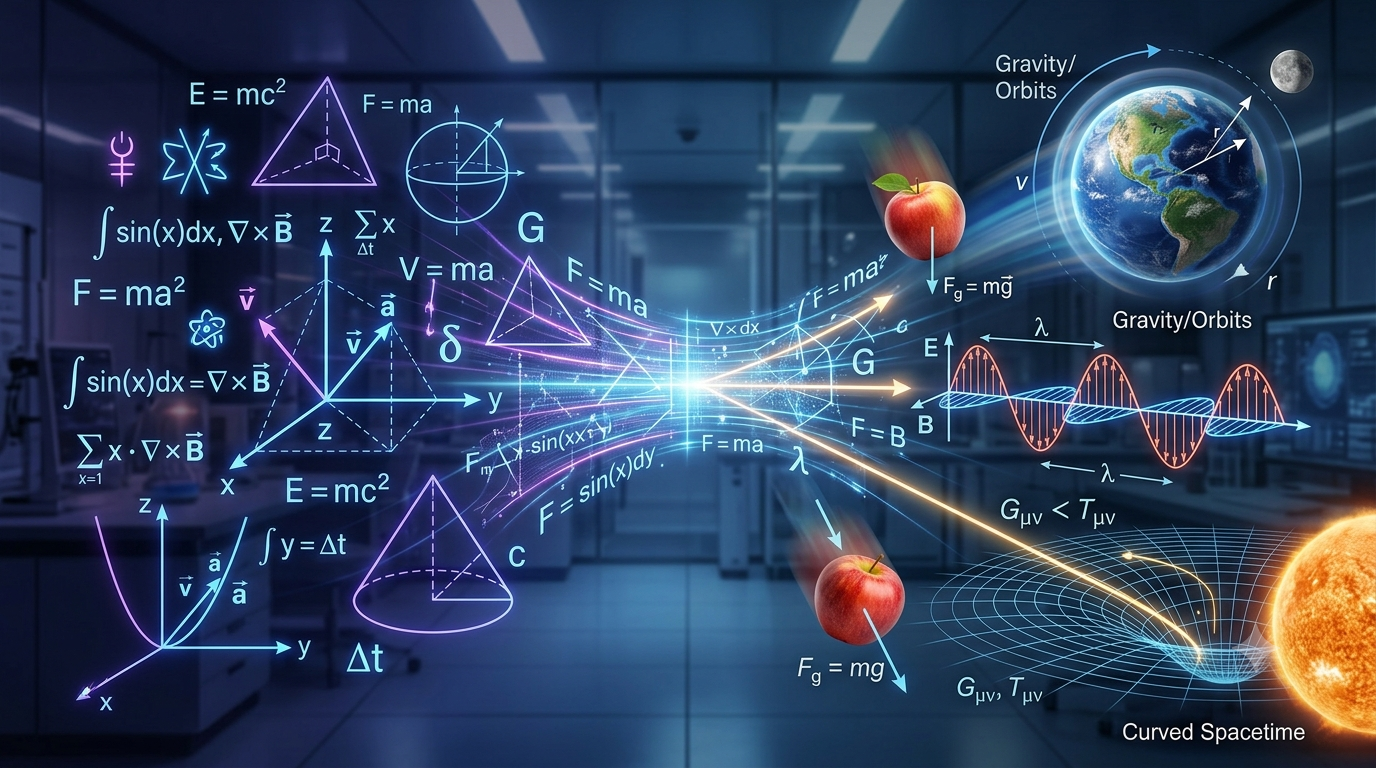
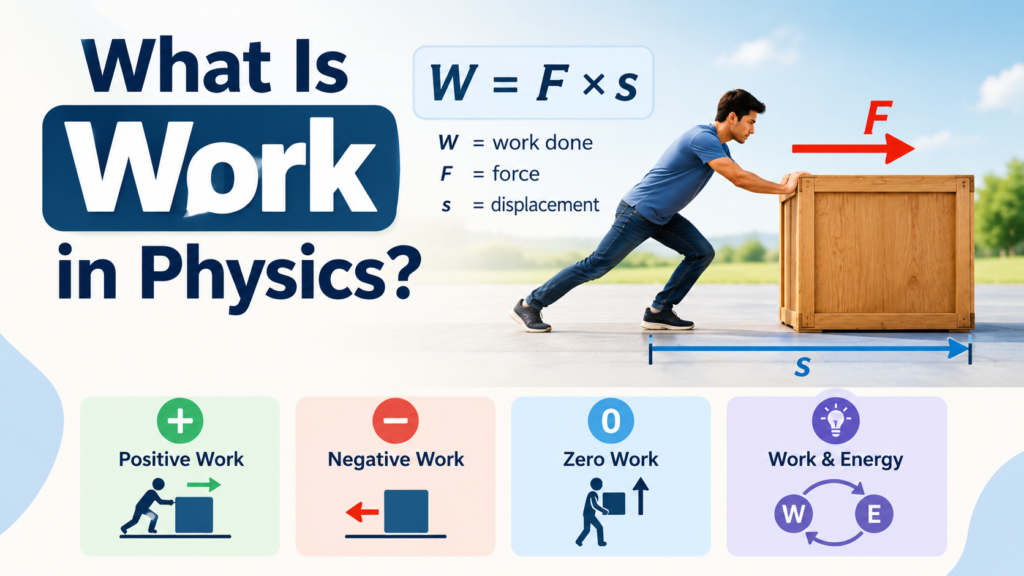
Physics is often described as the science of matter, energy, motion, space, and time. But behind almost every physical idea lies another powerful language: mathematics. Mathematics gives physicists a way to describe patterns, measure relationships, make predictions, and test whether an idea agrees with nature. Physics connects mathematics with reality by using mathematical models to turn observations into precise statements about how the universe works.
This connection is one of the most fascinating features of physics. A mathematical equation may look like a collection of symbols, but those symbols can represent real objects, measurable quantities, forces, energy, waves, and even the structure of space and time.
Mathematics Gives Physics a Precise Language
Nature does not explain itself using sentences or definitions. A falling object simply falls, planets orbit stars, and electric charges interact. Physics needs a language that can describe these processes accurately.
Mathematics provides that language.
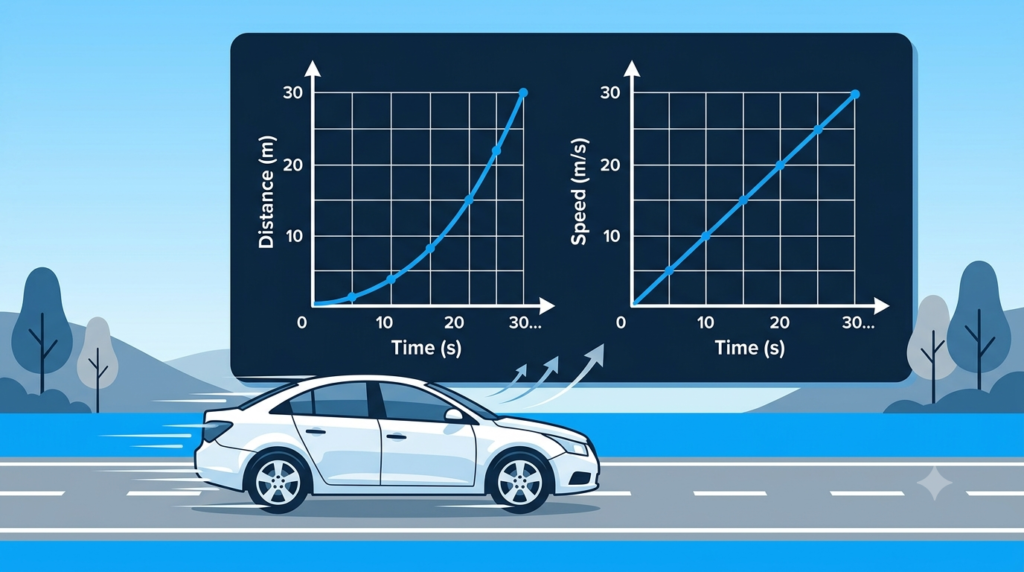
For example, speed can be expressed as:
Speed = Distance ÷ Time
This simple equation connects three measurable quantities. If an object travels 100 meters in 10 seconds, its average speed is 10 meters per second.
Without mathematics, we could say that one object moves faster than another. With mathematics, we can state exactly how fast it moves and compare its motion with other objects.
This precision becomes increasingly important when physical systems become more complicated.
Equations Represent Relationships in Nature
A physics equation is more than a calculation tool. It represents a relationship between physical quantities.
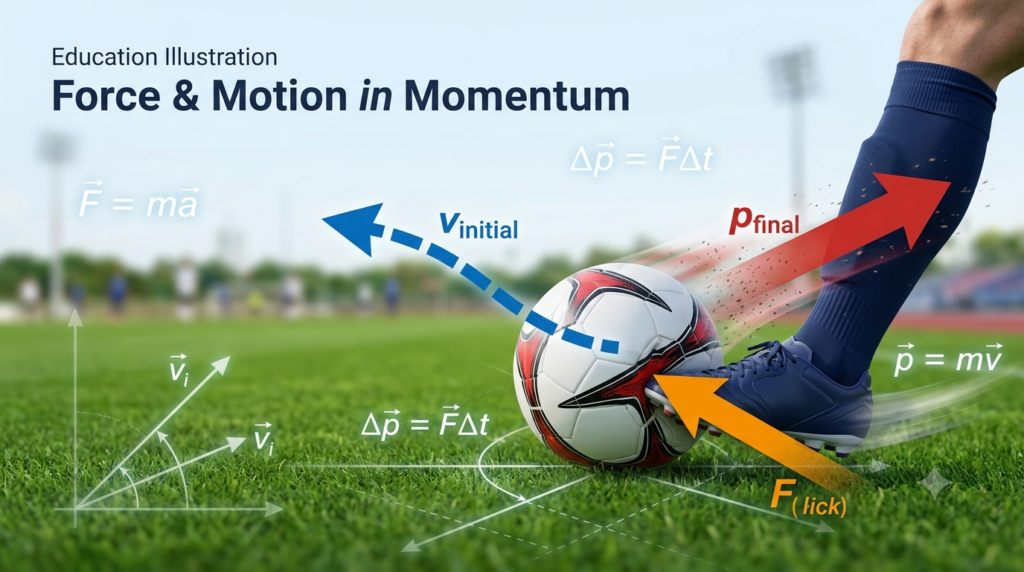
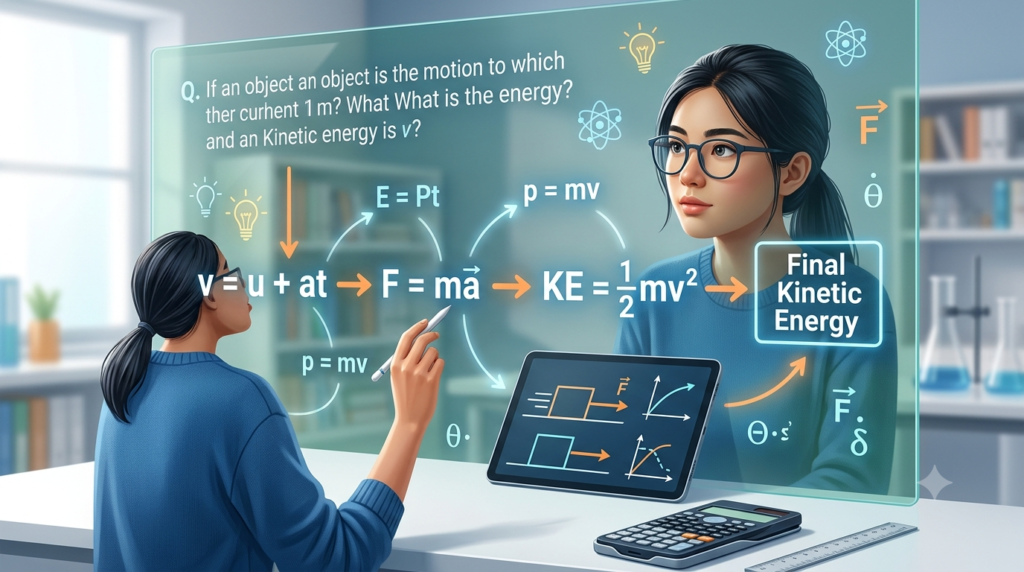
Consider Newton’s second law:
F = ma
Here, force is related to mass and acceleration. The equation tells us that increasing the force on an object generally increases its acceleration, while increasing the object’s mass makes the same force produce less acceleration.
This mathematical relationship allows physicists to make predictions.
If the mass of an object and the applied force are known, its acceleration can be calculated. The prediction can then be compared with an actual experiment. If measurements consistently agree with the prediction, the mathematical model gains support.
This is one of the central ways physics connects mathematics with reality.
Measurements Give Mathematics a Physical Meaning
Mathematics by itself is an abstract system. Physics gives mathematical quantities physical meaning by connecting them with measurements.
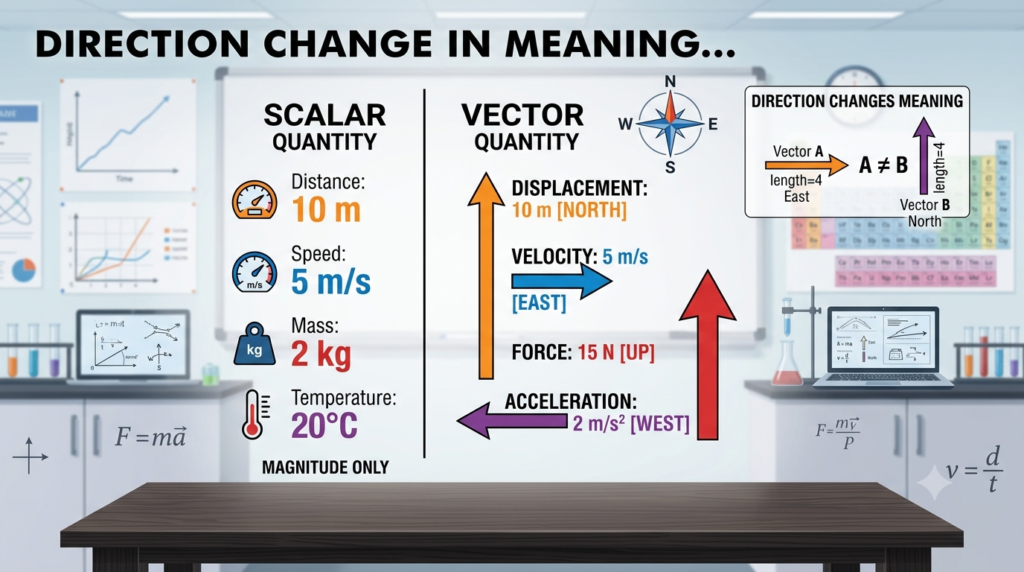
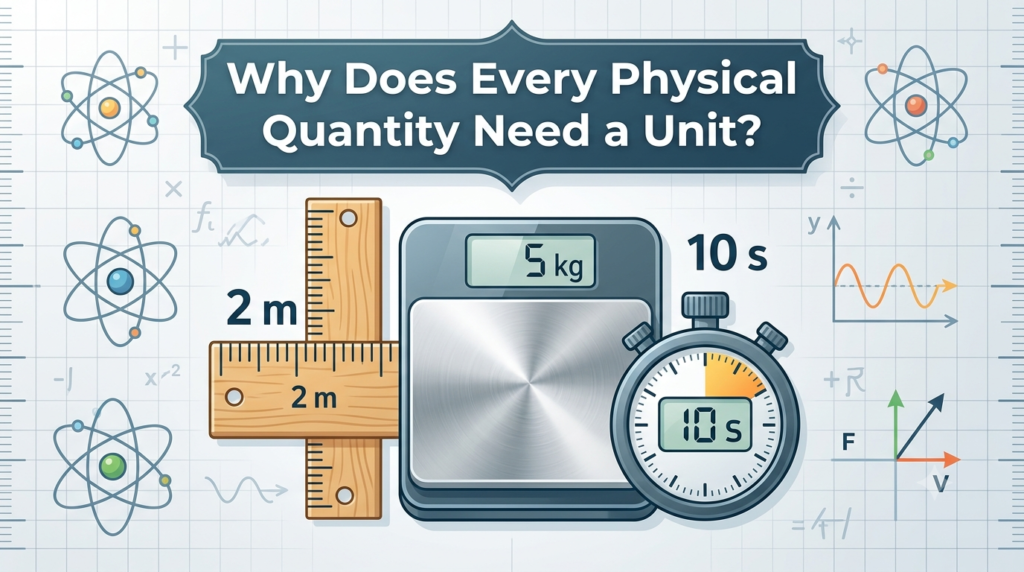
For example, the number 5 has no physical meaning by itself. But 5 meters represents a length, 5 seconds represents a time interval, and 5 kilograms represents a mass.
Units are therefore an important bridge between mathematics and reality.
When physicists write:
v = 20 m/s
the number 20 is not just an abstract number. It represents a measurable speed. The unit meters per second tells us what physical quantity the number describes.
This is why units are essential in physics. They help ensure that mathematical expressions correspond to real measurable quantities.
Mathematical Models Simplify Reality
The real world is extremely complicated. A moving object may experience air resistance, friction, gravity, vibrations, temperature changes, and countless other effects.
If physicists tried to include every possible detail in every calculation, many problems would become impossible to solve.
Instead, physics uses mathematical models.
A model simplifies reality by focusing on the factors that matter most for a particular problem. For example, when studying the motion of a ball, a physicist might initially ignore air resistance. This creates a simpler mathematical model that can still provide useful predictions.
The model is not reality itself. It is a mathematical representation of selected features of reality.
The important question is whether the model works well enough for the situation being studied.
Geometry Can Describe Physical Space
Mathematics connects with reality not only through numbers and equations but also through geometry.
Geometry helps physicists describe shapes, distances, angles, areas, and volumes. These ideas are useful in almost every branch of physics.
For example, the path of a projectile can be represented mathematically as a curve. The orbit of a planet can be described using geometric and mathematical relationships. Waves can be represented using curves that show how quantities change with position and time.
In modern physics, geometry becomes even more powerful.
Einstein’s theory of general relativity describes gravity using the geometry of spacetime. According to the theory, matter and energy influence the geometry of spacetime, and this geometry affects how objects move.
Here, mathematics is not simply being used to calculate a physical quantity. Mathematical geometry becomes part of the description of physical reality itself.
Calculus Helps Describe Change
Many physical processes involve continuous change. An object’s position changes with time, its velocity can change, and its acceleration can change as well.
Calculus provides the mathematical tools needed to describe such changes.
For example, velocity describes how position changes with time, while acceleration describes how velocity changes with time. These relationships can be expressed using derivatives.
Calculus is also used to understand motion, electricity, fluid flow, heat, waves, and many other physical systems.
This shows an important feature of physics: mathematics is not chosen randomly. Different mathematical tools become useful because they match different types of physical behavior.
Probability Helps Physics Describe Uncertainty
Not every physical prediction is completely certain. At the microscopic level, quantum physics uses probability in a fundamental way.
Instead of always predicting exactly where a particle will be found, quantum mechanics often calculates the probability of finding it in different locations or states.
Mathematical functions are used to represent these possibilities. When experiments are performed repeatedly, the observed results can be compared with the predicted probability distribution.
This creates another powerful connection between mathematics and reality. Mathematical probabilities are tested against large numbers of real-world observations.
Physics Uses Mathematics to Make Predictions
One of the greatest strengths of mathematical physics is prediction.
A good physical theory should not merely explain something that has already happened. It should also make predictions about what will happen under new conditions.
For example, mathematical equations can predict the trajectory of a spacecraft, the behavior of an electrical circuit, the frequency of a wave, or the motion of a falling object.
Predictions provide a way to test theories.
If a mathematical prediction repeatedly disagrees with carefully performed experiments, physicists must reconsider the model, its assumptions, or sometimes the underlying theory.
If the predictions consistently agree with measurements, confidence in the theory increases.
Dimensions and Mathematical Consistency Matter
Physics also uses mathematics to check whether an equation makes physical sense.
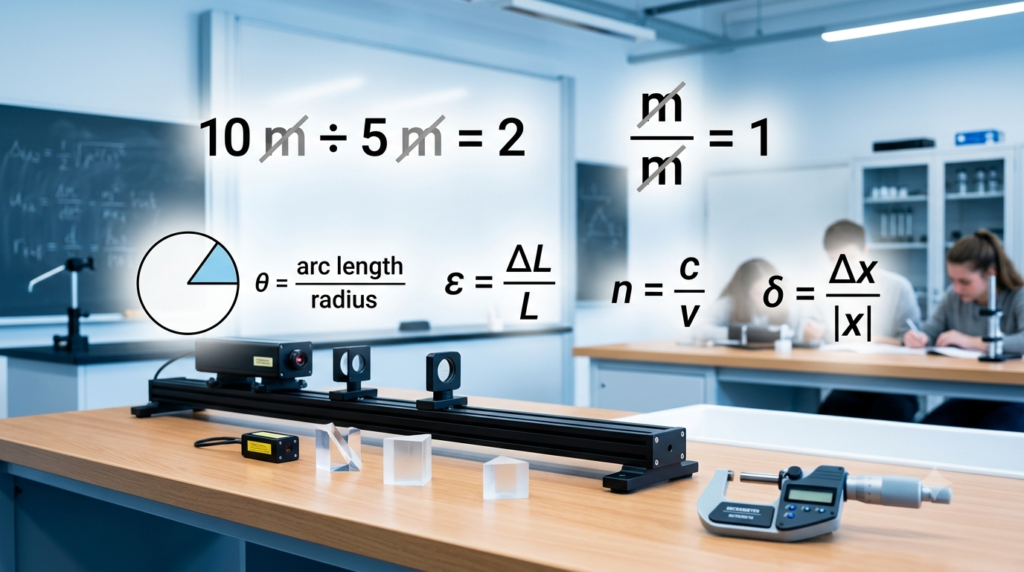
Dimensional analysis is a simple but powerful example. Quantities with different physical dimensions cannot normally be added directly.
For example, adding 5 meters to 3 seconds does not make physical sense because length and time represent different kinds of quantities.
Dimensional analysis can therefore reveal mistakes in equations and calculations before an experiment is performed.
This demonstrates that mathematics does not only help physicists calculate answers. It also helps them check whether their reasoning is physically meaningful.
When Mathematics Predicts Something New
Sometimes mathematics leads physics beyond what has already been observed.
A mathematical theory may produce a prediction that scientists have not yet directly detected. If later experiments confirm the prediction, the connection between mathematics and reality becomes especially striking.
The history of physics contains several examples where mathematical theories suggested new physical phenomena before experimental evidence became available.
This does not mean that every mathematically possible idea must exist in nature. Mathematics can describe many possibilities. Experiments are still necessary to determine which possibilities correspond to the physical universe.
Reality Tests the Mathematics
The relationship between mathematics and physics works in both directions.
Mathematics helps physicists build theories and make predictions, but reality ultimately tests those theories.
An equation may be mathematically elegant and logically consistent, yet still fail to describe nature accurately. Physical measurements decide whether a mathematical model is useful as a description of the real world.
This is what makes physics different from pure mathematics.
Mathematics asks whether a mathematical statement follows logically from its assumptions. Physics asks whether a mathematical description successfully represents something that happens in nature.
The Deeper Connection
The connection between mathematics and reality is one of the deepest ideas in science. Physics takes observations from the natural world and expresses their patterns mathematically. Those mathematical models are then used to calculate predictions, which are tested through experiments and measurements.
The process can be viewed as a continuous cycle:
Observation → Measurement → Mathematical Model → Prediction → Experiment → Refinement
Through this cycle, abstract symbols become connected to physical events.
From the motion of a falling object to the behavior of galaxies, mathematics gives physicists a framework for describing relationships that might otherwise be difficult or impossible to express precisely.
Conclusion
Physics connects mathematics with reality by using mathematical structures to describe measurable patterns in nature. Equations represent relationships, units connect numbers with physical quantities, models simplify complex systems, calculus describes change, geometry describes space, and probability helps explain uncertain outcomes.
But mathematics alone is not enough. A physical theory must ultimately face experimental evidence. Nature decides whether a mathematical model works.
This partnership between mathematics and observation is what makes physics so powerful. Mathematics provides the structure for describing the universe, while experiments provide the evidence that tells us whether that description is correct. Together, they allow humans to turn observations into explanations and explanations into predictions about the physical world.