In physics, numbers alone are often not enough to describe what is happening. A value such as 20 m/s, 10 N, or 5 m does not always tell the complete story. In many situations, we also need to know direction. Direction can change the meaning of a physical quantity because it tells us where something is moving, acting, or changing.
This is one of the most important ideas in physics. It helps us understand why some quantities are called scalars, while others are called vectors. Learning the role of direction makes concepts such as displacement, velocity, acceleration, force, and momentum much easier to understand.
Why Is Direction Important in Physics?
Imagine that someone tells you, “A car is moving at 60 km/h.” You know how fast the car is moving, but you do not know where it is going. It could be moving north, south, east, west, or in any other direction.
Now suppose the statement is changed to “A car is moving at 60 km/h toward the east.” The description is much more complete.
The number 60 km/h tells us the magnitude of the motion, while east tells us its direction.
This difference becomes especially important when two or more physical quantities interact. If two objects move in opposite directions, their effects may partially or completely cancel each other. If they move in the same direction, their effects may add together.
Therefore, direction is not simply extra information. For many physical quantities, it is an essential part of their meaning.
Scalars and Vectors
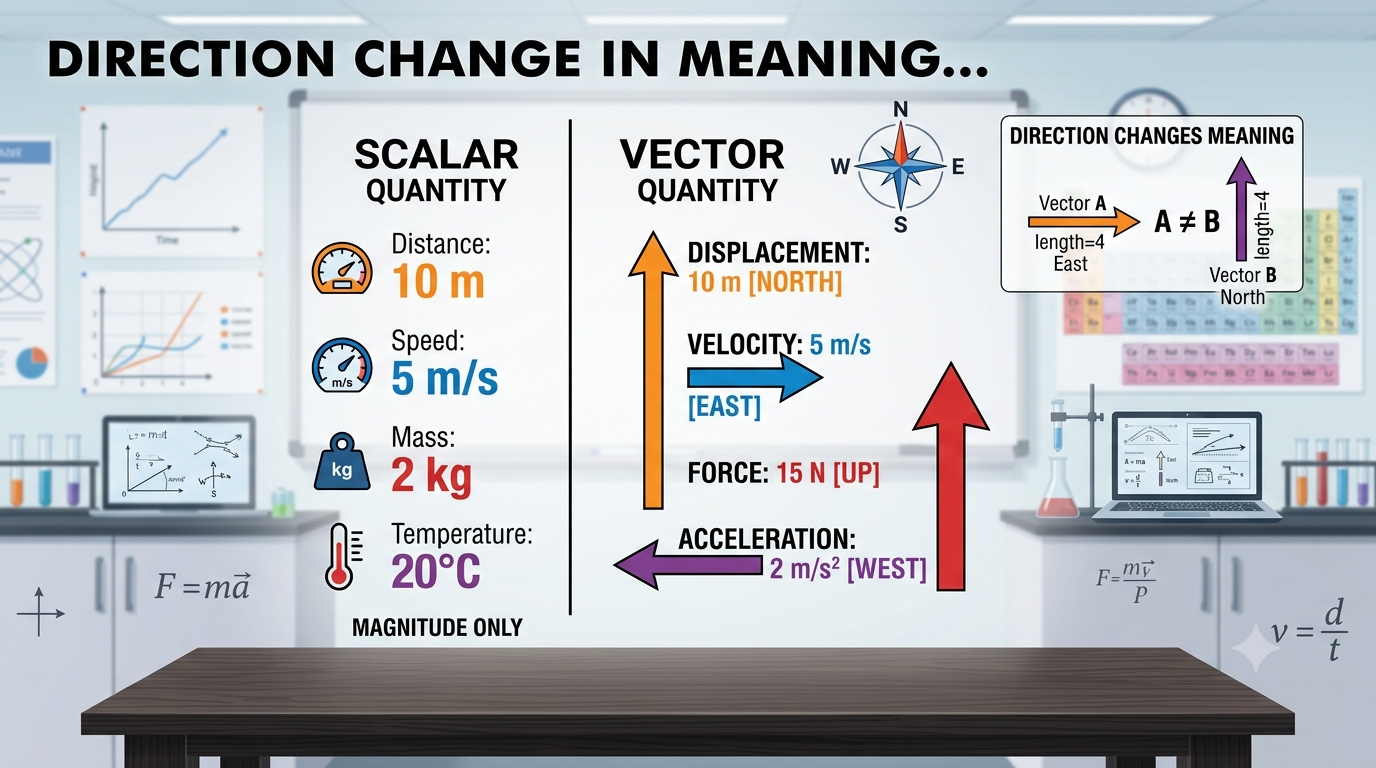
Physical quantities can broadly be divided into two groups: scalars and vectors.
A scalar quantity is completely described by its magnitude. It does not require a direction.
Examples include:
Mass
Time
Temperature
Distance
Speed
Energy
For example, if the temperature of a room is 25°C, the value itself gives the required information. We do not normally need to say that the temperature is 25°C toward the north.
A vector quantity, however, requires both magnitude and direction.
Examples include:
Displacement
Velocity
Acceleration
Force
Momentum
For example, saying that a force is 10 N does not completely describe the force. We may also need to know whether the force acts upward, downward, left, right, or in another direction.
Direction Can Change the Result
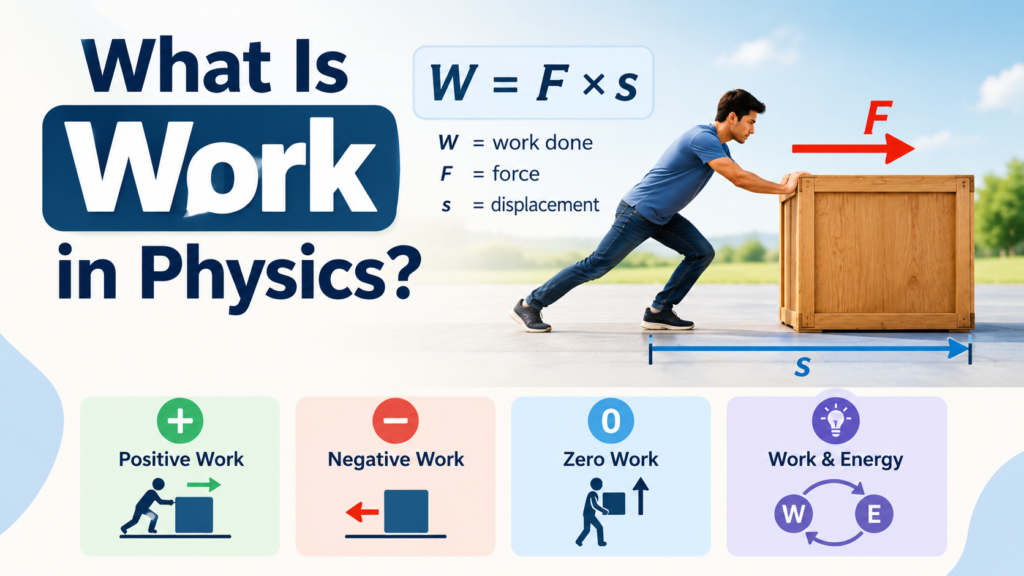
Consider two people pushing a box.
If one person pushes it toward the east with a force of 50 N and another person also pushes it toward the east with 30 N, the total force is:
50 N + 30 N = 80 N east
Both forces act in the same direction, so their effects add.
Now imagine that the second person pushes toward the west with a force of 30 N. The two forces act in opposite directions.
The net force becomes:
50 N east − 30 N west = 20 N east
The numerical values have not changed, but the direction has changed the final result.
This simple example shows why direction can fundamentally change the meaning of a physical quantity.
Distance and Displacement
Distance and displacement provide one of the clearest examples.
Distance tells us how much ground an object has covered. It is a scalar quantity.
Displacement tells us how far an object has moved from its initial position and in which direction. It is a vector quantity.
Suppose you walk 5 m east and then 5 m west. Your total distance is:
5 m + 5 m = 10 m
However, you finish at the same position where you started. Therefore, your displacement is:
0 m
The difference occurs because displacement considers direction, while distance does not.
This example shows that two quantities can describe the same journey but produce different results because one includes directional information.
Speed and Velocity
Speed and velocity are another important pair.
Speed tells us how quickly an object moves. It is a scalar quantity.
Velocity tells us how quickly an object’s position changes and includes direction. It is a vector quantity.
For example, a car may travel at 70 km/h. This is its speed.
If we say the car is traveling at 70 km/h toward the north, we are describing its velocity.
Direction becomes especially important when an object changes its path. A car traveling around a curved road may maintain nearly constant speed while its velocity continuously changes because its direction is changing.
Therefore, an object can have constant speed but changing velocity.
Acceleration Also Depends on Direction
Acceleration is often introduced as the rate at which velocity changes. Since velocity includes direction, acceleration can occur when either the magnitude of velocity changes or its direction changes.
Suppose a car increases its speed while traveling east. Its acceleration has a component toward the east.
Now imagine the car moving at constant speed around a circular track. Its speed remains constant, but its direction continuously changes. Because velocity is changing, the car is accelerating.
This is why an object moving in a circle can have acceleration even when its speed remains constant.
Direction therefore gives acceleration a deeper meaning than simply “getting faster.”
Force Has Direction
Force is another physical quantity where direction is essential.
When you push a door, the direction of your push affects how the door moves. Two forces with the same magnitude can produce completely different effects if they act in different directions.
For example, a 20 N force acting upward is different from a 20 N force acting downward.
Similarly, if two forces act on an object, we cannot always add their numerical values directly. We must consider their directions.
This is why physicists use vector addition to calculate the net force acting on an object.
Momentum Depends on Direction Too
Momentum is defined as the product of mass and velocity:
p = mv
Because velocity is a vector, momentum is also a vector.
Suppose two identical objects move at the same speed but in opposite directions. Their momenta have equal magnitudes but opposite directions.
If they are combined as a system, their momenta can cancel.
This idea is extremely important in collisions and in the study of conservation of momentum.
Without direction, it would be impossible to correctly describe many collision problems.
Direction Can Be Represented Mathematically
Physicists use several methods to represent direction.
One simple method is to choose a positive direction and a negative direction. For example, we might define east as positive and west as negative.
A velocity of:
+20 m/s
could represent 20 m/s east, while:
−20 m/s
could represent 20 m/s west.
Vectors can also be represented using arrows. The length of an arrow can represent the magnitude, while the arrowhead shows the direction.
In two or three dimensions, vectors can be divided into components along different axes. For example, a force can have horizontal and vertical components.
This mathematical representation allows complicated physical situations to be analyzed systematically.
Direction Is Relative to a Reference
Direction also depends on the reference system being used.
For example, a person sitting inside a moving train may appear stationary relative to the train. To someone standing beside the railway track, the person is moving along with the train.
Similarly, a velocity described as 20 m/s east is meaningful only when the reference direction and coordinate system are understood.
Physics therefore uses reference frames and coordinate systems to describe direction consistently.
Why Direction Matters in Real Life
The importance of direction is not limited to textbook problems. It appears everywhere in science and technology.
Engineers use vectors when designing bridges and buildings because forces act in different directions. Navigation systems use directional information to determine routes. Aircraft and ships must consider velocity and wind direction. Robotics systems use position, velocity, and force vectors to control movement.
Even sports provide simple examples. A football kicked with a certain speed can travel very differently depending on the direction of the kick.
Understanding direction helps us predict and control physical behavior.
Direction Gives Physical Quantities More Meaning
A number can describe how much of something exists, but direction can tell us how that quantity acts or changes.
For scalar quantities, magnitude is enough. For vector quantities, magnitude and direction work together.
This is why saying “10 N” is not always enough to describe a force, while “10 N upward” provides much more useful information. Similarly, “50 km/h” describes speed, but “50 km/h north” describes velocity.
The role of direction becomes even more important when several vectors interact. Their directions determine whether their effects add, oppose, or produce a result at an angle.
Conclusion
Direction can change the meaning of a physical quantity because many physical phenomena depend not only on how much but also on where something acts or changes.
Scalars such as mass, time, and speed can be described using magnitude alone. Vectors such as displacement, velocity, acceleration, force, and momentum require both magnitude and direction.
Once we understand this distinction, many physics concepts become clearer. We can understand why displacement can be zero even when distance is not, why velocity can change while speed remains constant, and why forces cannot always be added like ordinary numbers.
In physics, direction is therefore much more than an arrow attached to a number. It is an essential part of how we describe motion, interactions, and change in the physical world.