Imagine someone tells you that a table is “2” long. Does that tell you how long the table actually is? Not really. The number 2 could mean 2 metres, 2 feet, 2 centimetres, or something else entirely. The same problem appears whenever we measure something in physics.
Physics deals with measurable properties of the natural world. Length, mass, time, temperature, speed, force, energy, and electric current are examples of physical quantities. To describe these quantities clearly, we need two important things: a numerical value and a unit. The number tells us how much of a quantity is present, while the unit tells us what that number actually represents.
Without units, measurements would often be incomplete, confusing, and impossible to compare reliably.
What Is a Physical Quantity?
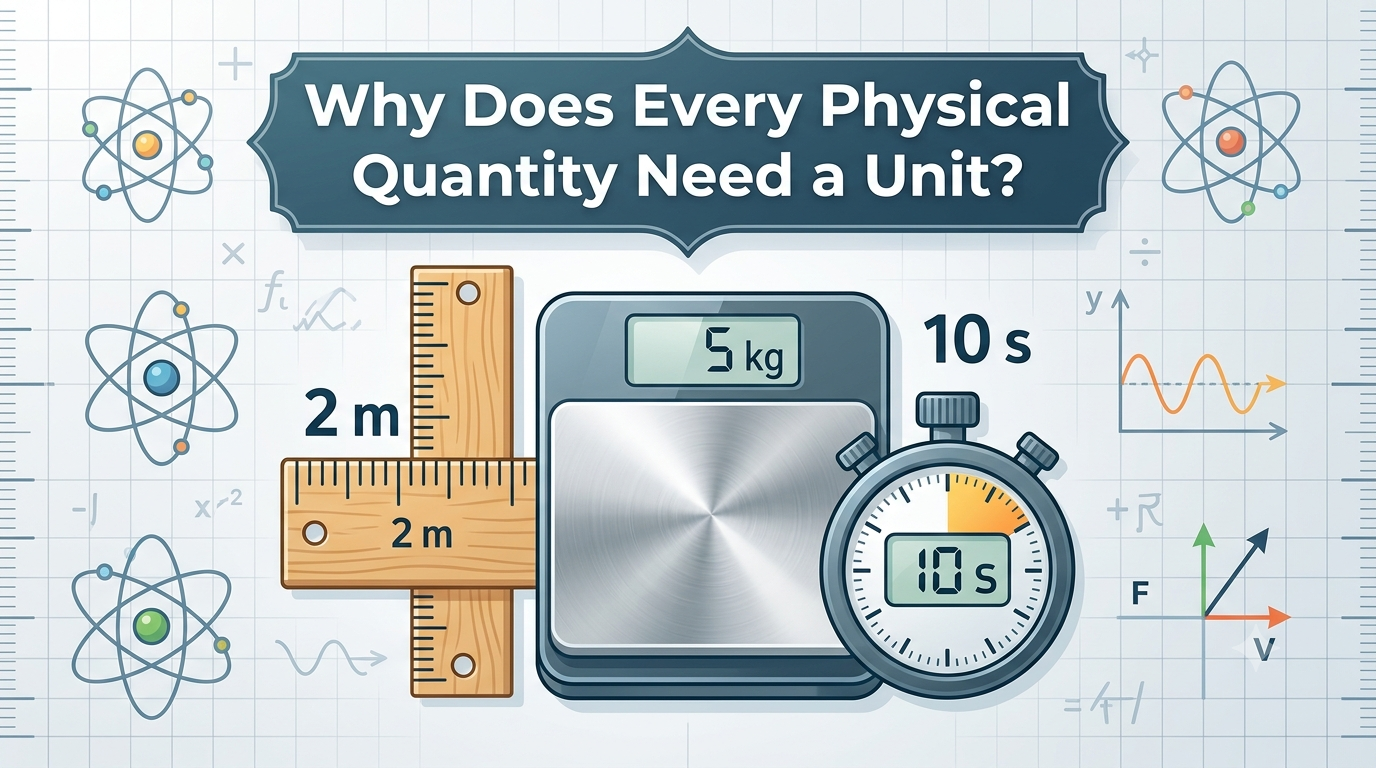
A physical quantity is a property that can be measured and expressed using a number and a standard unit. For example, the length of a table might be 2 metres, the mass of an object might be 5 kilograms, and the time taken to complete an experiment might be 10 seconds.
Every physical measurement can therefore be represented as:
Physical quantity = Numerical value × Unit
For example, if the length of a wire is 3 metres, “3” is the numerical value and “metre” is the unit.
The numerical value alone does not provide the complete measurement. The unit gives meaning to that number.
Why Is a Unit Necessary?
The main purpose of a unit is to provide a standard for measurement. Suppose two people measure the same wall. One person says its length is 4, while another says it is about 13.1. At first, their answers appear to disagree. But if the first measurement is 4 metres and the second is 13.1 feet, both may describe almost the same length.
This example shows why units are essential. They allow measurements to be understood and compared correctly.
A unit acts like a common language for measurements. When scientists in different countries use the same standard units, they can communicate their results without confusion.
Units Give Meaning to Numbers
A number without a unit can have many possible meanings.
Consider the statement, “The car is moving at 60.” It is incomplete. Is the speed 60 kilometres per hour, 60 metres per second, or 60 miles per hour? These values represent very different speeds.
Now consider the statement, “The car is moving at 60 kilometres per hour.” The meaning is immediately clear.
The unit provides essential information about the nature and scale of a measurement. This is why simply writing numbers in physics is rarely enough.
Units Make Measurements Comparable
Measurements become useful when they can be compared. However, comparison is meaningful only when the quantities are expressed using compatible units.
For example, suppose one stick is 2 metres long and another is 150 centimetres long. We cannot directly compare the numbers 2 and 150 because they use different units.
Converting them to the same unit gives:
2 metres = 200 centimetres
Now it is clear that the first stick is longer than the second.
This ability to convert and compare measurements is fundamental to physics, engineering, astronomy, chemistry, and many other scientific fields.
The Importance of Standard Units
Historically, different regions used many different measurement systems. People measured length using units such as inches, feet, yards, and other locally defined standards. Some traditional units were based on body parts, which could vary from person to person.
Such systems created difficulties in trade, construction, science, and communication.
To reduce these problems, scientists developed internationally agreed standards. Today, the International System of Units, known as the SI system, is the most widely used measurement system in science.
The SI system provides standard units such as the metre for length, kilogram for mass, second for time, kelvin for temperature, ampere for electric current, mole for amount of substance, and candela for luminous intensity.
These standards allow scientists around the world to describe measurements consistently.
Units Are Connected to Physical Quantities
Different physical quantities require different units because they describe different properties.
Length is commonly measured in metres, while mass is measured in kilograms and time in seconds. Speed is measured in metres per second, while force is measured in newtons and energy in joules.
The unit often tells us something important about the quantity being measured.
For example, metres per second combines length and time and therefore represents how quickly an object changes its position. Similarly, newtons can be expressed in terms of kilograms, metres, and seconds, showing that force is related to mass and acceleration.
This connection between units is especially useful when checking equations and calculations.
Units Help Check Physics Equations
Units are not only used to report answers. They can also help determine whether a physical equation makes sense.
Suppose we use the equation:
Speed = Distance ÷ Time
If distance is measured in metres and time in seconds, the resulting unit is metres per second.
If a calculation unexpectedly produces kilograms as the unit for speed, something is wrong.
This method is called dimensional analysis. Physicists use it to check equations, calculations, and relationships between physical quantities.
Units can therefore act as a kind of error-checking system.
What Happens Without Standard Units?
Without standard units, scientific communication would become much more difficult. Imagine researchers in different countries conducting the same experiment but using unrelated measurement systems. Comparing their results would require constant conversions, and misunderstandings could easily occur.
In engineering and technology, such mistakes can have serious consequences. A wrong unit conversion could affect the design of a machine, aircraft, bridge, electronic system, or spacecraft.
One famous example from science and engineering is the loss of NASA’s Mars Climate Orbiter in 1999, which was associated with a mismatch between units used by different parts of the mission. The incident demonstrated how important consistent units are when complex systems depend on measurements.
Units and Everyday Life
Units are not limited to laboratories. We use them constantly in everyday life.
We measure distance in kilometres, fuel in litres, body temperature in degrees Celsius, electricity in kilowatt-hours, and cooking ingredients in grams or millilitres.
When buying something, travelling, building furniture, following a recipe, or checking the weather, we depend on units to understand quantities.
Even when we are not consciously thinking about physics, units help us make sense of the physical world.
Can a Physical Quantity Exist Without a Unit?
A physical quantity exists in nature regardless of whether humans assign a unit to it. A tree has a certain height, an object has a certain mass, and a moving car has a certain speed whether or not we measure them.
However, when we want to communicate or calculate a measurement, we need a defined unit or an equivalent standard of comparison.
The unit is therefore not something that creates the physical quantity. Instead, it provides a standardized way of expressing and communicating its measured value.
Units Are More Than Labels
It may seem that units are simply labels added after numbers, but they play a much deeper role in physics.
They establish standards, provide meaning, allow comparisons, support calculations, reveal relationships between quantities, and help detect errors.
For example, saying that a light wave travels at approximately 300,000,000 metres per second communicates much more information than simply saying “300,000,000.” The unit tells us that the number represents a distance travelled per unit of time.
In this way, units become an essential part of scientific language.
Conclusion
Every physical quantity needs a unit when it is expressed as a measurement because a number alone is incomplete. The numerical value tells us how much, while the unit tells us what scale or standard that amount is measured against.
Standard units make measurements understandable, comparable, reproducible, and useful. They allow scientists, engineers, students, and ordinary people to communicate physical information accurately.
From the length of a pencil to the energy of a star, measurements depend on units to give numbers meaning. Without them, physics would be filled with numbers that could not be reliably understood or compared. Units may look like small symbols written beside measurements, but they are one of the foundations that make quantitative science possible.