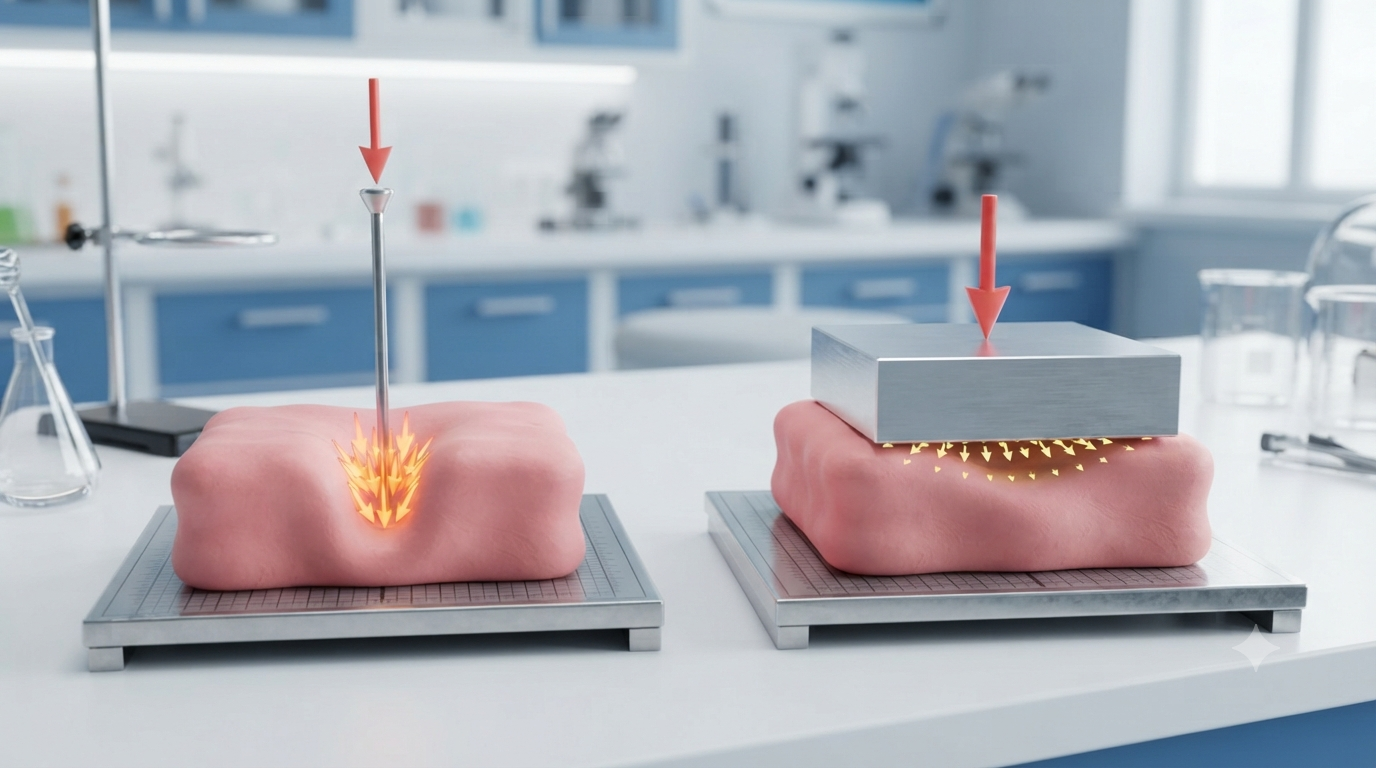

Pressure is one of the most common physical quantities we experience in everyday life, even though we may not always notice it. When we stand on the ground, drink through a straw, inflate a tyre, use a syringe, or observe air moving through the atmosphere, pressure is involved. In physics, pressure helps us understand how a force acts over a particular area.
The basic idea is simple: when a force is applied to a surface, the effect of that force depends not only on how large the force is but also on the area over which it acts. A force concentrated on a small area produces greater pressure, while the same force spread over a larger area produces less pressure.
What Is Pressure?
Pressure is defined as the normal force acting on a surface per unit area.
The formula for pressure is:
P = F/A
where:
P = pressure
F = normal force acting on the surface
A = area over which the force acts
This relationship shows that pressure increases when the applied force increases, provided the area remains constant. Similarly, pressure decreases when the same force is distributed over a larger area.
For example, imagine pressing your hand against a table. Your hand applies a force to the table over a certain area. If you press the same force using only one fingertip, the force acts over a much smaller area, so the pressure is greater.
Why Does Area Matter in Pressure?
The area over which a force acts plays an important role in determining pressure. For the same force, a smaller area produces greater pressure, while a larger area produces smaller pressure.
Consider a sharp needle. A needle has a very small tip. When a force is applied to the needle, that force is concentrated over the tiny area of its tip. As a result, the pressure becomes large enough to allow the needle to enter materials easily.
A blunt object, on the other hand, spreads the same force over a larger area and therefore produces less pressure.
This principle is used in many everyday objects. Sharp knives have thin cutting edges, drawing pins have pointed tips, and high-heeled shoes can exert greater pressure on the ground than flat shoes because their contact area is much smaller.
SI Unit of Pressure
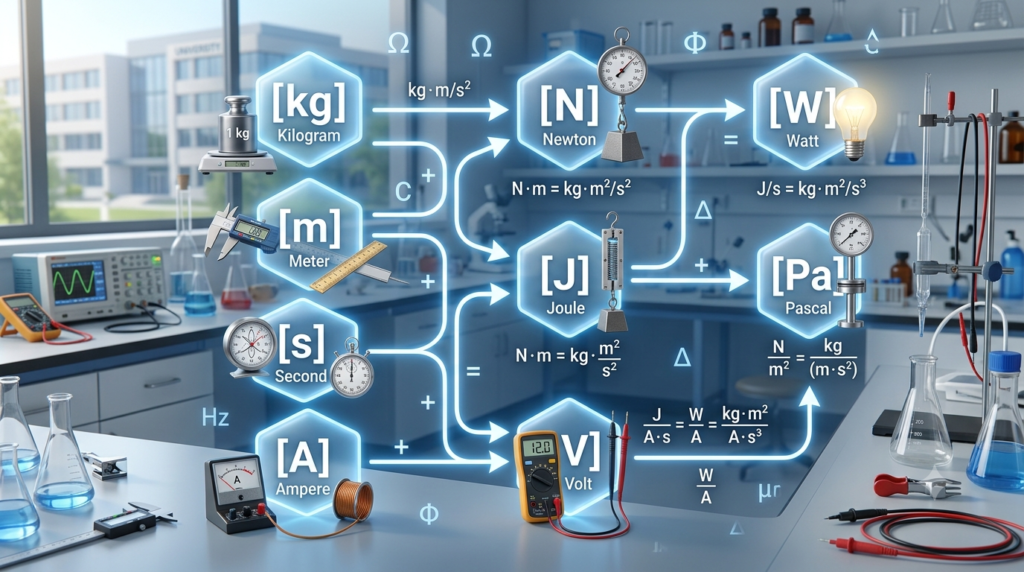
The SI unit of pressure is the pascal, represented by Pa.
One pascal is defined as the pressure produced when a normal force of one newton acts uniformly over an area of one square metre.
1 Pa = 1 N/m²
Therefore, the dimensional form of pressure can be written as:
Pressure = Force/Area
Since force has the dimensions [MLT⁻²] and area has the dimensions [L²]:
[P] = [MLT⁻²]/[L²] = [ML⁻¹T⁻²]
The pascal is a relatively small unit, so pressure is often expressed using larger units such as kilopascals (kPa) and megapascals (MPa).
Pressure and Force Are Not the Same
Pressure and force are related, but they are not the same physical quantity.
Force is a push or pull that can change the motion or shape of an object. It is measured in newtons.
Pressure describes how much force acts on a given area. It is measured in pascals.
Two objects can apply the same force but produce different pressures if their contact areas are different.
For example, suppose two people exert the same downward force on the ground. If one person stands on a large flat surface while the other stands on a much smaller surface, their pressures on the ground will be different.
This distinction is important because many physical effects depend on pressure rather than force alone.
Pressure in Solids
In solids, pressure is commonly considered when a force acts perpendicular to a surface. The pressure depends on both the magnitude of the force and the contact area.
A simple example is a brick placed on a table. The weight of the brick produces a downward force on the table. The bottom surface of the brick determines the area over which this force acts.
If the brick is turned so that it rests on a smaller face, its weight remains essentially the same, but the contact area decreases. Therefore, the pressure on the table increases.
This explains why objects with pointed or narrow contact surfaces can produce relatively high pressure.
Pressure in Liquids
Liquids also exert pressure. Unlike pressure from a solid object resting on a surface, liquid pressure acts in different directions.
The pressure inside a liquid increases with depth. This happens because a deeper point in the liquid has a greater amount of liquid above it, producing a greater downward force due to the liquid’s weight.
For a liquid of density ρ at depth h, the pressure caused by the liquid can be expressed as:
P = ρgh
where:
ρ = density of the liquid
g = acceleration due to gravity
h = depth
This relationship shows that liquid pressure depends on the density of the liquid, gravitational acceleration, and depth.
For example, water pressure is greater near the bottom of a swimming pool than near its surface.
Pressure in Gases
Gases also exert pressure. Gas molecules are constantly moving in different directions. When these molecules collide with the walls of a container, they exert forces on those walls. The combined effect of these collisions produces gas pressure.
The pressure of a gas can change when its temperature, volume, or amount changes.
A familiar example is a bicycle tyre. When air is pumped into the tyre, more air molecules are added and collisions with the inner walls increase. The pressure inside the tyre therefore rises.
Gas pressure is also responsible for the operation of many devices, including air pumps, pressure cookers, pneumatic systems, and some types of engines.
Atmospheric Pressure
Earth is surrounded by an atmosphere made of gases. These gases have mass, and gravity pulls them toward Earth. The weight of the atmosphere produces pressure on Earth’s surface. This is called atmospheric pressure.
We normally do not feel atmospheric pressure because it acts on our bodies from many directions, and the pressure inside our bodies helps balance the external pressure.
Atmospheric pressure changes with altitude. It generally decreases as we move higher above Earth’s surface because there is less air above us.
This change in atmospheric pressure is important in weather science, aviation, mountaineering, and many other applications.
Examples of Pressure in Everyday Life
Pressure can be observed in many ordinary situations:
A sharp knife cuts food because its thin edge produces high pressure.
A nail has a pointed tip that concentrates force over a small area.
Wide tyres help distribute the weight of vehicles over a larger area.
A straw works because of pressure differences between the inside of the straw and the surrounding atmosphere.
Pressure cookers use increased pressure to raise the boiling temperature of water.
Hydraulic machines use pressure in liquids to transmit force.
Atmospheric pressure affects weather and air movement.
These examples show that pressure is not limited to laboratory experiments. It is an important part of many natural and technological processes.
Why Is Pressure Important in Physics?
Pressure provides a way to describe how forces are distributed over surfaces and within fluids. It connects force with area and helps explain the behavior of solids, liquids, and gases.
Understanding pressure is essential for studying topics such as fluid mechanics, atmospheric science, hydraulics, thermodynamics, weather, and engineering. It also helps explain practical systems such as hydraulic brakes, pumps, water tanks, aircraft instruments, and medical devices.
The concept becomes especially useful when comparing situations where the same force produces different effects because the area changes.
Conclusion
Pressure is the normal force acting on a surface per unit area, and its basic formula is P = F/A. Its SI unit is the pascal (Pa), which is equivalent to one newton per square metre. Pressure depends on how force is distributed over an area, so a smaller area produces greater pressure for the same force. Pressure is also an important property of liquids and gases, where it changes with factors such as depth, density, temperature, and volume. From sharp needles and vehicle tyres to atmospheric pressure and hydraulic machines, pressure plays an important role in both everyday life and the physical world.
FAQs
Pressure is the normal force acting on a surface per unit area. It tells us how concentrated a force is over a particular surface. The basic formula for pressure is P = F/A, where P represents pressure, F represents the normal force, and A represents the area over which the force acts. The SI unit of pressure is the pascal (Pa), which is equal to one newton per square metre. Pressure is important in understanding solids, liquids, and gases. Everyday examples include pressure produced by sharp objects, air pressure inside tyres, water pressure, and atmospheric pressure.
The basic formula for pressure is P = F/A. Here, P is pressure, F is the normal force acting perpendicular to a surface, and A is the area over which the force is distributed. According to this formula, pressure increases when the force increases while the area remains constant. Pressure decreases when the same force is distributed over a larger area. For example, a sharp needle produces greater pressure than a blunt object because the force is concentrated over a much smaller area. The SI unit of pressure is the pascal, written as Pa.
The SI unit of pressure is the pascal (Pa). One pascal is defined as one newton of normal force acting uniformly over an area of one square metre. Therefore, 1 Pa = 1 N/m². The pascal is named after French mathematician and physicist Blaise Pascal. Because one pascal is a relatively small pressure, larger units such as kilopascals (kPa) and megapascals (MPa) are commonly used. Pressure measurements are important in many areas, including weather forecasting, engineering, fluid mechanics, medicine, and atmospheric science. Different pressure units may also be used depending on the application.
Area has an inverse relationship with pressure when the applied force remains constant. According to P = F/A, reducing the area increases pressure, while increasing the area decreases pressure. For example, a sharp needle has a tiny contact area, so the force applied to it produces high pressure at its tip. In contrast, wide tyres distribute the vehicle’s weight over a larger area, reducing the pressure on the ground. This principle explains why sharp knives cut easily and why objects designed to support heavy loads often have broad surfaces. The distribution of force is therefore important when considering pressure.
When the area remains constant, pressure increases as the applied normal force increases. This relationship comes directly from the formula P = F/A. For example, pressing a surface gently produces less pressure than pressing it strongly over the same area. Similarly, if additional weight is placed on an object resting on a surface, the downward force increases and therefore the pressure also increases. However, pressure does not depend on force alone. The area over which the force acts must also be considered. A large force spread over a large area can sometimes produce less pressure than a smaller force concentrated over a tiny area.
Liquid pressure is the force exerted by a liquid per unit area. A liquid produces pressure because of the weight of the liquid and the continuous movement of its particles. In a stationary liquid, pressure generally increases with depth because the amount of liquid above a deeper point is greater. The pressure caused by a liquid can be calculated using P = ρgh, where ρ is the liquid’s density, g is acceleration due to gravity, and h is depth. Liquid pressure is important in water tanks, dams, hydraulic machines, pipes, and many natural systems involving fluids.
Pressure increases with depth because a deeper point in a liquid has a greater column of liquid above it. The weight of this liquid produces a greater force on the deeper region. For a liquid of constant density, the pressure caused by the liquid is given by P = ρgh. As depth h increases, pressure also increases. This is why water pressure is greater at the bottom of a swimming pool than near its surface. Engineers consider this effect when designing dams, reservoirs, underwater equipment, and water-storage systems. Liquid pressure therefore plays an important role in both nature and engineering.
Atmospheric pressure is the pressure exerted by the weight of Earth’s atmosphere on surfaces. Earth’s atmosphere contains gases that have mass, and gravity pulls these gases toward the planet. Their weight produces pressure at Earth’s surface. Atmospheric pressure is not the same everywhere because it changes with altitude and weather conditions. It generally decreases as altitude increases because there is less air above a higher location. Atmospheric pressure is important in weather forecasting, aviation, breathing, boiling, and many everyday processes. Devices such as barometers are used to measure atmospheric pressure and monitor changes in atmospheric conditions.
Gases produce pressure because their particles are constantly moving and colliding with the walls of their container. Each collision produces a small force, and the combined effect of countless collisions creates measurable pressure. Gas pressure can change when factors such as temperature, volume, or the amount of gas change. For example, pumping more air into a bicycle tyre increases the number of air molecules inside it, leading to more collisions with the tyre’s inner surface and higher pressure. Gas pressure is important in tyres, air pumps, engines, pneumatic systems, pressure cookers, and many industrial applications.
Force and pressure are related but different physical quantities. Force is a push or pull that can change an object’s motion or shape, and its SI unit is the newton (N). Pressure describes how much normal force acts over a particular area, and its SI unit is the pascal (Pa). Pressure is calculated using P = F/A. Two objects can apply the same force but produce different pressures if their contact areas are different. For example, a sharp needle and a flat object may experience similar forces, but the needle produces greater pressure because its force acts over a much smaller area.
Related Post
What Do Coefficients Mean in Chemistry Formulas?
When you look at a chemical equation, you may notice numbers written before chemical formulas. These numbers are called coefficients. […]
Read MoreHow to Read Subscripts in Chemical Formulas
Chemical formulas are a simple way to represent substances using symbols and numbers. When you look at a formula such […]
Read MoreHow to Identify Elements in a Chemical Formula
Chemical formulas provide a simple way to describe the substances that make up the world around us. A formula may […]
Read MoreHow Elements Are Represented in Chemical Formulas
Chemistry deals with many different substances, from the oxygen we breathe to the water we drink and the minerals found […]
Read MoreChemical Symbols and Their Role in Chemistry Formulas
Chemistry is often described as the science of matter, but understanding chemistry also means learning how scientists communicate information about […]
Read MoreHow Chemical Formulas Represent Substances
Chemical formulas are one of the simplest ways scientists communicate information about matter. A substance may contain millions or billions […]
Read MoreWhat Is a Chemical Formula in Chemistry?
Chemistry is the study of substances, their properties, and the changes they undergo. To describe these substances clearly, chemists need […]
Read MoreBasic Types of Chemistry Formulas Explained
Chemistry formulas are one of the simplest ways scientists describe substances, reactions, and relationships between different particles. A formula can […]
Read MoreHow to Read and Understand Chemistry Formulas
Chemistry formulas may look like a collection of letters, numbers, and symbols, but they are actually a simple language used […]
Read MoreWhat Are Chemistry Formulas and Why Are They Important?
Chemistry is the science of substances, their properties, and the changes they undergo. To describe these substances clearly, chemists use […]
Read MoreHow to Verify an Answer Using Units
In physics, getting a numerical answer is only part of solving a problem. The next question is whether that answer […]
Read MoreHow to Check Whether a Physics Formula Is Correct
A physics formula is more than a collection of symbols and numbers. It represents a relationship between physical quantities and […]
Read MoreHow to Avoid Unit Conversion Mistakes in Physics
Unit conversion is one of the most common sources of mistakes in physics. A formula may be correct, the calculation […]
Read MoreHow to Avoid Sign Errors in Physics Calculations
Physics calculations are not only about choosing the correct formula and putting numbers into it. The signs of physical quantities […]
Read MoreCommon Mistakes When Using Physics Formulas
Physics formulas help us describe motion, forces, energy, electricity, heat, waves, and many other phenomena using mathematical relationships. A formula […]
Read MoreHow to Study Physics Formulas Step by Step
Physics formulas are an important part of learning physics, but simply memorizing them is not enough. A formula represents a […]
Read MoreHow to Organize Physics Formulas for Easy Revision
Physics becomes much easier when formulas are organized in a clear and meaningful way. Many learners struggle not because they […]
Read MoreHow to Build a Physics Formula Sheet
Physics involves many formulas, and remembering all of them can become difficult as you move from basic concepts to more […]
Read More