Acceleration is one of the most important concepts in physics because it describes how the velocity of an object changes with time. Whenever an object speeds up, slows down, or changes its direction of motion, it is accelerating. A car moving faster after a traffic light, a bicycle coming to a stop, and a ball moving around a circular path are all examples of accelerated motion.
Acceleration is not limited to situations where an object becomes faster. Even if an object’s speed remains constant, a change in its direction means its velocity has changed, and therefore the object is accelerating. Understanding acceleration helps us describe motion more accurately and forms the foundation for many topics in mechanics.
What Is Acceleration?
In physics, acceleration is defined as the rate of change of velocity with respect to time.
In simple terms, acceleration tells us how quickly an object’s velocity changes.
The average acceleration can be calculated using:
Acceleration = Change in velocity ÷ Time taken
It can also be written as:
a = (v − u) / t
where:
a = acceleration
u = initial velocity
v = final velocity
t = time taken
For example, suppose a car increases its velocity from 10 m/s to 30 m/s in 5 seconds. Its acceleration is:
a = (30 − 10) / 5 = 4 m/s²
Therefore, the car’s acceleration is 4 m/s².
This means that, on average, the car’s velocity increases by 4 m/s every second.
Acceleration Is a Vector Quantity
Acceleration is a vector quantity, which means it has both magnitude and direction.
This is important because velocity is also a vector quantity. A change in either the magnitude or direction of velocity produces acceleration.
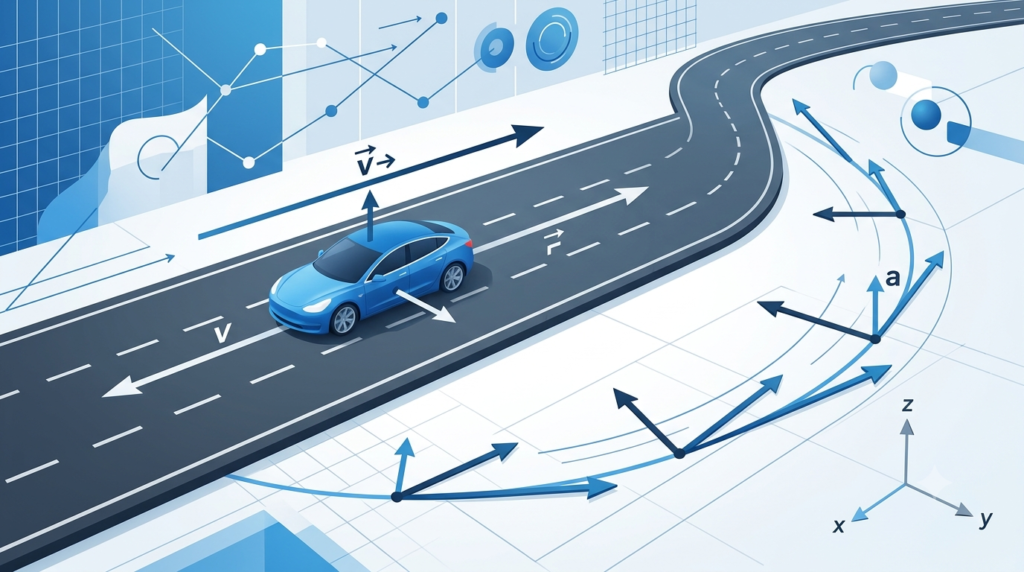
For example, imagine a car traveling around a circular track at a constant speed. Its speed may remain unchanged, but its direction continuously changes. Since velocity depends on both speed and direction, the velocity changes. Therefore, the car is accelerating.
This is why acceleration should not be understood simply as “speeding up.” It is more accurately described as a change in velocity.
Positive and Negative Acceleration
Acceleration can be positive or negative depending on the chosen direction of motion.
If an object moving in the positive direction becomes faster, its acceleration is generally positive. If its velocity decreases while moving in the positive direction, its acceleration is negative.
Negative acceleration is often called deceleration when it causes an object to slow down.
For example, if a car is moving forward and the driver applies the brakes, the car’s velocity decreases. The acceleration acts opposite to the direction of motion, resulting in slowing down.
However, negative acceleration does not always mean that an object is slowing down. If an object is already moving in the negative direction and its acceleration is also negative, its speed can actually increase.
Therefore, it is better to think about acceleration as a change in velocity rather than automatically equating negative acceleration with slowing down.
Uniform and Non-Uniform Acceleration
Acceleration can be classified according to how it changes with time.
Uniform Acceleration
An object has uniform acceleration when its velocity changes by equal amounts in equal intervals of time.
For example, if the velocity of an object increases by 5 m/s every second, its acceleration is constant at 5 m/s².
A freely falling object near Earth’s surface is often treated as an example of approximately uniform acceleration when air resistance is ignored. Its acceleration due to gravity is about 9.8 m/s² downward.
Non-Uniform Acceleration
An object has non-uniform acceleration when its velocity does not change at a constant rate.
For example, a car traveling through busy city traffic may accelerate, slow down, stop, and accelerate again. Its acceleration changes continuously depending on how the driver operates the vehicle.
Many real-world motions involve non-uniform acceleration.
Acceleration and Changes in Direction
An object can accelerate even when its speed remains constant.
Consider a ball attached to a string and swung in a circle. If the ball moves at constant speed, its speed does not change. However, its direction changes continuously.
Because velocity includes direction, the changing direction means that the velocity is constantly changing. Therefore, the ball experiences acceleration directed toward the center of the circular path.
This type of acceleration is called centripetal acceleration.
Circular motion provides an important example of why acceleration is about velocity rather than speed alone.
Acceleration and Time
Time plays an essential role in acceleration because acceleration measures how quickly velocity changes.
Suppose two cars both increase their velocity by 20 m/s. If the first car takes 10 seconds and the second takes 5 seconds, their accelerations are different.
For the first car:
a = 20 / 10 = 2 m/s²
For the second car:
a = 20 / 5 = 4 m/s²
The second car has greater acceleration because it produces the same change in velocity in less time.
Therefore, a larger acceleration means that velocity is changing more rapidly.
SI Unit of Acceleration
The SI unit of acceleration is metre per second squared, written as m/s².
The unit can be understood by looking at the definition of acceleration:
Acceleration = velocity ÷ time
Since velocity is measured in metres per second and time is measured in seconds:
m/s ÷ s = m/s²
An acceleration of 3 m/s² means that the velocity changes by 3 m/s every second, assuming the acceleration remains constant.
For example:
After 1 second: velocity changes by 3 m/s
After 2 seconds: velocity changes by 6 m/s
After 3 seconds: velocity changes by 9 m/s
The exact velocity also depends on the object’s initial velocity and the direction of acceleration.
Acceleration in Everyday Life
Acceleration is present in many situations around us.
When a bus starts moving from a stop, passengers may feel pushed backward because their bodies tend to maintain their previous state of motion while the bus accelerates forward.
When the bus suddenly stops, passengers may move forward because their bodies tend to continue moving.
Similarly, elevators accelerate when they begin moving and decelerate when they approach a floor. Aircraft experience acceleration during takeoff, and roller coasters produce large changes in velocity during their motion.
Sports also provide many examples. A football can accelerate when kicked, a runner accelerates at the beginning of a race, and a tennis ball changes its velocity rapidly when struck by a racket.
Acceleration and Force
Acceleration is closely connected to force through Newton’s second law of motion.
For an object of constant mass, the net force acting on the object determines its acceleration:
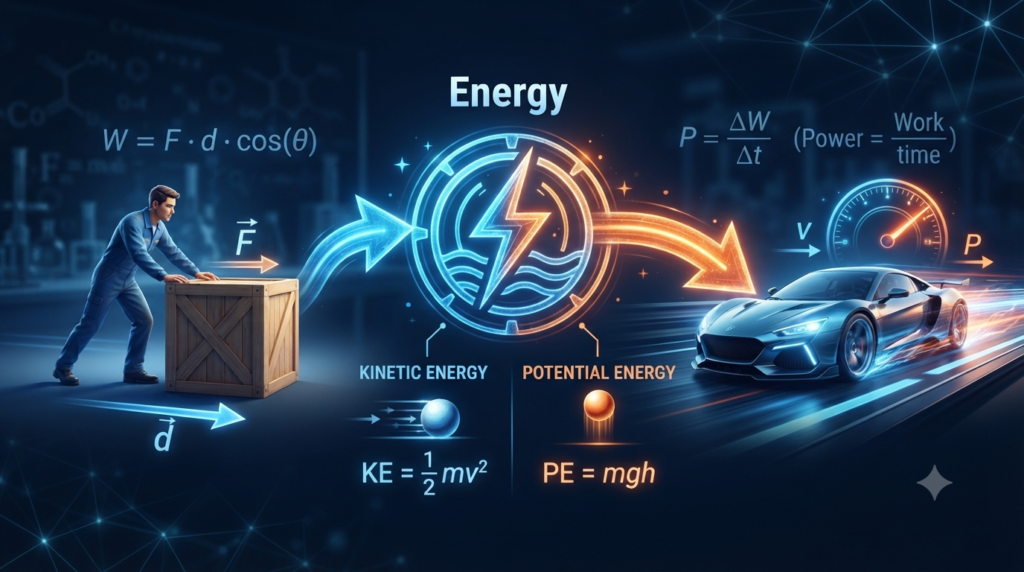
F = ma
where:
F = net force
m = mass
a = acceleration
This relationship shows that a larger net force produces greater acceleration for the same mass. It also shows that an object with greater mass requires more net force to produce the same acceleration.
For example, pushing an empty shopping cart with a certain force can produce noticeable acceleration. The same force applied to a heavily loaded cart produces less acceleration because the loaded cart has greater mass.
Acceleration Due to Gravity
One of the most familiar examples of acceleration is the acceleration caused by Earth’s gravity.
Near Earth’s surface, objects in free fall experience an acceleration of approximately 9.8 m/s² downward, when air resistance is neglected.
This means that the object’s downward velocity changes by approximately 9.8 m/s during each second of falling.
The acceleration due to gravity is commonly represented by the symbol g.
Although objects with different masses may appear to fall differently because of air resistance, in ideal free-fall conditions their gravitational acceleration is the same.
Acceleration Equations for Constant Acceleration
When acceleration is constant, several useful equations can describe motion.
One important equation is:
v = u + at
This equation relates initial velocity, final velocity, acceleration, and time.
Another useful equation for displacement is:
s = ut + ½at²
where s represents displacement.
These equations are widely used to solve problems involving objects moving with constant acceleration.
Why Is Acceleration Important?
Acceleration allows physicists to understand how motion changes rather than simply describing where an object is or how fast it is moving.
Knowing acceleration helps engineers design vehicles, aircraft, elevators, machines, and safety systems. It is also important in space exploration, where spacecraft must carefully control their acceleration to reach desired trajectories.
In physics, acceleration connects the study of motion with the study of forces. By measuring changes in velocity, scientists can investigate the forces acting on objects and predict how those objects will move.
Conclusion
Acceleration is the rate at which velocity changes with time. An object accelerates whenever its speed changes, its direction changes, or both. It is a vector quantity measured in metres per second squared (m/s²). Acceleration may be positive, negative, uniform, or non-uniform, depending on how velocity changes. Understanding acceleration is essential for studying motion, gravity, circular motion, and Newton’s laws of motion. From a car starting at a traffic light to a spacecraft changing its trajectory, acceleration provides a fundamental way to understand how and why motion changes.