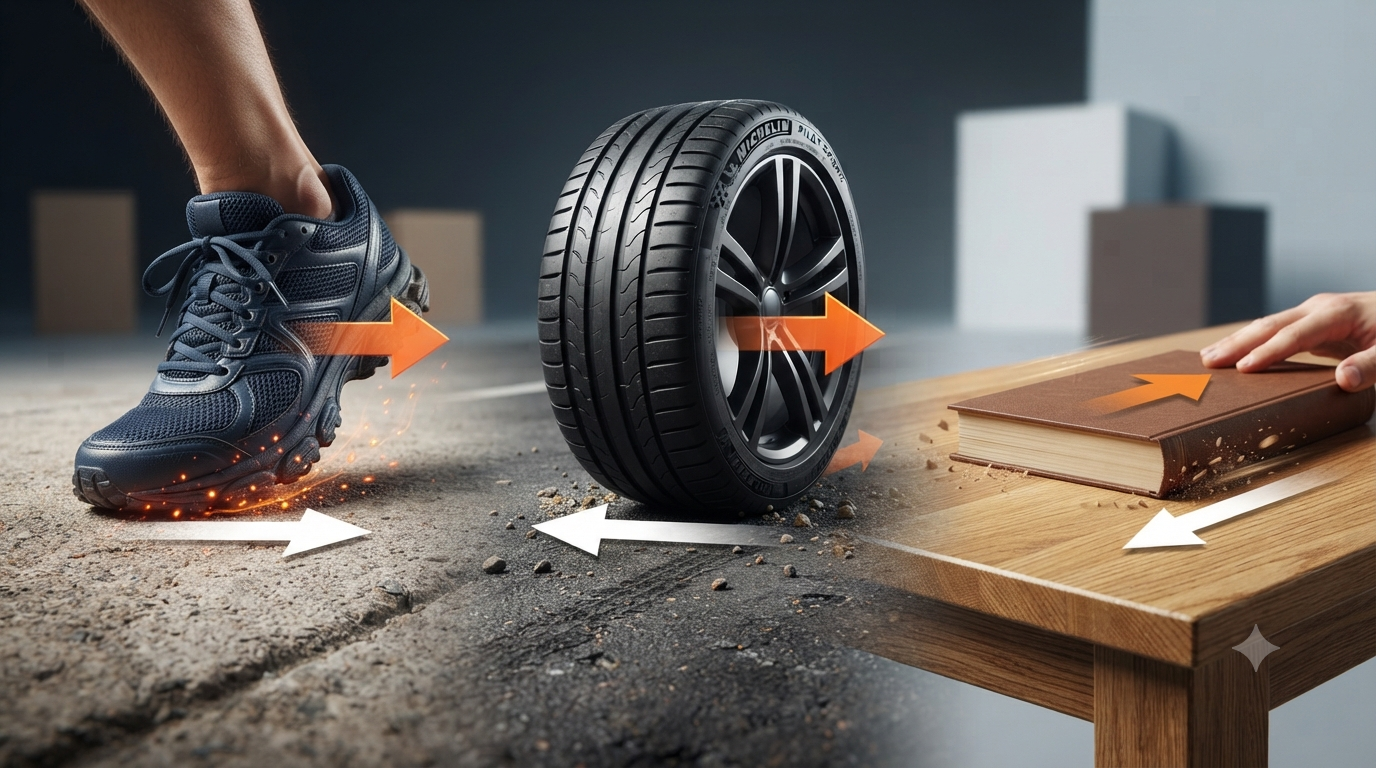

Friction is one of the most common forces we experience in everyday life. Whenever you walk, write with a pencil, ride a bicycle, stop a vehicle, or hold an object, friction is involved. Although friction often acts against motion, it is not simply a force that causes problems. Without it, many ordinary activities would become extremely difficult or even impossible.
Friction occurs when two surfaces are in contact and resist their relative motion or the tendency to move. Its effects depend on factors such as the nature of the surfaces, how strongly they are pressed together, and whether the surfaces are moving or stationary. Understanding friction helps explain why objects move, stop, grip surfaces, produce heat, and wear out over time.
What Is Friction?
Friction is a force that opposes the relative motion, or attempted motion, between two surfaces in contact. It acts along the surfaces and in the direction opposite to the motion or tendency of motion.
For example, when you push a book across a table, the book moves forward while friction acts backward. This opposing force makes the book slow down and eventually stop if you stop pushing.
Friction does not always prevent an object from moving. Instead, it resists relative motion between surfaces. In many situations, this resistance is useful because it provides the grip needed to control movement.
Why Does Friction Occur?
At first glance, two surfaces may appear smooth, but microscopic examination shows that they contain tiny irregularities. When two surfaces touch, these irregularities interact with one another. Forces between the materials at the points of contact also contribute to friction.
Even polished surfaces are not perfectly smooth at the microscopic level. As surfaces move against each other, their microscopic irregularities can interact, deform, and sometimes break away. This produces resistance to motion.
The amount of friction depends partly on the materials involved. For example, rubber generally provides more grip on a road than smooth metal does. This difference is important for tyres, shoes, and many other applications.
Types of Friction
Friction can be classified into several types depending on how the surfaces interact.
Static Friction
Static friction acts when an object is at rest but a force is trying to make it move. It prevents the object from starting to slide.
For example, if you push a heavy box gently and it does not move, static friction is balancing your applied force. As you increase the push, static friction increases up to a certain maximum value.
Static friction is essential for walking because it prevents your feet from simply sliding backward against the ground.
Sliding Friction
Sliding friction occurs when one surface slides over another. For example, when a book moves across a table, sliding friction acts between the book and the table.
Sliding friction usually makes moving objects slow down. It is useful in situations where controlled resistance is needed, but it can also cause energy loss and surface wear.
Rolling Friction
Rolling friction occurs when an object rolls over a surface. Wheels are designed to take advantage of rolling motion because rolling generally produces less resistance than sliding.
This is why carts, bicycles, cars, and trains use wheels. Instead of dragging an object across a surface, wheels allow it to roll, making movement easier and more efficient.
Fluid Friction
Fluid friction occurs when an object moves through a fluid such as air or water. It is also called drag.
For example, a cyclist experiences air resistance while riding. A swimmer experiences resistance from water. The shape and speed of an object can strongly affect the amount of fluid friction it experiences.
Why Is Friction Important?
Friction plays a major role in both natural processes and human technology. Many activities would not work without sufficient friction.
Friction Helps Us Walk
Walking depends on friction between our shoes or feet and the ground. When you push your foot backward against the ground, friction from the ground acts forward and helps move your body.
On a very slippery surface, there is not enough friction to provide a firm grip. This is why people can easily slip on wet floors, ice, or oily surfaces.
Friction Helps Vehicles Move and Stop
Vehicle tyres need friction with the road to accelerate, turn, and brake. When a driver applies the brakes, friction helps reduce the motion of the wheels and vehicle.
Brake systems are specifically designed to create controlled friction. Without adequate friction between tyres and the road, stopping and steering would become much more difficult.
Friction Helps Us Hold Objects
When you hold a phone, glass, book, or tool, friction helps prevent the object from slipping from your hand.
The roughness and material of surfaces influence their grip. This is why many tools and everyday objects are designed with textured or rubberized surfaces.
Friction Produces Heat
Friction can convert mechanical energy into thermal energy. You can notice this by rubbing your hands together quickly. Your hands become warmer because mechanical work is converted into heat.
This effect is useful in some applications, such as friction-based heating and braking systems. However, unwanted heat from friction can damage machines and reduce efficiency.
Disadvantages of Friction
Although friction is useful, it can also create several problems.
Friction causes moving parts in machines to wear over time. Gears, bearings, engines, and other components can lose material because their surfaces repeatedly interact.
Friction can also waste useful mechanical energy by converting part of it into heat. In machines, reducing unnecessary friction can improve efficiency and reduce energy consumption.
This is why lubricants such as oil and grease are often used between moving surfaces. They reduce direct contact and help decrease friction and wear.
How Can Friction Be Reduced?
Engineers use several methods to control unwanted friction.
Using Lubricants
Oil, grease, and other lubricants can form a layer between surfaces. This reduces direct contact and makes movement smoother.
Using Wheels and Bearings
Wheels replace much of the sliding motion with rolling motion. Bearings also help moving parts rotate with less resistance.
Smoothing Surfaces
Reducing surface irregularities can sometimes reduce friction, although friction depends on more than simply how smooth a surface appears.
Streamlining Objects
For objects moving through air or water, a streamlined shape can reduce fluid friction. Cars, aircraft, ships, and sports equipment often use shapes designed to reduce drag.
How Can Friction Be Increased?
In many situations, increasing friction is just as important as reducing it.
Tyres have specially designed tread patterns to provide better grip. Shoes often have textured soles to increase traction. Road surfaces are also designed to provide sufficient friction for vehicles.
Chalk can improve grip in activities such as climbing and gymnastics by reducing slipping between the hands and equipment.
Friction and Energy
Friction demonstrates that energy can change from one form to another. When a moving object experiences friction, some of its mechanical energy is transformed into thermal energy.
For example, when a bicycle slows down because of friction, its kinetic energy does not simply disappear. Much of it is converted into heat in the tyres, brakes, and surrounding materials.
This explains why friction is often described as a force that causes energy dissipation. The energy remains part of the physical system, but it becomes less available for useful mechanical motion.
Conclusion
Friction is a fundamental force that affects almost every type of motion we experience. It opposes relative motion between surfaces, but its role is much more important than simply slowing objects down. Friction allows us to walk, hold objects, control vehicles, write, and use machines safely.
At the same time, excessive friction can produce unwanted heat, energy loss, and wear. For this reason, science and engineering often focus on controlling friction rather than simply eliminating it. By understanding static, sliding, rolling, and fluid friction, we can better understand how objects move and how many everyday technologies work.
FAQs
Friction is a force that opposes the relative motion or attempted motion between two surfaces in contact. It acts along the surfaces and usually in the direction opposite to motion. For example, when a book is pushed across a table, friction acts against the direction in which the book moves. Friction occurs because surfaces have microscopic irregularities and interact at their contact points. Although friction can slow objects down, it is extremely useful. It allows people to walk, vehicles to move and stop, and objects to be held securely. Without friction, many everyday activities would become difficult or impossible.
Friction is important because it provides grip and allows us to control motion. When we walk, friction between our feet or shoes and the ground prevents us from slipping. It also allows tyres to grip roads, helping vehicles accelerate, turn, and stop. Friction enables us to hold objects, write with a pencil, open containers, and use many tools. At the same time, unwanted friction can cause energy loss, heating, and wear in machines. Therefore, friction is neither completely useful nor completely harmful. Its importance comes from our ability to control it according to the situation.
The main types of friction are static friction, sliding friction, rolling friction, and fluid friction. Static friction acts when an object is stationary but tends to move. Sliding friction occurs when one surface slides over another. Rolling friction acts when an object rolls across a surface and is generally lower than sliding friction. Fluid friction, also called drag, occurs when an object moves through a fluid such as air or water. Each type behaves differently and has different applications. Understanding these types helps explain everyday activities, vehicle movement, machine operation, sports, and the motion of objects through air and water.
Static friction is the frictional force that acts between surfaces when there is no relative motion between them. It prevents an object from beginning to slide when an external force is applied. For example, if you push a heavy box gently and it remains stationary, static friction acts against your push. Static friction can increase as the applied force increases, up to a maximum value. Once the applied force becomes greater than this maximum resistance, the object begins to move. Static friction is especially important for walking, standing, climbing, and maintaining grip between tyres and roads.
Friction between our feet or shoes and the ground provides the grip needed for walking. When a person pushes the ground backward with their foot, the ground exerts a frictional force on the foot in the forward direction. This helps the person move forward without their foot sliding backward. If there were very little friction, such as on a smooth and slippery surface, walking would become difficult because the feet could lose their grip. This is why shoes often have textured soles. The friction between the sole and the ground allows us to start walking, change direction, and maintain balance.
Friction is essential for vehicles because it provides traction between tyres and the road. When a vehicle accelerates, the tyres interact with the road through friction, allowing the vehicle to move forward. Friction also helps vehicles turn because it provides the sideways force needed to change direction. During braking, friction between the brake components and between the tyres and road helps reduce the vehicle’s speed. If the road is wet, icy, or oily, available friction can decrease, making vehicles harder to control. Therefore, suitable tyre design, road surfaces, and braking systems are important for safe transportation.
Friction can have several disadvantages, particularly when it occurs where smooth and efficient movement is desired. It can cause moving machine parts to wear down over time. Friction also converts some mechanical energy into heat, which can reduce the efficiency of machines and sometimes cause overheating. In engines, gears, bearings, and other mechanical systems, excessive friction can increase energy consumption and maintenance requirements. However, friction cannot always be eliminated because many activities depend on it. Engineers therefore try to reduce unwanted friction while maintaining useful friction where grip, braking, traction, or controlled movement is necessary.
Unwanted friction can be reduced using several methods. Lubricants such as oil and grease can form a layer between surfaces, reducing direct contact and making movement easier. Wheels and bearings can replace sliding motion with rolling motion, which generally produces less resistance. Engineers can also select suitable materials and surface treatments to control friction. For objects moving through air or water, streamlined shapes can reduce fluid friction or drag. Reducing friction is particularly important in machines because it can decrease energy loss, heat production, and wear. The best method depends on the type of friction and the application.
Yes, friction can be increased when greater grip or traction is required. Vehicle tyres use specially designed tread patterns to improve contact with road surfaces. Shoes often have textured soles that increase grip and reduce the chance of slipping. Rough surfaces can also provide greater resistance to sliding in suitable situations. In sports and climbing, materials may be selected specifically for their ability to provide strong frictional contact. Increasing friction is useful for walking, braking, holding objects, and controlling movement. However, excessive friction can also increase wear and energy loss, so it should be controlled rather than increased unnecessarily.
Friction can convert mechanical energy into thermal energy when surfaces move or rub against each other. When two surfaces interact, some of the energy associated with their motion is transferred into microscopic motion within the materials. This increases their thermal energy, causing them to become warmer. A simple example is rubbing your hands together quickly, which makes them feel warm. Vehicle brakes also become hot because friction converts part of the vehicle’s mechanical energy into heat. This conversion is useful in some applications, but excessive heat caused by friction can damage materials and reduce the efficiency of machines.
Related Post
What Do Coefficients Mean in Chemistry Formulas?
When you look at a chemical equation, you may notice numbers written before chemical formulas. These numbers are called coefficients. […]
Read MoreHow to Read Subscripts in Chemical Formulas
Chemical formulas are a simple way to represent substances using symbols and numbers. When you look at a formula such […]
Read MoreHow to Identify Elements in a Chemical Formula
Chemical formulas provide a simple way to describe the substances that make up the world around us. A formula may […]
Read MoreHow Elements Are Represented in Chemical Formulas
Chemistry deals with many different substances, from the oxygen we breathe to the water we drink and the minerals found […]
Read MoreChemical Symbols and Their Role in Chemistry Formulas
Chemistry is often described as the science of matter, but understanding chemistry also means learning how scientists communicate information about […]
Read MoreHow Chemical Formulas Represent Substances
Chemical formulas are one of the simplest ways scientists communicate information about matter. A substance may contain millions or billions […]
Read MoreWhat Is a Chemical Formula in Chemistry?
Chemistry is the study of substances, their properties, and the changes they undergo. To describe these substances clearly, chemists need […]
Read MoreBasic Types of Chemistry Formulas Explained
Chemistry formulas are one of the simplest ways scientists describe substances, reactions, and relationships between different particles. A formula can […]
Read MoreHow to Read and Understand Chemistry Formulas
Chemistry formulas may look like a collection of letters, numbers, and symbols, but they are actually a simple language used […]
Read MoreWhat Are Chemistry Formulas and Why Are They Important?
Chemistry is the science of substances, their properties, and the changes they undergo. To describe these substances clearly, chemists use […]
Read MoreHow to Verify an Answer Using Units
In physics, getting a numerical answer is only part of solving a problem. The next question is whether that answer […]
Read MoreHow to Check Whether a Physics Formula Is Correct
A physics formula is more than a collection of symbols and numbers. It represents a relationship between physical quantities and […]
Read MoreHow to Avoid Unit Conversion Mistakes in Physics
Unit conversion is one of the most common sources of mistakes in physics. A formula may be correct, the calculation […]
Read MoreHow to Avoid Sign Errors in Physics Calculations
Physics calculations are not only about choosing the correct formula and putting numbers into it. The signs of physical quantities […]
Read MoreCommon Mistakes When Using Physics Formulas
Physics formulas help us describe motion, forces, energy, electricity, heat, waves, and many other phenomena using mathematical relationships. A formula […]
Read MoreHow to Study Physics Formulas Step by Step
Physics formulas are an important part of learning physics, but simply memorizing them is not enough. A formula represents a […]
Read MoreHow to Organize Physics Formulas for Easy Revision
Physics becomes much easier when formulas are organized in a clear and meaningful way. Many learners struggle not because they […]
Read MoreHow to Build a Physics Formula Sheet
Physics involves many formulas, and remembering all of them can become difficult as you move from basic concepts to more […]
Read More