Geometry is one of the most useful areas of mathematics because it helps us understand the size, shape, and properties of objects around us. From measuring the floor of a room to calculating the area of a garden or the perimeter of a field, geometry formulas are used in everyday situations as well as in science, engineering, architecture, and design.
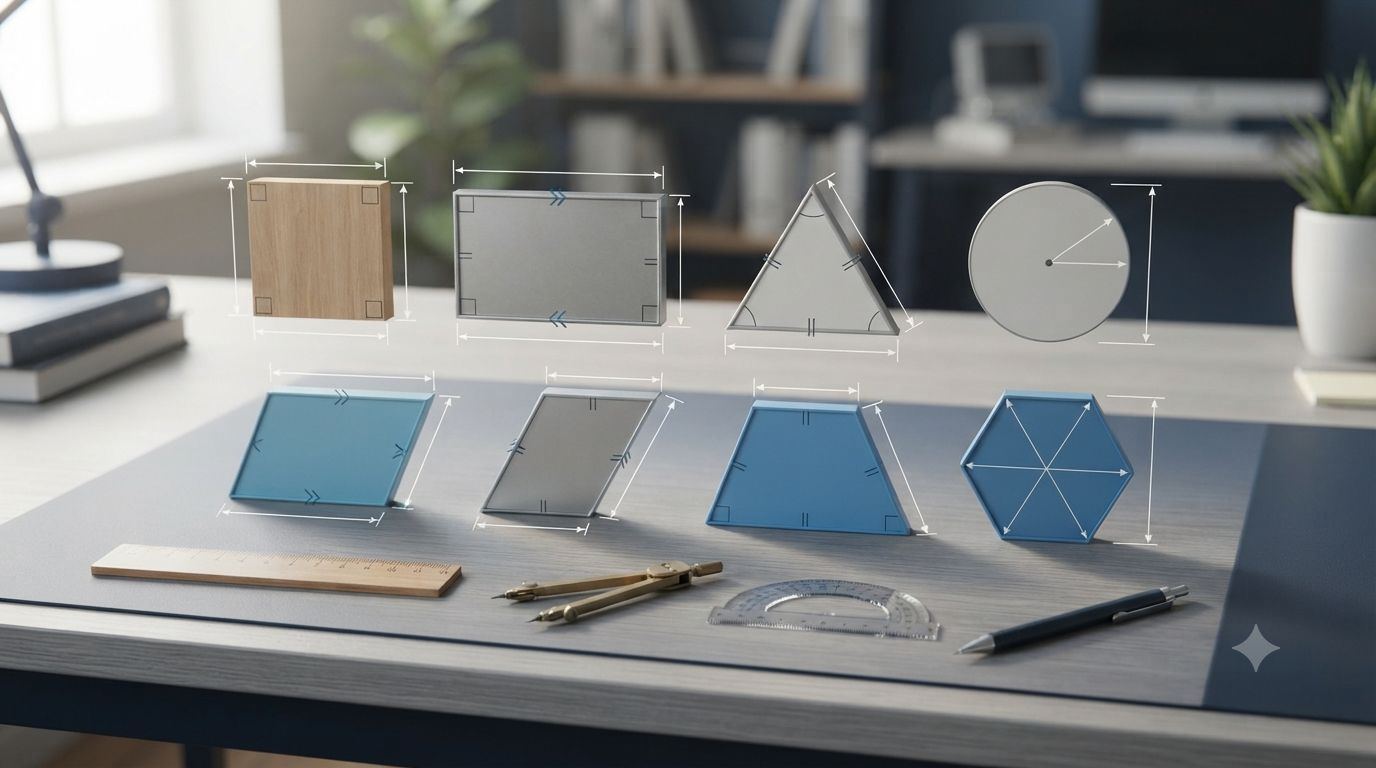
Plane figures are two-dimensional shapes. They have length and width but no thickness. Common plane figures include squares, rectangles, triangles, circles, parallelograms, rhombuses, trapezoids, and kites. Each shape has its own formulas for finding important measurements such as perimeter, area, and sometimes diagonal length.
Learning these basic geometry formulas becomes much easier when you understand what each measurement represents and when the formula should be used. This article explains the most important formulas for basic plane figures in a simple and practical way.
What Are Plane Figures?
A plane figure is a flat, two-dimensional shape that exists on a plane. Unlike three-dimensional objects such as cubes and cylinders, plane figures have only two dimensions: length and width.
Examples of plane figures include:
Square
Rectangle
Triangle
Circle
Parallelogram
Rhombus
Trapezoid
Kite
Regular polygon
Two measurements are especially important when studying plane figures: perimeter and area.
Perimeter
The perimeter is the total distance around a plane figure. It is found by adding the lengths of all its outer sides.
For example, if a rectangle has a length of 8 cm and a width of 5 cm, its perimeter is:
P = 2(l + w)
P = 2(8 + 5) = 26 cm
Therefore, the perimeter of the rectangle is 26 cm.
Area
Area is the amount of surface enclosed by a two-dimensional figure. It tells us how much space the shape covers.
For example, the area of a rectangle with a length of 8 cm and a width of 5 cm is:
A = l × w
A = 8 × 5 = 40 cm²
Therefore, the area is 40 square centimetres.
Basic Geometry Formulas for a Square
A square is a four-sided plane figure in which all four sides are equal and all four angles are 90°.
Let the side length of a square be a.
Perimeter of a Square
The perimeter is the sum of all four equal sides.
P = 4a
If the side is 6 cm:
P = 4 × 6 = 24 cm
Area of a Square
The area is calculated by multiplying the side by itself.
A = a²
For a square with a side of 6 cm:
A = 6² = 36 cm²
Diagonal of a Square
The diagonal is the line joining two opposite corners.
d = a√2
If the side is 6 cm:
d = 6√2 cm
The diagonal divides the square into two congruent right triangles.
Basic Geometry Formulas for a Rectangle
A rectangle is a four-sided figure with opposite sides equal and four right angles.
Let:
l = length
w = width
Perimeter of a Rectangle
P = 2(l + w)
For a rectangle with length 10 cm and width 4 cm:
P = 2(10 + 4) = 28 cm
Area of a Rectangle
A = l × w
For the same rectangle:
A = 10 × 4 = 40 cm²
Diagonal of a Rectangle
The diagonal can be calculated using the Pythagorean theorem.
d = √(l² + w²)
For a rectangle with length 10 cm and width 4 cm:
d = √(10² + 4²)
d = √116 cm
This formula is useful when the length and width are known but the diagonal is required.
Basic Geometry Formulas for a Triangle
A triangle is a polygon with three sides and three angles. Triangles can have different shapes, such as equilateral, isosceles, scalene, and right-angled triangles.
Let:
a, b, c = side lengths
b = base
h = perpendicular height
Perimeter of a Triangle
The perimeter is the sum of its three sides.
P = a + b + c
For sides of 5 cm, 6 cm, and 7 cm:
P = 5 + 6 + 7 = 18 cm
Area of a Triangle
The basic area formula is:
A = ½ × b × h
For a triangle with a base of 10 cm and height of 6 cm:
A = ½ × 10 × 6 = 30 cm²
The height must be perpendicular to the chosen base.
Area of an Equilateral Triangle
An equilateral triangle has three equal sides. If each side has length a, its area is:
A = (√3/4)a²
Its perimeter is:
P = 3a
Heron’s Formula
When all three sides of a triangle are known but the height is not given, Heron’s formula can be used.
First calculate the semiperimeter:
s = (a + b + c)/2
Then:
A = √[s(s − a)(s − b)(s − c)]
This formula is useful for finding the area of a triangle when only its three side lengths are available.
Basic Geometry Formulas for a Circle
A circle is a plane figure in which every point on the boundary is the same distance from its centre.
Important terms associated with a circle include radius, diameter, circumference, and area.
Let:
r = radius
d = diameter
π ≈ 3.14159
Diameter of a Circle
The diameter is twice the radius.
d = 2r
Therefore:
r = d/2
Circumference of a Circle
The circumference is the distance around the circle.
C = 2πr
It can also be written as:
C = πd
For a circle with a radius of 7 cm:
C = 2 × π × 7 = 14π cm
Area of a Circle
The area of a circle is:
A = πr²
For a circle with a radius of 7 cm:
A = π × 7² = 49π cm²
Using π ≈ 22/7, the area is approximately 154 cm².
Basic Geometry Formulas for a Parallelogram
A parallelogram is a quadrilateral in which opposite sides are parallel and equal.
Let:
b = base
h = perpendicular height
a = other side
Perimeter of a Parallelogram
P = 2(a + b)
Area of a Parallelogram
A = b × h
For example, if the base is 12 cm and the perpendicular height is 5 cm:
A = 12 × 5 = 60 cm²
It is important to use the perpendicular height rather than the slanted side when calculating area.
Basic Geometry Formulas for a Rhombus
A rhombus is a quadrilateral with four equal sides. Opposite sides are parallel, and its diagonals intersect at right angles.
Let:
a = side length
d₁ = first diagonal
d₂ = second diagonal
Perimeter of a Rhombus
P = 4a
Area of a Rhombus Using Diagonals
A = ½ × d₁ × d₂
For example, if the diagonals are 10 cm and 8 cm:
A = ½ × 10 × 8 = 40 cm²
Area of a Rhombus Using Base and Height
The area can also be calculated as:
A = b × h
This is similar to the area formula for a parallelogram.
Basic Geometry Formulas for a Trapezoid
A trapezoid is a quadrilateral with one pair of parallel sides. The parallel sides are commonly called the bases.
Let:
a = first parallel side
b = second parallel side
h = perpendicular height
c, d = non-parallel sides
Perimeter of a Trapezoid
P = a + b + c + d
Area of a Trapezoid
A = ½(a + b)h
For example, if the parallel sides are 12 cm and 8 cm and the height is 5 cm:
A = ½(12 + 8) × 5
A = 50 cm²
The height must be measured perpendicular to the parallel sides.
Basic Geometry Formulas for a Kite
A kite is a quadrilateral with two pairs of adjacent equal sides.
Let:
d₁ = first diagonal
d₂ = second diagonal
Area of a Kite
The area is:
A = ½ × d₁ × d₂
For example, if the diagonals are 14 cm and 10 cm:
A = ½ × 14 × 10 = 70 cm²
Perimeter of a Kite
If the two different side lengths are a and b, the perimeter is:
P = 2(a + b)
Basic Geometry Formulas for Regular Polygons
A regular polygon is a polygon in which all sides and all interior angles are equal. Examples include regular pentagons, hexagons, and octagons.
Let:
n = number of sides
a = side length
Perimeter of a Regular Polygon
P = na
For a regular hexagon with a side length of 5 cm:
P = 6 × 5 = 30 cm
Area of a Regular Polygon
The area can be calculated using the apothem:
A = ½ × P × ap
where ap is the apothem, the perpendicular distance from the centre of the polygon to one of its sides.
Another useful formula is:
A = [na²]/[4 tan(π/n)]
This formula is mainly useful when the number of sides and side length are known.
Summary of Basic Geometry Formulas
Keeping the most common formulas together makes them easier to revise.
| Plane Figure | Perimeter | Area |
|---|---|---|
| Square | P = 4a | A = a² |
| Rectangle | P = 2(l + w) | A = lw |
| Triangle | P = a + b + c | A = ½bh |
| Circle | C = 2πr | A = πr² |
| Parallelogram | P = 2(a + b) | A = bh |
| Rhombus | P = 4a | A = ½d₁d₂ |
| Trapezoid | P = a + b + c + d | A = ½(a + b)h |
| Kite | P = 2(a + b) | A = ½d₁d₂ |
| Regular Polygon | P = na | A = ½P × ap |
Units Used in Geometry
Using the correct unit is an important part of solving geometry problems.
Perimeter measures length, so its units are ordinary length units such as:
millimetres (mm)
centimetres (cm)
metres (m)
kilometres (km)
Area measures a surface, so its units are squared:
mm²
cm²
m²
km²
For example, a perimeter might be 24 cm, while an area might be 36 cm². These units should not be confused.
How to Choose the Correct Geometry Formula
The first step in solving a geometry problem is to identify the plane figure. Once the shape is known, determine what measurement the question is asking for.
If the question asks for the distance around a figure, find the perimeter or circumference. If it asks how much surface the figure covers, find the area.
Next, identify the measurements provided in the question. For example, a rectangle may give its length and width, while a triangle may give its base and perpendicular height.
Finally, substitute the known values into the appropriate formula and include the correct unit in the answer.
Always check whether the measurements use the same unit before calculating. If necessary, convert them first.
Common Mistakes When Using Geometry Formulas
Several simple mistakes can lead to incorrect answers even when the correct formula is known.
One common mistake is confusing perimeter with area. Perimeter measures the boundary, while area measures the enclosed surface.
Another mistake is using the wrong height. In formulas involving a base and height, such as the triangle or parallelogram area formula, the height must be perpendicular to the base.
Students also sometimes forget to square the radius when calculating the area of a circle. The correct formula is A = πr², not A = 2πr. The latter is the formula for circumference.
Units are another important consideration. Perimeter should have length units, while area should have square units.
Conclusion
Basic geometry formulas provide a foundation for understanding two-dimensional shapes and solving practical measurement problems. The most important formulas involve perimeter and area, with additional formulas used for diagonals, circumference, and special properties of different figures.
Squares and rectangles use simple multiplication and addition, while triangles, circles, parallelograms, rhombuses, trapezoids, kites, and regular polygons each have their own useful formulas. Understanding what each variable represents is just as important as memorizing the formula.
With regular practice, these formulas become easier to recognize and apply. Once the basic formulas are understood, they also provide a strong foundation for more advanced topics such as coordinate geometry, trigonometry, mensuration, and calculus.
FAQs
1. What are plane figures in geometry?
Plane figures are two-dimensional shapes that have length and width but no thickness. They are drawn on a flat surface and include common shapes such as squares, rectangles, triangles, circles, parallelograms, rhombuses, trapezoids, and kites. Plane figures can be studied using measurements such as perimeter, area, side length, height, radius, diameter, and diagonals. Understanding plane figures is an important part of basic geometry because these shapes appear in everyday objects, buildings, designs, maps, and many scientific applications. Learning their formulas helps you calculate their size and boundary accurately and provides a foundation for more advanced mathematical topics.
2. What is the difference between perimeter and area?
Perimeter and area describe different properties of a plane figure. Perimeter is the total distance around the outside boundary of a shape, while area is the amount of surface enclosed within the shape. Perimeter is measured in ordinary length units such as centimetres or metres. Area is measured in square units such as square centimetres or square metres. For example, a rectangle with a length of 8 cm and width of 5 cm has a perimeter of 26 cm and an area of 40 cm². Knowing whether a question asks for the boundary or enclosed surface helps you choose the correct formula.
3. What is the formula for the area of a square?
The area of a square is calculated by multiplying its side length by itself. The formula is A = a², where a represents the length of one side. Since all four sides of a square are equal, only one side measurement is needed to calculate its area. For example, if a square has a side length of 7 cm, its area is 7² = 49 cm². The answer uses square units because area measures the surface covered by the shape. The perimeter of the same square would be calculated separately using P = 4a.
4. How do you calculate the area of a rectangle?
The area of a rectangle is calculated by multiplying its length by its width. The formula is A = l × w, where l represents length and w represents width. For example, if a rectangle is 12 cm long and 5 cm wide, its area is 12 × 5 = 60 cm². The measurements should be expressed in the same units before performing the calculation. The area represents the total surface enclosed by the rectangle. This formula is one of the most commonly used geometry formulas and can also help understand the area formulas of several other plane figures.
5. What is the formula for the area of a triangle?
The area of a triangle is found by multiplying its base by its perpendicular height and then dividing the result by two. The formula is A = ½ × b × h, where b is the base and h is the perpendicular height. For example, if a triangle has a base of 10 cm and a height of 6 cm, its area is ½ × 10 × 6 = 30 cm². The height must be perpendicular to the selected base. The formula works for different types of triangles, including scalene, isosceles, and right-angled triangles.
6. What are the basic formulas for a circle?
The two most important formulas for a circle are the circumference and area formulas. The circumference is the distance around the circle and is calculated using C = 2πr or C = πd, where r is the radius and d is the diameter. The area is calculated using A = πr². The diameter is twice the radius, so d = 2r. The value of π is approximately 3.14159. For example, a circle with a radius of 5 cm has an area of approximately 78.54 cm².
7. What is the formula for the area of a parallelogram?
The area of a parallelogram is calculated by multiplying its base by its perpendicular height. The formula is A = b × h, where b represents the base and h represents the perpendicular height. For example, if the base is 9 cm and the perpendicular height is 4 cm, the area is 9 × 4 = 36 cm². It is important not to use the slanted side as the height unless it is perpendicular to the base. The perimeter of a parallelogram can be calculated using P = 2(a + b), where the two different side lengths are represented by a and b.
8. How do you calculate the area of a rhombus?
A rhombus has four equal sides, and its area can be calculated using its two diagonals. The formula is A = ½ × d₁ × d₂, where d₁ and d₂ are the lengths of the two diagonals. For example, if the diagonals of a rhombus are 12 cm and 8 cm, its area is ½ × 12 × 8 = 48 cm². The area can also be calculated using the base and perpendicular height with the formula A = b × h. Its perimeter is calculated using P = 4a, where a is the side length.
9. Why are correct units important in geometry calculations?
Correct units are important because they indicate what a measurement represents. Perimeter measures distance, so it uses ordinary length units such as mm, cm, m, or km. Area measures a surface, so it uses square units such as mm², cm², m², or km². For example, a rectangle may have a perimeter of 30 cm and an area of 50 cm². These units cannot be used interchangeably. Before applying a formula, make sure all measurements use compatible units. Converting measurements when necessary helps prevent calculation errors and ensures that the final answer is mathematically meaningful.
10. How can I remember basic geometry formulas easily?
The easiest way to remember geometry formulas is to understand what each formula represents instead of memorizing symbols alone. Group formulas according to the type of measurement, such as perimeter and area. Practice identifying the shape first and then determine which measurements are given. Drawing the figure and labeling its sides, height, radius, or diagonals can also make formulas easier to understand. Regularly solving simple problems helps build familiarity. A small formula sheet can be useful for revision, but understanding why a formula works is more valuable than memorizing it without context. With practice, the formulas become easier to recall and apply.