Angles are an essential part of geometry and mathematics. They help us describe the amount of rotation between two lines, understand the shapes of objects, and measure directions accurately. In everyday life, angles are used in construction, navigation, astronomy, engineering, surveying, and many other fields. While degrees are the most familiar unit for measuring angles, smaller units called minutes and seconds are useful when greater precision is required.
Degrees, minutes, and seconds form a traditional system for expressing angles in detail. In this system, one degree is divided into 60 minutes, and one minute is divided into 60 seconds. This arrangement makes it possible to represent both large angles and very small angular differences conveniently.
Learning how to measure angles using degrees, minutes, and seconds helps build a strong foundation in geometry and trigonometry. In this article, you will learn what these units mean, how to read them, how to convert between them, and how to solve practical problems involving angular measurements.
What Are Degrees, Minutes, and Seconds?
Degrees, minutes, and seconds are three related units used to express the size of an angle. They allow an angle to be written with different levels of precision.
1. Degrees
A degree is the basic unit used in this measurement system. A complete rotation around a point is divided into 360 equal parts, with each part representing one degree.
Text block:
1 complete rotation = 360°
1 right angle = 90°
1 straight angle = 180°
1 acute angle is less than 90°
1 obtuse angle is greater than 90° but less than 180°
For example, an angle measuring 45° represents half of a right angle. An angle measuring 120° is an obtuse angle because it is greater than 90° but smaller than 180°.
Degrees are commonly used in school geometry, architectural drawings, road design, and everyday descriptions of direction.
2. Minutes
When an angle needs to be measured more precisely than whole degrees allow, a degree can be divided into smaller units called minutes.
One degree contains 60 minutes. The symbol for an angular minute is ′, which is a prime mark.
Text block:
1° = 60′
1′ = 1/60°
For example, an angle of 25° 30′ means 25 degrees and 30 minutes. The additional 30 minutes represent half a degree.
Minutes in angular measurement should not be confused with minutes used to measure time. Although the same word is used, angular minutes describe a fraction of a degree rather than a duration.
3. Seconds
Seconds are smaller units used to express angles with even greater precision. One angular minute contains 60 angular seconds. The symbol for an angular second is ″, which is a double-prime mark.
Text block:
1′ = 60″
1° = 3,600″
1″ = 1/3,600°
For example, 18° 24′ 36″ means 18 degrees, 24 minutes, and 36 seconds.
Angular seconds are particularly useful in surveying, astronomy, geodesy, and precision measurement. They help represent small differences that would be difficult to express using whole degrees alone.
Understanding the Relationship Between Degrees, Minutes, and Seconds
The relationship between these three units is based on the number 60. This is known as a sexagesimal system.
Unlike the decimal system, which uses 10 as its base, the sexagesimal system divides each larger unit into 60 smaller units. Understanding this relationship is the key to converting angular measurements correctly.
Text block:
1° = 60′
1′ = 60″
1° = 60 × 60 = 3,600″
These relationships mean that 60 minutes make one degree, while 60 seconds make one minute.
For example, 2° equals 120′ because each degree contains 60 minutes. Similarly, 3° equals 10,800″ because each degree contains 3,600 seconds.
An angle can be expressed using degrees alone, degrees and minutes, or all three units. The choice depends on how much precision is needed.
How to Read Degrees, Minutes, and Seconds
Reading angular measurements becomes easier when you understand the symbols and the order in which the units appear.
The general format is:
Text block:
Degrees° Minutes′ Seconds″
For example:
Text block:
42° 18′ 25″
This measurement is read as 42 degrees, 18 minutes, and 25 seconds.
Each part has a specific meaning:
42° represents the whole degrees.
18′ represents the additional angular minutes.
25″ represents the additional angular seconds.
The units must be read in the correct order: degrees first, minutes second, and seconds last.
Consider another example:
Text block:
15° 45′ 30″
This means 15 degrees, 45 minutes, and 30 seconds. It is more precise than simply writing 15°, because it includes the additional angular minutes and seconds.
When recording measurements, use the correct symbols. A prime mark (′) identifies minutes, while a double-prime mark (″) identifies seconds. Writing these symbols clearly helps prevent confusion.
How to Measure an Angle Using a Protractor
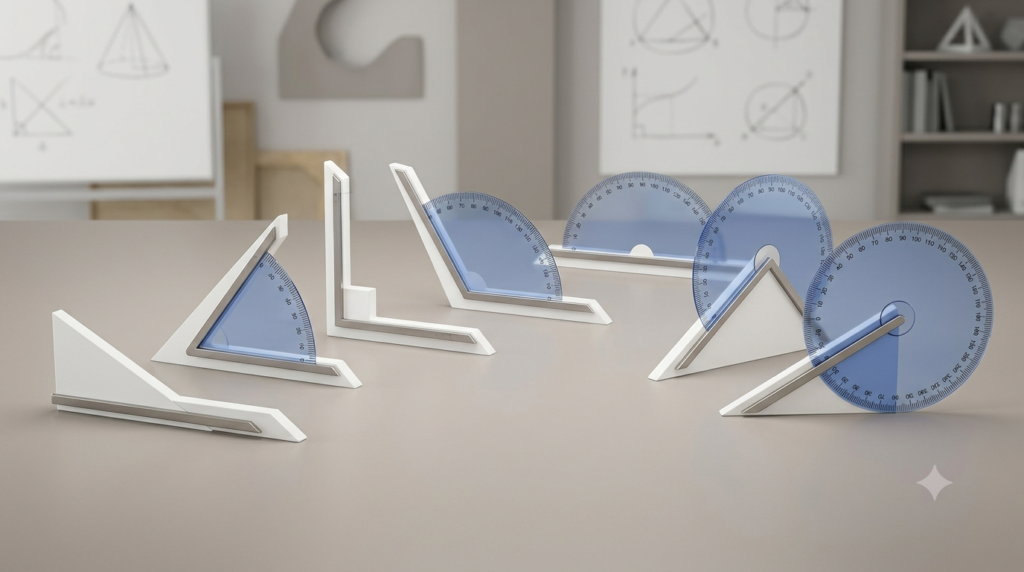
A protractor is a common mathematical instrument used to measure angles in degrees. Most school protractors show measurements from 0° to 180°. Some circular protractors cover a full 360° rotation.
A standard protractor is generally suitable for measuring angles to the nearest degree. Measuring minutes and seconds usually requires more precise instruments or additional calculations.
Step 1: Draw or Identify the Angle
An angle is formed by two rays that share a common endpoint, called the vertex.
Identify the two arms of the angle and the vertex before measuring. Make sure the angle is clearly visible.
Step 2: Place the Protractor Correctly
Position the center mark of the protractor directly over the vertex. Align its baseline with one arm of the angle.
Accurate alignment is important because even a small positioning error can affect the reading.
Step 3: Read the Degree Measurement
Look at the scale where the second arm crosses the curved edge of the protractor. Use the scale that begins at 0° on the arm aligned with the baseline.
For example, if the second arm crosses the scale at 65°, the measured angle is approximately 65°.
Step 4: Record the Measurement
Write the measured angle using the degree symbol.
Text block:
Measured angle ≈ 65°
The approximation symbol indicates that the measurement may not be exact. If the angle needs to be expressed in minutes and seconds, a more precise measurement is required.
Step 5: Obtain Greater Precision When Needed
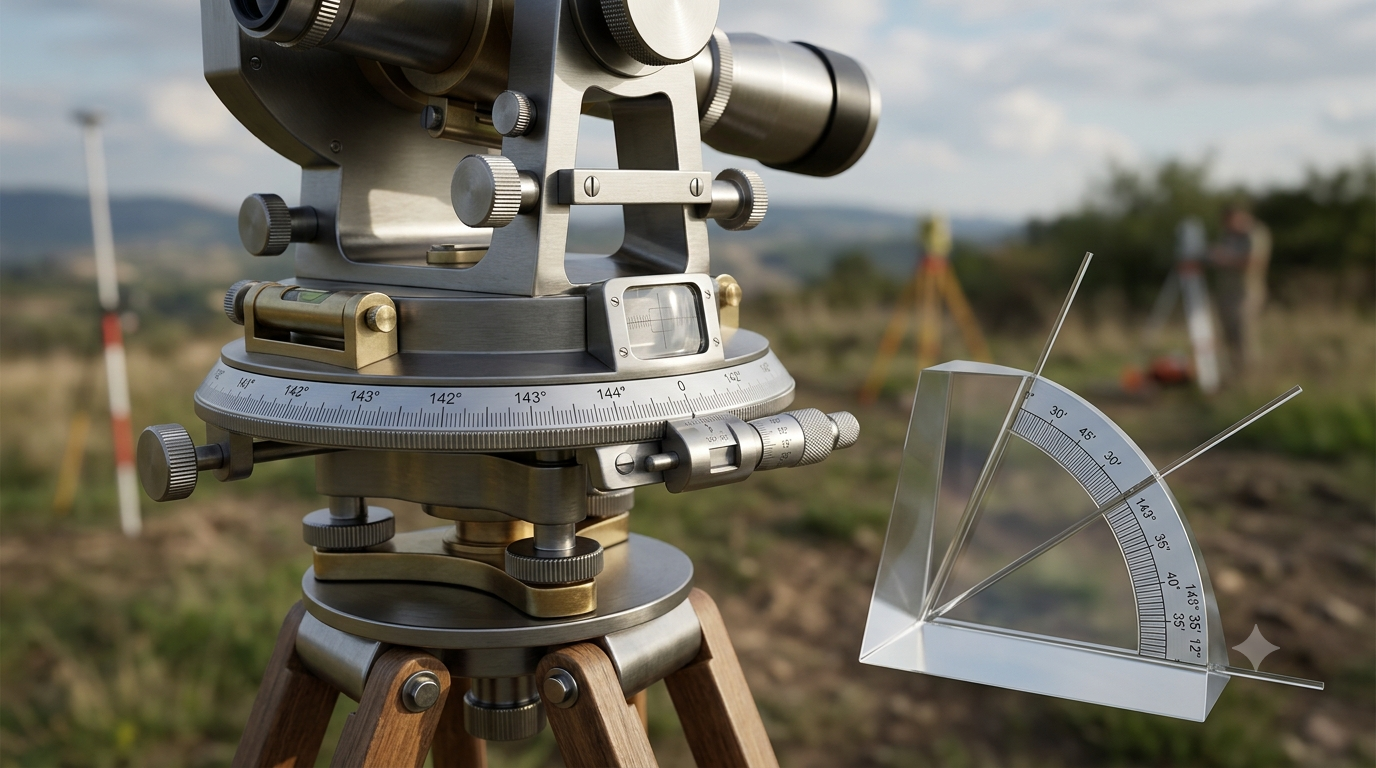
A standard protractor does not usually provide reliable measurements to the nearest angular minute or second. For such precision, professionals may use a theodolite, a total station, an optical instrument, or suitable digital measuring equipment.
The important principle is to match the precision of the instrument to the precision required for the task.
How to Convert Degrees into Minutes
Converting degrees into minutes is straightforward because each degree contains 60 minutes.
To convert a degree measurement into minutes, multiply the number of degrees by 60.
Text block:
Minutes = Degrees × 60
Example 1: Convert 7° into Minutes
Given an angle of 7°, multiply 7 by 60.
Text block:
Minutes = 7 × 60
Minutes = 420′
Therefore, 7° equals 420′.
Example 2: Convert 12° 25′ into Total Minutes
An angle containing both degrees and minutes can be converted into total minutes.
First, convert 12° into minutes.
Text block:
12 × 60 = 720′
Then add the existing 25′.
Text block:
Total minutes = 720′ + 25′
Total minutes = 745′
Therefore, 12° 25′ equals 745′.
This method is useful when adding, subtracting, or comparing angular measurements.
How to Convert Minutes into Degrees
To convert minutes into degrees, divide the number of minutes by 60.
Text block:
Degrees = Minutes ÷ 60
Example 1: Convert 180′ into Degrees
Text block:
Degrees = 180 ÷ 60
Degrees = 3°
Therefore, 180′ equals 3°.
Example 2: Convert 45′ into Degrees
Text block:
Degrees = 45 ÷ 60
Degrees = 0.75°
Therefore, 45′ equals 0.75°.
This result shows that 45 minutes represent three-quarters of a degree.
If the result is not a whole number, the decimal form can be useful for calculations involving trigonometric functions.
How to Convert Degrees, Minutes, and Seconds into Decimal Degrees
Decimal degrees express an angle as a single number instead of separating it into degrees, minutes, and seconds. This format is frequently used in calculators, geographic information systems, digital mapping, and scientific software.
To convert degrees, minutes, and seconds into decimal degrees, divide the minutes by 60 and the seconds by 3,600. Then add both values to the degree component.
Text block:
Decimal degrees = Degrees + (Minutes ÷ 60) + (Seconds ÷ 3,600)
Example 1: Convert 25° 30′ 00″ into Decimal Degrees
Given:
Text block:
Degrees = 25
Minutes = 30
Seconds = 0
Apply the conversion formula.
Text block:
Decimal degrees = 25 + (30 ÷ 60) + (0 ÷ 3,600)
Decimal degrees = 25 + 0.5 + 0
Decimal degrees = 25.5°
Therefore, 25° 30′ 00″ equals 25.5°.
Example 2: Convert 38° 15′ 36″ into Decimal Degrees
Given:
Text block:
Degrees = 38
Minutes = 15
Seconds = 36
Convert the minutes and seconds into fractions of a degree.
Text block:
15 ÷ 60 = 0.25°
36 ÷ 3,600 = 0.01°
Now add the values.
Text block:
Decimal degrees = 38 + 0.25 + 0.01
Decimal degrees = 38.26°
Therefore, 38° 15′ 36″ equals 38.26°.
Always retain enough decimal places during intermediate calculations. Rounding too early may introduce small errors.
How to Convert Decimal Degrees into Degrees, Minutes, and Seconds
Converting decimal degrees into degrees, minutes, and seconds requires separating the whole-number part from the decimal part.
Follow these steps:
The whole-number part represents the degrees.
Multiply the remaining decimal part by 60 to obtain the minutes.
Take the whole-number part of the minutes.
Multiply the remaining decimal part of the minutes by 60 to obtain the seconds.
Example: Convert 27.625° into Degrees, Minutes, and Seconds
The given angle is 27.625°.
First, identify the whole-number degree component.
Text block:
Degrees = 27°
The remaining decimal part is 0.625.
Multiply it by 60 to calculate the minutes.
Text block:
0.625 × 60 = 37.5′
The whole-number part gives 37′, while the remaining 0.5′ must be converted into seconds.
Text block:
Seconds = 0.5 × 60
Seconds = 30″
Therefore:
Text block:
27.625° = 27° 37′ 30″
This process allows decimal-degree measurements to be expressed in the traditional degrees-minutes-seconds format.
How to Convert Seconds into Degrees and Minutes
Seconds can also be converted into minutes or degrees using the same relationships.
To convert seconds into minutes, divide by 60. To convert seconds directly into degrees, divide by 3,600.
Text block:
Minutes = Seconds ÷ 60
Degrees = Seconds ÷ 3,600
Example 1: Convert 240″ into Minutes
Text block:
Minutes = 240 ÷ 60
Minutes = 4′
Therefore, 240″ equals 4′.
Example 2: Convert 7,200″ into Degrees
Text block:
Degrees = 7,200 ÷ 3,600
Degrees = 2°
Therefore, 7,200″ equals 2°.
These conversions are especially helpful when all measurements must be expressed in the same unit before performing calculations.
How to Add Angles Using Degrees, Minutes, and Seconds
Adding angles expressed in degrees, minutes, and seconds follows a process similar to adding numbers with different place values. The key is to remember that 60 seconds equal one minute and 60 minutes equal one degree.
Example: Add 24° 35′ 40″ and 18° 42′ 35″
Write the measurements in aligned columns.
Text block:
First angle = 24° 35′ 40″
Second angle = 18° 42′ 35″
Start by adding the seconds.
Text block:
40″ + 35″ = 75″
Since 75″ is greater than 60″, convert it into 1′ 15″. Carry 1′ into the minutes column.
Next, add the minutes.
Text block:
35′ + 42′ + 1′ = 78′
Convert 78′ into 1° 18′. Carry 1° into the degrees column.
Finally, add the degrees.
Text block:
24° + 18° + 1° = 43°
The final answer is:
Text block:
24° 35′ 40″ + 18° 42′ 35″ = 43° 18′ 15″
Carrying extra units whenever the total reaches 60 is essential for obtaining the correct answer.
How to Subtract Angles Using Degrees, Minutes, and Seconds
Subtracting angular measurements may require borrowing from the next larger unit. If there are not enough seconds, borrow 1′, which equals 60″. If there are not enough minutes, borrow 1°, which equals 60′.
Example: Subtract 12° 48′ 35″ from 25° 20′ 15″
Write the subtraction clearly.
Text block:
25° 20′ 15″ − 12° 48′ 35″
First, subtract the seconds. Since 15″ is smaller than 35″, borrow 1′ from the minutes column.
The seconds become 75″, and the minutes decrease from 20′ to 19′.
Text block:
75″ − 35″ = 40″
Next, subtract the minutes. Since 19′ is smaller than 48′, borrow 1° from the degrees column.
The minutes become 79′, and the degrees decrease from 25° to 24°.
Text block:
79′ − 48′ = 31′
Finally, subtract the degrees.
Text block:
24° − 12° = 12°
Therefore:
Text block:
25° 20′ 15″ − 12° 48′ 35″ = 12° 31′ 40″
Borrowing ensures that each unit can be subtracted correctly without changing the overall value of the angle.
Real-Life Applications of Degrees, Minutes, and Seconds
Degrees, minutes, and seconds are useful in situations where accurate angular measurements are important.
1. Surveying and Land Measurement
Surveyors measure angles to establish property boundaries, calculate land dimensions, and create accurate maps. Instruments such as theodolites and total stations can measure horizontal and vertical angles with high precision.
Angular measurements help surveyors determine the relative positions of points on the ground.
2. Astronomy
Astronomers use angular measurements to describe the apparent positions and separations of celestial objects. Angular seconds are especially useful when describing small apparent distances between stars or measuring fine details in astronomical observations.
For example, the apparent size of a distant object may be only a few angular seconds.
3. Navigation and Geography
Geographic coordinates can be expressed in degrees, minutes, and seconds. Latitude describes a position north or south of the Equator, while longitude describes a position east or west of the Prime Meridian.
For example, a location might be recorded using coordinates such as 19° 04′ 00″ N. This is a sample coordinate format, not a complete location.
Modern navigation systems often use decimal degrees, but the degrees-minutes-seconds format remains widely recognized.
4. Engineering and Construction
Engineers use angular measurements when designing structures, aligning machinery, checking slopes, and establishing precise directions. In applications where small angular errors can affect the final result, minutes and seconds provide additional detail.
5. Mathematics and Trigonometry
In trigonometry, angles are used to calculate unknown sides and angles of triangles. Converting between degrees, minutes, seconds, and decimal degrees makes it easier to work with calculators and mathematical tables.
Accurate angular values are particularly important when solving problems involving navigation, heights, distances, and geometric relationships.
Common Mistakes to Avoid
Although the system is straightforward, a few common errors can lead to incorrect results.
Confusing Angular Minutes with Time
An angular minute is one-sixtieth of a degree. It is not a minute of time. Similarly, an angular second is one-sixtieth of an angular minute, not a second of time.
Always consider the context when interpreting these units.
Forgetting the Conversion Factor
Remember that 1° equals 60′ and 1′ equals 60″. Using 100 instead of 60 is a common mistake caused by confusing the sexagesimal system with the decimal system.
Incorrectly Converting Decimal Degrees
When converting decimal degrees into minutes, multiply only the decimal part by 60. Do not multiply the whole angle by 60 unless the goal is to convert the entire angle into minutes.
Failing to Carry or Borrow
During addition and subtraction, a result of 60 seconds must be converted into one minute. Similarly, 60 minutes must be converted into one degree.
Leaving a measurement with 60 or more seconds or minutes can make the final answer inconsistent with the standard format.
Rounding Too Early
When high precision is required, keep additional decimal places during intermediate calculations. Round only the final result to the precision appropriate for the instrument and task.
Conclusion
Measuring angles using degrees, minutes, and seconds is an important mathematical skill that supports the study of geometry, trigonometry, astronomy, surveying, navigation, and engineering. Degrees represent the main unit, while minutes and seconds allow angles to be expressed with greater precision. The relationship between these units is simple: one degree contains 60 minutes, and one minute contains 60 seconds.
By learning how to read angular measurements, use a protractor, convert between units, and add or subtract angles, you can solve a wide range of mathematical and practical problems. Regular practice with worked examples will help you become more confident and accurate. Whether you are studying basic geometry or exploring advanced scientific applications, understanding degrees, minutes, and seconds provides a valuable foundation for measuring angles correctly.
FAQs
1. What are degrees, minutes, and seconds in angle measurement?
Degrees, minutes, and seconds are units used to measure angles with different levels of precision. A degree is the basic unit, while minutes and seconds represent smaller parts of a degree. One degree contains 60 minutes, and one minute contains 60 seconds. For example, an angle written as 35° 20′ 15″ means 35 degrees, 20 minutes, and 15 seconds. These units are commonly used in geometry, surveying, astronomy, navigation, and geography. They allow angular measurements to be recorded more precisely than using whole degrees alone.
2. How many minutes are there in one degree?
One degree contains 60 angular minutes. This relationship is an essential rule for converting angles between degrees and minutes. To convert degrees into minutes, multiply the number of degrees by 60. For example, 5° equals 300′ because 5 × 60 = 300. Similarly, 12° equals 720′. Angular minutes are represented by the prime symbol (′). Remember that angular minutes are different from minutes used to measure time. Understanding this conversion makes it easier to solve geometry problems, perform angular calculations, and express measurements in smaller units when greater precision is required.
3. How many seconds are there in one degree?
One degree contains 3,600 angular seconds. This is because each degree contains 60 minutes, and each minute contains 60 seconds. Therefore, 60 × 60 = 3,600 seconds in one degree. Angular seconds are represented by the double-prime symbol (″). For example, 2° equals 7,200″, while 4° equals 14,400″. Seconds are useful when measuring very small angular differences in astronomy, surveying, and precision engineering. Converting degrees into seconds involves multiplying the degree value by 3,600. This relationship helps express angular measurements using a single, smaller unit.
4. How do you convert degrees, minutes, and seconds into decimal degrees?
To convert degrees, minutes, and seconds into decimal degrees, divide the minutes by 60 and the seconds by 3,600. Add both results to the number of degrees. For example, to convert 25° 30′ 00″, calculate 25 + (30 ÷ 60) + (0 ÷ 3,600). The result is 25.5°. Decimal degrees are commonly used in digital maps, calculators, geographic information systems, and scientific software. This conversion combines three separate units into one numerical value, making calculations easier. Keep sufficient decimal places during intermediate calculations to avoid unnecessary rounding errors.
5. How do you convert decimal degrees into degrees, minutes, and seconds?
To convert decimal degrees into degrees, minutes, and seconds, first separate the whole-number part from the decimal part. The whole-number part represents degrees. Multiply the remaining decimal part by 60 to obtain minutes. Keep the whole-number part of the minutes and multiply the remaining decimal part by 60 to obtain seconds. For example, 27.625° becomes 27° 37′ 30″. This method is useful when converting digital angle measurements into a traditional format. It is important to retain the correct units at each step and round the final seconds only when necessary.
6. What instrument is used to measure angles in degrees?
A protractor is the most common instrument for measuring angles in degrees in school mathematics and basic geometry. A standard semicircular protractor measures angles from 0° to 180°, while a circular protractor can measure a full 360° rotation. More precise instruments, such as theodolites and total stations, are used in surveying, construction, and engineering. To measure an angle with a protractor, place its center at the vertex and align the baseline with one arm. Read the scale where the other arm crosses it. The accuracy of the measurement depends on the instrument and its correct positioning.
7. How do you add angles expressed in degrees, minutes, and seconds?
To add angles in degrees, minutes, and seconds, add the seconds first, followed by the minutes and degrees. If the seconds total 60 or more, convert every complete group of 60 seconds into one minute and carry it to the minutes column. Apply the same rule to minutes, converting each complete group of 60 minutes into one degree. For example, 10° 25′ 40″ + 5° 15′ 35″ equals 15° 41′ 15″. Organizing the values into aligned columns helps prevent mistakes. Always check whether carrying is needed before writing the final answer.
8. How do you subtract angles using degrees, minutes, and seconds?
To subtract angles, arrange the measurements so that degrees, minutes, and seconds are aligned. Subtract the seconds first. If the upper value has fewer seconds than the lower value, borrow one minute, which equals 60 seconds. If there are insufficient minutes, borrow one degree, which equals 60 minutes. For example, 20° 15′ 10″ − 8° 25′ 30″ equals 11° 49′ 40″. Borrowing allows each unit to be subtracted correctly. After completing the calculation, check that the seconds and minutes are each less than 60 in the final standard format.
9. Why are degrees, minutes, and seconds important in astronomy and navigation?
Degrees, minutes, and seconds help describe directions, positions, and small angular differences accurately. In astronomy, these units are used to express the apparent positions and separations of celestial objects. In navigation and geography, latitude and longitude can be recorded in this format to identify locations on Earth. Surveyors also use precise angular measurements to map land and determine the positions of points. Although many modern digital systems use decimal degrees, degrees, minutes, and seconds remain widely recognized. Their ability to express small fractions of a degree makes them valuable whenever detailed angular measurements are required.
10. What is the difference between angular minutes and minutes of time?
Angular minutes and minutes of time measure different quantities. An angular minute is a unit of angle equal to one-sixtieth of a degree, while a minute of time represents one-sixtieth of an hour. Similarly, an angular second equals one-sixtieth of an angular minute, whereas a second of time equals one-sixtieth of a minute of time. Although the same words are used, their meanings depend on the context. Angular minutes use the prime symbol (′), and angular seconds use the double-prime symbol (″). Recognizing this difference helps prevent confusion in mathematics, astronomy, navigation, and scientific calculations.