
What Are Chemistry Formulas and Why Are They Important?

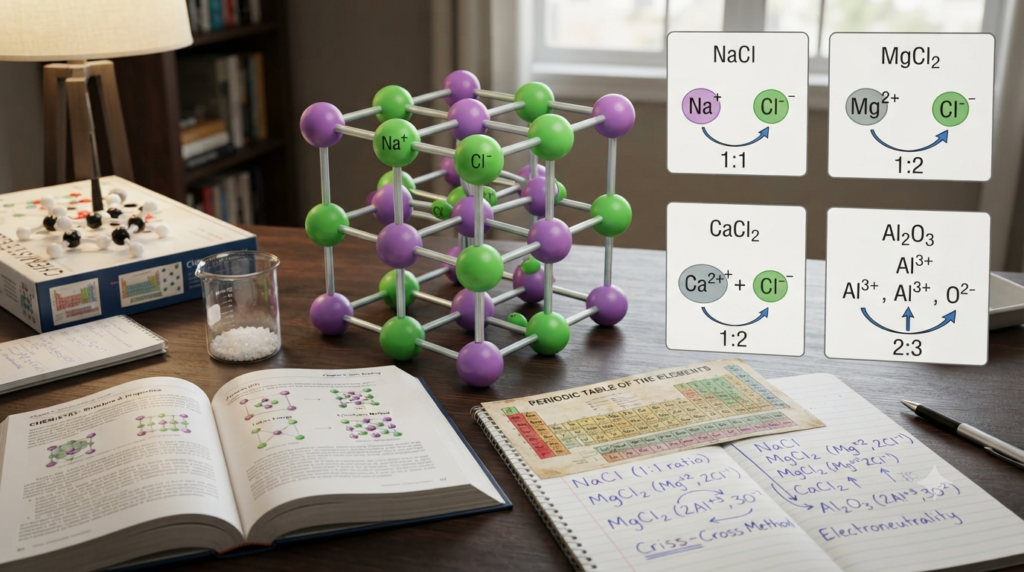
Chemistry formulas such as H₂O, CO₂, and NaCl with molecular models and chemical equations on a laboratory desk

Chemistry is the science of substances, their properties, and the changes they undergo. To describe these substances clearly, chemists use a special language made of symbols, numbers, and formulas. Chemistry formulas help us represent elements, compounds, molecules, and chemical reactions in a short and meaningful way. Instead of writing the complete names and amounts of every substance repeatedly, a formula can communicate the same information much more efficiently.

From water and oxygen to medicines, fertilizers, fuels, and materials used in technology, chemistry formulas are connected with countless substances around us. Learning how these formulas work makes chemistry easier to understand because they provide a direct connection between the names of substances, their composition, and their chemical behavior.

What Is a Chemistry Formula?

A chemistry formula is a symbolic representation that shows the composition or identity of a chemical substance. It uses chemical symbols for elements and numbers to indicate how atoms are combined.

For example, water is represented by the formula H₂O. The symbol H represents hydrogen, while O represents oxygen. The small number ₂ shows that one molecule of water contains two hydrogen atoms and one oxygen atom.

Similarly, carbon dioxide is written as CO₂. This tells us that each molecule contains one carbon atom and two oxygen atoms.

A formula therefore provides information that the name of a substance alone may not immediately reveal.

How Do Chemistry Formulas Work?

Chemistry formulas are based on internationally accepted chemical symbols. Each element has its own symbol, usually consisting of one or two letters.

For example:

  • H = Hydrogen

  • O = Oxygen

  • C = Carbon

  • N = Nitrogen

  • Na = Sodium

  • Cl = Chlorine

  • Ca = Calcium

Numbers written as subscripts show the number of atoms of an element present in a molecule or formula unit.

Consider ammonia, NH₃. The formula contains one nitrogen atom and three hydrogen atoms. The absence of a subscript after N means there is one nitrogen atom.

When no number is written after an element symbol, the number is understood to be one.

Chemistry Formulas Show Composition

One of the most important uses of a chemistry formula is to show what a substance is made of.

For example, glucose has the formula C₆H₁₂O₆. From this formula, we can determine that a glucose molecule contains six carbon atoms, twelve hydrogen atoms, and six oxygen atoms.

This information is useful because the properties of a substance are closely connected with its composition.

Another example is calcium carbonate, CaCO₃. Its formula shows the presence of calcium, carbon, and oxygen. The oxygen count is three because the O symbol has the subscript ₃.

Therefore, formulas provide a compact way to describe the elemental composition of substances.

Different Types of Chemistry Formulas

Chemists use several types of formulas depending on the information they want to communicate.

Molecular Formula

A molecular formula shows the actual number of atoms of each element in a molecule.

For example:

H₂O = water

CO₂ = carbon dioxide

C₆H₁₂O₆ = glucose

Molecular formulas are especially useful for substances that exist as individual molecules.

Empirical Formula

An empirical formula shows the simplest whole-number ratio of atoms in a compound.

For example, the molecular formula of glucose is C₆H₁₂O₆. Dividing all the subscripts by 6 gives the empirical formula CH₂O.

The molecular formula gives the actual number of atoms in a molecule, while the empirical formula gives the simplest ratio.

Structural Formula

A structural formula provides information about how atoms are connected.

For example, ethanol can be represented as CH₃CH₂OH. This gives more information about the arrangement of atoms than simply writing its molecular formula, C₂H₆O.

Structural formulas are particularly important in organic chemistry because substances with the same molecular formula can have different structures and properties.

Why Are Chemistry Formulas Important?

Chemistry formulas are important because they allow scientists to communicate chemical information accurately and efficiently.

1. They Identify Substances

A formula provides a standard way to identify a chemical substance.

For example, H₂O identifies water, while CO₂ identifies carbon dioxide. Scientists around the world can understand these formulas regardless of their native language.

2. They Show the Elements Present

A formula immediately tells us which elements are present in a compound.

For example, NaCl contains sodium and chlorine. CaO contains calcium and oxygen.

This makes it easier to study the composition and properties of different substances.

3. They Show Atomic Ratios

Subscripts provide important information about the ratio of atoms.

In H₂O, hydrogen and oxygen occur in a 2:1 ratio. In CO₂, carbon and oxygen occur in a 1:2 ratio.

These ratios are essential for understanding chemical reactions and calculating the quantities of reactants and products.

4. They Help Write Chemical Equations

Chemical formulas are essential for representing chemical reactions.

For example, hydrogen reacts with oxygen to form water:

2H₂ + O₂ → 2H₂O

The formulas identify the substances involved, while the numbers in front of the formulas show the relative amounts needed for the reaction.

This allows chemists to represent complicated chemical processes in a simple form.

5. They Help With Chemical Calculations

Chemistry formulas are also important for quantitative calculations.

The formula H₂O can be used to determine the molar mass of water. Hydrogen has an atomic mass of approximately 1 u and oxygen has an atomic mass of approximately 16 u.

Therefore:

H₂O = (2 × 1) + 16 = 18 u

The same principle can be used to calculate molar masses, determine the percentage composition of compounds, and solve stoichiometric problems.

Chemistry Formulas in Everyday Life

Chemistry formulas are not limited to laboratories and textbooks. They describe many substances used in everyday life.

Water is H₂O. Oxygen is O₂. Carbon dioxide is CO₂. Common salt is NaCl. Baking soda is NaHCO₃.

Medicines, cleaning products, fertilizers, fuels, plastics, cosmetics, and food additives also contain chemical substances that can be represented using formulas.

For example, the formula of hydrogen peroxide is H₂O₂. It is used in some cleaning and disinfecting applications. Its formula shows that it contains two hydrogen atoms and two oxygen atoms per molecule.

Understanding formulas can therefore help us recognize and compare substances encountered in daily life.

Chemistry Formulas Help Scientists Communicate

Science depends on accurate communication. Chemical names can sometimes be long or difficult to interpret, especially when many substances are involved. Formulas provide a universal shorthand.

A scientist in India, Japan, Brazil, or Germany can recognize H₂O as water without needing to translate the word into another language.

This universal nature makes chemistry formulas extremely valuable in scientific research, education, medicine, manufacturing, and environmental science.

How to Read a Chemistry Formula

Reading a chemistry formula becomes easier when you follow a few simple steps.

First, identify each element symbol. Next, look for the subscripts. A subscript tells you how many atoms of that element are present.

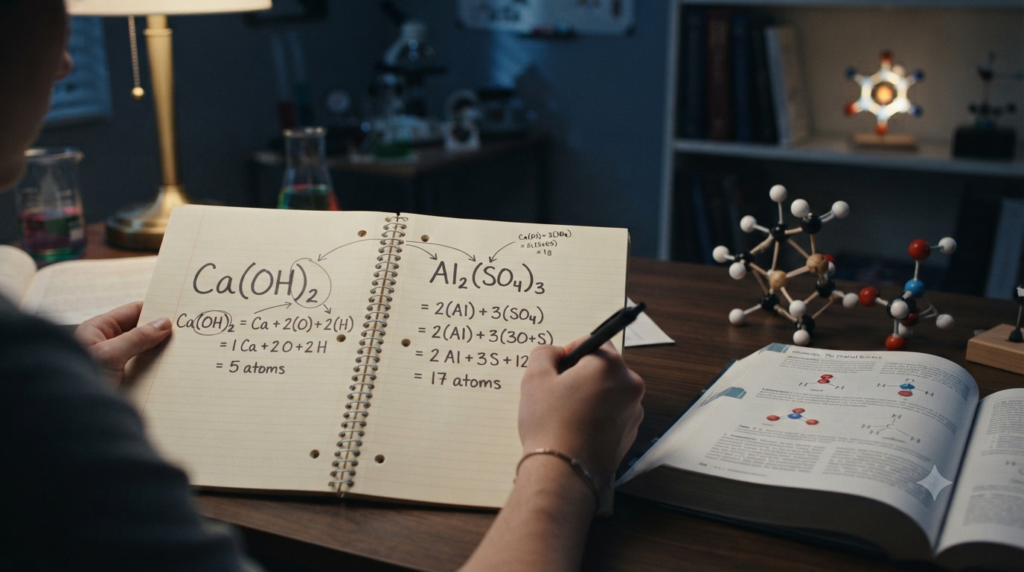
For example, consider Al₂(SO₄)₃.

There are two aluminium atoms. The group SO₄ appears three times because of the subscript outside the brackets. Therefore, the compound contains two aluminium atoms, three sulfur atoms, and twelve oxygen atoms.

This shows why brackets and subscripts are important when reading more complex formulas.

Conclusion

Chemistry formulas are a simple but powerful language for describing matter. They show which elements are present, how atoms are combined, and, in many cases, how substances participate in chemical reactions. Formulas such as H₂O, CO₂, NaCl, and C₆H₁₂O₆ allow complex chemical information to be communicated in a compact and universal form.

Understanding chemistry formulas is therefore an important foundation for learning chemistry. Once you become comfortable reading symbols, subscripts, ratios, and structures, many other areas of chemistry become easier to understand. From basic classroom experiments to advanced scientific research, chemistry formulas provide the language needed to describe the world of matter.

FAQs

1. What is a chemistry formula?

A chemistry formula is a symbolic way of representing a chemical substance. It uses chemical symbols and numbers to show which elements are present and how their atoms are combined. For example, H₂O represents water and shows that each water molecule contains two hydrogen atoms and one oxygen atom. The letters come from the symbols of the elements, while small numbers called subscripts indicate the number of atoms. Chemistry formulas make it easier for scientists and learners to identify substances, understand their composition, write chemical equations, and perform calculations. They also provide a common scientific language used around the world.

2. What information does a chemical formula provide?

A chemical formula mainly provides information about the elements present in a substance and their relative numbers or ratios. For example, CO₂ shows that carbon dioxide contains carbon and oxygen, with one carbon atom for every two oxygen atoms. A formula can also help determine the composition and molar mass of a compound. In more advanced chemistry, different types of formulas can provide additional information. Molecular formulas show actual numbers of atoms in molecules, empirical formulas show the simplest ratios, and structural formulas show how atoms are connected. Therefore, chemical formulas provide a compact representation of important chemical information.

3. What do subscripts mean in chemistry formulas?

Subscripts are small numbers written after chemical symbols in a formula. They indicate how many atoms of that element are present in one molecule or formula unit. For example, H₂O contains a subscript ₂ after H, meaning there are two hydrogen atoms. There is no number after O, so it represents one oxygen atom. In CO₂, the subscript ₂ indicates two oxygen atoms. Subscripts are important because changing them can change the identity of a substance. For example, H₂O and H₂O₂ represent different substances. Therefore, subscripts should always be read carefully when interpreting chemical formulas.

4. What is the difference between a molecular formula and an empirical formula?

A molecular formula shows the actual number of atoms of each element in one molecule of a substance, while an empirical formula shows the simplest whole-number ratio of those atoms. For example, glucose has the molecular formula C₆H₁₂O₆. Dividing all the subscripts by six gives its empirical formula, CH₂O. The two formulas provide different levels of information. The molecular formula tells us the actual composition of an individual molecule, whereas the empirical formula describes the simplest ratio between the elements. Both are useful in chemistry, particularly when studying compound composition and performing chemical calculations.

5. Why are chemistry formulas important in chemical equations?

Chemistry formulas are essential for writing chemical equations because they identify the reactants and products involved in a chemical reaction. For example, the equation 2H₂ + O₂ → 2H₂O represents hydrogen reacting with oxygen to form water. The formulas identify each substance, while the numbers placed before them indicate their relative amounts. Chemical equations can therefore communicate chemical reactions much more efficiently than lengthy descriptions. Formulas also allow equations to be balanced according to the conservation of atoms. This makes them essential for understanding reactions, calculating quantities, and studying how substances change during chemical processes.

6. How do you read a chemistry formula?

To read a chemistry formula, first identify the chemical symbols and then examine the subscripts. A missing subscript means one atom. For example, H₂O contains two hydrogen atoms and one oxygen atom. If parentheses are present, the subscript outside the parentheses applies to everything inside them. For example, Ca(OH)₂ contains one calcium atom, two oxygen atoms, and two hydrogen atoms. It is useful to read formulas carefully from left to right and identify each element before counting atoms. With practice, even complex formulas become easier to understand and can provide detailed information about a compound’s composition.

7. Can chemistry formulas help calculate molar mass?

Yes, chemistry formulas are essential for calculating molar mass. A formula tells you which elements are present and how many atoms of each element are included. You can then multiply the number of atoms of each element by its atomic mass and add the results. For example, water has the formula H₂O. Using approximate atomic masses of 1 for hydrogen and 16 for oxygen, its molar mass is calculated as (2 × 1) + 16 = 18 g/mol. Molar mass calculations are widely used in chemistry laboratories, chemical equations, stoichiometry, and quantitative scientific experiments.

8. Why do scientists use chemical symbols and formulas?

Scientists use chemical symbols and formulas because they provide a concise and internationally understood way to communicate chemical information. Chemical names can vary between languages, but symbols such as H, O, C, and Na are used consistently in scientific communication. A formula can quickly show the composition of a substance without requiring a long description. This is especially useful when scientists write chemical equations, research papers, laboratory procedures, and calculations. Chemical formulas also reduce confusion by providing standardized representations of substances. Their universal nature allows scientists from different countries and backgrounds to communicate chemical information efficiently and accurately.

9. What is a structural formula in chemistry?

A structural formula shows how atoms are arranged and connected within a molecule. While a molecular formula gives the number of atoms present, a structural formula provides information about their connections. For example, ethanol has the molecular formula C₂H₆O, while its condensed structural formula can be written as CH₃CH₂OH. This shows how the carbon, hydrogen, and oxygen atoms are arranged. Structural formulas are especially important in organic chemistry because different substances can have the same molecular formula but different arrangements of atoms. These different structures can lead to different physical and chemical properties.

10. Where are chemistry formulas used in everyday life?

Chemistry formulas are used to describe substances found throughout everyday life. Water is H₂O, oxygen is O₂, carbon dioxide is CO₂, and common salt is NaCl. Chemistry formulas are also used when studying medicines, fertilizers, fuels, cleaning products, food ingredients, plastics, cosmetics, and many other materials. They help scientists understand what substances contain and how those substances may react. In laboratories and industries, formulas are used to prepare materials, calculate quantities, and represent chemical reactions. Learning basic chemistry formulas therefore provides a useful way to understand both familiar substances and more complex materials used in modern life.

Related Posts

Leave a Comment

Your email address will not be published. Required fields are marked *

Scroll to Top