
A chemical formula is much more than a short name for a substance. It gives important information about what a compound contains and the relative number of atoms of each element present in it. When we look at a formula such as H₂O, CO₂, or NaCl, the symbols and numbers tell us about the composition of the substance in a compact and precise way.
One of the most important ideas behind chemical formulas is fixed composition. A pure compound contains its constituent elements in a definite ratio. This ratio does not change simply because the amount of the compound changes. Whether we have a tiny sample of water or a large quantity of water, the ratio of hydrogen atoms to oxygen atoms remains the same.
Understanding how chemical formulas represent fixed composition helps us read formulas correctly, count atoms, calculate masses, write chemical equations, and understand how compounds are formed.
What Is Fixed Composition?
Fixed composition means that a pure chemical compound always contains the same elements in the same definite ratio.
For example, water is represented by the formula H₂O. This formula tells us that water contains hydrogen and oxygen in a fixed atomic ratio of 2:1. For every two hydrogen atoms, there is one oxygen atom in a water molecule.
If we have one molecule of water, it contains:
2 hydrogen atoms
1 oxygen atom
If we have 100 water molecules, they contain:
200 hydrogen atoms
100 oxygen atoms
The number of molecules has changed, but the ratio of hydrogen to oxygen remains 2:1.
This is what makes the composition fixed.
How Chemical Formulas Show Composition
A chemical formula uses element symbols and numbers to represent the composition of a substance.
Consider the formula:
H₂O
The symbols H and O represent hydrogen and oxygen. The small number 2 written after H is called a subscript. It tells us that two hydrogen atoms are present for every one oxygen atom.
When no subscript is written after an element symbol, the number is understood to be one.
Therefore:
H₂O = 2 hydrogen atoms + 1 oxygen atom
Now consider carbon dioxide:
CO₂
There is no number after C, so the number of carbon atoms is one. The subscript 2 after O means that there are two oxygen atoms.
Therefore:
CO₂ = 1 carbon atom + 2 oxygen atoms
The formula directly communicates the atomic composition of the compound.
Why Subscripts Are Important
Subscripts are one of the most important parts of a chemical formula because they determine the ratio of atoms.
For example:
H₂O means:
2 hydrogen : 1 oxygen
But:
H₂O₂ means:
2 hydrogen : 2 oxygen
These are different substances because their atomic compositions are different.
H₂O is water, while H₂O₂ is hydrogen peroxide. Changing a subscript changes the composition and can produce a completely different substance.
This is why subscripts in chemical formulas cannot be changed randomly.
For example, changing H₂O to H₃O does not simply mean “more hydrogen in water.” It represents a different chemical composition.
Chemical Formulas Represent Ratios of Atoms
A chemical formula gives the simplest information needed to describe the composition of a compound at the atomic level.
For example:
NH₃
The formula represents ammonia. It contains:
1 nitrogen atom
3 hydrogen atoms
Therefore, the atomic ratio is:
N : H = 1 : 3
Similarly:
CH₄
represents methane and contains:
1 carbon atom
4 hydrogen atoms
So the atomic ratio is:
C : H = 1 : 4
The formula allows us to identify the relative number of atoms without having to write a long description.
Fixed Composition Does Not Mean Fixed Amount
An important point is that fixed composition does not mean that every sample must contain the same number of atoms or molecules.
The amount of a compound can change.
For example, a small drop of water and a large tank of water contain different numbers of water molecules. However, every water molecule has the same composition, H₂O.
This means that the quantity of a substance can change while its composition remains fixed.
If the number of water molecules doubles, the numbers of hydrogen and oxygen atoms also double, but their ratio remains unchanged.
For example:
1 H₂O molecule → 2 H atoms and 1 O atom
10 H₂O molecules → 20 H atoms and 10 O atoms
1,000 H₂O molecules → 2,000 H atoms and 1,000 O atoms
In every case:
H : O = 2 : 1
How Coefficients Differ From Subscripts
Chemical formulas can also contain numbers placed before the formula. These numbers are called coefficients.
For example:
2H₂O
The coefficient 2 means that there are two water molecules.
Each H₂O molecule contains 2 hydrogen atoms and 1 oxygen atom. Therefore, 2H₂O contains:
4 hydrogen atoms
2 oxygen atoms
The important difference is that a subscript changes the composition of one unit of the substance, while a coefficient changes the number of units.
Compare:
H₂O
One water molecule contains 2 H atoms and 1 O atom.
2H₂O
Two water molecules contain 4 H atoms and 2 O atoms.
But:
H₂O₂
contains 2 H atoms and 2 O atoms in each molecule and represents a different substance.
This distinction is essential when reading chemical equations and calculating the number of atoms.
Fixed Composition and the Law of Definite Proportions
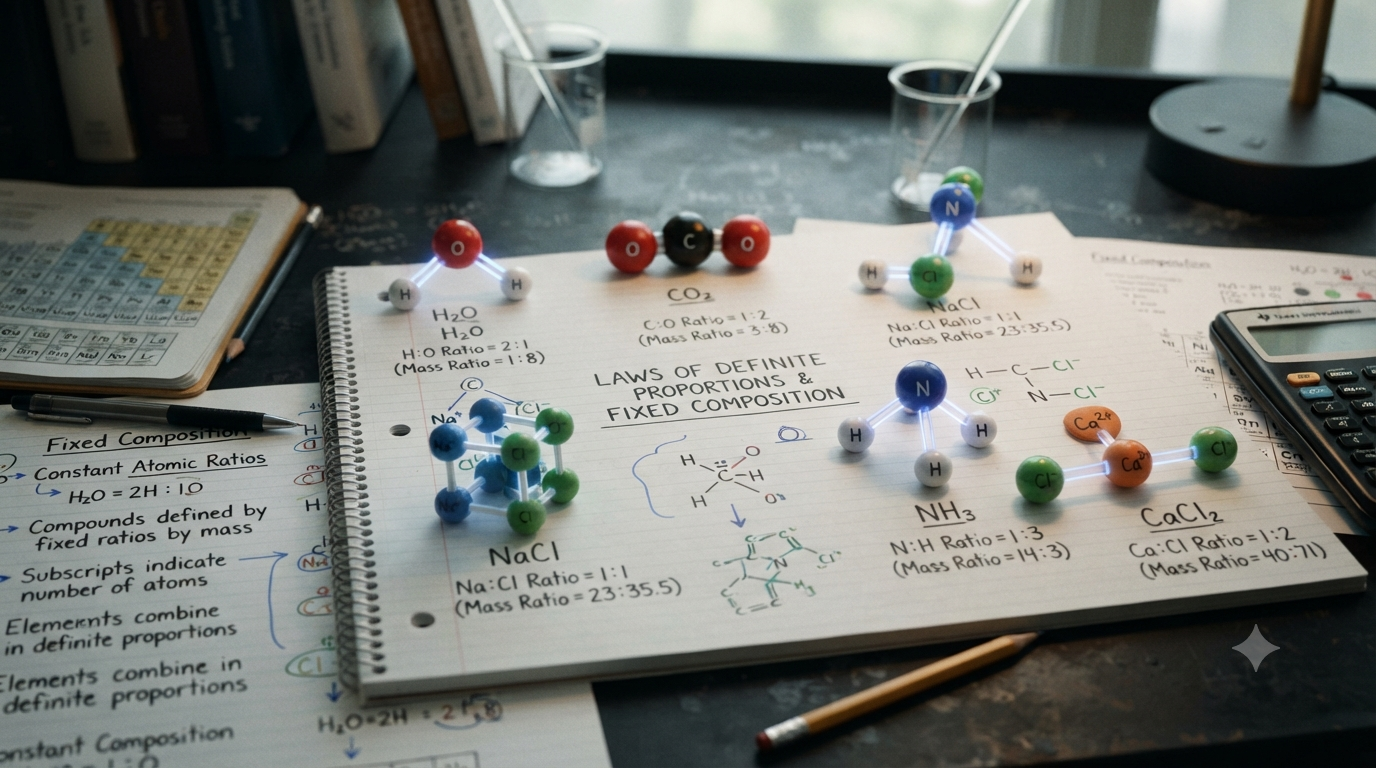
The idea of fixed composition is closely connected with the law of definite proportions, also called the law of constant composition.
This law states that a pure chemical compound always contains the same elements combined in the same definite proportion by mass.
For example, pure water always contains hydrogen and oxygen in a definite mass ratio. It does not matter whether the water comes from a glass, a river after purification, or a laboratory sample. Pure H₂O has the same chemical composition.
The chemical formula H₂O expresses the atomic relationship, while the relative atomic masses can be used to determine the mass relationship.
For H₂O:
Hydrogen contributes 2 × 1 = 2 mass units
Oxygen contributes 1 × 16 = 16 mass units
Total relative formula mass:
2 + 16 = 18
Therefore, the mass contribution of hydrogen and oxygen is:
2 : 16 = 1 : 8
So hydrogen and oxygen occur in water in a fixed mass ratio of approximately 1:8.
Examples of Fixed Composition
Many familiar compounds demonstrate fixed composition.
Sodium Chloride
The formula of sodium chloride is:
NaCl
It contains sodium and chlorine in a 1:1 ratio of formula units.
The formula does not mean that every sample contains only one sodium atom and one chlorine atom in total. Instead, it represents the fixed ratio of sodium to chlorine in the compound.
Carbon Dioxide
The formula is:
CO₂
It contains carbon and oxygen in a 1:2 atomic ratio.
For every carbon atom, there are two oxygen atoms.
Calcium Oxide
The formula is:
CaO
It represents calcium and oxygen in a 1:1 ratio.
Calcium Chloride
The formula is:
CaCl₂
It contains:
1 calcium atom
2 chlorine atoms
Therefore, the atomic ratio is:
Ca : Cl = 1 : 2
Each of these formulas communicates a specific and fixed composition.
Why Chemical Formulas Are So Useful
Chemical formulas allow scientists to communicate chemical information quickly and accurately.
A formula can tell us:
Which elements are present
How many atoms of each element are represented
The atomic ratio between the elements
The relative composition of the compound
The information needed to calculate formula mass
The quantities involved in chemical reactions
For example, from CaCl₂, we immediately know that calcium and chlorine occur in a 1:2 ratio.
This information can then be used to balance chemical equations, calculate reactant and product amounts, and determine the composition of samples.
Chemical Formulas and Conservation of Atoms
Chemical formulas also become important when chemical reactions are represented by equations.
Consider the formation of water:
2H₂ + O₂ → 2H₂O
On the left side:
Hydrogen = 4 atoms
Oxygen = 2 atoms
On the right side:
Hydrogen = 4 atoms
Oxygen = 2 atoms
The formulas and coefficients together show that atoms are rearranged rather than created or destroyed.
The formula H₂O tells us the fixed composition of water, while the coefficient 2 tells us how many water molecules are involved in the reaction.
This shows why understanding formulas is essential before learning how to balance chemical equations.
Fixed Composition at the Molecular Level
For molecular compounds, the formula usually represents the actual number of atoms in one molecule.
For example:
CO₂
represents one carbon atom bonded with two oxygen atoms in a carbon dioxide molecule.
Similarly:
NH₃
represents one nitrogen atom and three hydrogen atoms in an ammonia molecule.
The molecular formula therefore provides a direct picture of the elemental composition of each molecule.
However, not all substances exist as separate molecules. Ionic compounds such as NaCl form extended crystal structures. In such cases, the formula represents the simplest whole-number ratio of ions rather than a separate molecule.
Even in these cases, the principle of fixed composition remains the same.
What Happens When the Formula Changes?
Changing the subscripts in a formula changes the ratio of elements and therefore changes the composition.
Consider:
CO
and
CO₂
CO contains:
C : O = 1 : 1
CO₂ contains:
C : O = 1 : 2
Although both compounds contain carbon and oxygen, they have different compositions and different chemical properties.
This demonstrates why chemical formulas are precise. A small change in a subscript can represent a completely different compound.
Chemical Formula as a Chemical Identity
A chemical formula can be considered a compact identity for a compound because it specifies the elements and their relative proportions.
For example, H₂O is not simply a combination of the words hydrogen and oxygen. It specifies a particular atomic relationship.
Similarly, CO₂ identifies a compound containing carbon and oxygen in a definite 1:2 ratio.
This precision allows scientists around the world to communicate chemical information using the same symbolic language.
Conclusion
Chemical formulas represent fixed composition by showing which elements are present and the definite ratio in which their atoms or ions are combined. Subscripts are especially important because they indicate the number of atoms of each element in a chemical formula. A coefficient, on the other hand, changes the number of molecules or formula units without changing the composition of each unit.
The idea of fixed composition explains why a pure compound always contains its elements in a definite proportion. Whether we examine a small sample or a much larger amount, the elemental ratio remains constant. By learning how to read subscripts, coefficients, atomic ratios, and formulas, we can understand the composition of compounds and build a strong foundation for studying chemical reactions, stoichiometry, formula mass, and quantitative chemistry.
FAQs
1. What does fixed composition mean in chemistry?
Fixed composition means that a pure chemical compound always contains the same elements in a definite ratio. This ratio remains constant regardless of the amount of the compound present. For example, water has the formula H₂O, which means that hydrogen and oxygen are present in a 2:1 atomic ratio. A small drop of pure water and a large quantity of pure water have the same hydrogen-to-oxygen ratio. The number of molecules may change, but the composition of each molecule remains the same. This principle is known as the law of definite proportions or the law of constant composition.
2. How does a chemical formula show the composition of a compound?
A chemical formula shows the elements present in a compound and their relative numbers of atoms. Element symbols identify the elements, while subscripts indicate how many atoms of each element are represented. For example, CO₂ contains one carbon atom and two oxygen atoms, giving a carbon-to-oxygen ratio of 1:2. If no subscript appears after an element symbol, the number is understood to be one. Therefore, a formula provides a compact way to describe the composition of a substance. It allows scientists to understand the elemental makeup of compounds without writing a lengthy description.
3. Why are subscripts important in chemical formulas?
Subscripts are important because they show the number of atoms of an element in a chemical formula. For example, H₂O contains two hydrogen atoms and one oxygen atom. The subscript 2 applies only to the hydrogen symbol immediately before it. Changing a subscript changes the ratio of elements and can produce a different substance. For example, H₂O and H₂O₂ have different compositions and represent different compounds. Therefore, subscripts should not be changed when writing chemical formulas unless there is a valid chemical reason. They provide essential information about the fixed atomic composition of a compound.
4. What is the difference between a subscript and a coefficient?
A subscript tells us the number of atoms of an element within one molecule or formula unit, while a coefficient tells us how many molecules or formula units are present. For example, in 2H₂O, the coefficient 2 means there are two water molecules. Each water molecule contains two hydrogen atoms and one oxygen atom, so two molecules contain four hydrogen atoms and two oxygen atoms. In H₂O₂, the subscripts indicate that each molecule contains two hydrogen atoms and two oxygen atoms. Changing a coefficient changes the amount, while changing a subscript changes the composition.
5. How does H₂O represent fixed composition?
H₂O represents water’s fixed composition by showing that each water molecule contains two hydrogen atoms for every one oxygen atom. Therefore, the atomic ratio of hydrogen to oxygen is always 2:1. If there is one water molecule, there are two hydrogen atoms and one oxygen atom. If there are 1,000 water molecules, there are 2,000 hydrogen atoms and 1,000 oxygen atoms. Although the total amount changes, the ratio remains 2:1. This demonstrates fixed composition. The formula H₂O therefore provides a concise representation of the definite atomic relationship between hydrogen and oxygen in water.
6. Does fixed composition mean every sample contains the same amount of a compound?
No. Fixed composition does not mean that every sample contains the same total amount of a compound. It means that the elements within a pure compound occur in a definite ratio. For example, a glass of pure water and a large container of pure water contain different numbers of water molecules. However, both contain hydrogen and oxygen in the same 2:1 atomic ratio. The total number of atoms and molecules can vary according to the sample size, but the composition remains constant. Therefore, fixed composition describes the relationship between the constituent elements rather than the total quantity of the substance.
7. How does the law of definite proportions relate to chemical formulas?
The law of definite proportions states that a pure compound always contains the same elements in the same definite proportion by mass. Chemical formulas represent this fixed composition at the atomic or ionic level. For example, H₂O shows that water contains hydrogen and oxygen in a fixed atomic ratio of 2:1. Using the relative atomic masses of hydrogen and oxygen, the formula also allows us to determine their mass relationship. Thus, chemical formulas provide a symbolic representation of the composition described by the law of definite proportions. Together, they help explain why pure compounds have consistent chemical compositions.
8. Can changing a subscript change the identity of a compound?
Yes. Changing a subscript changes the ratio of elements and can produce a different compound with different properties. For example, CO contains one carbon atom and one oxygen atom, while CO₂ contains one carbon atom and two oxygen atoms. Both contain carbon and oxygen, but their compositions are different. Similarly, H₂O and H₂O₂ have different numbers of oxygen atoms relative to hydrogen. A chemical formula must therefore be written accurately because the subscripts provide essential information about the compound’s composition. Even a small change in a subscript can significantly change the substance being represented.
9. Do ionic compounds also have fixed composition?
Yes. Ionic compounds have fixed composition and are represented by formulas that show the simplest whole-number ratio of their ions. For example, NaCl represents sodium ions and chloride ions in a 1:1 ratio. Calcium chloride is represented by CaCl₂, showing a 1:2 ratio of calcium ions to chloride ions. Ionic compounds generally do not exist as separate molecules like many molecular substances do. Instead, their ions form extended crystal structures. Even so, the formula accurately represents the fixed ratio of ions present throughout the compound, which reflects its definite composition.
10. Why is understanding fixed composition important in chemistry?
Understanding fixed composition is important because it forms the foundation for many areas of chemistry. Chemical formulas allow us to identify the elements in a compound and determine their ratios. This information is needed for calculating formula mass, determining percentage composition, writing chemical equations, balancing reactions, and performing stoichiometric calculations. For example, knowing that H₂O contains hydrogen and oxygen in a fixed ratio helps us calculate the quantities involved in reactions that produce or consume water. Understanding fixed composition also helps explain why compounds have consistent properties and why changing their elemental ratios can produce different substances.
Related Posts
How to Rearrange Physics Formulas Correctly
Physics formulas are often written in a particular form to make calculations easier, but the required form of a formula […]
Read MoreWhat Is Formula Mass in Chemistry?
Chemistry often deals with substances that are made of atoms joined together in specific proportions. To understand how much matter […]
Read MoreHow to Read Subscripts in Chemical Formulas

Chemical formulas are a simple way to represent substances using symbols and numbers. When you look at a formula such […]
Read MoreWhat Is Density and How Is It Calculated?
Density is one of the most useful physical quantities in science. It helps us understand how much matter is packed […]
Read MoreHow does physics connect mathematics with reality?
Physics is often described as the science of matter, energy, motion, space, and time. But behind almost every physical idea […]
Read MoreHow Are Work and Energy Connected?
Work and energy are two of the most important ideas in physics. We use the word “work” in everyday life […]
Read MoreHow Charges Affect Chemical Formulas
Chemical formulas are a simple way to represent substances using symbols and numbers. A formula can tell us which elements […]
Read MoreHow to Convert Units Before Using a Physics Formula
Physics formulas help us describe motion, force, energy, pressure, electricity, heat, and many other physical phenomena. However, knowing the correct […]
Read MoreHow to Determine the Formula of a Compound From Its Name
Knowing the name of a chemical compound is often enough to determine its chemical formula if you understand the rules […]
Read MoreHow to Write Physics Formulas Correctly

Physics formulas are a powerful way to express relationships between physical quantities. A single equation can describe motion, force, energy, […]
Read MoreWhat Do Coefficients Mean in Chemistry Formulas?
When you look at a chemical equation, you may notice numbers written before chemical formulas. These numbers are called coefficients. […]
Read MoreHow Chemical Formulas Help Calculate Composition
Chemical formulas are much more than short combinations of element symbols. They provide a compact way to describe what a […]
Read MoreHow Chemical Formula Ratios Describe Compound Composition
A chemical formula is much more than a short way of naming a compound. It provides important information about what […]
Read MoreWhat Are Derived Units in Physics?
Physics uses measurements to describe everything from the motion of a car to the energy produced by a power plant. […]
Read MoreHow do parentheses affect the number of atoms in a formula?
Chemical formulas tell us which elements are present in a substance and how many atoms of each element are included. […]
Read MoreWhy is a subscript different from a coefficient?
When learning chemical formulas, two small numbers can appear next to chemical symbols and look surprisingly similar. One is called […]
Read MoreHow to Read Chemical Formulas in Laboratory Chemistry
Chemical formulas are one of the most useful forms of scientific shorthand in chemistry. A formula can tell you what […]
Read MoreChemical Formula vs Chemical Equation
Chemistry uses symbols, numbers, and formulas to describe substances and chemical changes. Two important ways of representing chemical information are […]
Read MoreWork, Energy and Power: Understanding Their Relationship
Work, energy, and power are three closely connected concepts in physics that help us understand how objects move, how forces […]
Read MoreMass and Weight: What Is the Difference?
Have you ever wondered why an object can have the same amount of matter but weigh differently in different places? […]
Read MoreWhat Is a Chemical Formula in Chemistry?
Chemistry is the study of substances, their properties, and the changes they undergo. To describe these substances clearly, chemists need […]
Read MoreDistance and Displacement: Definition and Differences
When an object moves from one place to another, we often describe its motion by saying how far it has […]
Read MoreHow to Read and Understand Chemistry Formulas
Chemistry formulas may look like a collection of letters, numbers, and symbols, but they are actually a simple language used […]
Read MoreCommon Formulas of Oxides in Chemistry
Oxides are among the most common compounds found in chemistry. They are formed when oxygen combines with another element, such […]
Read MoreMolecular Formula vs Empirical Formula
Chemical formulas give us a simple way to represent substances using the symbols of elements and numbers. However, not all […]
Read MoreCommon Formulas of Acids in Chemistry
Acids are among the most important substances studied in chemistry. They are found in laboratories, foods, medicines, industrial materials, and […]
Read MoreHow to Interpret Chemical Formulas in Chemical Reactions
Chemical reactions describe how substances change into new substances. To understand these changes, chemists use chemical formulas as a compact […]
Read MoreWhy do some physical quantities have no units?
When we study physics, we usually encounter quantities such as length, mass, time, speed, force, and energy. Each of these […]
Read MoreCommon Chemical Formulas Every Student Should Know
Chemistry becomes much easier when you understand the formulas behind common substances, compounds, acids, bases, salts, and gases. A chemical […]
Read MoreCommon Formulas of Bases in Chemistry
Bases are an important group of chemical substances that we encounter in laboratories, industries, medicines, agriculture, and everyday life. They […]
Read More