In science, theoretical values and experimental results are expected to agree closely. After all, theories are developed to explain observations and predict what should happen under specific conditions. However, when scientists perform an experiment, the measured result may not exactly match the theoretical value. This does not necessarily mean that the theory is wrong or that the experiment has failed.
Differences between theoretical and experimental values are a normal part of scientific investigation. They can arise from measurement limitations, experimental conditions, approximations in calculations, human errors, or factors that were not included in the theoretical model. Understanding these differences helps scientists improve experiments, refine theories, and learn more about the natural world.
What Are Theoretical Values?
A theoretical value is a quantity predicted using a scientific law, mathematical equation, or theoretical model. It is usually calculated from known relationships and assumed conditions.
For example, suppose an object is dropped from a certain height. If air resistance is ignored, its final velocity can be predicted using equations of motion. The calculated velocity is the theoretical value.
Theoretical calculations often assume ideal conditions. The object may be treated as a point mass, the gravitational acceleration may be considered constant, and air resistance may be ignored. These assumptions make calculations easier, but real-world conditions are usually more complicated.
What Are Experimental Results?
An experimental result is a value obtained by observing or measuring something during an actual experiment. Unlike a theoretical value, an experimental result is affected by the real conditions under which the experiment is performed.
For instance, if a student measures the time taken for an object to fall, the measured time may be slightly different from the time predicted by theory. The difference could be caused by the measuring instrument, reaction time, air resistance, or difficulty in determining the exact starting and ending moments.
Experimental results therefore represent what happens in a real situation, within the limitations of the measurement process.
Measurements Are Never Perfect
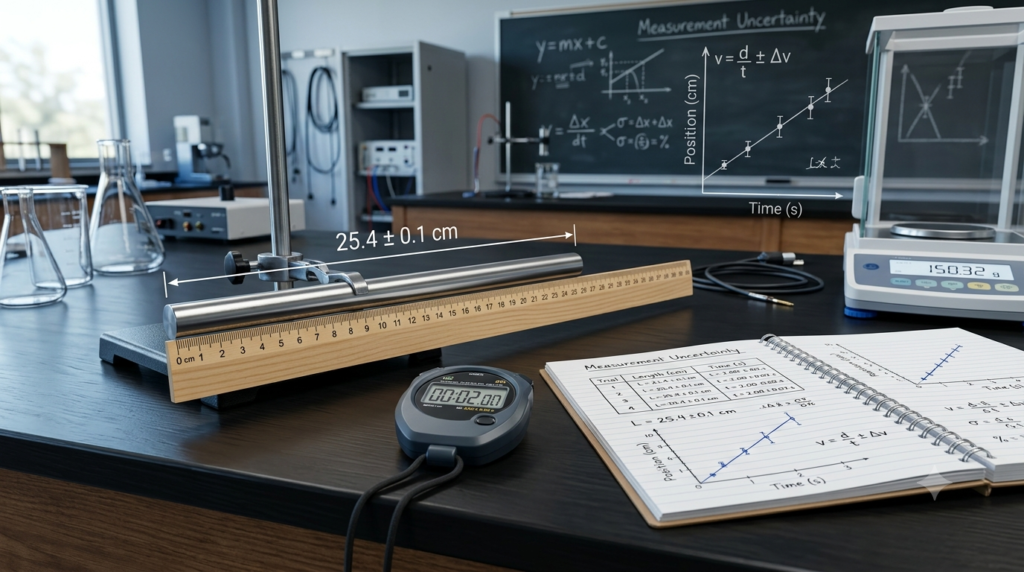
One of the most important reasons for differences is measurement uncertainty. No measuring instrument can usually provide a perfectly exact value.
A ruler has a limited smallest division. A stopwatch may measure time only to a particular precision. A thermometer has a limited resolution. Even advanced scientific instruments have uncertainties.
Suppose the actual length of an object is close to 10.00 cm, but the available ruler can measure only to the nearest millimetre. The measured value could be 9.9 cm, 10.0 cm, or 10.1 cm depending on how the measurement is taken.
Because every measurement has some uncertainty, experimental results should not be expected to match theoretical values exactly.
Instrumental Errors
Measuring instruments can introduce errors into an experiment. An instrument may not be perfectly calibrated, or it may have a zero error.
For example, if a weighing scale shows 0.05 kg when nothing is placed on it, every measurement made with that scale may be shifted. Similarly, a thermometer that has not been calibrated properly may consistently show temperatures slightly higher or lower than the actual temperature.
Instrumental errors can often be reduced by calibration, proper maintenance, and using more accurate instruments.
Human Errors
People also contribute to experimental differences. A person may read a scale from the wrong angle, record a value incorrectly, start a stopwatch slightly late, or misjudge a pointer’s position.
For example, when using an analogue meter, viewing the scale from an angle can produce a parallax error. In a timing experiment, human reaction time can affect when the stopwatch is started or stopped.
Careful experimental procedures can reduce these errors, but completely eliminating human involvement is not always possible.
Experimental Conditions May Differ From Ideal Conditions
Theoretical equations often assume ideal conditions, while experiments take place in the real world.
Consider the motion of a falling object. A simple theoretical calculation may ignore air resistance. In reality, air pushes against the object as it moves. The effect may be small for a dense object falling a short distance, but it can become significant for a lightweight object or a long fall.
Similarly, theoretical calculations involving electrical circuits may assume ideal wires and components. Real wires have resistance, batteries have internal resistance, and electrical components can change behaviour with temperature.
Therefore, the experimental system may not perfectly match the assumptions used in the theoretical calculation.
Approximations in Theoretical Models
Theoretical models often simplify reality. This is useful because complicated systems can be difficult to describe mathematically.
For example, when calculating the acceleration due to gravity near Earth’s surface, a value of approximately 9.8 m/s² is commonly used. The actual value varies slightly depending on location and altitude.
Similarly, many physics problems assume that surfaces are perfectly smooth, strings are massless, or pulleys are frictionless. These assumptions make the mathematics manageable, but real objects do not behave exactly this way.
As a result, an experimental value may differ from a theoretical prediction because the theoretical model itself is an approximation.
Random Errors
Random errors cause measurements to vary unpredictably from one trial to another. They may result from small changes in experimental conditions or limitations in measurement.
Imagine measuring the period of a pendulum several times. The measured values might be slightly different each time. One trial may give 1.98 seconds, another 2.01 seconds, and another 2.00 seconds.
Repeating the experiment and calculating the average can reduce the influence of random errors. This is why scientists commonly perform multiple trials instead of relying on a single measurement.
Systematic Errors
Systematic errors are different because they tend to affect measurements in a consistent direction. If an instrument is incorrectly calibrated, every measurement may be too high or too low.
For example, if a thermometer consistently reads 2°C higher than the actual temperature, repeating the measurement many times will not remove the error.
Systematic errors require identifying and correcting the source of the problem. Calibration, improved experimental design, and comparison with known standards can help reduce them.
Why Repeated Experiments Matter
Scientists rarely depend on a single experimental measurement when testing an important prediction. Repeating an experiment helps determine whether a difference is random or represents a consistent pattern.
Suppose a theoretical value is 50 units and five experimental measurements are 49.8, 50.2, 49.9, 50.1, and 50.0 units. These results are all close to the prediction. Small differences are expected because of measurement uncertainty.
However, if repeated experiments consistently produce values around 45 units, the difference deserves closer investigation. There may be a systematic error, an incorrect assumption, or a limitation in the theoretical model.
Percentage Error Helps Compare Results
Scientists often use percentage error to describe how far an experimental result is from a theoretical value.
The percentage error can be calculated using:
Percentage error = |Experimental value − Theoretical value| / Theoretical value × 100
For example, if the theoretical value is 100 units and the experimental value is 97 units, the difference is 3 units. The percentage error is therefore 3%.
A percentage error provides a useful way to judge the size of a difference rather than simply stating that two values are different.
Does a Difference Mean the Theory Is Wrong?
Not necessarily. A small difference between experimental and theoretical values is usually expected because real experiments involve uncertainty and practical limitations.
However, a large and repeatable difference can be scientifically important. It may indicate that an experimental method needs improvement, that an assumption is unrealistic, or that the theoretical model does not completely describe the situation.
This is an important feature of science. Theories are not simply accepted because they produce attractive mathematical equations. They are continuously tested against observations.
When Differences Lead to Better Science
Differences between predictions and observations can actually help scientific progress. If an experiment repeatedly produces results that cannot be explained by an existing theory, scientists investigate the reason.
Sometimes they discover an experimental problem. In other cases, they find that an existing model needs modification. Occasionally, unexpected results lead to entirely new scientific ideas.
The history of science contains many examples in which disagreements between theory and observation encouraged scientists to develop better explanations of nature.
Conclusion
Experimental results can differ from theoretical values for many reasons, including measurement uncertainty, instrument limitations, human errors, random errors, systematic errors, environmental conditions, and simplifications in theoretical models.
Theoretical values describe what a model predicts under particular assumptions, while experimental results show what happens under real conditions. Because real experiments are never perfectly ideal, exact agreement is not always expected.
What matters most is whether the difference is reasonable within the uncertainty of the experiment and whether repeated measurements show a consistent pattern. Scientists use these differences not as a reason to reject science, but as valuable information for improving measurements, experiments, and theories.
In this way, the comparison between theory and experiment is one of the most powerful processes in science. It allows us to test ideas against reality and gradually build more accurate descriptions of the natural world.