
Why Is Displacement Different From Distance?

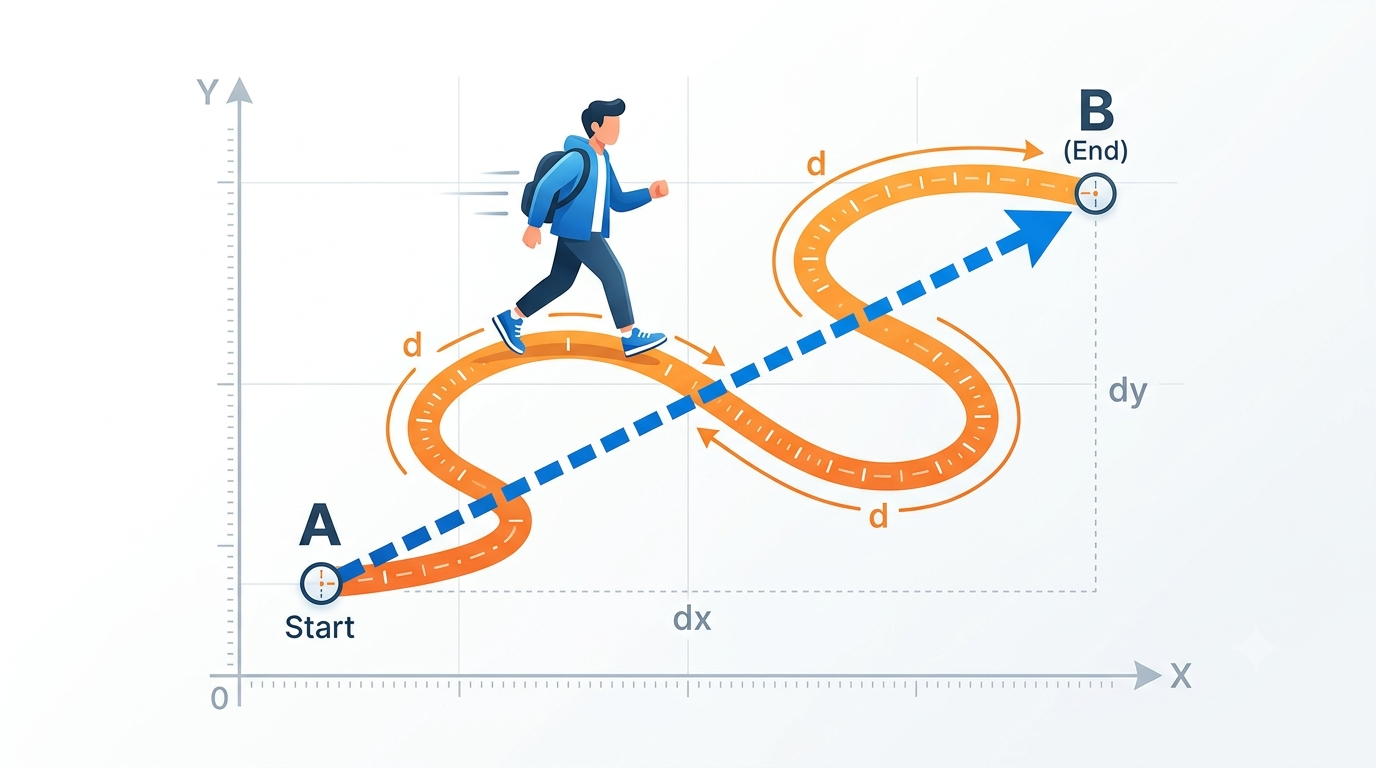
An educational illustration of a person walking along an orange curved path, compared to a blue straight dashed arrow indicating displacement from point A to point B on a Cartesian coordinate grid; the distance along this path is shown.

When we describe the motion of an object, we often want to know how far it has moved. Two important physical quantities used for this purpose are distance and displacement. At first, they may seem almost identical because both describe motion from one location to another. However, they represent different ideas.

Distance tells us how much ground an object has covered, while displacement tells us how much the object’s position has changed and in which direction. Understanding this difference is important because distance is a scalar quantity, whereas displacement is a vector quantity.

What Is Distance?

Distance is the total length of the actual path travelled by an object.

It does not matter which direction the object moves. We simply add up the lengths of all parts of the path.

For example, imagine a person walks 5 meters east and then 3 meters west. The total distance travelled is:

Distance = 5 m + 3 m = 8 m

The person has covered 8 meters of ground, even though they have not moved 8 meters away from their starting position.

Distance is a scalar quantity, which means it has magnitude but no direction. We can say that a car travelled 50 kilometers, but we do not need to specify a direction to describe its distance.

What Is Displacement?

Displacement is the change in an object’s position from its initial position to its final position.

Unlike distance, displacement takes direction into account. It is represented by the shortest straight-line path from the starting point to the final point.

For the same example, suppose a person walks 5 meters east and then 3 meters west. Their final position is 2 meters east of where they started.

Therefore:

Displacement = 2 m east

The distance is 8 meters, but the displacement is only 2 meters east.

This example immediately shows why distance and displacement are not always the same.

Distance Measures the Actual Path

One of the easiest ways to understand the difference is to imagine an object travelling along a curved or irregular path.

Suppose a cyclist travels from point A to point B along a winding road. The cyclist may travel 10 kilometers along the road. However, if a straight line between A and B is only 6 kilometers long, the cyclist’s distance is 10 kilometers.

The displacement is based only on the change from the initial position to the final position. It does not depend on the complicated route taken between those points.

So:

Distance = length of actual path travelled

Displacement = straight-line change in position with direction

Distance Is a Scalar Quantity

A scalar quantity is described completely by its magnitude.

Distance is scalar because it does not require a direction. If someone tells you that a runner travelled 4 kilometers, the statement is complete as far as distance is concerned.

Distance can never be negative. Its value is either positive or zero.

If an object remains at the same position, its distance travelled is zero. Once it moves, the distance increases according to the path it follows.

Displacement Is a Vector Quantity

A vector quantity has both magnitude and direction.

Displacement is therefore a vector. Saying that an object has a displacement of 5 meters is not always enough. We may also need to know whether the displacement is north, south, east, west, upward, downward, or in some other direction.

For example:

Displacement = 5 m east

contains both the magnitude, 5 meters, and the direction, east.

The direction is what makes displacement fundamentally different from distance.

Can Distance and Displacement Be Equal?

Yes. Distance and displacement can have the same magnitude when an object moves in a straight line in one direction without changing its direction.

Suppose a student walks 20 meters directly north from one point to another.

The actual path is 20 meters long, so:

Distance = 20 m

The change in position is also 20 meters north, so:

Displacement = 20 m north

Their numerical magnitudes are equal in this case.

However, they are still different physical quantities because one is scalar and the other is vector.

When Are Distance and Displacement Different?

They become different when an object changes direction or follows a path that is not a straight line.

Consider a person walking around a rectangular park. They start at one corner, walk around the park, and return to the starting point.

The person has travelled a certain distance because they covered the entire path.

But their final position is exactly the same as their initial position.

Therefore:

Distance > 0

Displacement = 0

This is one of the clearest examples of the difference between the two quantities.

Displacement Can Be Zero

An important feature of displacement is that it can be zero even when an object has travelled a considerable distance.

Imagine a runner completes one full lap of a circular track and finishes exactly where they started. The runner has covered the entire circumference of the track, so the distance is greater than zero.

But because the initial and final positions are identical, the displacement is zero.

This does not mean the runner did not move. It simply means that there was no overall change in position.

Displacement Can Be Positive or Negative

When motion occurs along a straight line, we can choose one direction as positive and the opposite direction as negative.

For example, if east is taken as positive, a displacement of 10 meters east can be written as:

+10 m

A displacement of 4 meters west can then be written as:

−4 m

The negative sign does not mean that the object travelled a negative distance. Instead, it indicates that the displacement is in the direction opposite to the chosen positive direction.

Distance does not work this way because distance has no direction and cannot be negative.

A Simple Example

Suppose a car travels 12 kilometers east and then 5 kilometers west.

The total distance is:

Distance = 12 + 5 = 17 km

The final position is 7 kilometers east of the starting point.

Therefore:

Displacement = 7 km east

So the car travelled 17 kilometers, but its overall change in position was only 7 kilometers east.

This example is useful because it shows that an object can travel a large distance while having a much smaller displacement.

Distance and Displacement in Everyday Life

The distinction between distance and displacement is useful in many real-world situations.

A navigation system may need to know the actual road distance between two locations to estimate travel time and fuel consumption. At the same time, the direct displacement between those locations can be useful in physics and geometry.

In sports, a runner’s total distance travelled may be important for measuring performance. In physics, however, displacement can help describe how far the runner’s position has changed from the starting point.

Similarly, when studying the motion of vehicles, robots, aircraft, or spacecraft, scientists and engineers often need both quantities.

Key Differences Between Distance and Displacement

The main differences can be summarized as follows:

Distance

  • Measures the total path travelled.

  • Is a scalar quantity.

  • Has magnitude only.

  • Has no direction.

  • Cannot be negative.

  • Depends on the actual path followed.

  • Can be greater than displacement.

Displacement

  • Measures the change in position.

  • Is a vector quantity.

  • Has magnitude and direction.

  • Depends only on the initial and final positions.

  • Can be positive, negative, or zero in one-dimensional motion.

  • Does not depend on the actual route taken.

  • Its magnitude can never be greater than the distance travelled.

Why Is Displacement Different From Distance?

The fundamental reason is that they answer different questions.

Distance asks:

“How much path did the object travel?”

Displacement asks:

“How much did the object’s position change, and in which direction?”

Because these questions are different, the quantities are different too.

Distance considers the entire journey. Displacement considers only the relationship between the starting and ending positions.

Understanding this distinction helps make many topics in physics easier, including speed, velocity, acceleration, motion graphs, and projectile motion.

Conclusion

Distance and displacement are closely related but should never be treated as identical. Distance describes the total length of the path travelled, while displacement describes the overall change in position from the initial point to the final point.

Distance is a scalar quantity and has only magnitude. Displacement is a vector quantity and has both magnitude and direction. If an object travels in a straight line without changing direction, their magnitudes may be equal. But when the object changes direction or follows a curved path, distance and displacement usually have different values.

The simplest way to remember the difference is this: distance describes the journey, while displacement describes the change in position.

FAQs

What is the difference between distance and displacement?

Distance is the total length of the path travelled by an object, while displacement is the change in its position from the starting point to the ending point. Distance is a scalar quantity, so it has only magnitude. Displacement is a vector quantity, so it has both magnitude and direction. For example, if a person walks 5 meters east and then 3 meters west, the total distance is 8 meters. However, the displacement is only 2 meters east. Distance depends on the actual path followed, whereas displacement depends only on the initial and final positions.

Why is displacement called a vector quantity?

Displacement is called a vector quantity because it has both magnitude and direction. Magnitude tells us how much the object’s position has changed, while direction tells us where the final position lies relative to the initial position. For example, saying that an object has a displacement of 10 meters does not completely describe its displacement. We might need to say 10 meters north, 10 meters east, or 10 meters downward. This directional information distinguishes displacement from distance. Distance only tells us how much path was travelled and therefore does not require directional information.

Can displacement be zero when distance is not zero?

Yes, displacement can be zero even when the distance travelled is greater than zero. This happens when an object returns to its original position. For example, imagine a runner completing one full lap of a circular track. The runner has travelled a distance equal to the circumference of the track. However, the final position is exactly the same as the starting position. Therefore, the displacement is zero. This example demonstrates why distance and displacement cannot always be treated as the same quantity. Distance describes the complete journey, while displacement describes only the overall change in position.

Can displacement be greater than distance?

No, the magnitude of displacement cannot be greater than the distance travelled. Distance measures the entire path followed by an object, while displacement represents the shortest straight-line change between the initial and final positions. A straight-line path between two points is always the shortest possible route. Therefore, the magnitude of displacement is always less than or equal to the distance. They are equal when an object moves in a straight line without changing direction. If the object follows a curved path or changes direction, the distance becomes greater than the magnitude of its displacement.

Can distance ever be negative?

No, distance cannot be negative. Distance represents the total length of the path travelled by an object, and length cannot have a negative value. Distance can be zero when an object has not moved, but once movement occurs, its value becomes positive. For example, if a car travels 15 kilometers, its distance travelled is 15 kilometers, not −15 kilometers. Negative signs are sometimes used when describing displacement in one-dimensional motion because displacement includes direction. A negative displacement means movement opposite to a chosen positive direction. Distance, however, has no direction and therefore cannot be negative.

When are distance and displacement equal?

Distance and the magnitude of displacement are equal when an object moves along a straight path in one direction without reversing or changing direction. For example, if a person walks 25 meters directly north, the distance travelled is 25 meters. The displacement is also 25 meters north, giving a displacement magnitude of 25 meters. However, if the person changes direction or follows a curved route, the distance will usually become greater than the magnitude of displacement. Therefore, equality occurs only when the actual path between the starting and ending positions is the shortest straight-line path.

How does direction affect displacement?

Direction is essential to displacement because displacement describes the change in position relative to a chosen reference direction. Suppose east is considered positive. If an object moves 8 meters east, its displacement can be represented as +8 meters. If it moves 8 meters west, its displacement can be represented as −8 meters. The negative sign does not mean negative movement or negative distance. It simply indicates movement in the opposite direction. Because displacement includes directional information, two objects can travel the same distance but have different displacements depending on their starting positions, ending positions, and directions.

Why is distance a scalar quantity?

Distance is a scalar quantity because it requires only magnitude to be completely described. It tells us the total length of the path travelled, without specifying a direction. For example, saying that a cyclist travelled 12 kilometers gives enough information about the cyclist’s distance. We do not need to say whether the cyclist travelled north, south, east, or west. Scalars such as distance, time, mass, and temperature are described by magnitude alone. In contrast, vector quantities such as displacement, velocity, and force require both magnitude and direction to provide a complete physical description.

How can a person travel a large distance but have small displacement?

A person can travel a large distance while having a small displacement by changing direction repeatedly. Imagine someone walking around a neighborhood and eventually ending close to their starting point. They may have travelled several kilometers, so their distance is large. However, because their final position is only a short distance from where they started, their displacement is small. If they return exactly to the starting point, their displacement becomes zero. This demonstrates that distance depends on the complete route, whereas displacement depends only on the initial and final positions of the moving object.

Why are distance and displacement important in physics?

Distance and displacement are important because they describe different aspects of motion. Distance helps determine how much path an object has covered, while displacement tells us how its position has changed. These concepts are used when studying speed, velocity, acceleration, motion graphs, and many other areas of physics. Understanding displacement is especially important because velocity depends on displacement, whereas speed is related to distance travelled. Engineers, scientists, and students use these quantities to analyze the motion of vehicles, machines, particles, athletes, and spacecraft. Learning their difference provides a foundation for understanding more advanced concepts of motion.

Related Posts

Leave a Comment

Your email address will not be published. Required fields are marked *

Scroll to Top