
What Is Gravity and Why Do Objects Fall?

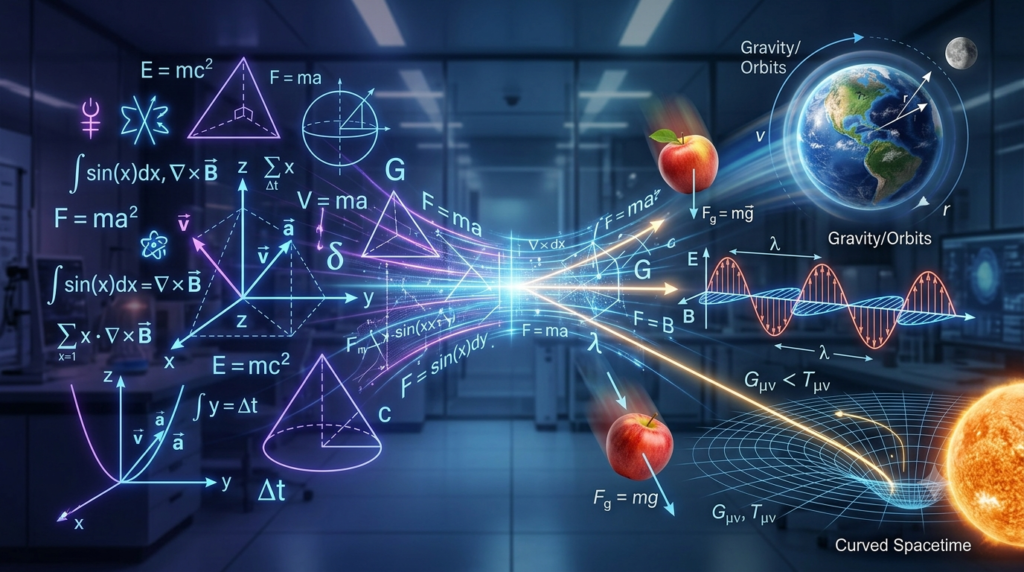
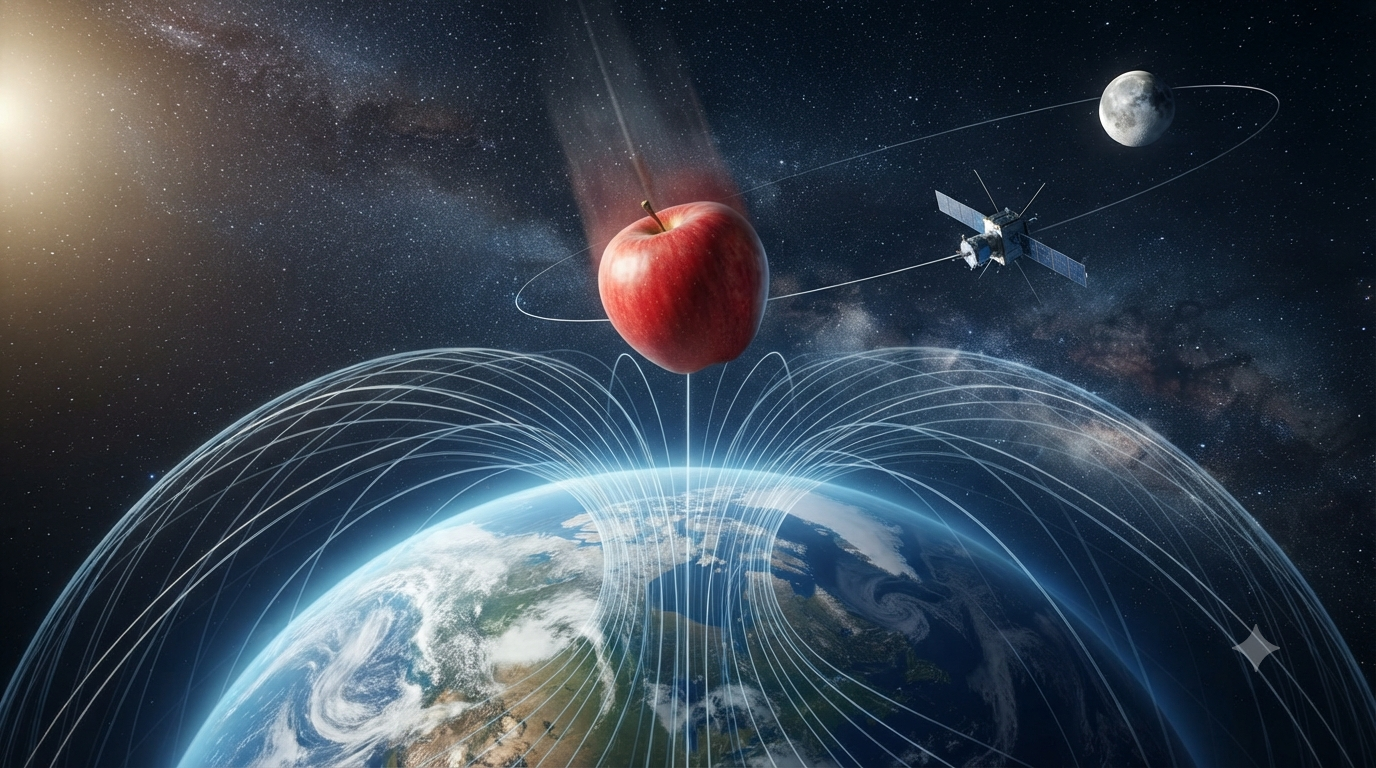
Gravity pulling a falling apple toward Earth and showing how gravitational force causes objects to fall

Gravity is one of the most familiar forces in everyday life, yet it is also one of the most fascinating ideas in physics. It keeps our feet on the ground, makes objects fall when we drop them, keeps the Moon around Earth, and helps planets remain in their orbits around the Sun. Without gravity, the universe would look completely different.

But what exactly is gravity? Why does a ball fall toward the ground instead of moving upward? Why do heavier and lighter objects fall toward Earth? And how does gravity work on such a large scale across space?

To understand these questions, we need to look at gravity from both the everyday and scientific perspectives.

What Is Gravity?

Gravity is the natural attraction between objects that have mass. Every object with mass produces a gravitational effect and can attract other objects with mass.

For example, Earth has a huge amount of mass, so its gravitational pull is strong enough to keep people, buildings, oceans, and the atmosphere close to its surface. When you jump upward, gravity pulls you back toward Earth.

Gravity is not limited to Earth. The Sun attracts Earth, Earth attracts the Moon, and the Moon also attracts Earth. In fact, every object in the universe attracts every other object through gravity.

The strength of gravitational attraction depends mainly on two things: the masses of the objects and the distance between them.

Why Do Objects Fall Toward Earth?

When you release an object from your hand, there is no longer a support force holding it up. Earth’s gravity then pulls the object toward Earth’s center.

This is why a dropped ball moves downward.

The word “downward” is useful when describing what we see near Earth’s surface, but gravity is actually pulling objects toward the center of Earth. People standing on opposite sides of Earth can both experience gravity as “downward” because, for each person, downward points approximately toward Earth’s center.

This simple idea explains why objects fall toward the ground rather than moving in a random direction.

Gravity Causes Acceleration

Gravity does more than simply pull objects downward. It causes falling objects to accelerate.

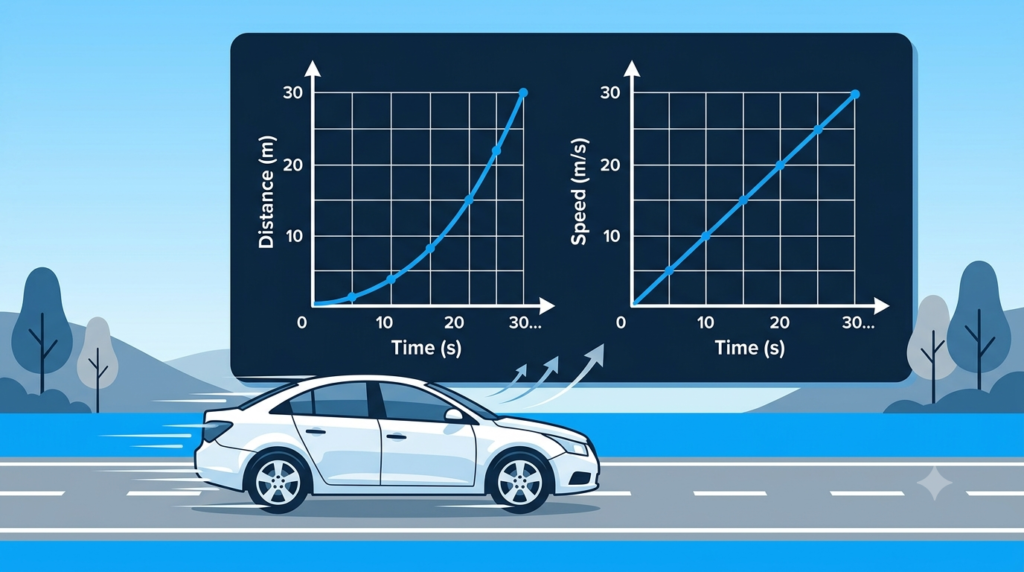
Near Earth’s surface, an object in free fall accelerates at approximately 9.8 m/s², if air resistance is ignored. This value is commonly represented by the symbol g.

This means that the speed of a freely falling object increases by about 9.8 metres per second every second.

For example, if an object starts from rest and falls freely:

  • After about 1 second, its speed is about 9.8 m/s.

  • After about 2 seconds, its speed is about 19.6 m/s.

  • After about 3 seconds, its speed is about 29.4 m/s.

The object does not gain the same amount of distance every second because its speed is continuously increasing.

Why Do Heavy and Light Objects Fall Together?

A common observation is that a heavy object seems to fall faster than a light object. For example, a stone may appear to fall faster than a sheet of paper.

However, this difference is mainly caused by air resistance.

If air resistance is removed, objects of different masses fall with the same gravitational acceleration near Earth’s surface. A heavy object and a light object dropped from the same height would reach the ground at the same time, assuming they start under the same conditions.

This happens because a more massive object experiences a greater gravitational force, but it also has greater inertia, meaning it resists changes in motion more strongly. These effects balance in such a way that the gravitational acceleration is approximately the same for all objects near Earth’s surface.

Newton’s Explanation of Gravity

The scientist Isaac Newton developed one of the first mathematical descriptions of gravity. His law of universal gravitation states that every mass attracts every other mass.

The gravitational force can be represented by:

F = Gm₁m₂/r²

Here:

  • F = gravitational force

  • G = universal gravitational constant

  • m₁ and m₂ = masses of the two objects

  • r = distance between their centres

This equation shows an important relationship. If the masses increase, the gravitational force increases. If the distance between the objects increases, the gravitational force becomes weaker.

The distance has an especially important effect because it appears squared in the denominator.

Why Does Earth’s Gravity Feel So Strong?

Earth does not have the strongest gravitational field in the universe, but its large mass produces a gravitational field strong enough to affect everything around it.

The gravitational acceleration near Earth’s surface is approximately:

g ≈ 9.8 m/s²

Your weight is a result of Earth’s gravitational pull on your mass. The relationship can be written as:

W = mg

Here:

  • W = weight

  • m = mass

  • g = acceleration due to gravity

Mass and weight are therefore not the same thing. Mass describes how much matter an object contains, while weight depends on the gravitational field acting on that mass.

For example, your mass would remain essentially the same on the Moon, but your weight would be much smaller because the Moon has weaker surface gravity than Earth.

Gravity and Orbits

Gravity does not only make objects fall. It can also keep objects moving in orbit.

The Moon is constantly being pulled toward Earth by gravity. At the same time, the Moon has sideways motion. Because of this combination, the Moon continuously falls toward Earth but keeps moving forward, causing it to follow a curved path around Earth.

The same basic idea applies to planets orbiting the Sun.

An orbit can therefore be understood as a balance between an object’s forward motion and gravitational attraction. The object is continually changing direction because gravity pulls it inward.

This is why astronauts and satellites can remain in orbit instead of simply falling straight down to Earth.

Gravity According to Einstein

Newton’s description of gravity works extremely well for many everyday situations, but Albert Einstein later developed a deeper explanation through his theory of general relativity.

According to general relativity, gravity is connected to the curvature of spacetime caused by mass and energy.

A simple way to imagine this is to think of a stretched surface. If a heavy object is placed on it, the surface bends. A smaller object moving nearby can then follow a curved path because of that distortion.

Space itself is not literally a rubber sheet, so this analogy has limitations. However, it can help us visualize the basic idea that massive objects affect the geometry of spacetime.

Einstein’s theory explains gravitational effects in situations where Newton’s description is not sufficient, including very strong gravitational fields and highly precise measurements.

Why Does Gravity Matter in Everyday Life?

Gravity affects almost every part of our daily experience.

It keeps us attached to Earth’s surface and allows us to walk without floating away. It gives objects weight, keeps water in oceans and rivers, and helps maintain Earth’s atmosphere.

Gravity also plays an important role in natural systems. It helps rain fall toward the ground, influences ocean tides, and keeps the Moon in orbit around Earth.

On a much larger scale, gravity helps form stars, planets, galaxies, and other structures in the universe.

What Would Happen Without Gravity?

If Earth’s gravity suddenly disappeared, objects would no longer be pulled toward Earth’s surface. People and objects would begin moving according to their existing motion and other forces.

The atmosphere and oceans would also be affected dramatically. Satellites and the Moon would no longer follow their current gravitational orbits around Earth.

This shows how fundamental gravity is. Although we usually notice it only when something falls, gravity is continuously shaping the environment around us and the large-scale structure of the universe.

Conclusion

Gravity is the natural attraction between masses, and it is responsible for much more than making objects fall. Near Earth’s surface, gravity causes objects to accelerate downward at about 9.8 m/s² when air resistance is ignored. It gives objects weight, keeps the atmosphere and oceans near Earth, and helps the Moon and artificial satellites remain in orbit.

Newton described gravity as a force between masses, while Einstein provided a deeper explanation in terms of curved spacetime. Together, these ideas show why gravity is one of the most important concepts in physics.

Every time an object falls, a much larger story is taking place: the same phenomenon that brings a dropped ball to the ground also helps organize planets, stars, and galaxies throughout the universe.

FAQs

What is gravity?

Gravity is a natural force of attraction between objects that have mass. Every object with mass produces a gravitational effect, although the strength of that effect depends on its mass and distance from other objects. Earth has enormous mass, so its gravity strongly affects objects near its surface. Gravity is responsible for keeping people and objects on the ground, holding the atmosphere around Earth, and keeping the Moon in orbit. Gravity also operates throughout the universe, influencing planets, stars, galaxies, and other cosmic structures. In simple terms, gravity is what causes masses to attract one another.

Why do objects fall toward Earth?

Objects fall toward Earth because Earth’s mass creates a gravitational field that attracts other masses toward its center. When you release an object, there is no longer a supporting force holding it in your hand, so Earth’s gravitational attraction causes it to accelerate downward. What we call “down” near Earth’s surface is approximately the direction toward Earth’s center. Gravity acts continuously, whether an object is falling, resting on the ground, or moving through the air. Even when an object appears stationary, Earth’s gravity is still acting on it. The ground simply provides an opposing support force.

Do heavier objects fall faster than lighter objects?

In the absence of air resistance, heavy and light objects fall with the same acceleration near Earth’s surface. This may seem surprising because a heavy object experiences a greater gravitational force. However, a heavier object also has greater inertia, meaning it requires more force to produce the same acceleration. These effects balance each other, resulting in approximately the same gravitational acceleration for objects of different masses. In everyday life, air resistance can make lighter objects such as feathers or sheets of paper fall more slowly. This is why it can appear that heavier objects naturally fall faster.

What is the acceleration due to gravity?

Acceleration due to gravity is the acceleration experienced by an object because of gravitational attraction. Near Earth’s surface, its average value is approximately 9.8 m/s². This is commonly represented by the symbol g. An object in free fall, with air resistance ignored, gains about 9.8 metres per second of speed every second. For example, an object starting from rest would have a speed of approximately 9.8 m/s after one second and 19.6 m/s after two seconds. The exact value of gravitational acceleration varies slightly depending on location, mainly because Earth is not a perfect sphere.

What is the difference between mass and weight?

Mass and weight are related but different physical quantities. Mass measures the amount of matter in an object and is measured in kilograms. Weight is the gravitational force acting on that mass and is measured in newtons. The relationship between them is W = mg, where W is weight, m is mass, and g is gravitational acceleration. Your mass remains essentially unchanged if you travel from Earth to the Moon. However, your weight becomes smaller because the Moon has weaker surface gravity. Therefore, mass is a property of the object, while weight depends on the gravitational field around it.

How did Newton explain gravity?

Isaac Newton developed the law of universal gravitation to describe how masses attract one another. According to Newton’s theory, every object with mass attracts every other object with mass. The gravitational force depends on the masses involved and the distance between them. Newton expressed this relationship mathematically as F = Gm₁m₂/r². The equation shows that increasing either mass increases the gravitational force, while increasing the distance decreases the force. Newton’s law successfully explained many phenomena, including falling objects, planetary motion, and the Moon’s orbit. It remains extremely useful for many calculations in physics and astronomy.

Why does the Moon not fall to Earth?

The Moon is actually continuously falling toward Earth because of Earth’s gravitational attraction. However, the Moon also has sideways motion. Instead of falling directly into Earth, its forward motion carries it along while gravity continually changes its direction. The result is a curved path around Earth called an orbit. This can be understood as continuous free fall around Earth. The Moon’s orbital motion is therefore not evidence that gravity is absent. Instead, its orbit demonstrates gravity at work. The same basic principle explains how artificial satellites can remain in orbit around Earth without immediately crashing into the surface.

Does gravity exist in space?

Yes, gravity exists throughout space. The idea that there is no gravity in space is a common misconception. Earth’s gravitational pull extends far beyond its surface, although it becomes weaker with increasing distance. Astronauts aboard the International Space Station still experience Earth’s gravity. They appear weightless mainly because they and the spacecraft are continuously falling around Earth together. Gravity also exists between the Sun and planets, between planets and their moons, and between stars and other massive objects. In fact, gravity is one of the fundamental interactions responsible for the large-scale structure and motion of objects throughout the universe.

How does Einstein explain gravity?

Albert Einstein’s general theory of relativity provides a deeper description of gravity. Instead of treating gravity simply as a conventional force, general relativity describes massive objects as affecting the geometry of space and time, together called spacetime. Objects then move through this curved spacetime. A common analogy is a heavy ball placed on a stretched surface, causing the surface to bend around it. Although this analogy is not a complete representation of spacetime, it can help visualize the concept. Einstein’s theory explains phenomena that Newton’s model cannot fully describe, particularly strong gravitational fields and highly precise gravitational effects.

Why is gravity important in the universe?

Gravity is essential for the structure and evolution of the universe. It keeps planets in orbit around stars, moons around planets, and many stars together within galaxies. Gravity also plays a major role in the formation of stars and planets by pulling matter together. On Earth, gravity keeps the atmosphere and oceans near the planet’s surface and gives objects their weight. Without gravity, matter would not organize into the large structures we observe throughout the cosmos. Although gravity is weaker than some other fundamental interactions at very small scales, its long-range nature allows it to dominate many large-scale astronomical systems.

Related Post

Leave a Comment

Your email address will not be published. Required fields are marked *

Scroll to Top