
A chemical formula is much more than a short way of naming a compound. It provides important information about what a substance contains and the ratio in which its elements are present. When we look at a formula such as H₂O, CO₂, NaCl, or CaCO₃, the symbols and numbers are not random. Each part of the formula communicates something about the composition of the compound.
Chemical formula ratios help us understand how atoms are combined in a substance. They tell us the relative number of atoms or ions of each element present in a compound and provide the basis for calculating composition, formula mass, and the amounts of substances involved in chemical reactions. Learning how these ratios work makes it easier to read chemical formulas, interpret chemical equations, and solve many chemistry problems.
What Is a Chemical Formula?
A chemical formula represents the composition of a chemical substance using element symbols and, when necessary, numerical subscripts. The element symbols identify which elements are present, while the subscripts show the relative number of atoms of each element.
For example:
H₂O
This formula contains hydrogen and oxygen. The subscript ₂ after H means that two hydrogen atoms are present for every one oxygen atom. Because there is no subscript after O, its number is understood to be one.
Therefore, the ratio of hydrogen atoms to oxygen atoms in water is:
2 : 1
Similarly, the formula CO₂ represents carbon dioxide. It contains one carbon atom for every two oxygen atoms, giving the ratio:
1 : 2
These ratios are one of the most important pieces of information provided by a chemical formula.
What Does a Formula Ratio Mean?
A formula ratio describes the relative proportions of the elements in a compound. It does not simply tell us which elements are present; it tells us how they are related numerically.
Consider the formula NH₃.
The formula contains:
1 nitrogen atom
3 hydrogen atoms
Therefore, the nitrogen-to-hydrogen ratio is:
1 : 3
This means that for every one nitrogen atom represented in the formula, there are three hydrogen atoms.
The same idea applies to larger formulas. For example, H₂SO₄ contains:
2 hydrogen atoms
1 sulfur atom
4 oxygen atoms
The ratio is:
2 : 1 : 4
So, the formula gives a compact description of the relative atomic composition of sulfuric acid.
Subscripts Show Atomic Ratios
Subscripts are the small numbers written to the lower right of an element symbol. They are directly responsible for showing the atomic ratio within a chemical formula.
For example:
CH₄
The subscript ₄ belongs only to hydrogen. Since carbon has no subscript, its value is one.
Therefore:
Carbon : Hydrogen = 1 : 4
Another example is Al₂O₃.
Here:
Aluminum = 2
Oxygen = 3
Therefore:
Aluminum : Oxygen = 2 : 3
Changing a subscript changes the composition represented by the formula. For example, H₂O and H₂O₂ are different substances because their element ratios are different.
H₂O has:
Hydrogen : Oxygen = 2 : 1
H₂O₂ has:
Hydrogen : Oxygen = 2 : 2 = 1 : 1
The difference in ratio represents a different chemical substance with different properties.
Why Ratios Are Important in Compound Composition
Atoms combine in specific proportions to form compounds. These proportions are not arbitrary. A chemical formula records the composition of the compound in a standardized form.
For example, sodium chloride has the formula NaCl. It contains sodium and chlorine in a 1 : 1 ratio.
Magnesium chloride has the formula MgCl₂. Its ratio is:
Magnesium : Chlorine = 1 : 2
The two compounds contain different elements or different proportions of the same elements, so they have different compositions and properties.
Understanding these ratios helps chemists describe substances precisely. Instead of writing a long description such as “one magnesium atom combined with two chlorine atoms,” the formula MgCl₂ communicates the same information in a compact form.
Formula Ratios in Molecular Compounds
For molecular compounds, the chemical formula usually represents the actual number of atoms in one molecule.
Take carbon dioxide:
CO₂
One molecule contains one carbon atom and two oxygen atoms.
Therefore:
C : O = 1 : 2
Methane is represented as:
CH₄
One methane molecule contains one carbon atom and four hydrogen atoms.
Therefore:
C : H = 1 : 4
The formula ratio is useful because molecules can contain very large numbers of atoms overall, but their proportions remain constant.
For example, a sample containing millions of methane molecules still has carbon and hydrogen in the same 1 : 4 atomic ratio.
Formula Ratios in Ionic Compounds
Formula ratios are also important for ionic compounds, but there is an important difference. Ionic compounds generally do not exist as separate molecules in the same way molecular substances do. Their formulas represent the simplest whole-number ratio of ions in the compound.
Consider sodium chloride:
NaCl
The formula indicates a 1 : 1 ratio of sodium ions to chloride ions.
Magnesium chloride is:
MgCl₂
This represents a 1 : 2 ratio of magnesium ions to chloride ions.
The ratio is connected to the charges of the ions. Magnesium forms Mg²⁺ ions, while chloride forms Cl⁻ ions. Two chloride ions are required to balance the charge of one magnesium ion.
Therefore:
Mg²⁺ + 2Cl⁻ → MgCl₂
The chemical formula records the resulting ion ratio.
Formula Ratios and Chemical Charges
For many ionic compounds, the ratio in a formula can be understood by balancing positive and negative charges.
For example, calcium forms Ca²⁺ and chlorine forms Cl⁻.
One calcium ion has a charge of +2, while one chloride ion has a charge of −1. Two chloride ions are therefore needed to balance one calcium ion.
The formula is:
CaCl₂
The ratio is:
Ca : Cl = 1 : 2
Similarly, aluminum forms Al³⁺ and oxygen forms O²⁻. To obtain overall electrical neutrality, the smallest whole-number combination is two aluminum ions and three oxide ions.
The formula is:
Al₂O₃
Therefore:
Al : O = 2 : 3
This shows how chemical formulas can communicate both composition and charge balance.
Reading Ratios From Parentheses
Some chemical formulas contain parentheses. In such formulas, a subscript outside the parentheses applies to everything inside them.
For example:
Ca(OH)₂
The subscript ₂ applies to the entire OH group.
Therefore, the formula contains:
Calcium = 1
Oxygen = 2
Hydrogen = 2
The atomic ratio is:
Ca : O : H = 1 : 2 : 2
Another example is Al₂(SO₄)₃.
The subscript ₃ outside the parentheses means there are three sulfate groups.
Each sulfate group contains one sulfur atom and four oxygen atoms.
Therefore:
Aluminum = 2
Sulfur = 3
Oxygen = 12
The ratio is:
Al : S : O = 2 : 3 : 12
Understanding parentheses is essential when determining the composition of more complex compounds.
Coefficients and Subscripts Are Different
One common mistake is confusing a coefficient with a subscript. Both are numbers, but they provide different information.
Consider:
2H₂O
The subscript ₂ tells us that each water molecule contains two hydrogen atoms and one oxygen atom.
The coefficient 2 tells us that there are two units of H₂O.
Therefore, 2H₂O contains:
Hydrogen = 2 × 2 = 4 atoms
Oxygen = 2 × 1 = 2 atoms
The ratio within each water unit remains:
H : O = 2 : 1
The coefficient changes the amount of substance being considered, while the subscripts define the composition of the compound.
Formula Ratios and Formula Mass
Chemical formula ratios are also used to calculate formula mass or molecular mass.
Consider H₂O.
The formula contains two hydrogen atoms and one oxygen atom. Therefore, its molecular mass can be calculated from the relative atomic masses:
H₂O = 2(1) + 16
H₂O = 18
The ratio tells us how many times the atomic mass of each element must be included in the calculation.
For CO₂:
CO₂ = 1(12) + 2(16)
CO₂ = 44
The two oxygen atoms contribute twice the atomic mass of one oxygen atom because the formula contains two oxygen atoms.
Thus, the formula ratio directly affects the mass of the compound.
Formula Ratios and Percentage Composition
Chemical formulas can also be used to determine the percentage by mass of each element in a compound.
For example, consider water, H₂O.
Its approximate molecular mass is:
2(1) + 16 = 18
The mass contributed by hydrogen is:
2 × 1 = 2
The percentage of hydrogen is:
(2 ÷ 18) × 100 ≈ 11.1%
The mass contributed by oxygen is:
16
The percentage of oxygen is:
(16 ÷ 18) × 100 ≈ 88.9%
Therefore, the formula ratio provides the starting point for calculating the mass contribution of each element.
Formula Ratios and Empirical Formulas
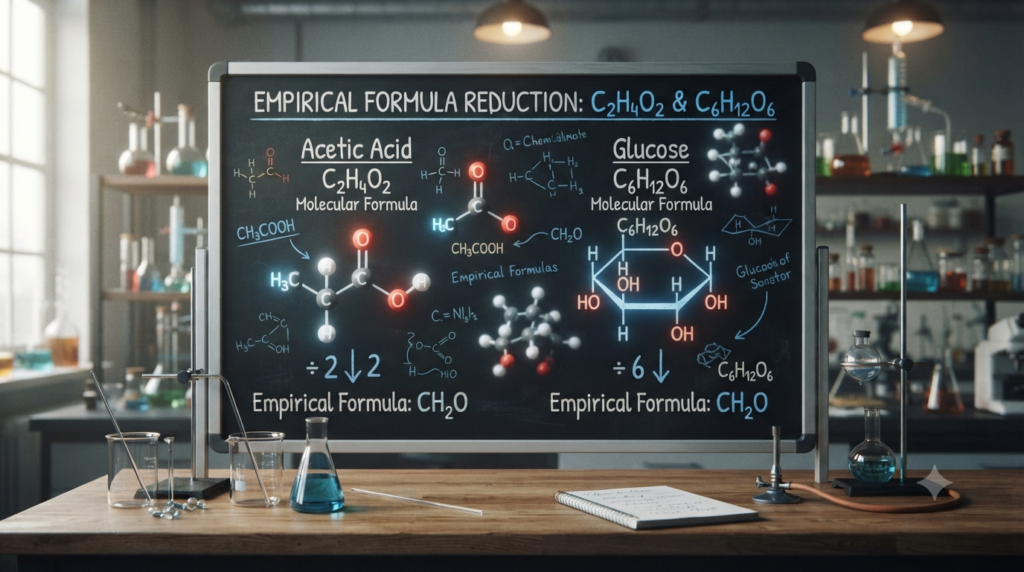
An empirical formula shows the simplest whole-number ratio of elements in a compound.
For example, suppose a compound has an atomic ratio of:
C : H = 1 : 2
Its empirical formula is:
CH₂
A molecular formula may contain a multiple of this ratio. For example:
C₂H₄
has the ratio:
2 : 4
which simplifies to:
1 : 2
Therefore, C₂H₄ and CH₂ have the same simplest element ratio, although they do not represent the same molecular formula.
This distinction is important in chemical analysis because empirical formulas describe the simplest ratio, while molecular formulas can show the actual number of atoms in a molecule.
Formula Ratios in Chemical Equations
Chemical formula ratios also play a major role in chemical equations. When formulas are combined with coefficients in a balanced equation, they describe the relative amounts of substances involved in a reaction.
For example:
2H₂ + O₂ → 2H₂O
The coefficients show that:
2 units of hydrogen react with
1 unit of oxygen to produce
2 units of water
The formula H₂O itself gives the internal composition of water, while the coefficients describe the proportions of substances reacting.
This distinction allows chemists to move from understanding compound composition to calculating quantities in chemical reactions.
A Simple Method for Finding Formula Ratios
You can determine the composition ratio of a compound by following a few simple steps.
Step 1: Identify Every Element
Look at the chemical formula and list each element symbol.
For example:
Al₂(SO₄)₃
The elements are aluminum, sulfur, and oxygen.
Step 2: Determine the Number of Atoms
Read the subscripts carefully. Remember that a subscript outside parentheses multiplies everything inside them.
For Al₂(SO₄)₃:
Al = 2
S = 3
O = 12
Step 3: Write the Ratio
Write the element quantities in the same order as the elements appear in the formula.
Al : S : O = 2 : 3 : 12
Step 4: Simplify Only When Appropriate
If the question asks for the simplest ratio, divide all values by their common factor.
For example:
2 : 4
can be simplified to:
1 : 2
However, when simply describing the atom counts represented by a chemical formula, keep the formula’s actual subscripts.
Common Mistakes When Reading Formula Ratios
Several mistakes can lead to incorrect interpretations of chemical formulas.
One common mistake is ignoring a missing subscript. When no subscript is written, the number is one.
For example:
CO₂
does not mean zero carbon atoms. It means one carbon atom and two oxygen atoms.
Another mistake is applying a subscript outside parentheses to only the last element. In Ca(OH)₂, the ₂ applies to both O and H.
A third mistake is confusing coefficients with subscripts. In 3CO₂, the coefficient 3 multiplies the entire formula, while the subscript ₂ applies only to oxygen.
It is also important not to change subscripts when balancing a chemical equation. Changing a subscript changes the identity or composition of the substance. Coefficients should be changed instead.
Why Learning Formula Ratios Matters
Understanding formula ratios creates a strong foundation for many areas of chemistry. It helps with chemical nomenclature, formula writing, molar mass calculations, percentage composition, empirical and molecular formulas, stoichiometry, and balancing chemical equations.
Once the meaning of subscripts and formula ratios becomes familiar, chemical formulas stop looking like collections of symbols and numbers. They become compact descriptions of matter.
For example:
H₂O → 2 : 1 ratio of H to O
CO₂ → 1 : 2 ratio of C to O
NH₃ → 1 : 3 ratio of N to H
CaCl₂ → 1 : 2 ratio of Ca to Cl
Al₂O₃ → 2 : 3 ratio of Al to O
Each formula communicates a specific relationship between its elements.
Conclusion
Chemical formula ratios provide a simple but powerful way to describe the composition of compounds. Element symbols identify the elements present, while subscripts show their relative numbers. In molecular compounds, these ratios can represent the atoms in a molecule, while in ionic compounds they generally represent the simplest ratio of ions in the compound.
Formula ratios also provide the foundation for calculating formula mass, percentage composition, empirical formulas, and the quantities involved in chemical reactions. By carefully reading subscripts, understanding parentheses, and distinguishing coefficients from subscripts, we can extract a large amount of information from even a short chemical formula.
Learning to interpret these ratios is therefore an essential step toward understanding how elements combine and how chemists describe the composition of matter.
FAQs
1. What is a chemical formula ratio?
A chemical formula ratio shows the relative number of atoms or ions of different elements present in a compound. It is determined mainly by the subscripts written in the chemical formula. For example, H₂O contains two hydrogen atoms and one oxygen atom, so its hydrogen-to-oxygen ratio is 2:1. Similarly, CO₂ has a carbon-to-oxygen ratio of 1:2. These ratios help describe the composition of compounds clearly and compactly. Understanding formula ratios is useful for calculating molecular mass, percentage composition, empirical formulas, and quantities involved in chemical reactions.
2. How do subscripts show ratios in chemical formulas?
Subscripts indicate how many atoms of an element are represented in a chemical formula. If no subscript appears, the number is understood to be one. For example, in NH₃, nitrogen has no subscript, so there is one nitrogen atom, while hydrogen has a subscript 3, meaning three hydrogen atoms. Therefore, the nitrogen-to-hydrogen ratio is 1:3. In H₂SO₄, the ratio of hydrogen, sulfur, and oxygen atoms is 2:1:4. Reading subscripts carefully allows you to determine the relative composition of a compound directly from its chemical formula.
3. What does H₂O tell us about compound composition?
The formula H₂O tells us that water contains hydrogen and oxygen in a 2:1 atomic ratio. The subscript 2 after hydrogen means that two hydrogen atoms are present for every one oxygen atom. Because oxygen has no written subscript, its value is one. At the molecular level, one water molecule contains two hydrogen atoms bonded with one oxygen atom. The formula therefore communicates both the elements present and their relative numbers. This information is also useful when calculating the molecular mass and percentage composition of water.
4. How are formula ratios used in ionic compounds?
In ionic compounds, formula ratios generally represent the simplest whole-number ratio of positive and negative ions required to form an electrically neutral compound. For example, magnesium chloride has the formula MgCl₂. Magnesium forms Mg²⁺ ions, while chloride forms Cl⁻ ions. Two chloride ions are therefore required to balance one magnesium ion, producing a 1:2 ratio. Similarly, Al₂O₃ represents a 2:3 ratio of aluminum ions to oxide ions. Thus, formula ratios in ionic compounds are closely related to ion charges and electrical neutrality.
5. What is the difference between a coefficient and a subscript?
A subscript describes the composition of one formula unit or molecule, while a coefficient tells how many units of that substance are being considered. For example, in 2H₂O, the subscript 2 means each water molecule contains two hydrogen atoms. The coefficient 2 means there are two water molecules. Therefore, 2H₂O contains four hydrogen atoms and two oxygen atoms. This distinction is particularly important when balancing chemical equations. Subscripts should not normally be changed when balancing equations because changing a subscript changes the composition of the substance.
6. How do parentheses affect chemical formula ratios?
Parentheses group atoms or polyatomic ions together, and a subscript outside the parentheses applies to the entire group. For example, Ca(OH)₂ contains one calcium atom, two oxygen atoms, and two hydrogen atoms. The subscript 2 multiplies both O and H. Another example is Al₂(SO₄)₃. It contains two aluminum atoms, three sulfur atoms, and twelve oxygen atoms because the subscript 3 applies to the entire sulfate group. Understanding parentheses is essential for accurately determining the element ratios in compounds with polyatomic ions or repeated groups.
7. Can chemical formula ratios help calculate molecular mass?
Yes. Chemical formula ratios directly determine how many atoms of each element contribute to the molecular or formula mass. For example, H₂O contains two hydrogen atoms and one oxygen atom. Using approximate atomic masses of 1 for hydrogen and 16 for oxygen, its molecular mass is 2(1) + 16 = 18. For CO₂, the calculation is 1(12) + 2(16) = 44. Therefore, the subscripts in a chemical formula tell us how many times each element’s atomic mass must be included in the calculation.
8. What is the relationship between formula ratios and empirical formulas?
An empirical formula represents the simplest whole-number ratio of elements in a compound. A molecular formula may contain a multiple of that same ratio. For example, C₂H₄ has a carbon-to-hydrogen ratio of 2:4, which simplifies to 1:2. Therefore, its empirical formula is CH₂. The molecular formula provides information about the actual number of atoms in a molecule, while the empirical formula provides the simplest ratio. Formula ratios are therefore essential for converting experimental composition data into empirical formulas and understanding the relationship between molecular and simplest compositions.
9. Why are chemical formula ratios important in stoichiometry?
Chemical formula ratios are fundamental to stoichiometry because they help determine the amounts of elements and compounds involved in chemical reactions. A balanced chemical equation uses coefficients to establish the relative amounts of reactants and products, while the formulas themselves show the composition of each substance. For example, in 2H₂ + O₂ → 2H₂O, the formula H₂O shows that each water unit contains hydrogen and oxygen in a 2:1 atomic ratio. Combining formula information with balanced equation coefficients allows chemists to calculate quantities, masses, and mole relationships in reactions.
10. Why is it important to understand chemical formula ratios?
Understanding chemical formula ratios makes it easier to interpret chemical formulas and solve many chemistry problems. Ratios reveal the relative numbers of atoms or ions in compounds and provide the foundation for calculating formula mass, percentage composition, empirical formulas, molecular formulas, and stoichiometric relationships. They also help explain why ionic compounds have particular formulas based on charge balance. Once you understand what subscripts, coefficients, and parentheses represent, chemical formulas become much easier to read. This skill provides an important foundation for studying chemical reactions, quantitative chemistry, and the composition of matter.
Related Posts
How should a student organize chemistry formulas for easy revision?
Chemistry involves many formulas, symbols, equations, ions, compounds, and numerical relationships. As the syllabus grows, simply memorizing formulas one after […]
Read MoreHow to Solve Physics Formula Based Problems
Physics formula-based problems become much easier when you understand what a formula means and how to use it correctly. Many […]
Read MoreWhat Do Coefficients Mean in Chemistry Formulas?
When you look at a chemical equation, you may notice numbers written before chemical formulas. These numbers are called coefficients. […]
Read MoreHow to Handle Different Units in Physics Problems
Physics problems often look difficult because they contain formulas, numbers, symbols, and different units at the same time. A formula […]
Read MoreSI Unit of Amount of Substance Mole Explained
The mole is one of the seven SI base units used in science. It is the SI unit of amount […]
Read MoreCommon Formulas of Important Organic Compounds
Organic chemistry is the study of carbon-containing compounds and the way their atoms are arranged, bonded, and transformed during chemical […]
Read MoreHow to Count Atoms From a Chemical Formula
Chemical formulas provide a compact way to describe what a substance is made of. A formula tells us which elements […]
Read MoreHow does physics connect mathematics with reality?
Physics is often described as the science of matter, energy, motion, space, and time. But behind almost every physical idea […]
Read MoreHow can chemical formulas be used to understand chemical reactions?

Chemical reactions are processes in which substances change into new substances. We can observe some reactions through changes in color, […]
Read MoreWhat Are Physics Formulas and Why Are They Important?
Physics is the study of matter, energy, motion, forces, space, time, and the interactions that shape the natural world. To […]
Read MoreWhat Is an Empirical Formula?
An empirical formula is a simple way of representing the composition of a chemical compound. It shows the simplest whole-number […]
Read MoreWork, Energy and Power: Understanding Their Relationship
Work, energy, and power are three closely connected concepts in physics that help us understand how objects move, how forces […]
Read MoreWhy Is Accuracy Different From Precision?
When we measure something, we usually want to know how close our result is to the actual value. But measurements […]
Read MoreHow to Read and Understand Chemistry Formulas
Chemistry formulas may look like a collection of letters, numbers, and symbols, but they are actually a simple language used […]
Read MoreWhat Is Power in Physics?
Power is an important concept in physics that tells us how quickly work is done or energy is transferred. Two […]
Read MoreWhy are chemical formulas important in chemistry?
Chemistry is the study of matter, its properties, composition, and the changes it undergoes. To understand and communicate these ideas […]
Read MoreSpeed and Velocity: Understanding the Difference
When we describe how fast something is moving, we often use the word “speed.” In everyday conversation, speed and velocity […]
Read MoreWhich chemistry formulas are essential for beginners to learn first?
Chemistry becomes much easier when you understand the formulas used to represent substances, reactions, quantities, and relationships between different chemical […]
Read MoreSI Unit of Luminous Intensity Candela Explained
Luminous intensity is an important physical quantity used to describe how strongly a light source emits visible light in a […]
Read MoreMolecular Mass vs Formula Mass
When studying chemistry, you often come across terms such as atomic mass, molecular mass, and formula mass. These terms may […]
Read MoreHow to Learn Physics Formulas Without Rote Memorization
Physics formulas can seem difficult when there are dozens of equations to remember. Students often try to memorize formulas repeatedly, […]
Read MoreCommon Chemical Formulas Every Student Should Know
Chemistry becomes much easier when you understand the formulas behind common substances, compounds, acids, bases, salts, and gases. A chemical […]
Read MoreHow does a chemical formula represent a substance?
A chemical formula is a short and precise way of representing a substance using chemical symbols and numbers. Instead of […]
Read MoreHow Whole Number Ratios Are Used in Chemical Formulas
Chemical formulas are a simple way of showing what a substance is made of. A formula tells us which elements […]
Read MoreHow can measurement errors be reduced?
Measurement is an essential part of science. Whether scientists are studying the motion of an object, measuring temperature, determining the […]
Read MoreHow to Calculate Molecular Mass Step by Step
Molecular mass is an important concept in chemistry because it helps us understand how heavy a molecule is compared with […]
Read MoreHow Are Derived Units Built From Fundamental Units?
Physics uses units to make measurements meaningful. Saying that a car travels at a speed of 20 does not tell […]
Read MoreHow Valency Helps in Writing Chemical Formulas
Writing a chemical formula is not simply a matter of putting element symbols together. A correct formula must show how […]
Read MoreHow to Interpret the Ratio of Elements in a Compound
When a chemical compound is represented by a chemical formula, the symbols and numbers in that formula contain important information […]
Read MoreCommon Formulas of Salts in Chemistry
Salts are an important group of chemical compounds found in laboratories, industries, food, agriculture, medicines, and everyday materials. In chemistry, […]
Read More