Physics formulas are more than mathematical expressions written in textbooks. They are compact ways of describing how physical quantities are connected. A formula can tell us how motion changes, how forces act, how energy is transferred, or how measurements are related. However, simply memorizing a formula is not enough. To use it correctly, we need to understand what each symbol means, what relationship the formula describes, and what the result tells us physically.
Learning how to read and interpret a physics formula makes problem-solving easier and more meaningful. Instead of treating equations as something to memorize, you can begin to see them as a language that connects mathematics with physical reality.
What Does It Mean to Read a Physics Formula?
Reading a physics formula means identifying the symbols, quantities, operations, and relationships contained in the equation.
Consider the familiar formula:
v = s/t
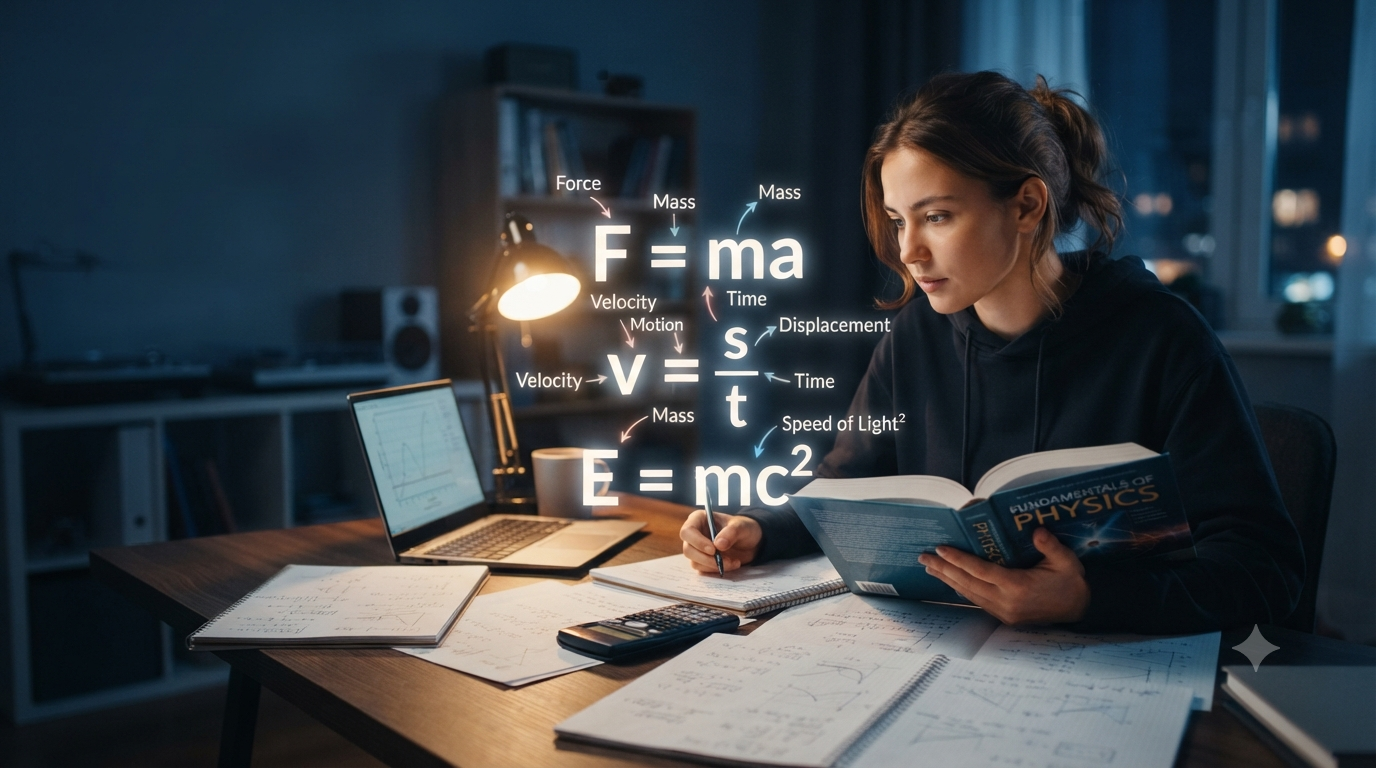
Here, v represents speed or velocity depending on the context, s represents distance or displacement, and t represents time. The formula tells us that the distance covered per unit time determines the average speed.
Reading the formula is therefore not just saying “v equals s divided by t.” It means understanding that speed depends on both the distance travelled and the time taken.
A formula should always be read as a physical statement, not just as a mathematical expression.
Start by Identifying Every Symbol
The first step in understanding a formula is to identify every symbol.
For example:
F = ma
This equation contains three symbols:
F = force
m = mass
a = acceleration
The equation tells us that the net force acting on an object is related to its mass and acceleration.
When reading an unfamiliar formula, ask:
What does each symbol represent?
What physical quantity does it describe?
What unit is used for that quantity?
Is the quantity a scalar or a vector?
Does the symbol have a special meaning in this particular context?
Symbols can sometimes represent different quantities in different topics. Therefore, never assume the meaning of a symbol without checking the context.
Understand the Mathematical Operations
The mathematical operations in a formula describe how physical quantities are connected.
For example:
P = F/A
This formula represents pressure as force divided by area.
The division tells us that pressure depends on how much force is distributed over a given area. If the same force acts over a smaller area, the pressure increases. If the force is spread over a larger area, the pressure decreases.
Similarly, in:
W = Fd
work is related to force and displacement when the force acts along the direction of displacement.
The mathematical structure of a formula therefore contains physical information. Addition, subtraction, multiplication, division, powers, and roots can all represent different types of relationships.
Look for Relationships Between Quantities
A physics formula usually tells us how one quantity changes when another quantity changes.
Consider:
s = vt
If time remains constant and velocity increases, the distance travelled increases. If velocity remains constant and time increases, the distance also increases.
This is called a direct relationship.
Now consider:
P = F/A
If force increases while area remains constant, pressure increases. But if area increases while force remains constant, pressure decreases.
This shows that some quantities may be directly related while others are inversely related.
Understanding these relationships is often more useful than memorizing the formula itself.
Check the Units
Units provide an important way to interpret and check a physics formula.
Take:
v = s/t
The SI unit of distance is metre (m), and the SI unit of time is second (s).
Therefore:
v = metre/second = m/s
The unit of speed is therefore metres per second.
Units can help you understand what a formula produces and can also help identify mistakes during calculations.
For example, if you calculate speed and obtain a result in kilograms, something has gone wrong because kilograms are a unit of mass, not speed.
Unit checking is one of the simplest and most powerful habits in physics problem-solving.
Understand What the Formula Says Physically
After identifying the symbols and units, ask what the formula means in the real world.
Consider:
p = mv
This formula gives the momentum of an object.
It tells us that momentum depends on both mass and velocity. A heavier object moving at the same velocity has greater momentum than a lighter object. Similarly, an object moving faster has greater momentum if its mass remains unchanged.
The formula is therefore not simply a calculation rule. It describes a physical relationship between mass, velocity, and momentum.
This physical interpretation helps you predict how a result should change before doing any calculation.
Pay Attention to Constants
Some formulas contain constants that have specific physical meanings.
For example:
F = Gm₁m₂/r²
Here, G is the gravitational constant.
The constant does not represent a quantity that changes from one ordinary gravitational interaction to another. Instead, it establishes the strength of the gravitational interaction in the equation.
Constants are important because they often connect mathematical relationships with experimentally measured properties of nature.
When you encounter a constant, find out what it represents and what units it has.
Notice Powers and Exponents
Powers in physics formulas can reveal how strongly one quantity affects another.
Consider:
E = mc²
The speed of light, c, is squared. This means the value of the speed of light has a very large influence on the relationship between mass and energy.
Another important example is:
F = Gm₁m₂/r²
The distance appears as r² in the denominator. This means gravitational force decreases according to the square of the distance.
If the distance becomes twice as large, the gravitational force becomes one-fourth as large, assuming the masses remain unchanged.
Therefore, never ignore powers in a physics formula. They can contain important information about how nature behaves.
Check the Conditions of the Formula
A formula may only be valid under certain conditions.
For example:
v = u + at
is commonly used for motion with constant acceleration.
If acceleration is changing significantly with time, this simple equation may not be appropriate.
Similarly, some formulas apply only to idealized situations. A physics equation may assume negligible air resistance, constant temperature, uniform motion, or other specific conditions.
Before using a formula, ask:
Under what conditions is this equation valid?
Knowing the conditions prevents formulas from being applied incorrectly.
Rearrange the Formula When Necessary
A formula can often be rearranged to find different quantities.
For example:
F = ma
If we want to find mass:
m = F/a
If we want to find acceleration:
a = F/m
The physical relationship has not changed. Only the mathematical arrangement has changed.
Being able to rearrange formulas is especially useful when solving physics problems because the unknown quantity may not always appear alone on the left side of the original equation.
Use Estimation Before Calculation
Before substituting numbers into a formula, make a rough prediction.
Suppose you use:
v = s/t
If an object travels about 100 metres in about 10 seconds, you can expect the speed to be around 10 m/s.
If your calculator later gives 1,000 m/s, you immediately know that something may be wrong.
Estimation gives you a sense of whether the final answer is reasonable. It is a useful habit because physics is not only about obtaining a numerical answer but also about understanding whether that answer makes physical sense.
Interpret the Final Answer
A physics calculation is incomplete until the answer is interpreted.
Suppose you calculate:
v = 20 m/s
Do not stop at the number 20. State what it means.
The object has an average speed of 20 metres per second.
Similarly, if you calculate a force of 50 N, understand that the force has a magnitude of 50 newtons and consider its direction if the force is a vector quantity.
The final answer should include an appropriate unit and, when necessary, direction or other relevant information.
Use Graphs to Understand Formulas
Many physics formulas can also be understood through graphs.
For example:
v = s/t
can be connected to the relationship between distance and time. For uniform motion, a distance-time graph has a constant slope, and that slope represents speed.
Similarly, a velocity-time graph can help us understand acceleration because the slope of the graph represents acceleration.
Graphs provide a visual way to understand equations and can reveal relationships that may not be immediately obvious from the formula alone.
A Simple Method for Reading Any Physics Formula
Whenever you encounter a new formula, follow a systematic process:
Write the formula clearly.
Identify every symbol.
Define each physical quantity.
Identify the units.
Look at the mathematical operations.
Determine which quantities are directly or inversely related.
Pay attention to powers and constants.
Check the conditions under which the formula applies.
Rearrange the equation if necessary.
Substitute values with correct units.
Estimate the expected result.
Check the final answer and interpret its physical meaning.
This approach turns formula-based problems into a logical process rather than a memory exercise.
Why Understanding Formulas Is Better Than Memorizing Them
Memorizing formulas may help with short-term problem-solving, but understanding them provides a much stronger foundation.
When you understand a formula, you can often remember it more naturally because you know what it represents. You can also rearrange it, check its units, predict how quantities will change, and recognize when it should or should not be used.
Physics becomes easier when formulas are treated as descriptions of nature rather than isolated equations.
Conclusion
Reading and interpreting a physics formula means going beyond the symbols on the page. A formula represents a relationship between physical quantities, and every part of it can provide useful information. By identifying symbols, understanding mathematical operations, checking units, recognizing relationships, considering conditions, and interpreting the final result, you can use formulas with greater confidence.
The goal is not simply to remember that F = ma or v = s/t. The goal is to understand what these equations are saying about the physical world. Once formulas begin to make physical sense, solving physics problems becomes more logical, efficient, and meaningful.