
Why Chemical Formulas Use Whole Number Subscripts

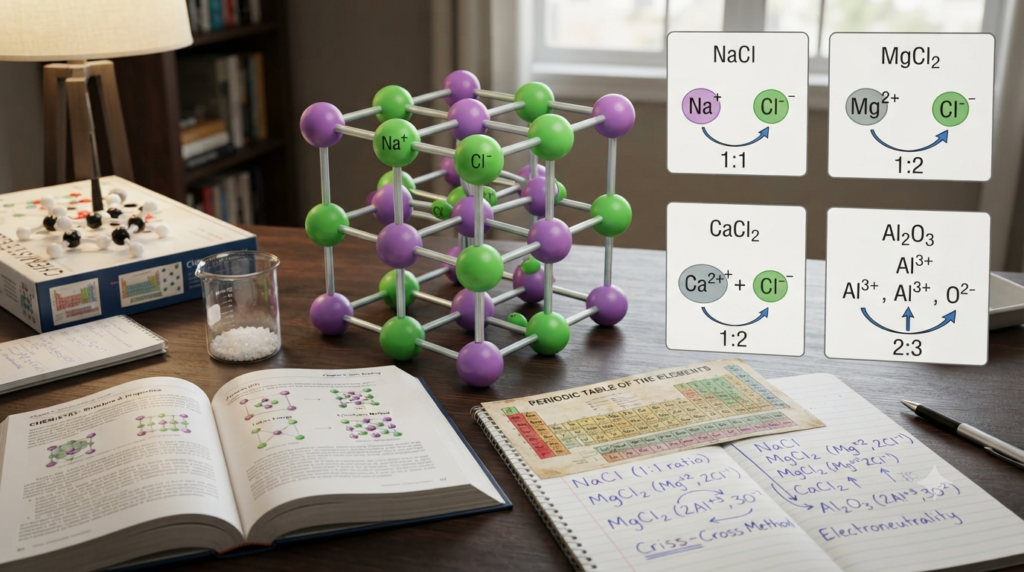
Chemistry formulas showing whole number subscripts in H₂O, CO₂, NH₃, and Al₂O₃ with molecular models and periodic table.

Chemical formulas are one of the simplest ways scientists communicate information about substances. A formula such as H₂O tells us that water contains hydrogen and oxygen in a definite proportion. Similarly, CO₂ represents carbon dioxide, while NaCl represents sodium chloride. One small part of these formulas carries a great deal of information: the subscript.

Subscripts are the small numbers written at the lower right of chemical symbols. They tell us how many atoms of an element are represented in a molecule or formula unit. But why do chemical formulas normally use whole number subscripts rather than decimal or fractional numbers? Why do we write H₂O instead of H₁.₅O or CO₂.₅?

The answer is connected to atoms, ratios, chemical composition, and the way substances are defined. Whole number subscripts allow chemical formulas to represent definite ratios of atoms or ions. Understanding this idea makes it easier to understand molecular formulas, empirical formulas, ionic compounds, and chemical equations.

What Is a Subscript in a Chemical Formula?

A subscript is a small number placed after and slightly below an element symbol in a chemical formula.

For example:

  • H₂O contains two hydrogen atoms and one oxygen atom.

  • CO₂ contains one carbon atom and two oxygen atoms.

  • NH₃ contains one nitrogen atom and three hydrogen atoms.

  • CH₄ contains one carbon atom and four hydrogen atoms.

If no subscript is written after an element symbol, the number is understood to be one.

Therefore, CO₂ can be interpreted as:

C₁O₂

The subscript does not simply decorate the formula. It provides information about the ratio in which the elements occur.

Chemical Formulas Represent Ratios

One of the most important reasons chemical formulas use whole number subscripts is that they represent ratios.

Consider water, H₂O. The formula tells us that hydrogen and oxygen occur in a ratio of:

2 : 1

This means that for every two hydrogen atoms, there is one oxygen atom in a water molecule.

Carbon dioxide, CO₂, has a carbon-to-oxygen ratio of:

1 : 2

Ammonia, NH₃, has a nitrogen-to-hydrogen ratio of:

1 : 3

These are whole-number ratios.

A chemical formula therefore provides a compact way of showing the relative number of atoms present in a substance.

Why Ratios Are Written as Whole Numbers

A ratio can sometimes be written using fractions or decimals, but chemical formulas are generally expressed using the smallest possible whole-number ratio.

For example, suppose the ratio between two elements is:

1 : 2

There is no need to write this as:

0.5 : 1

Both ratios describe the same relationship, but 1 : 2 is simpler and directly represents the numbers of atoms involved.

Similarly, a ratio such as:

1.5 : 1

can be multiplied by 2 to give:

3 : 2

The second form is preferred because chemical formulas describe discrete numbers of atoms or ions.

This is an important principle behind empirical formulas.

Atoms Are Discrete Particles

Atoms are individual particles. You can have one atom, two atoms, three atoms, and so on. You cannot normally have 1.5 of an individual atom in a particular molecule.

For example, a water molecule contains:

  • 2 hydrogen atoms

  • 1 oxygen atom

It does not contain 1.5 hydrogen atoms.

This discrete nature of atoms helps explain why molecular formulas use whole number subscripts. A molecule is built from actual atoms, and the number of atoms in one molecule must be a whole number.

The same basic idea applies to many ionic compounds. A formula unit of sodium chloride contains sodium and chloride ions in a 1:1 ratio, so its formula is NaCl.

Chemical Compounds Have Definite Composition

Many chemical compounds have a definite composition. This means that their constituent elements combine in specific proportions.

For example, water has a fixed composition represented by H₂O. Hydrogen peroxide has a different composition represented by H₂O₂.

Notice that changing a subscript changes the substance.

H₂O represents water.

H₂O₂ represents hydrogen peroxide.

The difference is only one additional oxygen atom per molecule, but that difference changes the substance and its properties.

This shows why subscripts must accurately represent the actual atomic ratio of a compound.

Whole Number Subscripts and Molecules

Molecular substances consist of molecules containing specific numbers of atoms.

For example, a carbon dioxide molecule contains:

1 carbon atom + 2 oxygen atoms

Therefore, its formula is:

CO₂

A methane molecule contains:

1 carbon atom + 4 hydrogen atoms

Therefore:

CH₄

Because individual molecules contain definite numbers of atoms, whole number subscripts are appropriate for molecular formulas.

A formula such as CH₄.₅ would suggest that an individual methane molecule contains four and a half hydrogen atoms, which does not describe a normal methane molecule.

Whole Number Ratios and Empirical Formulas

The connection between whole number subscripts becomes especially clear when studying empirical formulas.

An empirical formula gives the simplest whole-number ratio of elements in a compound.

Suppose experimental data shows that a compound contains carbon and hydrogen in a ratio of:

2 : 6

This ratio can be simplified by dividing both numbers by 2:

1 : 3

The empirical formula is therefore:

CH₃

The molecular formula might be C₂H₆, but its simplest whole-number ratio is CH₃.

This is why empirical formulas are called the simplest whole-number ratios of elements.

Why Decimals Can Appear During Calculations

Students sometimes become confused because chemical formulas use whole number subscripts, while calculations can produce decimal values.

For example, when determining an empirical formula from experimental data, calculated mole ratios might initially look like:

C : H = 1 : 1.5

At this stage, the 1.5 does not mean that the final formula contains 1.5 hydrogen atoms.

Instead, the ratio is a result of measurement and calculation. The ratio must be converted into the appropriate whole-number relationship.

Multiplying both values by 2 gives:

2 : 3

The empirical formula can then be written as:

C₂H₃

Therefore, decimal values may occur temporarily during chemical calculations, but the final formula is normally expressed using the appropriate whole-number ratio.

The Difference Between a Ratio and an Actual Number of Atoms

It is useful to distinguish between a ratio and a physical count.

A ratio can be expressed in many mathematically equivalent ways.

For example:

2 : 4

is equivalent to:

1 : 2

and:

0.5 : 1

However, a chemical formula is not merely a mathematical ratio written in any convenient form. It is a symbolic representation of the composition of a substance.

Writing the simplest whole-number ratio makes the formula easier to interpret and connects the formula with actual particles.

Ionic Compounds Also Use Whole Number Subscripts

Whole number subscripts are also important for ionic compounds.

Ionic compounds contain positively charged ions called cations and negatively charged ions called anions. Their formulas must show an electrically neutral combination of ions.

Consider magnesium chloride.

Magnesium forms Mg²⁺ ions, while chloride forms Cl⁻ ions.

One Mg²⁺ ion requires two Cl⁻ ions to balance the total charge:

Mg²⁺ + 2Cl⁻ → MgCl₂

Therefore, the formula is:

MgCl₂

The subscript 2 shows that two chloride ions are associated with each magnesium ion in the formula unit.

The formula cannot be written as MgCl₁.₅ because the formula must represent a whole-number combination of ions.

Charge Balance Leads to Whole Number Ratios

The same principle applies to many ionic compounds.

For calcium chloride:

Ca²⁺ and Cl⁻ combine in a 1:2 ratio.

Formula:

CaCl₂

For aluminum oxide:

Al³⁺ and O²⁻ combine in a 2:3 ratio.

Formula:

Al₂O₃

The charges balance:

2 × (+3) = +6

3 × (−2) = −6

The resulting formula uses whole numbers because the compound contains whole ions in the required ratio.

What Happens When a Subscript Is Changed?

Changing a subscript changes the composition represented by the formula.

For example:

CO represents carbon monoxide.

CO₂ represents carbon dioxide.

These are different compounds because the ratio of carbon to oxygen is different.

Similarly:

SO₂ and SO₃

represent different sulfur oxides.

This is why subscripts must not be changed casually when balancing chemical equations or writing formulas.

A subscript is part of the identity of a chemical formula.

Subscripts Are Different From Coefficients

Another important point is the difference between a subscript and a coefficient.

Consider:

2H₂O

The subscript ₂ belongs to the formula H₂O. It tells us that each water molecule contains two hydrogen atoms.

The coefficient 2 tells us that there are two water molecules.

Therefore:

2H₂O

represents:

2 × 2 = 4 hydrogen atoms

and:

2 × 1 = 2 oxygen atoms

Changing the coefficient changes the amount of the substance. Changing a subscript changes the composition of the substance itself.

This distinction is essential when balancing chemical equations.

Why Chemical Formulas Do Not Usually Use Fractional Subscripts

Fractional subscripts would make it difficult to interpret a formula as the composition of an individual molecule or formula unit.

For example, suppose someone writes:

H₁.₅O

The expression could mathematically be converted into:

H₃O₂

by multiplying all subscripts by 2. The second expression provides a whole-number ratio and is therefore much more useful as a chemical formula if that ratio represents the substance.

Chemical notation favors the simplest meaningful whole-number relationship.

This does not mean fractions are never encountered in chemistry. Chemists may use fractional coefficients in balanced equations or decimal ratios during calculations. However, these uses are different from the role of subscripts in a chemical formula.

Whole Number Subscripts and Conservation of Matter

Chemical formulas are also connected to the conservation of matter.

During a chemical reaction, atoms are rearranged, but atoms of each element are not simply created or destroyed in an ordinary chemical reaction.

For example:

2H₂ + O₂ → 2H₂O

On the left side:

  • Hydrogen atoms = 4

  • Oxygen atoms = 2

On the right side:

  • Hydrogen atoms = 4

  • Oxygen atoms = 2

The subscripts tell us the composition of each molecule, while the coefficients allow us to represent the correct number of molecules so that the atoms are conserved.

Whole Number Subscripts Make Chemical Communication Clear

Chemistry involves enormous numbers of particles. Scientists therefore need a concise system for communicating composition.

Instead of writing:

one carbon atom combined with two oxygen atoms

chemists can simply write:

CO₂

Instead of describing two aluminum atoms combined with three oxygen atoms, they can write:

Al₂O₃

This compact notation works because the meaning of subscripts is standardized.

Whole number subscripts make chemical formulas easier to read, compare, calculate, and communicate.

Can a Substance Have a Non-Whole Composition?

There are important exceptions and complications in advanced chemistry. Some materials, especially certain solids known as non-stoichiometric compounds, can have compositions that vary within a range. Their structures may contain vacancies or defects, so their compositions are sometimes represented using formulas involving variables or approximate ratios.

For example, a material may be described using a form such as:

Fe₁₋ₓO

Here, x represents a variable related to the composition.

However, this is different from saying that an individual atom is physically divided into a fraction. The notation describes the average or variable composition of a large collection of particles or a crystal structure.

For introductory chemistry, the key principle remains that standard chemical formulas are written using whole-number subscripts to represent the simplest definite ratio of atoms or ions.

Why This Concept Matters in Chemistry

Understanding whole number subscripts helps with many important chemistry topics.

It helps you:

  • Read chemical formulas correctly.

  • Count atoms in molecules and formula units.

  • Write formulas for ionic compounds.

  • Determine empirical formulas.

  • Calculate molecular and formula masses.

  • Understand chemical equations.

  • Balance chemical reactions.

  • Distinguish between different compounds.

  • Interpret mole ratios in chemical reactions.

Once the meaning of subscripts becomes clear, many chemistry calculations become easier because the formula provides the basic numerical relationship between the elements.

Conclusion

Chemical formulas use whole number subscripts because they represent definite ratios of atoms or ions in a substance. Individual atoms and ions are discrete particles, so a normal molecule or formula unit contains whole numbers of these particles. Whole-number ratios also provide a simple and standardized way to describe chemical composition.

Subscripts such as the ₂ in H₂O and CO₂ tell us how many atoms are represented in each molecule or formula unit. When experimental calculations produce decimal ratios, those values are usually converted into the appropriate simplest whole-number ratio before writing an empirical formula.

The idea may seem simple, but it is fundamental to chemistry. Once you understand why chemical formulas use whole number subscripts, formulas become more than symbols—they become a compact language for describing the composition and structure of matter.

FAQs

1. Why do chemical formulas use whole number subscripts?

Chemical formulas use whole number subscripts because they represent the actual ratio of atoms or ions in a substance. Atoms are discrete particles, so a molecule cannot normally contain a fractional atom. For example, H₂O contains two hydrogen atoms and one oxygen atom in each water molecule. Similarly, CO₂ contains one carbon atom and two oxygen atoms. Whole number subscripts make these relationships clear and easy to understand. They also provide a standardized way to represent the composition of compounds. When calculations produce decimal ratios, chemists usually convert them into the appropriate simplest whole-number ratio before writing the final chemical formula.

2. What does a subscript tell us in a chemical formula?

A subscript tells us how many atoms of an element are represented in a molecule or formula unit. For example, the ₂ in H₂O means that each water molecule contains two hydrogen atoms. The oxygen symbol has no subscript, so it represents one oxygen atom. In CO₂, the ₂ indicates two oxygen atoms for every one carbon atom. Subscripts are therefore essential for understanding the composition of a substance. They should not be confused with coefficients, which indicate the number of molecules or formula units involved in a chemical equation. Changing a subscript changes the composition represented by the formula.

3. Why is H₂O written instead of H₁.₅O?

H₂O is written instead of H₁.₅O because a water molecule contains whole atoms, not fractional atoms. The ratio of hydrogen to oxygen in water is 2:1. Although 1.5:1 may appear as a mathematical ratio in some calculations, it is not the standard way to represent the composition of an individual water molecule. Chemical formulas use whole-number ratios so that the formula corresponds to actual particles. If a calculated ratio contains fractions or decimals, the values can often be multiplied by a suitable factor to obtain whole numbers. This produces a chemically meaningful formula.

4. What is a simplest whole-number ratio in chemistry?

A simplest whole-number ratio is a ratio between elements expressed using the smallest possible positive whole numbers. It is especially important when determining empirical formulas. For example, if the ratio of carbon to hydrogen in a compound is 2:6, both numbers can be divided by 2 to give 1:3. The simplest ratio is therefore 1:3, represented as CH₃. Similarly, a ratio such as 0.5:1 can be multiplied by 2 to obtain 1:2. Using the simplest whole-number ratio makes chemical formulas easier to interpret and provides a consistent way of representing the relative amounts of elements.

5. Can decimal numbers appear when calculating a chemical formula?

Yes. Decimal numbers can appear during chemical calculations, especially when determining an empirical formula from experimental data. For example, calculated mole ratios might initially produce values such as 1:1.5. The 1.5 does not mean that the final compound contains one and a half atoms. Instead, it indicates that the calculated ratio needs further processing. Multiplying both values by 2 gives 2:3, which is a whole-number ratio. The appropriate chemical formula can then be written using those whole numbers. Therefore, decimals may occur during calculations, but standard chemical formulas generally use whole-number subscripts.

6. Do ionic compounds also use whole number subscripts?

Yes. Ionic compounds normally use whole number subscripts to show the ratio of positive and negative ions required to produce an electrically neutral compound. For example, magnesium forms Mg²⁺ ions and chloride forms Cl⁻ ions. Two chloride ions are needed to balance the charge of one magnesium ion, giving MgCl₂. Similarly, aluminum oxide is Al₂O₃ because two Al³⁺ ions provide a total charge of +6, while three O²⁻ ions provide −6. The subscripts therefore show the simplest whole-number ratio of ions needed for charge balance. They are an important part of writing correct ionic formulas.

7. What happens if we change a subscript in a chemical formula?

Changing a subscript changes the ratio of elements represented by the formula and can therefore represent a different substance. For example, CO represents carbon monoxide, while CO₂ represents carbon dioxide. The difference is the number of oxygen atoms associated with each carbon atom. Similarly, H₂O and H₂O₂ represent different compounds. A subscript is part of the chemical formula itself, so it should not be changed when balancing a chemical equation. Instead, coefficients are changed to balance equations. Understanding this difference is essential because changing a subscript changes the composition rather than simply changing the amount of a substance.

8. What is the difference between a subscript and a coefficient?

A subscript tells us the number of atoms of an element within one molecule or formula unit, while a coefficient tells us how many molecules or formula units are present. For example, in 2H₂O, the subscript ₂ means each water molecule contains two hydrogen atoms. The coefficient 2 means there are two water molecules. Therefore, 2H₂O contains four hydrogen atoms and two oxygen atoms in total. When balancing chemical equations, coefficients are changed while subscripts remain unchanged. Changing a subscript would alter the identity or composition of the substance represented by the formula.

9. Why are whole number subscripts important for empirical formulas?

Whole number subscripts are essential for empirical formulas because an empirical formula represents the simplest whole-number ratio of elements in a compound. Experimental data may first give mole ratios containing decimals. These values must be converted into an appropriate whole-number relationship before the empirical formula is written. For example, a calculated ratio of carbon to hydrogen of 1:1.5 can be multiplied by 2 to give 2:3, resulting in the empirical formula C₂H₃. This process does not mean atoms are being divided or created. It simply converts the calculated proportional relationship into the standard whole-number notation used in chemical formulas.

10. Why are chemical formulas important in understanding compounds?

Chemical formulas provide a compact way to communicate the composition of compounds. They show which elements are present and, through their subscripts, indicate the relative number of atoms or ions. For example, H₂O shows that water contains hydrogen and oxygen in a 2:1 ratio, while CO₂ shows a 1:2 carbon-to-oxygen ratio. Chemical formulas are used throughout chemistry to calculate molecular masses, determine empirical formulas, write chemical equations, balance reactions, and understand chemical composition. Learning how to interpret whole number subscripts therefore provides an important foundation for studying more advanced chemical concepts and calculations.

Related Posts

Leave a Comment

Your email address will not be published. Required fields are marked *

Scroll to Top