A chemical formula tells us much more than the name of a substance. It also gives information about the types and numbers of atoms present in that substance. By carefully reading the symbols, subscripts, coefficients, and brackets in a chemical formula, we can determine exactly how many atoms of each element are present.
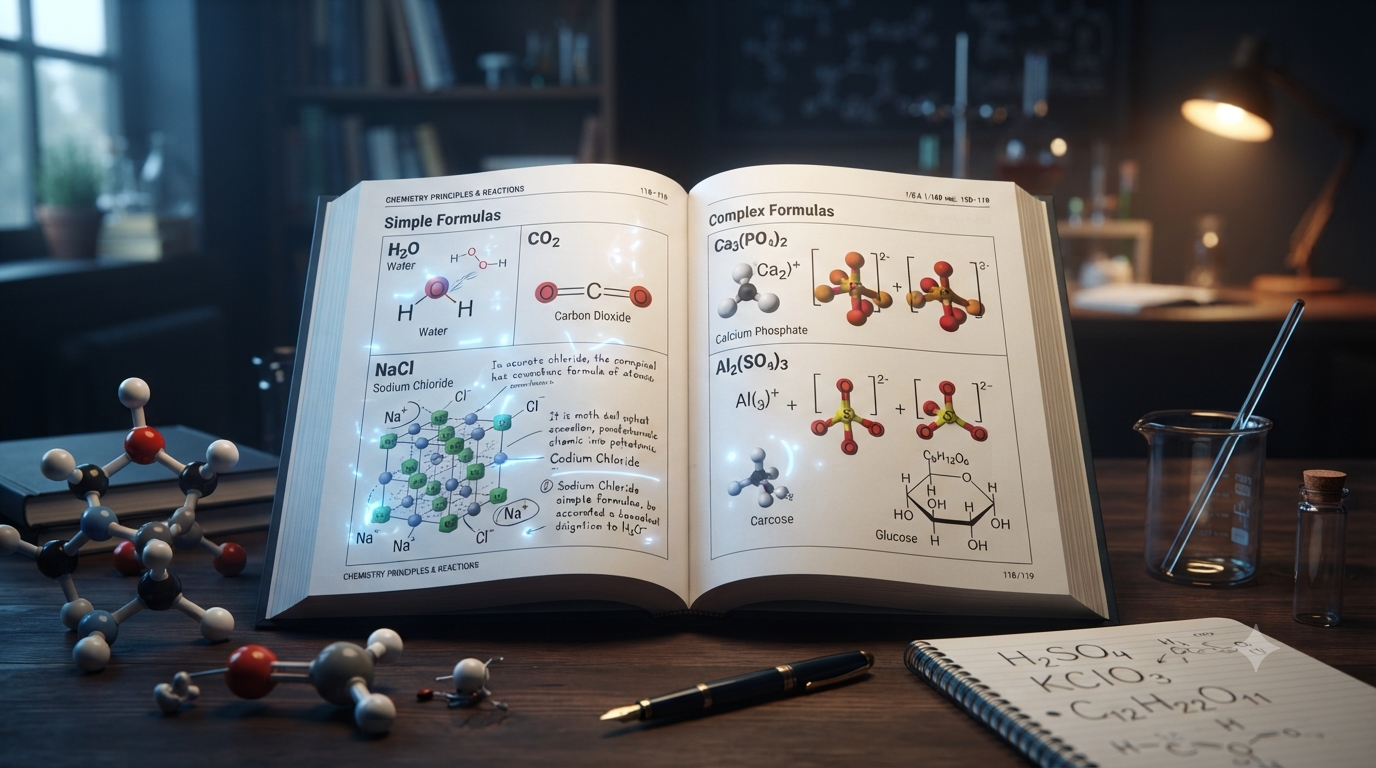
For example, the formula H₂O tells us that one water molecule contains two hydrogen atoms and one oxygen atom. Similarly, CO₂ contains one carbon atom and two oxygen atoms. These examples are simple, but chemical formulas can become more complicated when they contain brackets, polyatomic ions, or coefficients.
Learning how to count atoms from a chemical formula is therefore an important basic chemistry skill. It helps with understanding chemical reactions, balancing equations, calculating formula mass, studying compounds, and solving stoichiometry problems. The key is to read the formula systematically rather than trying to count everything at once.
What Does a Chemical Formula Tell You?
A chemical formula uses chemical symbols and numbers to represent the composition of a substance. Each chemical symbol represents an element, while a subscript tells us how many atoms of that element are present.
Consider the formula:
H₂O
There are two different elements in this formula:
H represents hydrogen.
O represents oxygen.
The small number 2 written after H is called a subscript. It tells us that there are two hydrogen atoms. There is no number after O, so the number of oxygen atoms is understood to be 1.
Therefore:
H₂O = 2 hydrogen atoms + 1 oxygen atom
The formula contains three atoms in total.
What Is a Subscript?
A subscript is a small number written at the lower right of a chemical symbol or group of symbols. It tells us how many times that element or group occurs in the formula.
For example:
CO₂
The subscript 2 belongs to oxygen. Therefore, CO₂ contains:
1 carbon atom
2 oxygen atoms
Total atoms = 1 + 2 = 3
Now consider:
N₂O₅
The subscript 2 belongs to nitrogen, while 5 belongs to oxygen.
Therefore:
Nitrogen = 2 atoms
Oxygen = 5 atoms
Total atoms = 7 atoms
A useful rule is:
A subscript applies to the chemical symbol immediately before it.
If no subscript is written, the number is 1.
Counting Atoms in Simple Chemical Formulas
The easiest formulas contain individual element symbols without brackets.
For example:
CH₄
Carbon has no subscript, so there is 1 carbon atom. Hydrogen has a subscript 4, so there are 4 hydrogen atoms.
Therefore:
CH₄ = 1 carbon atom + 4 hydrogen atoms
Total number of atoms = 5
Another example is:
C₆H₁₂O₆
This formula contains three elements:
Carbon = 6 atoms
Hydrogen = 12 atoms
Oxygen = 6 atoms
Total atoms = 6 + 12 + 6 = 24 atoms
This is the formula of glucose. The formula tells us the relative number of atoms in one molecule of glucose.
What If There Is No Subscript?
When a chemical symbol does not have a subscript, its subscript is understood to be 1.
For example:
NaCl
There is no number after Na and no number after Cl.
Therefore:
Na = 1 atom
Cl = 1 atom
Total = 2 atoms
Similarly:
MgO
contains:
Mg = 1 atom
O = 1 atom
Total = 2 atoms.
Remembering the invisible 1 is one of the most important steps when counting atoms.
How to Count Atoms Step by Step
A reliable method can make even complicated formulas easier to understand.
Step 1 Identify Every Element
Look through the formula and identify each chemical symbol.
For example:
CaCO₃
The elements are:
Ca = calcium
C = carbon
O = oxygen
Be careful not to confuse symbols containing two letters with two separate elements. Ca is one element, calcium, not C + a.
Step 2 Look for Subscripts
Next, check whether each element has a subscript.
In CaCO₃:
Ca has no subscript → 1 atom
C has no subscript → 1 atom
O has subscript 3 → 3 atoms
Therefore:
CaCO₃ contains 1 calcium atom, 1 carbon atom, and 3 oxygen atoms.
Step 3 Add the Atoms
To find the total number of atoms in one formula unit:
1 + 1 + 3 = 5
So CaCO₃ contains 5 atoms in total.
Counting Atoms in Formulas With Two-Letter Symbols
Some element symbols contain two letters, such as Na, Mg, Ca, Al, Cl, and Fe. The first letter is uppercase and the second letter is lowercase.
For example:
Al₂O₃
Here:
Al = aluminium
O = oxygen
The subscript 2 applies to Al, and the subscript 3 applies to O.
Therefore:
Aluminium = 2 atoms
Oxygen = 3 atoms
Total = 5 atoms
It is important to read chemical symbols correctly. A capital letter generally begins a new element symbol, while a lowercase letter may be part of the same symbol.
For example, Co means cobalt, whereas CO represents carbon and oxygen separately.
Counting Atoms in Formulas With Brackets
Brackets or parentheses make atom counting slightly more challenging. When a subscript appears outside a bracket, it applies to every element inside the bracket.
Consider:
Ca(OH)₂
Inside the brackets we have OH.
The subscript 2 outside the bracket means that the entire OH group occurs twice.
Therefore:
Ca = 1 atom
O = 2 atoms
H = 2 atoms
Total atoms = 1 + 2 + 2 = 5
The important point is that the 2 outside the bracket multiplies both O and H.
Another Example With Brackets
Consider:
Al₂(SO₄)₃
First identify the parts:
Al₂
(SO₄)₃
Al₂ means:
Al = 2 atoms
Inside the brackets:
SO₄ contains:
S = 1 atom
O = 4 atoms
The subscript 3 outside the brackets multiplies both values:
S = 1 × 3 = 3 atoms
O = 4 × 3 = 12 atoms
Therefore:
Aluminium = 2 atoms
Sulfur = 3 atoms
Oxygen = 12 atoms
Total atoms = 2 + 3 + 12 = 17 atoms
This multiplication rule is essential for formulas containing polyatomic ions or groups.
Counting Atoms in Formulas With Nested Brackets
Some chemical formulas may contain more than one level of grouping. In such cases, work from the innermost group outward.
For example, consider a formula containing a grouped unit with another subscript. The safest approach is to determine the number of atoms inside the smallest group first, then multiply by the subscript immediately outside that group.
This prevents the common mistake of applying a number to only the last element instead of the entire group.
The general rule is:
A subscript outside a bracket multiplies every atom inside that bracket.
What Is a Coefficient?
A coefficient is a number written in front of a chemical formula.
For example:
3H₂O
The 3 is not part of the chemical formula itself. It tells us that there are three molecules or formula units of H₂O.
One H₂O molecule contains:
2 hydrogen atoms
1 oxygen atom
Therefore, 3H₂O contains:
Hydrogen = 3 × 2 = 6 atoms
Oxygen = 3 × 1 = 3 atoms
Total atoms = 6 + 3 = 9 atoms
This gives us an important distinction:
Subscripts tell us the number of atoms within one molecule or formula unit, while coefficients tell us how many molecules or formula units are present.
Subscript vs Coefficient
Consider:
2CO₂
The subscript 2 belongs only to oxygen. The coefficient 2 applies to the entire formula.
One CO₂ molecule contains:
C = 1
O = 2
Two CO₂ molecules contain:
C = 2
O = 4
Total atoms = 6
This is why coefficients must be considered when counting atoms in a chemical equation or a group of molecules.
Counting Atoms in Chemical Equations
Atom counting is especially useful when studying chemical equations.
Consider:
2H₂ + O₂ → 2H₂O
On the left side:
2H₂ contains:
H = 2 × 2 = 4 atoms
O₂ contains:
O = 2 atoms
On the right side:
2H₂O contains:
H = 2 × 2 = 4 atoms
O = 2 × 1 = 2 atoms
Therefore, both sides contain:
4 hydrogen atoms
2 oxygen atoms
This is the basic idea behind balancing chemical equations. Atoms are not created or destroyed during an ordinary chemical reaction, so the number of atoms of each element must be equal on both sides.
Counting Atoms in Polyatomic Ions
Polyatomic ions are groups of atoms that carry an overall charge. Their formulas can also contain subscripts and brackets.
For example:
SO₄²⁻
The charge 2− does not mean there are two oxygen atoms. The subscript 4 tells us there are four oxygen atoms.
Therefore:
S = 1 atom
O = 4 atoms
Total = 5 atoms
Now consider:
2SO₄²⁻
The coefficient 2 means there are two sulfate ions.
Therefore:
S = 2 atoms
O = 8 atoms
Total = 10 atoms
The ionic charge itself does not change the number of atoms.
Does a Charge Affect Atom Counting?
No. A charge tells us about the electrical charge of an ion, not the number of atoms.
For example:
NH₄⁺
The plus sign indicates the ion has a positive charge. It does not mean one extra atom.
The formula contains:
N = 1 atom
H = 4 atoms
Total = 5 atoms
Similarly:
SO₄²⁻ contains:
S = 1 atom
O = 4 atoms
Total = 5 atoms.
Always distinguish between subscripts, which indicate atom numbers, and charges, which indicate electrical charge.
Common Examples of Atom Counting
Here are several examples using different types of formulas.
H₂SO₄
H = 2
S = 1
O = 4
Total = 7 atoms
Na₂CO₃
Na = 2
C = 1
O = 3
Total = 6 atoms
Mg(OH)₂
Mg = 1
O = 2
H = 2
Total = 5 atoms
C₂H₅OH
C = 2
H = 6
O = 1
Total = 9 atoms
The hydrogen count is 6 because there are 5 hydrogen atoms in C₂H₅ plus 1 hydrogen atom in OH.
Fe₂(SO₄)₃
Fe = 2
S = 3
O = 12
Total = 17 atoms
These examples show why it is important to inspect the entire formula rather than simply adding the visible numbers.
Common Mistakes When Counting Atoms
Several mistakes occur frequently when students first learn atom counting.
Ignoring the Invisible Subscript 1
In NaCl, some learners may count only the visible elements without recognizing that each has one atom.
The correct count is:
Applying a Bracket Subscript to Only One Element
In Mg(OH)₂, the 2 applies to both O and H.
Incorrect:
O = 2, H = 1
Correct:
O = 2, H = 2
Confusing a Coefficient With a Subscript
In 3H₂O, the 3 applies to the whole formula, while the 2 applies only to hydrogen.
Treating a Charge as an Atom Number
In SO₄²⁻, the 2− is a charge, not a subscript.
Misreading Two-Letter Element Symbols
Ca is one element, calcium. Cl is one element, chlorine. They should not be split into separate symbols.
A Simple Method to Avoid Mistakes
For difficult formulas, create a small counting table.
For example, consider:
Al₂(SO₄)₃
| Element | Original Count | Bracket Multiplier | Final Count |
|---|---|---|---|
| Al | 2 | 1 | 2 |
| S | 1 | 3 | 3 |
| O | 4 | 3 | 12 |
Then add the final counts:
2 + 3 + 12 = 17 atoms
This method is particularly useful when formulas contain several elements or brackets.
Why Is Atom Counting Important?
Counting atoms is not just an exercise in reading formulas. It forms the foundation of several important chemistry concepts.
It helps us understand the composition of compounds and interpret chemical equations. It is also necessary when calculating relative molecular mass, molar mass, percentage composition, and the quantities of substances involved in chemical reactions.
For example, if we know that H₂O contains two hydrogen atoms and one oxygen atom, we can use this information to understand its composition and calculate its molecular or molar mass.
Atom counting also becomes essential in stoichiometry, where chemical formulas are used to determine the relationships between reactants and products.
A Quick Rule for Counting Atoms
When you need to count atoms from a chemical formula, follow this sequence:
Identify the elements → find the subscripts → apply bracket multipliers → apply coefficients if present → add the atoms.
For a formula without a coefficient, first determine the atoms in one molecule or formula unit.
For a formula with a coefficient, multiply every atom count by that coefficient.
For a formula containing brackets, multiply every atom inside the bracket by the subscript outside it.
This systematic approach works for both simple and complicated chemical formulas.
Conclusion
Counting atoms from a chemical formula becomes straightforward once the role of each number is understood. Chemical symbols identify the elements, subscripts show how many atoms of an element are present, bracket subscripts multiply entire groups, and coefficients multiply the complete formula.
For example, Ca(OH)₂ contains one calcium atom, two oxygen atoms, and two hydrogen atoms, giving a total of five atoms. A coefficient changes the number of molecules or formula units, while a charge does not change the atom count.
The best way to become confident with atom counting is to practice formulas of increasing complexity. Start with simple compounds such as H₂O and CO₂, then move to formulas containing brackets and coefficients. Once this skill becomes familiar, many other chemistry topics, including chemical equations, formula mass, composition, and stoichiometry, become easier to understand.
FAQs
1. How can you count atoms from a chemical formula?
To count atoms from a chemical formula, first identify each element symbol and then look for the subscript written after it. A subscript tells you how many atoms of that element are present. If there is no subscript, the number is understood to be one. For example, H₂O contains two hydrogen atoms and one oxygen atom, giving three atoms in total. If brackets are present, apply the subscript outside the bracket to every element inside it. For example, Ca(OH)₂ contains one calcium, two oxygen, and two hydrogen atoms. Finally, add the numbers to find the total number of atoms.
2. What does a subscript mean in a chemical formula?
A subscript is a small number written at the lower right of a chemical symbol or group of symbols. It tells you how many atoms of that element or group are present. For example, in CO₂, the subscript 2 applies to oxygen, so there are two oxygen atoms. Carbon has no subscript, meaning there is one carbon atom. In H₂SO₄, the subscripts show two hydrogen atoms and four oxygen atoms, while sulfur has one atom. Subscripts are therefore essential for determining the composition of a molecule or formula unit and for correctly counting the atoms represented by a chemical formula.
3. What does it mean when an element has no subscript?
When an element symbol has no subscript, its number of atoms is understood to be one. For example, in H₂O, hydrogen has the subscript 2, so there are two hydrogen atoms. Oxygen has no subscript, so there is one oxygen atom. Similarly, NaCl contains one sodium atom and one chlorine atom. This invisible number 1 is important when counting atoms because not every element in a chemical formula has a visible number. Always assume a subscript of 1 when no number is written after an element symbol. This makes it easier to calculate the complete atom count accurately.
4. How do you count atoms when a chemical formula has brackets?
When a chemical formula contains brackets or parentheses, the subscript outside the brackets applies to every element inside them. For example, Mg(OH)₂ contains one magnesium atom. Inside the brackets are oxygen and hydrogen. The subscript 2 multiplies both elements, giving two oxygen atoms and two hydrogen atoms. Therefore, Mg(OH)₂ contains one magnesium, two oxygen, and two hydrogen atoms, for a total of five atoms. A useful method is to first count the atoms inside the brackets and then multiply each count by the number outside the brackets. This prevents errors when counting atoms in complex formulas.
5. What is the difference between a subscript and a coefficient?
A subscript tells you how many atoms of an element are present within one molecule or formula unit. A coefficient is a number placed before the entire chemical formula and tells you how many molecules or formula units are present. For example, in 2H₂O, the subscript 2 means each water molecule contains two hydrogen atoms. The coefficient 2 means there are two water molecules. Therefore, there are four hydrogen atoms and two oxygen atoms altogether. The distinction is important when counting atoms in chemical equations. Always apply a coefficient to every atom represented by the complete formula.
6. Does a chemical charge count as an atom?
No. A chemical charge does not represent an atom. It indicates the electrical charge carried by an ion. For example, SO₄²⁻ contains one sulfur atom and four oxygen atoms. The 2− represents the charge of the sulfate ion, not two additional atoms. Similarly, NH₄⁺ contains one nitrogen atom and four hydrogen atoms, while the plus sign indicates its electrical charge. When counting atoms, focus on chemical symbols and their subscripts. Charges should not be added to the atom count. Understanding this difference is especially important when working with ionic compounds and polyatomic ions.
7. How many atoms are present in H₂SO₄?
The chemical formula H₂SO₄ represents sulfuric acid. It contains three elements: hydrogen, sulfur, and oxygen. The subscript 2 after H means there are two hydrogen atoms. Sulfur has no subscript, so there is one sulfur atom. The subscript 4 after O means there are four oxygen atoms. Therefore, H₂SO₄ contains two hydrogen atoms, one sulfur atom, and four oxygen atoms. Adding them gives a total of seven atoms in one molecule. The formula can therefore be written as 2 H + 1 S + 4 O, giving seven atoms altogether.
8. How many atoms are present in Al₂(SO₄)₃?
Al₂(SO₄)₃ contains aluminium, sulfur, and oxygen. The subscript 2 after Al means there are two aluminium atoms. Inside the brackets, SO₄ contains one sulfur atom and four oxygen atoms. The subscript 3 outside the brackets multiplies both sulfur and oxygen. Therefore, sulfur has 1 × 3 = 3 atoms, while oxygen has 4 × 3 = 12 atoms. The complete formula contains two aluminium atoms, three sulfur atoms, and twelve oxygen atoms. Adding these numbers gives 17 atoms in total. This example demonstrates why bracket subscripts must be applied to every element inside the brackets.
9. Why is counting atoms important in chemistry?
Counting atoms is an important basic chemistry skill because chemical formulas are used to describe the composition of substances. Knowing the number of atoms helps you understand compounds, interpret chemical equations, calculate molecular and formula masses, and solve stoichiometry problems. For example, knowing that H₂O contains two hydrogen atoms and one oxygen atom allows you to understand its composition and use the formula in chemical calculations. Atom counting is also essential when balancing chemical equations because the number of atoms of each element must be conserved. Learning this skill provides a foundation for understanding many more advanced chemistry concepts.
10. What is the easiest method for counting atoms in a chemical formula?
The easiest method is to follow the formula systematically. First, identify every element symbol. Second, check the subscript after each element; if there is no subscript, use one. Third, look for brackets and multiply every atom inside a bracket by the subscript outside it. Fourth, if a coefficient appears before the formula, multiply the entire atom count by that coefficient. Finally, add the individual atom counts to find the total. For example, Ca(OH)₂ contains one calcium, two oxygen, and two hydrogen atoms, giving five atoms altogether. This step-by-step approach reduces common counting mistakes.
Related Posts
Why does every physical quantity need a unit?
Imagine someone tells you that a table is “2” long. Does that tell you how long the table actually is? […]
Read MoreWhat Is an Empirical Formula?
An empirical formula is a simple way of representing the composition of a chemical compound. It shows the simplest whole-number […]
Read MoreMolecular Formula vs Empirical Formula
Chemical formulas give us a simple way to represent substances using the symbols of elements and numbers. However, not all […]
Read MoreHow to Identify the Simplest Ratio in a Chemical Formula
Chemical formulas do more than identify substances. They also show how atoms of different elements are combined. By looking carefully […]
Read MoreHow to Know Which Physics Formula to Use
Physics problems often seem difficult not because the mathematics is complicated, but because it can be hard to decide which […]
Read MoreWhy Is Energy Conserved Even When It Seems to Disappear?
Energy is one of the most important ideas in science. We use energy to move objects, produce light, heat homes, […]
Read MoreWhat Is Dimensional Analysis in Physics?
Physics is full of equations, measurements, and mathematical relationships. But how can we know whether an equation makes physical sense? […]
Read MoreHow to Study Physics Formulas Step by Step
Physics formulas are an important part of learning physics, but simply memorizing them is not enough. A formula represents a […]
Read MoreHow can you identify the elements present in a formula?
A chemical formula is a short way of showing what a substance is made of. Instead of writing the complete […]
Read MoreHow Does Force Change the Momentum of an Object?
Momentum is one of the most useful ideas in physics for understanding how objects move and how their motion changes. […]
Read MoreWhy are vectors needed to describe motion?
Motion is one of the most basic ideas in physics. We see objects moving everywhere: a car travels along a […]
Read MoreWhat Is a Structural Formula?
A structural formula is a way of representing a chemical compound by showing how its atoms are arranged and connected […]
Read MoreHow to Build a Physics Formula Sheet
Physics involves many formulas, and remembering all of them can become difficult as you move from basic concepts to more […]
Read MoreChemical Formula vs Chemical Equation
Chemistry uses symbols, numbers, and formulas to describe substances and chemical changes. Two important ways of representing chemical information are […]
Read MoreHow Physics Formulas Describe Physical Relationships
Physics is the study of how the natural world works, from the motion of objects to the behavior of light, […]
Read MoreHow to Convert Units Before Using a Physics Formula
Physics formulas help us describe motion, force, energy, pressure, electricity, heat, and many other physical phenomena. However, knowing the correct […]
Read MoreHow to Rearrange Physics Formulas Correctly
Physics formulas are often written in a particular form to make calculations easier, but the required form of a formula […]
Read MoreCommon Polyatomic Ions and Their Formulas
Polyatomic ions are groups of two or more atoms that are chemically bonded together and carry an overall electrical charge. […]
Read MoreWhy Can Experimental Results Differ From Theoretical Values?
In science, theoretical values and experimental results are expected to agree closely. After all, theories are developed to explain observations […]
Read MoreHow to Write Formulas Using Valency
Writing chemical formulas becomes much easier when you understand valency. A chemical formula tells us which elements are present in […]
Read MoreWhat does a subscript mean in a chemical formula?
A chemical formula is a short way of showing what a substance is made of. Instead of writing the names […]
Read MoreSI Unit of Mass Kilogram and Why It Is the Base Unit
Mass is one of the most important physical quantities in physics. It tells us how much matter an object contains […]
Read MoreHow to Determine the Formula of a Compound From Its Name
Knowing the name of a chemical compound is often enough to determine its chemical formula if you understand the rules […]
Read MoreHow Chemical Formulas Represent Substances
Chemical formulas are one of the simplest ways scientists communicate information about matter. A substance may contain millions or billions […]
Read MoreHow Does Measurement Uncertainty Affect a Physics Experiment?
Every physics experiment involves measurement. We measure length, time, mass, temperature, voltage, current, speed, or other physical quantities to understand […]
Read MoreSI Unit of Electric Current Ampere Explained
Electric current is one of the most important physical quantities in electricity and magnetism. Whenever electric charge moves through a […]
Read MoreHow to Convert Units in Physics
Unit conversion is one of the most important skills in physics. Measurements are expressed using units such as metres, kilometres, […]
Read MoreWhat Do Symbols Mean in Physics Formulas?
Physics formulas are written using mathematical symbols, letters, and numbers. These symbols help scientists describe motion, force, energy, time, temperature, […]
Read MoreHow can beginners memorize important chemical formulas without confusion?
Learning chemical formulas can feel confusing when you are just starting chemistry. There may be many formulas to remember, different […]
Read MoreHow to Calculate Molar Mass From a Chemical Formula
Molar mass is one of the most useful concepts in chemistry because it connects the microscopic world of atoms and […]
Read More