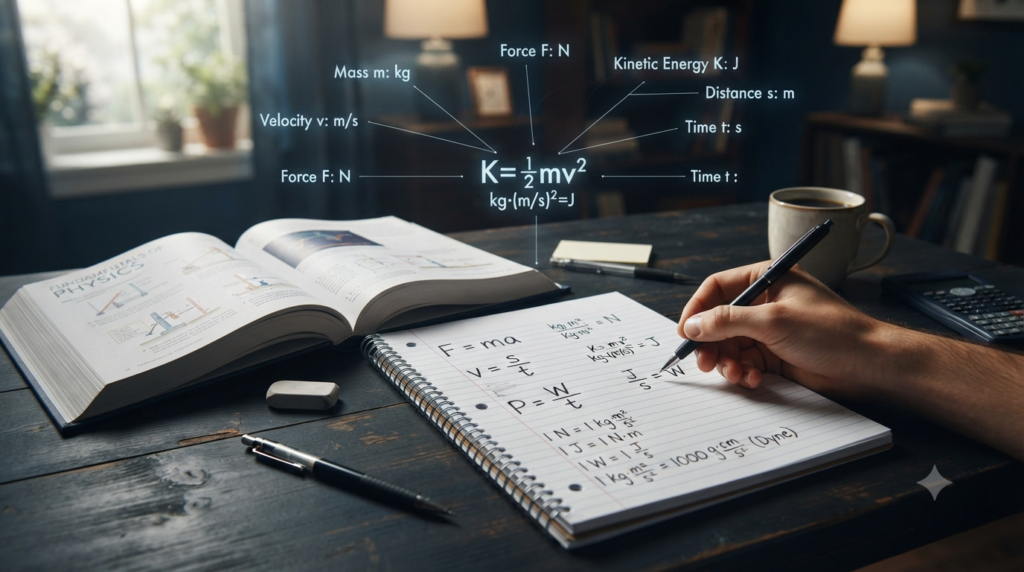
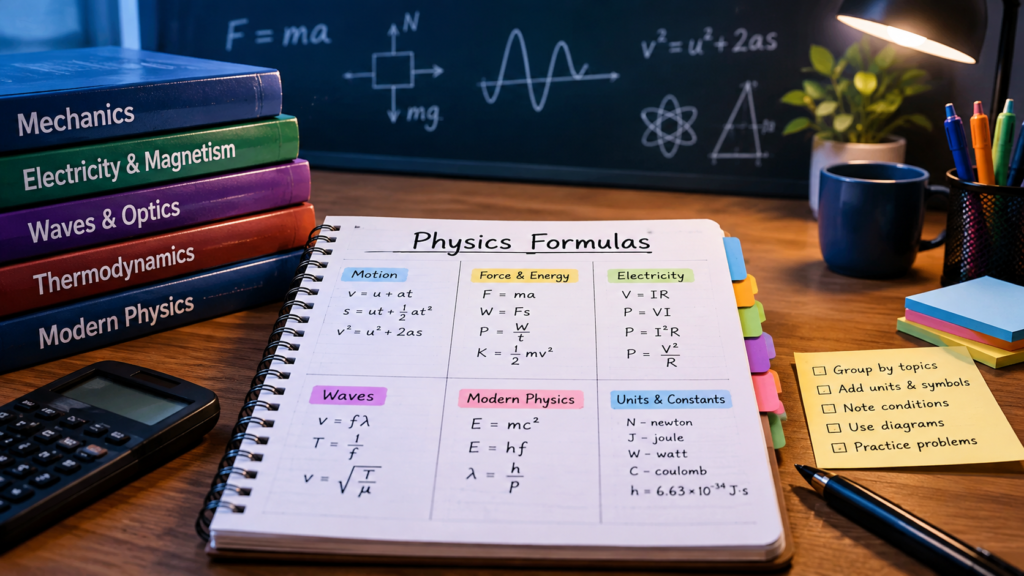
Physics equations often contain several symbols, numbers, and quantities. To understand an equation correctly, it is important to know which quantities can change and which remain fixed. A constant is a quantity that keeps the same value under the conditions being considered. Constants help describe physical relationships and make equations useful for predicting how one quantity depends on another.
When solving physics problems, identifying constants is not just about finding numbers. A symbol can also represent a constant even when its numerical value is not written in the equation. Learning how to recognize these quantities makes equations easier to understand, rearrange, and apply correctly.
What Is a Constant in Physics?
A constant is a quantity whose value does not change within a particular physical situation or equation. It is different from a variable, whose value can change.
For example, consider the equation:
F = ma
Here, force F, mass m, and acceleration a can vary depending on the situation. If we study an object with a fixed mass, however, its mass can be treated as a constant during that particular problem.
Another example is:
v = u + at
If the acceleration a is constant, then the equation describes motion under constant acceleration. In this case, acceleration does not change with time.
The important point is that whether a quantity is a constant can depend on the physical situation being studied.
Constants and Variables Are Different
The easiest way to identify a constant is to compare it with a variable.
A variable can take different values. A constant remains unchanged under the specified conditions.
For example:
s = vt
If an object moves at a fixed speed, v is constant while time t changes. As time increases, displacement s changes.
In this equation:
s is a variable.
t is a variable.
v can be a constant if the speed remains unchanged.
Therefore, the same symbol may sometimes act as a variable and sometimes as a constant depending on the conditions of the problem.
Look for Fixed Numerical Values
One of the simplest ways to identify constants is to look for numbers that do not change.
Consider:
y = 3x + 5
The numbers 3 and 5 are fixed numerical values in this equation. They do not change when x changes.
The value of y changes as x changes, but the coefficients 3 and 5 remain fixed.
In physics, numerical constants often appear as coefficients in equations. For example:
F = 2ma
If 2 is simply a numerical factor in the relationship, it remains fixed while the physical quantities change.
However, not every number appearing in a physics equation should automatically be called a physical constant. Some numbers may simply be coefficients, conversion factors, or values supplied for a particular problem.
Recognize Universal Physical Constants
Some constants have fixed values throughout physics and are known as fundamental or universal constants.
Examples include:
Speed of light: c ≈ 3.00 × 10⁸ m/s
Gravitational constant: G ≈ 6.67 × 10⁻¹¹ N m²/kg²
Planck constant: h ≈ 6.626 × 10⁻³⁴ J s
Elementary charge: e ≈ 1.602 × 10⁻¹⁹ C
These constants have specific values and units. They appear in equations describing fundamental physical laws.
For example, Einstein’s mass-energy relationship is:
E = mc²
Here, c represents the speed of light in vacuum. It is treated as a universal constant, while E and m can vary.
Recognizing commonly used physical constants can make advanced physics equations much easier to interpret.
Identify Constants by Their Role in an Equation
Sometimes a constant is easier to identify by looking at what role it plays.
Consider Hooke’s law:
F = kx
Here, k is the spring constant. For a particular spring within its elastic limit, k remains constant. The force F and displacement x can change.
The symbol k therefore represents a constant for that particular spring.
Another example is Newton’s law of universal gravitation:
F = Gm₁m₂/r²
The gravitational constant G is fixed. The masses m₁ and m₂ and the distance r can vary.
This shows that constants can have specific physical meanings rather than being simple numbers.
Check the Conditions of the Problem
A quantity should not be classified as a constant without considering the conditions.
For example:
v = u + at
In this equation, a is often described as constant when studying uniformly accelerated motion. But acceleration does not have to be constant in every physical situation.
If acceleration changes with time, then treating a as a constant would be incorrect.
Similarly, in the equation:
p = ρgh
for fluid pressure under certain conditions, density ρ and gravitational acceleration g may be treated as constants while depth h changes.
Thus, always ask: Is this quantity changing under the conditions being studied?
Constants in Equations of Motion
Equations of motion provide useful examples of constants and variables.
Consider:
s = ut + ½at²
When studying motion with constant acceleration:
s can change.
t changes as time passes.
u is the initial velocity and remains fixed for the chosen motion.
a is treated as constant.
The initial velocity u is therefore a fixed starting value for that particular motion, while acceleration a remains constant according to the assumption of the equation.
Understanding these roles helps prevent confusion when substituting values into motion equations.
Constants Can Be Hidden in Symbols
Not all constants appear as ordinary numbers.
Consider:
C = 2πr
The number 2 and π are constants. The radius r can change.
The constant π has an exact mathematical value, approximately 3.14159. It appears frequently in physics equations involving circles, waves, rotation, and oscillations.
Similarly, equations may contain symbols such as G, c, h, or k that represent constants.
Therefore, when reading an equation, do not look only for ordinary numerical values. Pay attention to symbols that have fixed physical or mathematical meanings.
Use Units to Recognize Physical Constants
Units can also provide clues.
Suppose an equation contains:
F = kx
Force has units of newtons, while displacement has units of metres. Therefore, k must have units that allow the equation to remain dimensionally correct:
k = F/x
So the unit of k is N/m.
The units of a constant often reveal what physical quantity it represents.
For example, the gravitational constant G has units that are quite different from the speed of light c. Knowing these units can help distinguish different constants in an equation.
Do Not Confuse Constants With Known Values
A known value is not always a constant.
Suppose a physics problem says that a car has a mass of 1,000 kg. The value 1,000 kg is fixed for that particular problem, so mass can be treated as constant during the calculation.
But mass itself is not a universal constant.
This distinction is important:
A quantity can be constant in a particular problem without being a universal physical constant.
The mass of an object may remain unchanged during an experiment, while the gravitational constant G has a fixed fundamental value.
A Simple Method to Identify Constants
When you encounter a new physics equation, use the following steps.
Step 1: Write Down the Equation
Start by looking at the complete equation.
For example:
F = Gm₁m₂/r²
Step 2: Identify Every Symbol
Determine what each symbol represents.
F is force, G is the gravitational constant, m₁ and m₂ are masses, and r is distance.
Step 3: Ask Which Quantities Can Change
Consider the physical situation. Masses or distance may change between different situations.
Step 4: Look for Fixed Values
Check for mathematical constants, numerical coefficients, or known physical constants.
Step 5: Check the Conditions
Determine whether a quantity is assumed to remain unchanged during the problem.
Step 6: Check the Units
Units can help confirm whether a symbol represents a particular physical constant.
This process provides a reliable way to separate constants from variables.
Why Identifying Constants Matters
Knowing which quantities are constant makes physics equations easier to understand and solve.
If a constant is identified correctly, you can simplify an equation, compare different situations, and understand how variables affect one another.
For example, if:
F = ma
and mass remains constant, then force is directly proportional to acceleration:
F ∝ a
The constant mass controls the relationship between force and acceleration.
This way of thinking is important not only for solving numerical problems but also for understanding graphs, experiments, formulas, and physical laws.
Conclusion
Identifying constants in physics equations requires more than simply searching for numbers. A constant is a quantity that remains unchanged under the conditions being considered. It may be a mathematical constant such as π, a universal physical constant such as G or c, or a quantity that is fixed for a particular experiment or problem.
The best approach is to identify each symbol, determine which quantities can change, examine the conditions, and use units to confirm their physical roles. Once you become comfortable distinguishing constants from variables, physics equations become much easier to read, interpret, and apply.

FAQs
A constant is a quantity that remains unchanged under the conditions being considered. It can be a fixed numerical value, a mathematical constant, or a physical constant. For example, π is a mathematical constant, while the speed of light in vacuum, c, is a fundamental physical constant. Some quantities are constant only within a particular problem. For example, the mass of an object may remain fixed during an experiment, even though mass is not a universal constant. Identifying constants helps you understand which quantities can change and which remain fixed while using a physics equation.
Start by identifying every symbol and number in the equation. Then ask whether each quantity can change under the conditions of the problem. A quantity that remains unchanged can be treated as a constant. Also look for familiar mathematical constants such as π and physical constants such as G, c, and h. The conditions of the problem are important because a quantity may be constant in one situation but variable in another. Checking the units can also help confirm the role of a constant. This systematic approach makes complicated equations easier to understand.
A constant remains unchanged under specified conditions, while a variable can take different values. For example, in the equation F = ma, force, mass, and acceleration can all vary depending on the situation. If the mass of an object remains fixed, however, mass can be treated as a constant for that particular problem. Similarly, in motion with constant acceleration, acceleration is treated as a constant while velocity and displacement may change. The difference depends on how the quantities behave in the physical situation being studied. Understanding this distinction is essential for interpreting and solving physics equations correctly.

Not necessarily. Some numbers are fixed coefficients or mathematical constants, while others may represent values supplied for a particular problem. For example, in an equation such as F = 2ma, the number 2 is a fixed numerical factor. However, a value such as 5 kg given for an object’s mass is a known value for that specific problem, not a universal physical constant. Mathematical constants such as π have fixed values, while physical constants such as G and c have established values. Therefore, it is important to understand the meaning and role of a number before calling it a constant.
Universal constants are physical quantities with fixed values that are used across many areas of physics. They are not dependent on the particular object or experiment being studied. Examples include the speed of light in vacuum, c, the gravitational constant, G, and the Planck constant, h. These constants appear in fundamental physical laws and equations. For example, Einstein’s equation E = mc² contains c, the speed of light in vacuum. Universal constants are different from quantities that are simply held constant during one experiment. Recognizing them helps learners understand the fundamental relationships described by physics equations.
Yes. A quantity can be treated as a constant when its value does not change during the particular situation being studied. For example, the mass of a car can be considered constant while calculating its motion if no mass is added or removed. Similarly, acceleration can be treated as constant in uniformly accelerated motion. This does not mean that the quantity is always a universal constant. Its status depends on the conditions of the problem. Therefore, when identifying constants, always consider what is changing and what is being held fixed during the physical process or experiment.
Constants provide fixed reference values that help establish relationships between changing quantities. They allow equations to describe physical behavior consistently. For example, in Hooke’s law, F = kx, the spring constant k determines the relationship between force and displacement for a particular spring within its elastic limit. In Newton’s gravitational equation, G connects mass, distance, and gravitational force. Without such constants, many physical relationships could not be expressed accurately. Identifying constants also makes calculations easier because you can recognize which values remain unchanged while other quantities vary.
Yes. Units can provide useful clues about what a constant represents. In the equation F = kx, for example, the spring constant can be found from k = F/x. Since force is measured in newtons and displacement in metres, k has units of N/m. These units help identify its physical meaning. Similarly, different physical constants have characteristic units that distinguish them from other quantities. Dimensional analysis can therefore be used to check whether an equation and its constants are consistent. However, units alone may not always prove that a quantity is constant, so the physical conditions must also be considered.
Yes. π is a mathematical constant with an approximately fixed value of 3.14159. It represents the ratio of a circle’s circumference to its diameter and appears frequently in physics equations involving circular motion, rotation, waves, oscillations, and geometry. For example, the circumference of a circle is given by C = 2πr. Here, π remains constant while the radius r can vary. Unlike a physical constant such as G, π is a mathematical constant. Recognizing mathematical constants is useful because they may appear in physics equations without being explicitly described as physical quantities.
The easiest method is to examine how each quantity behaves in the specific problem. First, identify every symbol and numerical value. Next, ask whether the quantity changes during the situation being studied. If it remains unchanged, it can be treated as a constant under those conditions. Then check whether it is a mathematical constant, universal physical constant, or simply a fixed value for the problem. Finally, examine its units and physical meaning. This approach helps distinguish constants from variables and makes physics equations easier to read, interpret, rearrange, and use correctly.
Related Posts
Engineering Notation Converter
Engineering Notation Converter Convert numbers to and from engineering notation quickly and accurately. Conversion Mode Number to Engineering NotationEngineering Notation […]
Read MoreStandard Form to Scientific Notation Converter
Standard Form to Scientific Notation Converter Convert ordinary numbers into scientific notation using a coefficient and a power of 10. […]
Read MoreScientific Notation Converter
Scientific Notation Converter Convert decimal numbers into scientific notation and scientific notation into standard decimal form quickly and accurately. Conversion […]
Read MoreNumber Comparison Calculator
Number Comparison Calculator Enter two numbers to find out which number is greater, smaller, or whether both numbers are equal. […]
Read MoreSum of Geometric Series Calculator
Sum of Geometric Series Calculator Calculate the sum of finite and infinite geometric series with step-by-step solutions. Select Series Type […]
Read MoreSum of Arithmetic Series Calculator
Sum of Arithmetic Series Calculator Calculate the sum of an arithmetic series by entering its first term, common difference, and […]
Read MoreNumber Sequence Generator
Number Sequence Generator Generate number sequences easily using arithmetic, geometric, Fibonacci, or custom patterns. Sequence Type Arithmetic SequenceGeometric SequenceFibonacci SequenceCustom […]
Read MoreOdd or Even Number Checker
Odd or Even Number Checker Enter any whole number to find out whether it is odd or even. Enter a […]
Read MoreDivisibility Checker
Divisibility Checker Check whether a number is divisible by another number without leaving a remainder. Enter Number Enter a positive […]
Read MorePhysical States of Elements in the Periodic Table
The periodic table contains 118 known chemical elements, and each element has its own physical and chemical properties. One important […]
Read MoreRelative Atomic Mass and Its Significance in the Periodic Table
Every element in the periodic table has a unique atomic number and an atomic mass. While the atomic number tells […]
Read MoreIsotopes and Their Relationship with the Periodic Table
Atoms are the basic building blocks of all matter. Every chemical element consists of atoms that contain protons, neutrons, and […]
Read MoreOxidation States of Elements in the Periodic Table
Oxidation state is an important concept in chemistry that helps us understand how atoms behave when they form chemical compounds […]
Read MoreNature of Oxides Across the Periodic Table
Oxides are among the most common and important compounds in chemistry. They are formed when oxygen combines with another element, […]
Read MorePeriodic Trends in the Chemical Reactivity of Elements
The periodic table is one of the most important tools in chemistry because it helps us understand and predict the […]
Read MoreNonmetallic Character and Its Periodic Trend
Elements in the periodic table are generally classified into three major categories: metals, nonmetals, and metalloids. Metals usually lose electrons […]
Read MoreMetallic Character and Its Periodic Trend
The periodic table organizes elements according to their atomic numbers and chemical properties. One of the important properties used to […]
Read MoreElectronegativity and Its Periodic Variation
Electronegativity is one of the most important concepts in chemistry because it helps explain how atoms attract shared electrons when […]
Read More