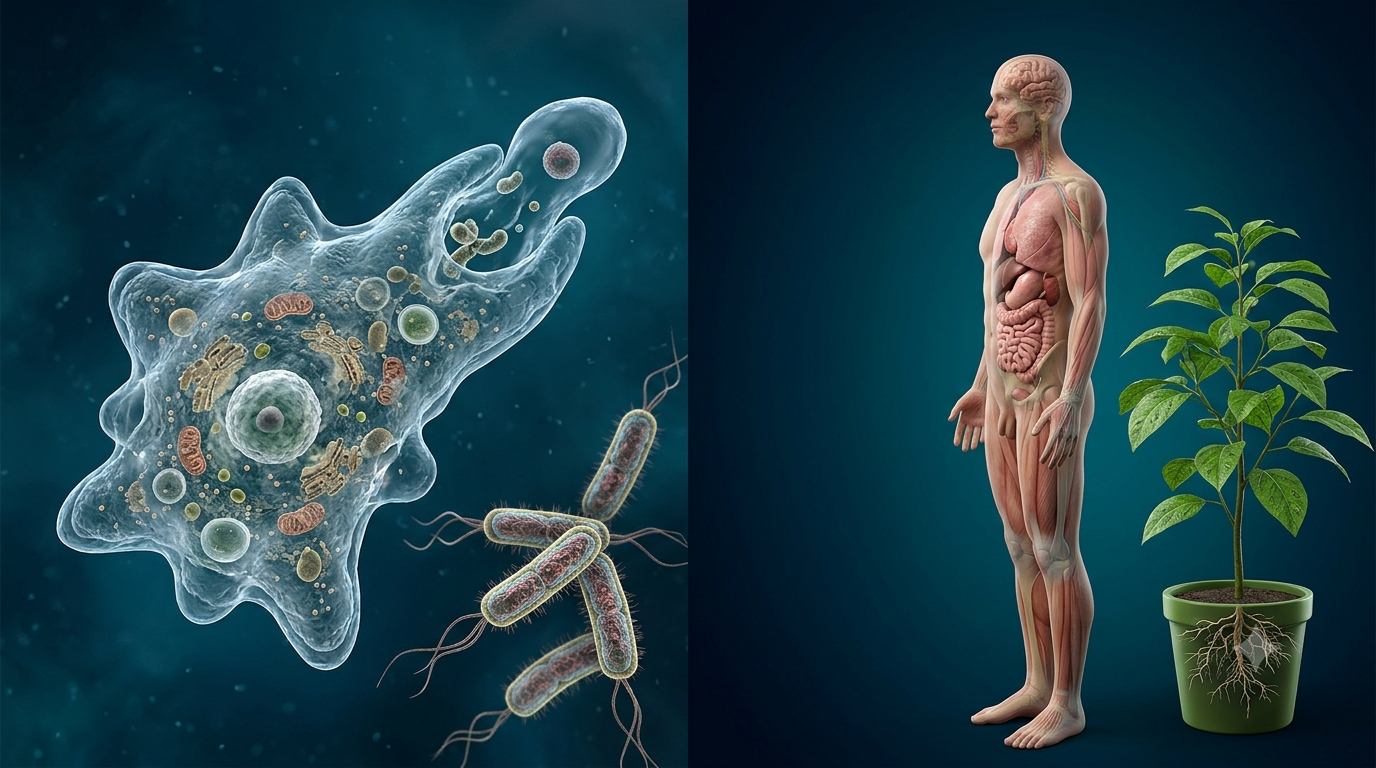
Living organisms show an incredible variety of forms, sizes, and structures. Some organisms consist of just one cell, while others are made up of millions, billions, or even trillions of cells. Despite this difference, both types can carry out the essential activities required for life. Based on the number of cells in their bodies, organisms are broadly classified into two groups: unicellular organisms and multicellular organisms. Bacteria and Amoeba are examples of unicellular organisms, whereas humans, trees, birds, and most animals are multicellular organisms. Understanding unicellular vs multicellular organisms helps us learn how living things are organized, how they obtain energy, how they reproduce, and how their bodies perform different functions. Although both groups share fundamental characteristics of life, they differ significantly in their structure, organization, growth, reproduction, and survival strategies.
What Are Unicellular Organisms?
Unicellular organisms are living things that consist of only one cell. This single cell performs all the essential activities needed to keep the organism alive. These activities include obtaining nutrients, producing energy, removing waste, responding to environmental changes, and reproducing.
Unlike multicellular organisms, unicellular organisms do not have specialized groups of cells working together. Instead, their single cell carries out all necessary life processes independently.
Many unicellular organisms are microscopic and cannot be seen clearly with the naked eye. However, some can form colonies or become large enough to be visible under certain conditions.
Examples of Unicellular Organisms
Bacteria: Bacteria are single-celled organisms found in soil, water, air, and inside other living things. Some bacteria help with digestion and nutrient recycling, while others can cause diseases.
Amoeba: Amoeba is a unicellular organism commonly found in freshwater environments. It uses temporary extensions of its cell membrane called pseudopodia to move and capture food.
Paramecium: Paramecium is a single-celled organism that usually lives in freshwater. It uses tiny hair-like structures called cilia for movement and for directing food toward its oral groove.
Yeast: Yeast is a unicellular fungus widely used in baking and fermentation. It can reproduce by budding under suitable conditions.
Euglena: Euglena is a unicellular organism commonly found in freshwater. It contains chloroplasts that allow many species to produce food through photosynthesis when light is available.
Characteristics of Unicellular Organisms
Unicellular organisms have several important characteristics:
They consist of a single cell.
One cell performs all essential life processes.
Most are microscopic, although some are visible without a microscope.
Many reproduce through binary fission, budding, or other methods.
They generally have a relatively simple level of cellular organization.
Many can respond directly to changes in their surroundings.
Their survival often depends on the ability of their single cell to perform multiple functions.
Unicellular organisms demonstrate that a single cell can be a complete living system. Their relatively simple structure allows many of them to reproduce rapidly when environmental conditions are favorable.
What Are Multicellular Organisms?
Multicellular organisms are living things made up of more than one cell. Their bodies may contain hundreds, thousands, millions, or trillions of cells, depending on the species.
In most multicellular organisms, different cells perform different functions. For example, muscle cells help produce movement, nerve cells transmit signals, and red blood cells transport oxygen in humans. These specialized cells work together to maintain the life of the entire organism.
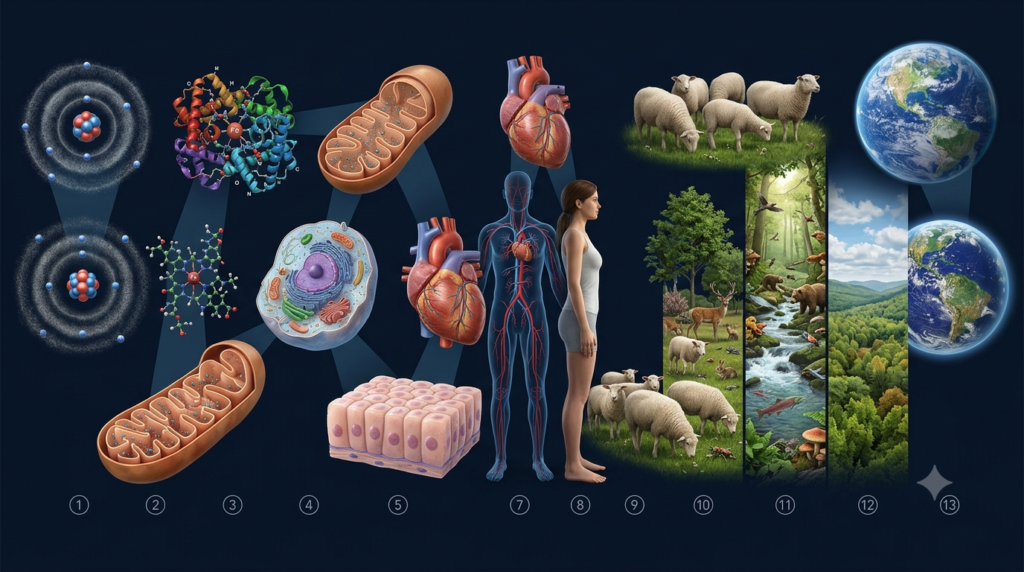
Multicellular organisms also show different levels of biological organization. In animals, cells form tissues, tissues form organs, and organs work together in organ systems. Plants have their own specialized cells, tissues, and organs, including roots, stems, and leaves.
Examples of Multicellular Organisms
Humans: The human body contains many types of specialized cells. These cells work together to support movement, digestion, breathing, circulation, and other essential activities.
Animals: Dogs, elephants, fish, insects, and birds are multicellular organisms. Their bodies contain different cell types that contribute to movement, feeding, protection, and reproduction.
Plants: Trees, grasses, flowering plants, and ferns are multicellular organisms. Their specialized cells support photosynthesis, water transport, growth, and reproduction.
Fungi: Mushrooms and many other fungi are multicellular. Their bodies commonly consist of thread-like structures called hyphae, which together form a network known as a mycelium.
Seaweeds: Many seaweeds, including large kelps, are multicellular organisms. They live in aquatic environments and obtain energy through photosynthesis.
Characteristics of Multicellular Organisms
Multicellular organisms generally have the following characteristics:
Their bodies consist of multiple cells.
Many cells become specialized for particular functions.
Different cells coordinate their activities.
In complex organisms, cells are organized into tissues, organs, and organ systems.
Growth commonly involves increases in cell number and cell size.
Many organisms have specialized reproductive structures or cells.
Their internal processes are coordinated to maintain stable conditions.
The division of work among different cells allows multicellular organisms to develop complex structures and perform many activities simultaneously.
Unicellular vs Multicellular Organisms: Key Differences
Although both unicellular and multicellular organisms are living things, their cellular organization differs in several important ways.
1. Number of Cells
The most obvious difference is the number of cells in the organism.
A unicellular organism consists of only one cell. That single cell forms the entire organism and performs all essential life functions.
A multicellular organism consists of multiple cells. These cells may be similar or different in structure and function, depending on the organism.
For example, a bacterium is unicellular, while a human is multicellular.
2. Cell Specialization
Cell specialization refers to the process by which cells develop structures and functions suited to particular tasks.
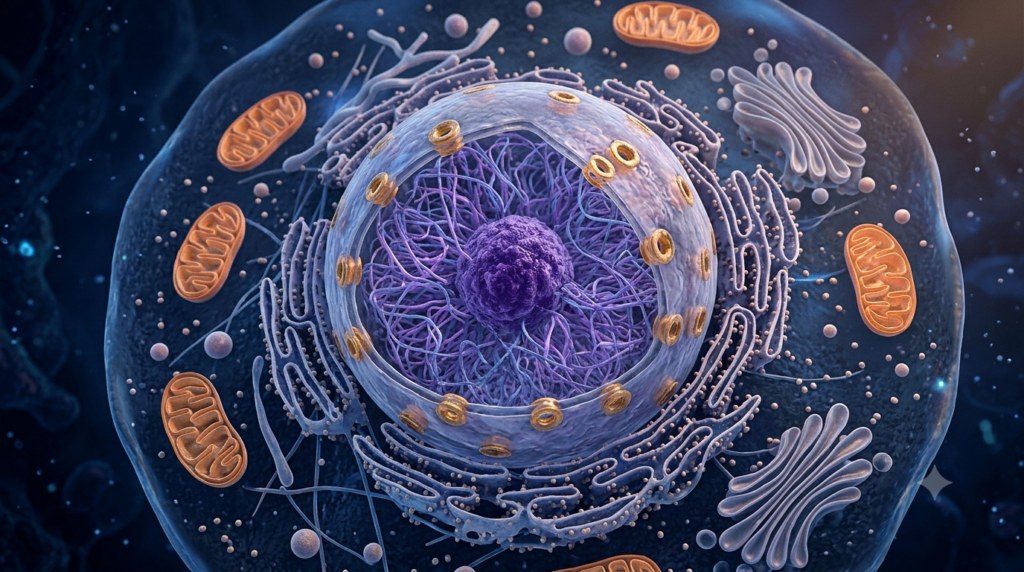
In unicellular organisms, the same cell performs all essential functions. Its internal structures may have different roles, but there are no separate specialized body cells performing independent tasks.
In multicellular organisms, different cells often specialize in different activities. Human nerve cells transmit electrical and chemical signals, while muscle cells contract to produce movement. In plants, root hair cells help absorb water and minerals, while leaf cells carry out much of the photosynthesis.
This specialization makes complex biological activities possible.
3. Body Organization
Unicellular organisms have a relatively simple level of organization because their entire bodies consist of one cell. However, this does not mean they lack complex internal structures. Some unicellular organisms possess specialized cellular structures that help them move, obtain food, and regulate their internal environment.
Multicellular organisms can have several levels of organization. In many animals, the hierarchy is:
Cell → Tissue → Organ → Organ system → Organism
For example, muscle cells form muscle tissue, which contributes to organs and organ systems involved in movement.
Plants also have organized tissues and organs, but their structures differ from those of animals.
4. Size and Visibility
Most unicellular organisms are microscopic. Their small size allows substances to move across the cell membrane and within the cell over relatively short distances.
Multicellular organisms often grow much larger because they contain many cells. Their bodies can develop complex structures that support larger sizes.
However, size alone is not a perfect way to classify organisms. Some unicellular organisms are large enough to be seen without a microscope, while some multicellular organisms are extremely small.
The number of cells, rather than visibility, determines whether an organism is unicellular or multicellular.
5. Nutrition and Energy
Unicellular organisms obtain nutrients and energy according to their particular biological characteristics. Some absorb nutrients from their surroundings, some ingest food particles, and others produce their own food through photosynthesis.
For example, Amoeba engulfs food particles, while many bacteria absorb dissolved nutrients. Euglena can photosynthesize when light is available.
Multicellular organisms also obtain energy in different ways. Animals consume food, plants generally produce organic food through photosynthesis, and fungi absorb nutrients from organic material.
Their specialized cells and body structures help coordinate the processes involved in obtaining, transporting, and using nutrients.
6. Respiration and Waste Removal
Unicellular organisms exchange many substances directly with their surroundings through their cell membrane. Oxygen, carbon dioxide, and certain waste products can move across the membrane, depending on the organism and the substance involved.
Some unicellular organisms use oxygen for cellular respiration, while others obtain energy through anaerobic processes.
In multicellular organisms, different structures help manage gas exchange and waste removal. Humans use the lungs for gas exchange and the kidneys to remove certain metabolic wastes from the blood. Plants exchange gases through structures such as stomata and lenticels and manage waste products through several processes.
The exact mechanisms vary between organisms.
7. Growth and Development
Unicellular organisms usually grow as their single cell increases in size and develops the materials needed for survival and reproduction. When conditions are suitable, many divide to produce new individuals.
Multicellular organisms generally grow through a combination of cell growth and cell division. During development, cells may also differentiate, becoming specialized for particular functions.
For example, a seed develops into a plant through repeated cell division, cell expansion, and tissue formation. A human develops from a fertilized egg through numerous stages of cell division and differentiation.
8. Reproduction
Many unicellular organisms reproduce asexually. Binary fission is common among bacteria, while budding occurs in yeast. Some unicellular organisms also have more complex reproductive processes.
Multicellular organisms reproduce through different methods. Many plants and animals reproduce sexually, involving the fusion of reproductive cells. Some multicellular organisms can also reproduce asexually through processes such as fragmentation, budding, or vegetative propagation.
Reproductive methods vary considerably, so it is not correct to assume that all unicellular organisms reproduce asexually or that all multicellular organisms reproduce sexually.
9. Response to the Environment
Unicellular organisms respond to environmental changes through the activities of their single cell. They may move toward favorable conditions, avoid harmful substances, or change their metabolism in response to available nutrients.
For example, some bacteria move toward certain chemicals through a process called chemotaxis.
Multicellular organisms often use specialized cells, tissues, and signaling systems to coordinate responses. Animals may use nervous and endocrine systems, while plants respond to light, gravity, touch, and other environmental signals through different biological mechanisms.
These coordinated responses help organisms adjust to changing conditions.
10. Survival and Repair
In a unicellular organism, serious damage to its only cell can threaten the survival of the entire organism. Its ability to recover depends on the type and extent of damage.
Multicellular organisms may be able to survive the loss or damage of some cells because other cells continue performing essential functions. Many can repair tissues by producing new cells.
For example, human skin can heal after a minor cut as cells divide and contribute to tissue repair. However, not all multicellular organisms can replace every damaged cell or regenerate every body part.
Comparison Table of Unicellular and Multicellular Organisms
| Feature | Unicellular Organisms | Multicellular Organisms |
|---|---|---|
| Number of cells | One cell | Multiple cells |
| Cell specialization | One cell performs all essential life functions | Different cells may perform specialized functions |
| Organization | Cellular level | May include cells, tissues, organs, and organ systems |
| Size | Usually small; some are visible | Often larger, but some are microscopic |
| Growth | Usually involves growth of the single cell | Involves cell growth and cell division |
| Reproduction | Commonly binary fission or budding; other methods occur | Sexual or asexual reproduction, depending on the organism |
| Nutrient acquisition | Occurs through the single cell | May involve specialized structures and coordinated processes |
| Waste removal | Often directly through the cell membrane | May involve specialized organs or other structures |
| Response | Coordinated within one cell | May involve specialized cells and signaling systems |
| Examples | Bacteria, Amoeba, Paramecium, yeast | Humans, trees, birds, mushrooms |
Advantages of Unicellular Organisms
Unicellular organisms have several advantages that help them survive in a wide range of environments.
Simple Organization
A single cell carries out all essential life activities. This organization does not require the development of multiple tissues and organs.
Rapid Reproduction
Many unicellular organisms can reproduce quickly under favorable conditions. A bacterial population, for example, can increase rapidly when sufficient nutrients and suitable environmental conditions are available.
Efficient Resource Use
Their small size often allows unicellular organisms to exchange substances efficiently with their surroundings. They may also require fewer total resources than much larger organisms.
Adaptation to Different Environments
Unicellular organisms inhabit diverse environments, including soil, freshwater, oceans, and the bodies of other organisms. Some can survive harsh conditions through specialized adaptations, although their tolerance varies by species.
Advantages of Multicellular Organisms
Multicellular organisms benefit from having many cells that can work together.
Division of Labor
Different cells can perform different tasks. This allows the organism to carry out several biological activities efficiently at the same time.
Larger Body Size
Having many cells makes it possible for organisms to develop larger bodies. Large size can provide advantages such as protection from certain predators and access to different ecological roles.
Complex Structures
Multicellular organisms can develop specialized tissues, organs, and organ systems. These structures support complex movement, feeding, reproduction, and internal regulation.
Repair and Replacement
Many multicellular organisms can replace damaged or worn-out cells. Tissue repair and cell replacement help maintain the body over time, although the ability to regenerate varies between species and tissues.
Similarities Between Unicellular and Multicellular Organisms
Despite their differences, unicellular and multicellular organisms share several fundamental characteristics.
Both are living organisms: They carry out essential life processes and maintain biological organization.
Both contain cells: The cell is the basic structural and functional unit of life. Unicellular organisms consist of one cell, while multicellular organisms consist of many.
Both use energy: All living organisms require energy to carry out cellular activities. They obtain energy from different sources and convert it into usable forms.
Both grow and develop: Unicellular organisms grow as individual cells, while multicellular organisms generally grow through cell division and cell enlargement.
Both respond to their surroundings: Organisms detect or respond to environmental conditions in ways that support survival.
Both reproduce: Reproduction allows living organisms to produce new individuals and pass genetic information to subsequent generations.
Both contain genetic material: Their hereditary information directs cellular activities and contributes to the characteristics passed from one generation to the next.
These similarities show that cellular life shares important biological foundations regardless of the number of cells in an organism.
Are All Unicellular Organisms Simple?
Unicellular organisms are often described as simple because they consist of only one cell. However, this description can be misleading if it suggests that their biology is always uncomplicated.
A single cell may carry out numerous coordinated chemical reactions, regulate its internal conditions, detect environmental signals, and control reproduction. Some unicellular organisms possess complex structures for movement, feeding, and survival.
For example, Paramecium uses cilia for movement and feeding, while Amoeba changes its shape to capture food. Bacteria can also communicate chemically and coordinate certain activities within populations.
Therefore, having one cell does not mean that an organism lacks sophisticated biological mechanisms. Unicellular organisms demonstrate how much a single cell can accomplish.
Can a Unicellular Organism Become Multicellular?
The evolution of multicellularity is an important topic in biology. Scientists believe that multicellularity evolved independently in several groups of organisms over evolutionary history.
One possible pathway involves individual cells remaining attached after division. Over time, groups of cells may develop ways to cooperate, communicate, and specialize.
In some multicellular organisms, cells become dependent on one another and cannot survive independently under normal conditions. In other organisms, cells can live separately or form groups depending on environmental circumstances.
Certain algae, for example, form colonies in which cells live together. However, a colony is not necessarily equivalent to a true multicellular organism with integrated cell specialization and coordinated development.
The evolution of multicellularity allowed life to develop new forms of organization, including complex plants, animals, and fungi.
Conclusion
Unicellular and multicellular organisms represent two major forms of cellular organization in living things. Unicellular organisms, such as bacteria, Amoeba, and Paramecium, consist of a single cell that performs all essential life functions. Multicellular organisms, including humans, plants, and most animals, contain many cells that can specialize and work together. These differences influence their growth, reproduction, nutrition, size, and overall organization. However, both groups share fundamental characteristics, including the use of energy, possession of genetic material, and the ability to respond to their environments. Learning about unicellular vs multicellular organisms provides a foundation for understanding cell biology, biological diversity, and the evolution of complex life on Earth.
FAQs
1. What is the main difference between unicellular and multicellular organisms?
The main difference between unicellular and multicellular organisms is the number of cells in their bodies. Unicellular organisms consist of only one cell, which performs all essential life functions, including obtaining nutrients, producing energy, and reproducing. Examples include bacteria, Amoeba, and Paramecium. In contrast, multicellular organisms contain many cells that often specialize in different functions. Humans, trees, birds, and mushrooms are examples of multicellular organisms. These specialized cells work together to maintain the organism’s survival. Both types perform essential life processes, but their cellular organization and complexity differ significantly.
2. What are some examples of unicellular organisms?
Common examples of unicellular organisms include bacteria, Amoeba, Paramecium, Euglena, and yeast. Bacteria are found in soil, water, and living organisms, where they perform various ecological and biological functions. Amoeba moves and captures food using temporary extensions called pseudopodia. Paramecium uses hair-like structures called cilia for movement and feeding. Euglena can perform photosynthesis when suitable conditions are available, while yeast is widely used in baking and fermentation. Each organism consists of a single cell that carries out its essential life processes. Many unicellular organisms are microscopic and can be observed clearly using a microscope.
3. What are some examples of multicellular organisms?
Multicellular organisms include humans, dogs, birds, fish, insects, trees, flowering plants, and mushrooms. These organisms contain multiple cells that may perform different functions. In humans, muscle cells support movement, nerve cells transmit signals, and red blood cells transport oxygen. In plants, root cells absorb water and minerals, while many leaf cells perform photosynthesis. Multicellular fungi commonly consist of networks of thread-like structures called hyphae. Depending on the organism, cells may form tissues, organs, and organ systems. This organization enables multicellular organisms to carry out complex activities, grow into larger forms, and coordinate different biological processes.
4. How do unicellular organisms perform all life functions with one cell?
Unicellular organisms perform essential life functions through the coordinated activities of their single cell. The cell membrane controls the movement of substances into and out of the cell. Internal structures and biochemical reactions help the organism obtain nutrients, produce energy, and maintain suitable internal conditions. Some unicellular organisms move using cilia or flagella, while others use pseudopodia. Waste products may leave through the cell membrane or be handled through specialized cellular processes. Reproduction commonly occurs through cell division or budding. Although these organisms have only one cell, that cell functions as a complete living system capable of maintaining life.
5. Why are multicellular organisms usually larger than unicellular organisms?
Multicellular organisms can generally grow larger because their bodies contain many cells that work together. Instead of relying on a single cell to perform every function, they can develop specialized cells and structures that support larger body sizes. Different tissues and organs help transport nutrients, exchange gases, remove wastes, and coordinate internal activities. However, larger size also creates challenges because substances must travel greater distances within the body. Multicellular organisms overcome these challenges through specialized transport systems and other adaptations. Nevertheless, size alone does not determine cellular organization, because some unicellular organisms are visible to the naked eye.
6. How do unicellular and multicellular organisms reproduce?
Unicellular and multicellular organisms reproduce through different methods. Many unicellular organisms reproduce asexually. For example, bacteria commonly reproduce through binary fission, while yeast can reproduce by budding. Some unicellular organisms also have more complex reproductive processes. Multicellular organisms may reproduce sexually or asexually, depending on the species. Sexual reproduction generally involves the fusion of reproductive cells, while asexual reproduction produces offspring without fertilization. Examples of asexual reproduction in multicellular organisms include vegetative propagation in plants and budding in certain animals. Reproductive methods vary widely, so neither group is limited to only one reproductive strategy.
7. Do unicellular organisms have specialized cells?
Unicellular organisms do not have separate specialized body cells because their entire bodies consist of a single cell. However, their cells can contain specialized internal structures that perform particular functions. For example, Amoeba uses pseudopodia for movement and food capture, while Paramecium uses cilia for movement and feeding. Bacteria may also possess structures that help them move or attach to surfaces. In multicellular organisms, specialization usually occurs among different cells within the same body. Muscle cells, nerve cells, and blood cells in humans illustrate this type of specialization. Therefore, cellular structures can perform specialized roles even in unicellular organisms.
8. What are the advantages of unicellular organisms?
Unicellular organisms have several advantages that help them survive in different environments. Their relatively simple organization allows a single cell to carry out all essential life processes without requiring tissues or organs. Many unicellular organisms reproduce rapidly under favorable conditions, allowing their populations to increase quickly. Their small size often supports efficient exchange of nutrients and waste products with the surroundings. Some can also adapt to changing environmental conditions through changes in their cellular activities. Unicellular organisms are found in diverse habitats, including oceans, freshwater, soil, and living organisms. Their simple structure does not prevent them from displaying complex biological processes.
9. What are the advantages of multicellular organisms?
Multicellular organisms benefit from division of labor, in which different cells perform specialized functions. This organization allows them to develop tissues, organs, and organ systems that support complex biological activities. Larger body size can provide advantages in protection, movement, and access to different ecological opportunities. Many multicellular organisms can also replace damaged or worn-out cells, helping maintain their bodies. For example, human skin can repair minor injuries through cell division and tissue regeneration. Specialized structures also help plants transport water and nutrients and allow animals to coordinate movement and internal processes. However, multicellular organisms generally require coordinated systems to support their many cells.
10. What similarities exist between unicellular and multicellular organisms?
Unicellular and multicellular organisms share several fundamental characteristics of life. Both are made of cells, which are the basic structural and functional units of living things. They contain genetic material that carries hereditary information and helps direct cellular activities. Both require energy to perform essential processes, although their energy sources and methods of obtaining nutrients differ. They also grow, respond to environmental conditions, and reproduce. Furthermore, both depend on coordinated chemical reactions to maintain life. The main distinction is how their cells are organized. Unicellular organisms rely on one cell, whereas multicellular organisms use multiple cells that may specialize and cooperate.