
Why is a subscript different from a coefficient?

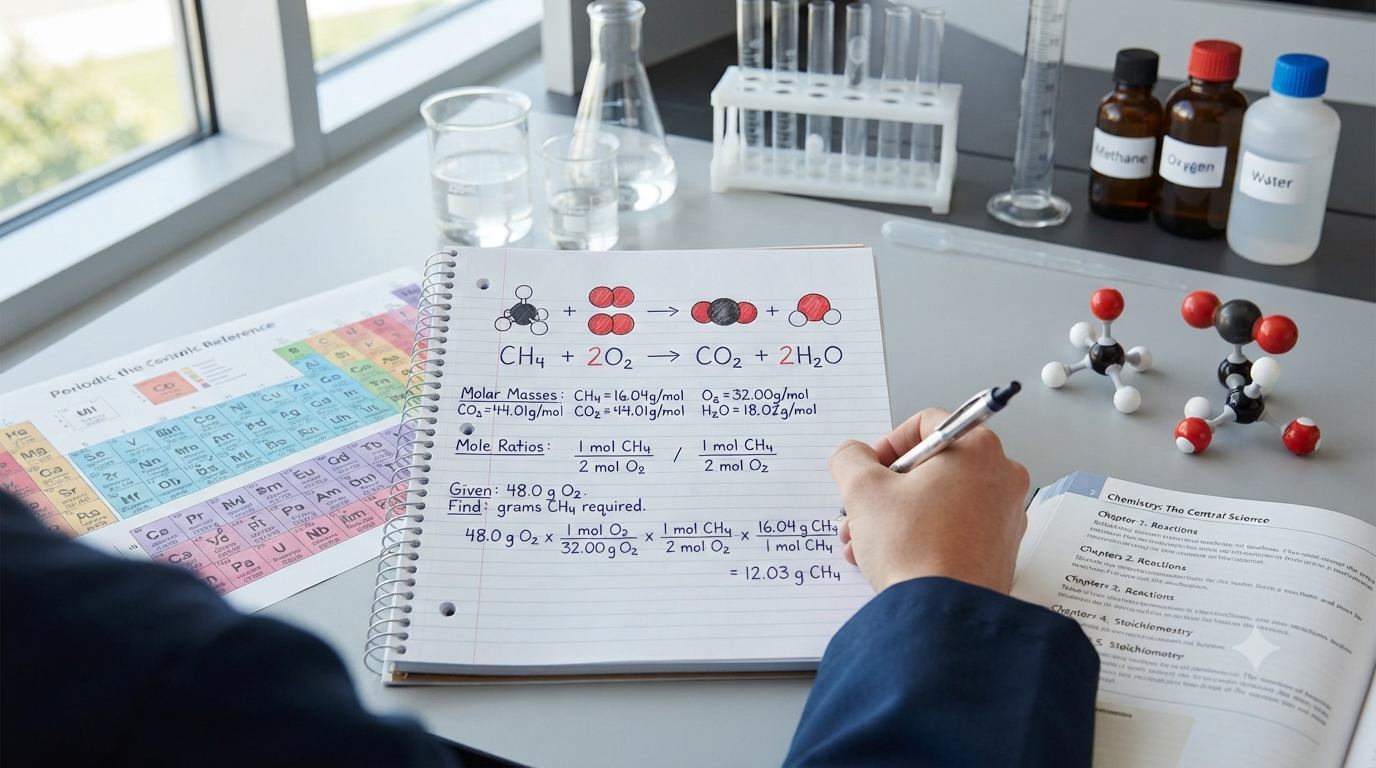
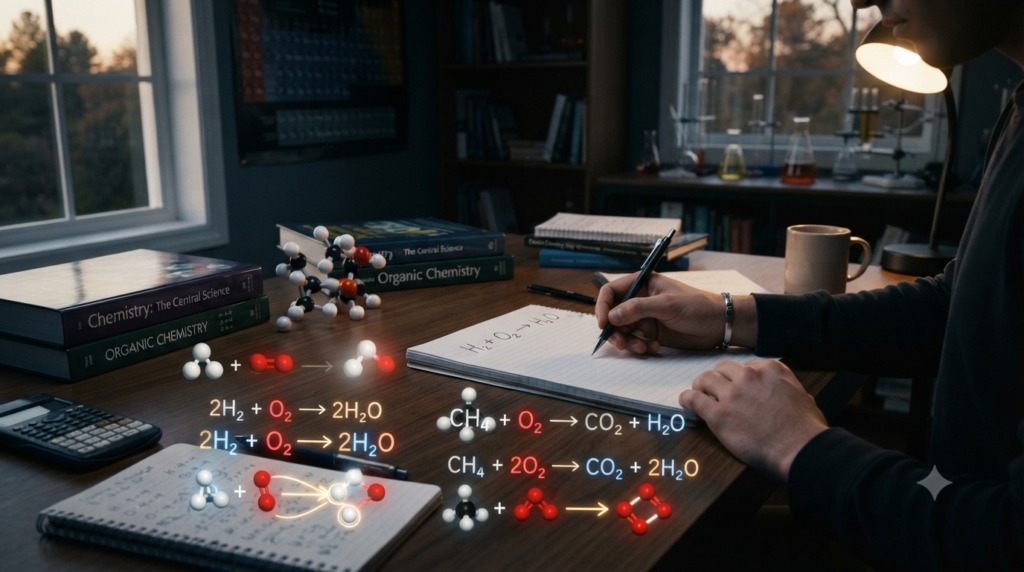
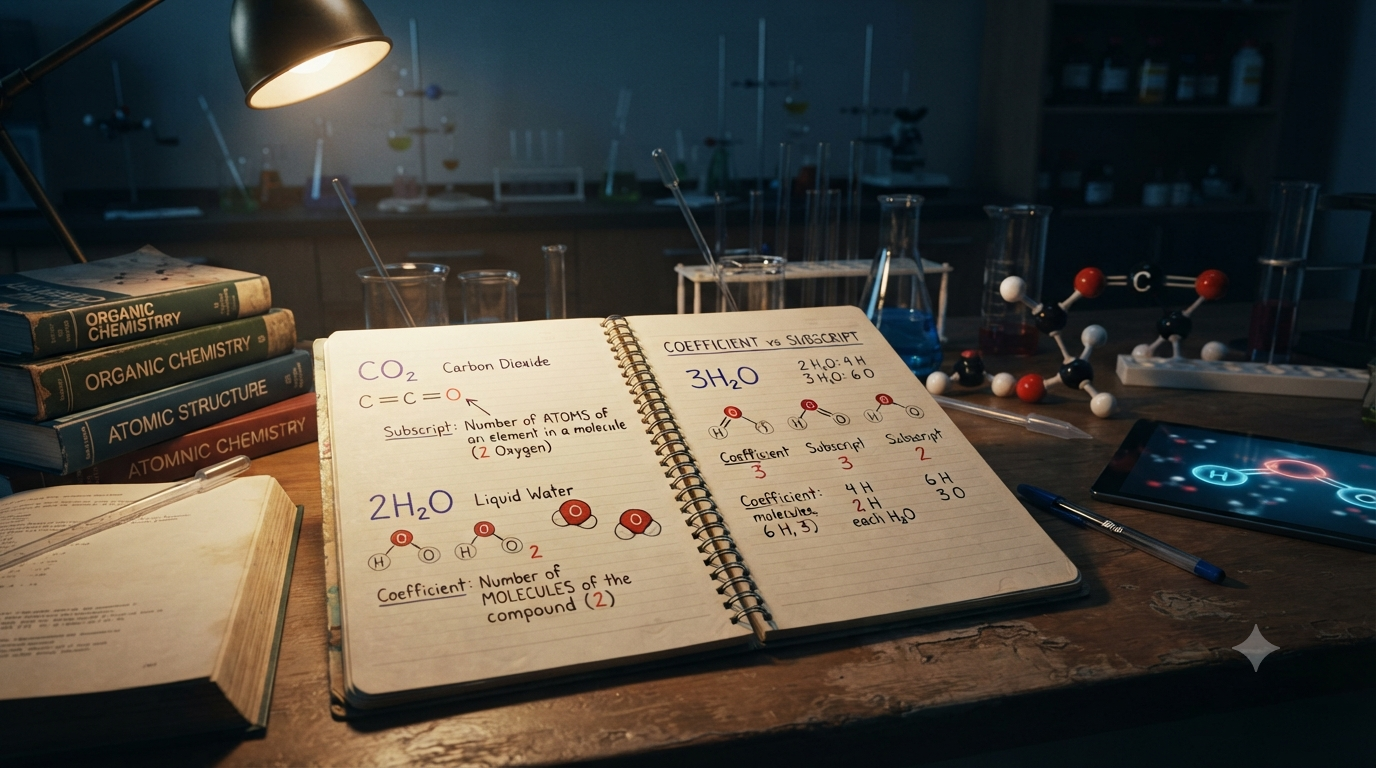
A chemistry study scene explaining the difference between a subscript and coefficient using formulas such as H₂O, CO₂, and 3H₂O.

When learning chemical formulas, two small numbers can appear next to chemical symbols and look surprisingly similar. One is called a subscript, while the other is called a coefficient. Although both can be used to show quantities, they do very different jobs in chemistry.

For example, consider the expressions 2H₂O and H₂O. The small 2 written after H is a subscript, while the larger 2 written before H₂O is a coefficient. The subscript tells us about the composition of one water molecule, whereas the coefficient tells us how many water molecules are being considered.

Understanding this difference is important because changing a subscript can change the substance itself, while changing a coefficient changes only the amount of that substance. This distinction becomes especially important when writing chemical formulas, balancing chemical equations, counting atoms, and solving stoichiometry problems.

What Is a Subscript in a Chemical Formula?

A subscript is a small number written at the lower right of a chemical symbol in a chemical formula. It tells us how many atoms of that element are present in one molecule or formula unit.

For example:

H₂O

The subscript 2 appears after H. This means that each water molecule contains two hydrogen atoms. There is no subscript after O, which means there is one oxygen atom.

Therefore:

H₂O = 2 hydrogen atoms + 1 oxygen atom

The subscript is directly connected to the chemical formula. It describes the fixed composition of the substance represented by that formula.

Examples of Subscripts

Consider a few common formulas:

CO₂

The subscript 2 after O means that one carbon dioxide molecule contains:

  • 1 carbon atom

  • 2 oxygen atoms

NH₃

The subscript 3 after H means that one ammonia molecule contains:

  • 1 nitrogen atom

  • 3 hydrogen atoms

CH₄

The subscript 4 after H means that one methane molecule contains:

  • 1 carbon atom

  • 4 hydrogen atoms

The important point is that the subscript describes the ratio of atoms within the substance.

What Is a Coefficient in Chemistry?

A coefficient is a number written before a chemical formula. It tells us how many molecules, formula units, or moles of that substance are being considered.

For example:

3H₂O

The coefficient 3 means that there are three water molecules if we are talking about individual molecules.

The formula H₂O still represents water. The coefficient does not change the identity of the substance. It simply tells us how much of that substance is present.

For three water molecules:

3H₂O

Each H₂O molecule contains 2 hydrogen atoms and 1 oxygen atom.

Therefore:

  • Hydrogen atoms = 3 × 2 = 6

  • Oxygen atoms = 3 × 1 = 3

So, 3H₂O contains 6 hydrogen atoms and 3 oxygen atoms.

The Main Difference Between a Subscript and a Coefficient

The easiest way to understand the difference is to remember what each number describes.

A subscript tells us how many atoms are present in one unit of a substance.

A coefficient tells us how many units of that substance are present.

Consider:

2H₂O

Here, there are two different numbers:

  • 2 before H₂O = coefficient

  • 2 after H = subscript

The subscript 2 tells us that one H₂O molecule contains two hydrogen atoms.

The coefficient 2 tells us that there are two H₂O molecules.

Therefore:

2H₂O = 2 × H₂O

Since one H₂O contains 2 hydrogen atoms and 1 oxygen atom:

2H₂O = 4 H atoms + 2 O atoms

The coefficient multiplies the entire formula, while the subscript applies only to the element or group immediately associated with it.

Why Can’t We Change a Subscript Freely?

Changing a subscript changes the chemical composition of a substance. This can produce a completely different substance.

For example:

H₂O

represents water.

If the subscript after hydrogen is changed:

H₂O₂

the formula now represents hydrogen peroxide.

Both substances contain hydrogen and oxygen, but their atom ratios are different.

Water has:

2 H : 1 O

Hydrogen peroxide has:

2 H : 2 O

Changing the subscript therefore changes the identity and properties of the substance.

This is why subscripts should not be changed when balancing a chemical equation.

Why Can We Change a Coefficient?

A coefficient changes the amount of a substance without changing its identity.

For example:

H₂O

and

5H₂O

both represent water.

The first expression represents one unit of water, while the second represents five units of water.

The ratio inside each water molecule remains unchanged.

One H₂O molecule contains:

2 H atoms + 1 O atom

Five H₂O molecules contain:

10 H atoms + 5 O atoms

The substance has not changed. Only the quantity has changed.

Subscripts Describe Composition

A useful way to remember the role of a subscript is to think of it as part of the chemical formula’s identity.

Consider:

CO₂

The formula tells us that carbon dioxide contains one carbon atom for every two oxygen atoms.

The subscript 2 is therefore important for identifying the composition of carbon dioxide.

If we write:

CO

we are no longer representing carbon dioxide. We are representing carbon monoxide.

The difference is only one subscript, but that small change represents a different compound.

This shows why subscripts are chemically significant.

Coefficients Describe Quantity

Coefficients are mainly used to show the amount of a substance.

Consider:

4CO₂

The coefficient 4 means there are four units of carbon dioxide.

Each CO₂ unit contains:

  • 1 carbon atom

  • 2 oxygen atoms

Therefore, four CO₂ units contain:

  • 4 carbon atoms

  • 8 oxygen atoms

The coefficient multiplies every atom represented by the formula.

So:

4CO₂ = 4 × 1 C + 4 × 2 O

Therefore:

4CO₂ = 4 C atoms + 8 O atoms

Subscripts and Coefficients in Chemical Equations

The difference becomes especially important when balancing chemical equations.

Consider the reaction:

H₂ + O₂ → H₂O

This equation is not balanced because the number of hydrogen and oxygen atoms is different on the two sides.

To balance it, we change the coefficients:

2H₂ + O₂ → 2H₂O

Notice that the subscripts have not been changed.

The formula H₂ remains H₂.

The formula O₂ remains O₂.

The formula H₂O remains H₂O.

Only the coefficients are changed.

Now count the atoms.

On the left:

2H₂

contains 4 hydrogen atoms.

O₂

contains 2 oxygen atoms.

On the right:

2H₂O

contains 4 hydrogen atoms and 2 oxygen atoms.

The equation is balanced.

This demonstrates an important rule:

When balancing a chemical equation, change coefficients, not subscripts.

What Happens If You Change the Subscript Instead?

Suppose someone tries to balance the equation by changing H₂O into H₂O₂.

They might write:

H₂ + O₂ → H₂O₂

This may appear to solve the atom-counting problem, but it changes the product.

H₂O is water, while H₂O₂ is hydrogen peroxide.

The chemical reaction has therefore been changed rather than balanced.

This is why students should never change subscripts simply to make the number of atoms match.

Coefficients Multiply the Entire Formula

Another important difference is that a coefficient applies to the entire chemical formula.

Consider:

3Ca(OH)₂

The coefficient 3 means there are three units of calcium hydroxide.

The subscript 2 after the parentheses means that each calcium hydroxide unit contains two OH groups.

To count the atoms:

Each Ca(OH)₂ contains:

  • 1 Ca atom

  • 2 O atoms

  • 2 H atoms

With a coefficient of 3:

  • Ca = 3 × 1 = 3

  • O = 3 × 2 = 6

  • H = 3 × 2 = 6

Therefore:

3Ca(OH)₂ contains 3 Ca atoms, 6 O atoms, and 6 H atoms.

The coefficient multiplies everything in the formula, while the subscript 2 applies to the OH group.

What About Parentheses?

Subscripts can also apply to groups of atoms when parentheses are used.

For example:

Al₂(SO₄)₃

The subscript 3 outside the parentheses applies to the entire sulfate group.

One sulfate group contains:

SO₄

That means:

  • 1 sulfur atom

  • 4 oxygen atoms

Because there are three sulfate groups:

  • Sulfur = 3 atoms

  • Oxygen = 3 × 4 = 12 atoms

The formula also contains the subscript 2 after Al, so there are 2 aluminum atoms.

Therefore:

Al₂(SO₄)₃

contains:

  • 2 Al atoms

  • 3 S atoms

  • 12 O atoms

This is another example of why the position of a subscript matters.

A Simple Comparison

The difference can be summarized using one formula:

4NH₃

Here:

4 = coefficient

It tells us that four NH₃ units are present.

3 = subscript

It tells us that each NH₃ unit contains three hydrogen atoms.

Therefore:

4NH₃

contains:

  • Nitrogen = 4 × 1 = 4 atoms

  • Hydrogen = 4 × 3 = 12 atoms

The coefficient tells us how many units, while the subscript tells us what each unit contains.

Why This Difference Matters in Stoichiometry

Subscripts and coefficients are also important in stoichiometry, the part of chemistry that deals with quantitative relationships in chemical reactions.

For example:

2H₂ + O₂ → 2H₂O

The coefficients show the ratio:

2 : 1 : 2

This means two units of hydrogen react with one unit of oxygen to produce two units of water.

These coefficients can also represent mole ratios:

2 mol H₂ : 1 mol O₂ : 2 mol H₂O

The subscripts, however, tell us about the composition of each substance.

For H₂:

2 hydrogen atoms per molecule

For O₂:

2 oxygen atoms per molecule

For H₂O:

2 hydrogen atoms and 1 oxygen atom per molecule

Thus, coefficients are especially important for relationships between substances, while subscripts describe the internal composition of each substance.

A Quick Rule to Remember

A simple memory rule can make this distinction easier:

Subscript = inside the formula

Coefficient = in front of the formula

Another useful rule is:

Subscript changes composition.

Coefficient changes quantity.

For example:

H₂O

Changing the subscript:

H₂O₂

changes the substance.

Changing the coefficient:

3H₂O

changes only the amount of water.

This rule is especially useful when balancing equations.

Common Mistakes Students Make

One common mistake is treating a coefficient and a subscript as interchangeable. They are not.

For example, in:

2CO₂

the coefficient 2 does not mean that the formula contains two carbon atoms and two oxygen atoms. Instead, it means there are two CO₂ units.

Each CO₂ unit contains one carbon atom and two oxygen atoms.

Therefore:

2CO₂ = 2 C atoms + 4 O atoms

Another common mistake is changing subscripts while balancing equations. This changes the chemical formula and may create a different substance.

Students may also forget that a coefficient multiplies all atoms in a formula. In:

3H₂O

the coefficient 3 multiplies both hydrogen and oxygen.

It does not apply only to hydrogen.

Final Understanding

A subscript and a coefficient may both be numbers, but they have different meanings in chemistry. A subscript is part of a chemical formula and tells us how many atoms of an element, or how many groups of atoms, are present in one formula unit or molecule. A coefficient is written before the formula and tells us how many molecules, formula units, or moles of that substance are being considered.

The difference is easy to see in 3H₂O. The subscript 2 tells us that each water molecule contains two hydrogen atoms. The coefficient 3 tells us that three water molecules are present.

Most importantly, changing a subscript can change the substance, while changing a coefficient changes only the amount. This is why coefficients are changed when balancing chemical equations, but subscripts are kept unchanged. Once this distinction is clear, reading chemical formulas, counting atoms, balancing equations, and understanding stoichiometry become much easier.

FAQs

1. What is a subscript in a chemical formula?

A subscript is a small number written at the lower right of a chemical symbol in a chemical formula. It tells us how many atoms of that element are present in one molecule or formula unit. For example, in H₂O, the subscript 2 after H means that each water molecule contains two hydrogen atoms. Oxygen has no subscript, so it represents one oxygen atom. Subscripts are part of the chemical formula and describe the composition of a substance. Changing a subscript can change the substance itself. For example, H₂O and H₂O₂ represent different substances with different compositions and properties.

2. What is a coefficient in chemistry?

A coefficient is a number written before a chemical formula. It tells us how many molecules, formula units, or moles of a substance are being considered. For example, in 3H₂O, the coefficient 3 means that three water molecules or three units of water are present. The coefficient does not change the identity of the substance. Instead, it changes its quantity. Each H₂O molecule still contains two hydrogen atoms and one oxygen atom. Therefore, 3H₂O contains six hydrogen atoms and three oxygen atoms. Coefficients are especially important when balancing chemical equations and calculating mole relationships in stoichiometry.

3. What is the difference between a subscript and a coefficient?

A subscript describes the composition of one molecule or formula unit, while a coefficient describes the number of molecules or formula units present. For example, in 2CO₂, the coefficient 2 means there are two CO₂ units. The subscript 2 means each CO₂ unit contains two oxygen atoms. Therefore, two CO₂ units contain two carbon atoms and four oxygen atoms. A useful rule is that a subscript tells us what each unit contains, while a coefficient tells us how many units are present. Changing a subscript can change the substance, whereas changing a coefficient changes only the amount.

4. Why should subscripts not be changed when balancing equations?

Subscripts should not be changed when balancing chemical equations because they are part of a substance’s chemical formula. Changing a subscript changes the ratio of atoms and can create a different substance. For example, water is H₂O, while H₂O₂ is hydrogen peroxide. If we change H₂O into H₂O₂ to balance an equation, we are changing the substance rather than balancing the original reaction. Chemical equations are balanced by changing coefficients placed before formulas. This changes the number of molecules or formula units while keeping the identity and composition of each substance unchanged. This preserves the original chemical reaction.

5. Does a coefficient multiply every atom in a formula?

Yes. A coefficient applies to the entire chemical formula that follows it. For example, in 4H₂O, the coefficient 4 multiplies both the hydrogen and oxygen atoms represented by H₂O. Each water molecule contains two hydrogen atoms and one oxygen atom. Therefore, four water molecules contain eight hydrogen atoms and four oxygen atoms. Similarly, in 3CO₂, the coefficient 3 multiplies the entire CO₂ formula. This gives three carbon atoms and six oxygen atoms. Remembering that a coefficient affects the whole formula is important when counting atoms, balancing equations, and performing stoichiometric calculations involving chemical reactions.

6. Can a coefficient change the identity of a substance?

No. A coefficient does not change the identity of a substance. It only changes how much of that substance is present. For example, H₂O, 2H₂O, and 5H₂O all represent water. The coefficient indicates the number of water molecules, formula units, or moles being considered. Each individual H₂O unit still has the same composition: two hydrogen atoms and one oxygen atom. In contrast, changing a subscript can produce a different substance. For example, changing H₂O to H₂O₂ changes water into hydrogen peroxide. Therefore, coefficients affect quantity, while subscripts define composition.

7. How do you count atoms using coefficients and subscripts?

To count atoms, first identify the subscript for each element and then multiply those numbers by the coefficient. For example, consider 3NH₃. The coefficient 3 means there are three NH₃ units. Each unit contains one nitrogen atom and three hydrogen atoms. Therefore, nitrogen atoms = 3 × 1 = 3, while hydrogen atoms = 3 × 3 = 9. So, 3NH₃ contains three nitrogen atoms and nine hydrogen atoms. When parentheses are present, the subscript outside the parentheses must also be considered. This method helps accurately count atoms in chemical formulas and chemical equations.

8. What does the subscript in H₂O mean?

The subscript 2 in H₂O means that each water molecule contains two hydrogen atoms. There is no subscript after oxygen, so oxygen is present as one atom. Therefore, one H₂O molecule contains two hydrogen atoms and one oxygen atom. The subscript describes the fixed atomic composition of the water molecule. If the subscript were changed, the chemical formula would represent a different substance. For example, H₂O₂ contains two hydrogen atoms and two oxygen atoms and represents hydrogen peroxide. Thus, the subscript is essential for showing the correct ratio of elements within a chemical compound.

9. How are coefficients used in chemical equations?

Coefficients are used in chemical equations to balance the number of atoms on both sides of a reaction. For example, the equation H₂ + O₂ → H₂O is not balanced. By adding coefficients, it becomes 2H₂ + O₂ → 2H₂O. Now there are four hydrogen atoms and two oxygen atoms on both sides. The chemical formulas themselves remain unchanged. This is important because the coefficients represent the relative amounts of substances participating in the reaction. They can also represent mole ratios, making them essential for stoichiometry and quantitative chemical calculations involving reactants and products.

10. What is the easiest way to remember the difference?

An easy way to remember the difference is: subscript means composition, coefficient means quantity. A subscript is written within or as part of a chemical formula and tells us how many atoms or groups are present in one unit. A coefficient is written before the formula and tells us how many units are present. For example, in 2H₂O, the 2 before H₂O is the coefficient, while the 2 after H is the subscript. The coefficient means two water units, while the subscript means two hydrogen atoms in each unit. This simple distinction helps prevent common chemistry mistakes.

Related Posts

Leave a Comment

Your email address will not be published. Required fields are marked *

Scroll to Top