
Arithmetic Formulas for Basic Mathematical Calculations

Arithmetic formulas for addition subtraction multiplication division fractions percentages and basic calculations

Arithmetic is one of the most fundamental parts of mathematics. It deals with the basic operations we use to work with numbers, including addition, subtraction, multiplication, and division. Whether you are calculating the total cost of items, finding the difference between two quantities, working out an average, or comparing numbers, arithmetic formulas provide simple methods for solving everyday mathematical problems.

Understanding arithmetic formulas is useful far beyond the classroom. These formulas appear in shopping, budgeting, measurements, time calculations, data analysis, science, engineering, and many other areas. Once the basic rules are understood, more complicated mathematical calculations become easier to follow.

This article explains the most important arithmetic formulas used for basic mathematical calculations. It covers fundamental operations, properties of numbers, fractions, percentages, averages, ratios, proportions, powers, and other useful relationships.

What Are Arithmetic Formulas?

Arithmetic formulas are mathematical expressions or rules that help us perform calculations systematically. They use numbers, mathematical operations, and symbols to represent relationships between quantities.

For example, the formula for addition can be written as:

a + b = c

Here, a and b are numbers being added, while c is the result or sum.

Similarly, subtraction can be represented as:

a − b = c

These simple formulas form the foundation of many calculations used in mathematics and everyday life.

Basic Arithmetic Operations

The four fundamental arithmetic operations are addition, subtraction, multiplication, and division. Understanding these operations is the first step toward using arithmetic formulas correctly.

Addition Formula

Addition combines two or more quantities to find their total.

a + b = c

Here:

  • a = first number

  • b = second number

  • c = sum

For example:

25 + 15 = 40

Therefore, the sum of 25 and 15 is 40.

Addition can also involve several numbers:

10 + 20 + 15 = 45

Addition is commonly used to find totals, combined quantities, distances, costs, and many other values.

Subtraction Formula

Subtraction finds the difference between two numbers or determines how much remains after removing one quantity from another.

a − b = c

Here:

  • a = minuend

  • b = subtrahend

  • c = difference

For example:

75 − 30 = 45

The difference between 75 and 30 is 45.

Subtraction is useful for calculating remaining money, differences in measurements, changes in quantities, and decreases.

Multiplication Formula

Multiplication is a repeated addition process. It is used when the same quantity occurs multiple times.

a × b = c

Here:

  • a = first factor

  • b = second factor

  • c = product

For example:

12 × 5 = 60

This means 12 is added five times, or 5 is added twelve times.

Multiplication is useful for calculating the total cost of several identical items, areas, quantities in groups, and repeated measurements.

Division Formula

Division separates a quantity into equal parts or determines how many times one number is contained in another.

a ÷ b = c

or

a / b = c

Here:

  • a = dividend

  • b = divisor

  • c = quotient

For example:

60 ÷ 5 = 12

The number 60 is divided into five equal parts, giving 12 in each part.

When division does not produce an exact whole number, a remainder may occur.

For example:

17 ÷ 5 = 3 remainder 2

The relationship can also be written as:

Dividend = Divisor × Quotient + Remainder

Therefore:

17 = 5 × 3 + 2

Arithmetic Order of Operations

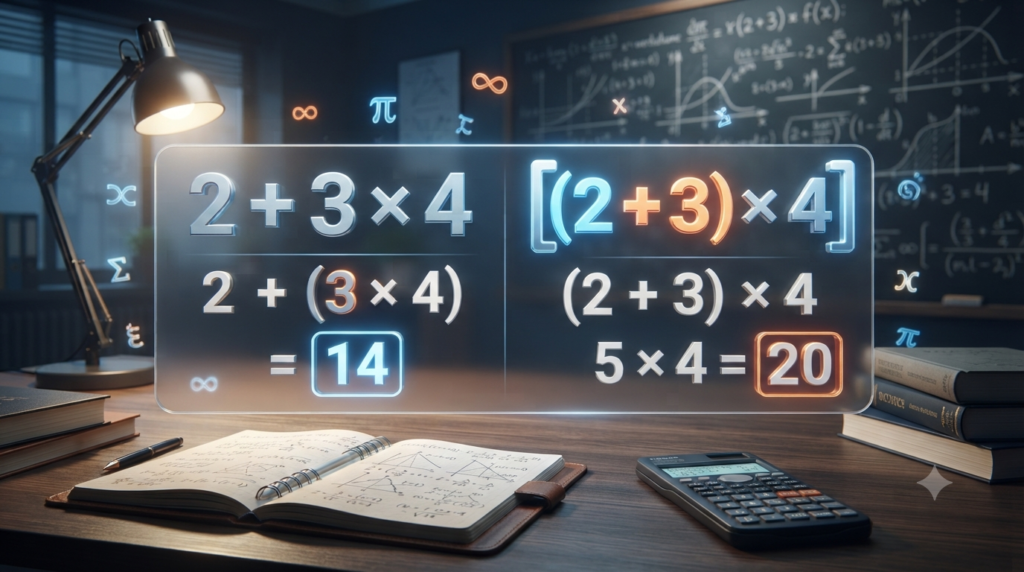
When an expression contains several arithmetic operations, they should be performed in the correct order. The standard order is commonly remembered using BODMAS or PEMDAS, depending on the convention being used.

The basic order is:

  1. Brackets or parentheses

  2. Orders or exponents

  3. Division

  4. Multiplication

  5. Addition

  6. Subtraction

For example:

8 + 4 × 3 = 8 + 12 = 20

Multiplication is performed before addition.

With brackets:

(8 + 4) × 3 = 12 × 3 = 36

The brackets are calculated first.

Following the correct order of operations prevents different interpretations of the same expression.

Properties of Addition

Arithmetic operations follow certain properties that make calculations easier.

Commutative Property of Addition

The order of numbers does not change their sum.

a + b = b + a

For example:

7 + 9 = 9 + 7 = 16

This property allows numbers to be rearranged when convenient.

Associative Property of Addition

When three or more numbers are added, changing their grouping does not change the result.

(a + b) + c = a + (b + c)

For example:

(2 + 5) + 8 = 2 + (5 + 8) = 15

Additive Identity

Adding zero to any number leaves the number unchanged.

a + 0 = a

For example:

35 + 0 = 35

The number zero is therefore called the additive identity.

Properties of Multiplication

Multiplication also follows several important properties.

Commutative Property of Multiplication

Changing the order of factors does not change the product.

a × b = b × a

For example:

6 × 8 = 8 × 6 = 48

Associative Property of Multiplication

The grouping of factors does not change the product.

(a × b) × c = a × (b × c)

For example:

(2 × 3) × 5 = 2 × (3 × 5) = 30

Multiplicative Identity

Multiplying any number by one leaves the number unchanged.

a × 1 = a

For example:

72 × 1 = 72

Therefore, 1 is the multiplicative identity.

Multiplication by Zero

Any number multiplied by zero gives zero.

a × 0 = 0

For example:

125 × 0 = 0

Distributive Property

The distributive property connects multiplication with addition and subtraction.

For addition:

a × (b + c) = (a × b) + (a × c)

For subtraction:

a × (b − c) = (a × b) − (a × c)

For example:

5 × (10 + 2)

Using the distributive property:

5 × 10 + 5 × 2 = 50 + 10 = 60

This property is particularly useful for mental calculations and simplifying mathematical expressions.

Fractions and Basic Arithmetic Formulas

Fractions represent parts of a whole and are an important part of arithmetic.

A fraction is written as:

a/b

where a is the numerator and b is the denominator, with b ≠ 0.

Addition of Fractions

For fractions with the same denominator:

a/c + b/c = (a + b)/c

For example:

3/8 + 2/8 = 5/8

For fractions with different denominators, they must first be converted to a common denominator.

Subtraction of Fractions

For the same denominator:

a/c − b/c = (a − b)/c

For example:

7/10 − 3/10 = 4/10 = 2/5

Multiplication of Fractions

Multiply the numerators and denominators separately:

a/b × c/d = ac/bd

For example:

2/3 × 4/5 = 8/15

Division of Fractions

To divide one fraction by another, multiply the first fraction by the reciprocal of the second.

a/b ÷ c/d = a/b × d/c

Therefore:

a/b ÷ c/d = ad/bc

For example:

2/3 ÷ 4/5 = 2/3 × 5/4 = 10/12 = 5/6

Decimal Arithmetic

Decimals are another way of representing numbers and fractions.

Addition and subtraction of decimals require the decimal points to be aligned.

For example:

12.50 + 3.25 = 15.75

For multiplication, the decimal places are counted after multiplying the numbers.

For example:

2.5 × 4 = 10

Decimal division can be performed by moving the decimal point when appropriate.

For example:

12.6 ÷ 3 = 4.2

Decimals are commonly used for money, measurements, scientific calculations, and percentages.

Percentage Formula

A percentage represents a quantity out of 100.

The basic percentage formula is:

Percentage = (Part / Whole) × 100

For example, if 25 out of 50 students complete a task:

Percentage = (25 / 50) × 100 = 50%

To find a percentage of a number:

Percentage value = (Percentage / 100) × Number

For example:

20% of 150 = (20 / 100) × 150 = 30

Percentages are widely used in discounts, taxes, interest, statistics, marks, and comparisons.

Average Formula

The arithmetic mean, commonly called the average, is found by dividing the sum of values by the number of values.

Average = Sum of all values / Number of values

For example, consider the numbers 10, 20, 30, and 40.

Average = (10 + 20 + 30 + 40) / 4

Average = 100 / 4 = 25

The average provides a single value that represents the central level of a group of numbers.

Ratio Formula

A ratio compares two quantities of the same type.

A ratio can be written as:

a : b

For example, if a box contains 10 red balls and 5 blue balls, the ratio of red balls to blue balls is:

10 : 5 = 2 : 1

Ratios are often simplified by dividing both terms by their common factor.

Proportion Formula

A proportion states that two ratios are equal.

a/b = c/d

Cross multiplication gives:

a × d = b × c

For example:

2/3 = 8/12

because:

2 × 12 = 3 × 8

Both sides equal 24.

Proportions are useful when scaling quantities, comparing measurements, and solving problems involving equivalent relationships.

Powers and Exponents

Powers provide a short way to represent repeated multiplication.

aⁿ = a × a × a …

where the factor a appears n times.

For example:

2³ = 2 × 2 × 2 = 8

Some basic exponent rules include:

aᵐ × aⁿ = aᵐ⁺ⁿ

aᵐ / aⁿ = aᵐ⁻ⁿ, for a ≠ 0

(aᵐ)ⁿ = aᵐⁿ

A number raised to the power of one remains unchanged:

a¹ = a

A nonzero number raised to the power of zero equals one:

a⁰ = 1

Square and Square Root Formulas

The square of a number is obtained by multiplying the number by itself.

a² = a × a

For example:

9² = 9 × 9 = 81

A square root is the number that produces a given number when multiplied by itself.

√a = b if b² = a

For example:

√64 = 8

because:

8² = 64

Square and square root calculations are commonly used in geometry, measurement, algebra, and many practical calculations.

Negative Numbers in Arithmetic

Arithmetic also includes negative numbers. The rules for adding and subtracting signed numbers are important.

When two numbers have the same sign, their absolute values are added and the common sign is retained.

For example:

−5 + (−3) = −8

When numbers have different signs, subtract the smaller absolute value from the larger absolute value and use the sign of the number with the larger absolute value.

For example:

−9 + 4 = −5

For multiplication and division:

Positive × Positive = Positive

Negative × Negative = Positive

Positive × Negative = Negative

Negative × Positive = Negative

The same sign rules apply to division.

Useful Arithmetic Relationships

Several basic relationships are useful when checking calculations.

For addition:

Sum − One Addend = Other Addend

For subtraction:

Minuend − Difference = Subtrahend

For multiplication:

Product ÷ One Factor = Other Factor

For division:

Dividend ÷ Divisor = Quotient

These relationships can be used to verify whether a calculation is reasonable.

Why Arithmetic Formulas Matter

Arithmetic formulas provide a structured way to work with numbers. Instead of solving every calculation from scratch, a known formula or rule can make the process faster and more reliable.

These formulas are used in everyday situations such as calculating shopping totals, comparing prices, determining discounts, managing budgets, measuring quantities, calculating averages, converting values, and working with time.

They also provide the foundation for more advanced areas of mathematics. Algebra, geometry, statistics, calculus, physics, chemistry, economics, and computer science all depend on basic numerical operations.

Learning arithmetic formulas therefore does more than improve basic calculation skills. It develops numerical reasoning and creates a foundation for understanding more complex mathematical ideas.

Conclusion

Arithmetic formulas are the foundation of mathematical calculation. Addition, subtraction, multiplication, and division form the four basic operations, while fractions, decimals, percentages, averages, ratios, proportions, powers, and square roots extend these operations to more practical situations.

Understanding properties such as commutativity, associativity, and distributivity also makes calculations easier and helps explain why different methods produce the same result. By learning these formulas and practicing how they are applied, anyone can build stronger numerical skills and approach everyday calculations with greater confidence.

Arithmetic may begin with simple numbers and operations, but these basic ideas form the building blocks for almost every area of mathematics and many scientific applications.

FAQs

1. What are arithmetic formulas?

Arithmetic formulas are mathematical rules used to perform basic calculations with numbers. They help us solve problems involving addition, subtraction, multiplication, division, fractions, percentages, averages, ratios, and other numerical relationships. For example, the addition formula a + b = c represents the process of combining two quantities to find their total. Arithmetic formulas make calculations more organized and easier to understand. They are used in everyday activities such as shopping, budgeting, measuring quantities, comparing values, and calculating discounts. Learning these formulas also provides an important foundation for more advanced areas of mathematics, including algebra, geometry, statistics, and calculus.

2. What are the four basic arithmetic operations?

The four basic arithmetic operations are addition, subtraction, multiplication, and division. Addition combines quantities to find a total, while subtraction finds the difference between quantities. Multiplication is used to find the total of repeated or equal quantities, and division separates a quantity into equal parts or determines how many times one number fits into another. Their basic forms are a + b, a − b, a × b, and a ÷ b. These four operations are the foundation of arithmetic and are used in almost every type of numerical calculation. More advanced mathematical operations are often built upon these basic operations.

3. What is the formula for addition?

The basic addition formula is a + b = c, where a and b are the numbers being added and c is their sum. For example, 25 + 15 = 40, so 40 is the sum of 25 and 15. Addition can involve two or many numbers, such as 10 + 20 + 15 = 45. Addition is used to combine quantities, calculate totals, find accumulated values, and solve everyday problems involving numbers. One important property of addition is that the order of the numbers does not affect the result, which is expressed as a + b = b + a.

4. What is the formula for subtraction?

The basic subtraction formula is a − b = c, where a is the minuend, b is the subtrahend, and c is the difference. For example, 75 − 30 = 45, so the difference is 45. Subtraction is used when finding how much one quantity differs from another or determining how much remains after something is removed. It is commonly used in financial calculations, measurements, comparisons, and everyday situations. Unlike addition, subtraction is not commutative, meaning that changing the order generally changes the result. For example, 10 − 4 = 6, but 4 − 10 = −6.

5. What is the formula for multiplication?

The basic multiplication formula is a × b = c, where a and b are factors and c is the product. Multiplication can be understood as repeated addition. For example, 12 × 5 = 60 means that 12 is added five times, producing 60. Multiplication is useful when working with equal groups, repeated quantities, prices, measurements, areas, and many other calculations. Multiplication has the commutative property, meaning a × b = b × a. It also follows the associative property, written as (a × b) × c = a × (b × c), which allows factors to be regrouped without changing the product.

6. What is the formula for division?

The basic division formula can be written as a ÷ b = c, where a is the dividend, b is the divisor, and c is the quotient. For example, 60 ÷ 5 = 12. Division is used to separate a quantity into equal parts or determine how many times one number is contained in another. When a division does not produce a whole number, there may be a remainder. The relationship can be written as Dividend = Divisor × Quotient + Remainder. Division by zero is not defined, so the divisor must not be zero in ordinary arithmetic calculations.

7. What is the percentage formula?

The basic percentage formula is Percentage = (Part / Whole) × 100. It expresses a quantity as a portion of 100. For example, if 25 out of 50 items meet a condition, the percentage is (25 / 50) × 100 = 50%. To find a percentage of a number, use Percentage value = (Percentage / 100) × Number. For example, 20% of 150 = (20 / 100) × 150 = 30. Percentages are widely used for discounts, taxes, marks, statistics, interest, price changes, and comparisons between quantities.

8. How do you calculate an average?

The arithmetic average, or mean, is calculated by adding all the values and dividing the total by the number of values. The formula is Average = Sum of all values / Number of values. For example, for 10, 20, 30, and 40, the average is (10 + 20 + 30 + 40) / 4 = 25. The average provides a single value that represents the central level of a set of numbers. It is commonly used when analyzing measurements, test results, prices, temperatures, and other numerical data. The arithmetic mean is one of the most commonly used forms of average.

9. What is the formula for a ratio?

A ratio compares two quantities and is commonly written as a : b. For example, if there are 10 red objects and 5 blue objects, the ratio of red objects to blue objects is 10 : 5, which can be simplified to 2 : 1. To simplify a ratio, divide both terms by their greatest common factor. Ratios are useful for comparing quantities, describing proportions, scaling measurements, and solving practical problems. The quantities being compared should represent the same type of measurement or have compatible units. Ratios form an important foundation for understanding proportions and many mathematical relationships.

10. Why are arithmetic formulas important?

Arithmetic formulas are important because they provide simple and organized methods for solving numerical problems. They are used in everyday activities such as calculating prices, managing money, measuring quantities, finding percentages, comparing values, and calculating averages. Arithmetic also forms the foundation of more advanced mathematical subjects. Algebra, geometry, statistics, calculus, physics, chemistry, economics, and computer science all rely on basic arithmetic operations and numerical relationships. Learning arithmetic formulas helps develop calculation skills and numerical reasoning. Once these basic formulas are understood, it becomes easier to work with more complex mathematical expressions and solve practical problems accurately.

Related Posts

Leave a Comment

Your email address will not be published. Required fields are marked *

Scroll to Top