Chemical formulas are one of the simplest ways scientists communicate information about matter. A substance may contain millions or billions of atoms, yet a short formula can tell us which elements are present and how their atoms are arranged or combined. For example, H₂O represents water, CO₂ represents carbon dioxide, and NaCl represents sodium chloride.
Learning how chemical formulas work helps us understand chemistry more clearly. Instead of describing a substance with long sentences, chemists use symbols, numbers, and formulas to represent its composition. These formulas can also help us determine the number of atoms, calculate molecular masses, write chemical equations, and understand how substances behave during chemical reactions.
What Is a Chemical Formula?
A chemical formula is a symbolic representation of a substance. It uses chemical symbols to show which elements are present and numerical subscripts to indicate how many atoms of each element are involved.
For example, the formula H₂O contains two different element symbols: H for hydrogen and O for oxygen. The small number ₂ after H tells us that two hydrogen atoms are present. Since there is no number written after O, it represents one oxygen atom.
Therefore, one molecule of water contains:
2 hydrogen atoms
1 oxygen atom
Similarly, CO₂ represents carbon dioxide. It contains one carbon atom and two oxygen atoms.
Chemical formulas make it possible to represent the composition of substances in a compact and universally understood form.
How Chemical Symbols Represent Elements
Every chemical formula is built from chemical symbols. Each element has a unique symbol, usually consisting of one or two letters.
The first letter is always capitalized, while the second letter, if present, is lowercase. For example:
H = Hydrogen
O = Oxygen
C = Carbon
Na = Sodium
Cl = Chlorine
Ca = Calcium
Mg = Magnesium
When these symbols are combined, they can represent compounds and other substances.
For example, calcium carbonate has the formula CaCO₃. This formula contains calcium, carbon, and oxygen. The symbols themselves identify the elements, while the numbers provide information about their quantities.
What Do Subscripts Mean?
A subscript is a small number written at the lower right of an element symbol. It tells us how many atoms of that element are represented in one molecule or formula unit.
Consider H₂O. The subscript ₂ belongs only to hydrogen, so there are two hydrogen atoms. Oxygen has no subscript, which means there is one oxygen atom.
Now consider CO₂. The subscript ₂ belongs to oxygen, giving one carbon atom and two oxygen atoms.
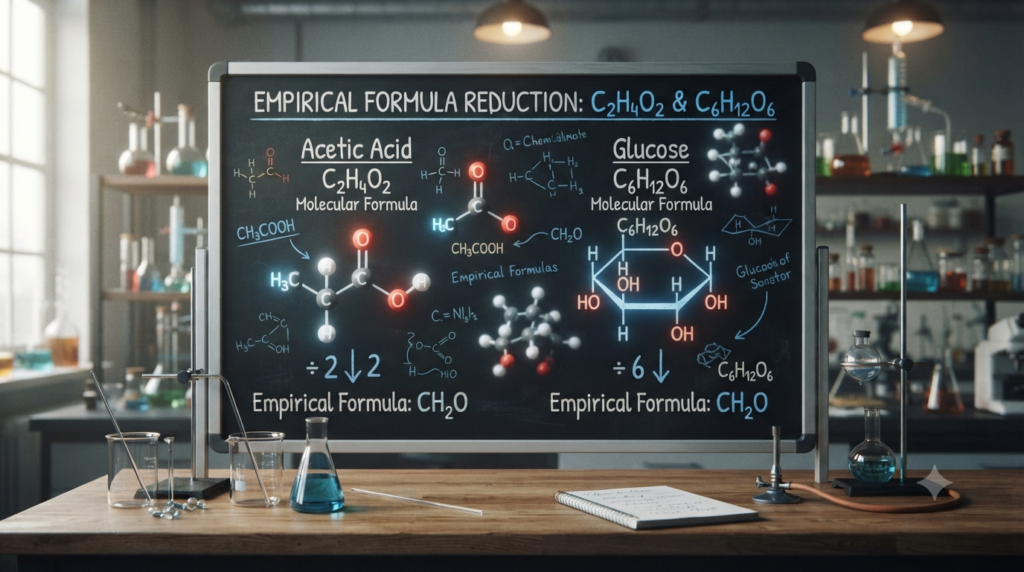
Another example is C₆H₁₂O₆, the formula for glucose. It represents:
6 carbon atoms
12 hydrogen atoms
6 oxygen atoms
The subscripts therefore provide important information about the composition of the substance.
Why Chemical Formulas Are More Than Names
A chemical formula does more than give a substance a short name. It provides quantitative information about its composition.
For example, the formula NH₃ represents ammonia. It tells us that every molecule contains one nitrogen atom and three hydrogen atoms. This fixed ratio is an important characteristic of the substance.
Similarly, H₂O always has hydrogen and oxygen atoms in a 2:1 ratio. If the ratio changed, the substance would no longer be water.
This shows that chemical formulas communicate the definite composition of substances.
Chemical Formulas of Compounds
Compounds are substances formed when atoms of two or more different elements are chemically combined. Their formulas show the elements involved and their proportions.
For example, sodium chloride is represented as NaCl. It contains sodium and chlorine in a 1:1 ratio.
Magnesium chloride has the formula MgCl₂. The formula shows that magnesium and chlorine combine in a ratio of 1:2.
Aluminum oxide is represented by Al₂O₃. It contains two aluminum atoms for every three oxygen atoms in its formula unit.
These formulas help chemists understand the composition of compounds without needing to describe the arrangement using words alone.
Molecular Formulas
A molecular formula shows the actual number of atoms of each element in one molecule of a molecular substance.
For example, the molecular formula of methane is CH₄. One methane molecule contains one carbon atom and four hydrogen atoms.
Ethane has the formula C₂H₆, meaning that one molecule contains two carbon atoms and six hydrogen atoms.
Molecular formulas are particularly useful for substances made of individual molecules. They provide direct information about the atoms present in each molecule.
Formula Units in Ionic Compounds
Not every substance exists as separate molecules. Ionic compounds form large repeating structures called crystal lattices. For such substances, chemical formulas are commonly described in terms of formula units.
For example, NaCl represents sodium chloride. It indicates a 1:1 ratio of sodium ions to chloride ions in the ionic structure.
Likewise, CaCl₂ represents calcium chloride and indicates a ratio of one calcium ion to two chloride ions.
Although these formulas do not necessarily describe individual molecules, they still communicate the simplest whole-number ratio of ions in the compound.
Parentheses and Subscripts
Some chemical formulas contain parentheses. Parentheses are used when a group of atoms occurs more than once.
For example, calcium hydroxide is written as Ca(OH)₂. The subscript ₂ outside the parentheses applies to the entire OH group.
Therefore, Ca(OH)₂ contains:
1 calcium atom
2 oxygen atoms
2 hydrogen atoms
Another example is Al₂(SO₄)₃. The subscript ₃ applies to the entire sulfate group, SO₄.
This means the formula contains:
2 aluminum atoms
3 sulfur atoms
12 oxygen atoms
Understanding parentheses is important when counting atoms in more complex formulas.
Coefficients and Subscripts Are Different
Chemical equations often contain numbers placed in front of formulas. These are called coefficients and should not be confused with subscripts.
For example:
2H₂O
The coefficient 2 means there are two water molecules. Each water molecule contains two hydrogen atoms and one oxygen atom.
Therefore, two H₂O molecules contain:
4 hydrogen atoms
2 oxygen atoms
Changing a subscript changes the substance, while changing a coefficient changes the number of particles represented.
For example, H₂O and H₂O₂ are different substances because their formulas have different subscripts. However, 2H₂O simply represents two units of water.
Chemical Formulas and Chemical Reactions
Chemical formulas are essential for writing chemical equations. They allow scientists to represent reactants and products accurately.
For example, hydrogen reacts with oxygen to form water:
2H₂ + O₂ → 2H₂O
The formulas show which substances participate in the reaction. The coefficients ensure that the number of atoms is balanced on both sides.
On the left side, there are four hydrogen atoms and two oxygen atoms. On the right side, there are also four hydrogen atoms and two oxygen atoms.
This demonstrates how chemical formulas and equations work together to represent chemical changes.
What Chemical Formulas Can Tell Us
A chemical formula can provide several useful pieces of information. It can show:
Which elements are present
The number of atoms of each element in a molecule or formula unit
The ratio of elements in a compound
The relative composition of a substance
Information needed to calculate molar mass
The substances involved in chemical reactions
For example, from CO₂ we can immediately identify carbon and oxygen and determine that the atom ratio is 1:2.
Chemists can use this information for calculations, laboratory work, industrial processes, and scientific research.
Conclusion
Chemical formulas provide a concise language for representing substances. By combining chemical symbols with subscripts, they show which elements are present and how their atoms are combined. Formulas such as H₂O, CO₂, NaCl, and Ca(OH)₂ allow us to understand the composition of substances without lengthy descriptions.
Knowing how to read chemical formulas is an important foundation for studying chemistry. Once we understand the meaning of symbols, subscripts, parentheses, and coefficients, we can interpret increasingly complex compounds and chemical equations. In this way, chemical formulas connect the microscopic world of atoms and ions with the substances we observe and use in everyday life.

FAQs
1. What is a chemical formula?
A chemical formula is a short symbolic way of representing a substance. It uses chemical symbols to identify the elements present and numbers called subscripts to show how many atoms of each element are involved. For example, H₂O represents water and contains two hydrogen atoms and one oxygen atom. Chemical formulas make it easier for scientists to communicate information about substances without using lengthy descriptions. They can represent molecules, compounds, or the simplest ratios of ions in ionic substances. By learning to read chemical formulas, you can understand the composition of substances and use that information in chemical equations and calculations.
2. What do the symbols in a chemical formula mean?
The symbols in a chemical formula represent chemical elements. Each element has a unique symbol, usually consisting of one or two letters. The first letter is always capitalized, while the second letter, when present, is lowercase. For example, H represents hydrogen, O represents oxygen, C represents carbon, and Na represents sodium. When these symbols appear together in a formula, they identify the elements that make up the substance. For example, CO₂ contains carbon and oxygen. The symbols tell us which elements are present, while subscripts provide information about their quantities. Together, they give a concise description of a substance’s composition.
3. What does a subscript mean in a chemical formula?
A subscript is a small number written at the lower right of an element symbol or group of elements. It tells you how many atoms of that element are represented in a molecule or formula unit. For example, H₂O has a subscript ₂ after hydrogen, meaning there are two hydrogen atoms. Oxygen has no subscript, so one oxygen atom is understood. In C₆H₁₂O₆, the subscripts show six carbon atoms, twelve hydrogen atoms, and six oxygen atoms. Subscripts are important because they show the fixed proportions of elements within a particular substance and help us understand its chemical composition.
4. How does a chemical formula show the composition of a compound?
A chemical formula shows the elements present in a compound and their relative proportions. For example, MgCl₂ represents magnesium chloride. The formula contains magnesium and chlorine, with one magnesium atom for every two chlorine atoms. Similarly, Al₂O₃ contains aluminum and oxygen in a 2:3 ratio. These proportions are not arbitrary; they reflect the chemical composition of the compound. By examining the symbols and subscripts, you can identify which elements are combined and determine their ratios. This makes chemical formulas useful for studying compounds, calculating their masses, writing chemical equations, and understanding how substances are formed.
5. What is the difference between a molecular formula and a formula unit?
A molecular formula represents the actual number of atoms of each element in one molecule of a molecular substance. For example, CH₄ represents one methane molecule containing one carbon atom and four hydrogen atoms. A formula unit, however, represents the simplest whole-number ratio of ions in an ionic compound. For example, NaCl represents a 1:1 ratio of sodium ions to chloride ions in the ionic structure. Ionic compounds generally form extended crystal lattices rather than separate molecules. Therefore, describing NaCl as a formula unit is more appropriate than calling it a molecule. Both types of formulas communicate chemical composition.
6. What do parentheses mean in chemical formulas?
Parentheses in chemical formulas show that a group of atoms occurs more than once. A subscript outside the parentheses applies to the entire group inside them. For example, Ca(OH)₂ represents calcium hydroxide. The subscript ₂ applies to both O and H, so the formula contains one calcium atom, two oxygen atoms, and two hydrogen atoms. Another example is Al₂(SO₄)₃. Here, the sulfate group SO₄ occurs three times, giving two aluminum atoms, three sulfur atoms, and twelve oxygen atoms. Recognizing parentheses helps you correctly count atoms and understand more complicated chemical formulas.
7. What is the difference between a coefficient and a subscript?
A coefficient is a number placed in front of a chemical formula, while a subscript is a small number written within the formula. They have different meanings. For example, 2H₂O means two water molecules. Each molecule contains two hydrogen atoms and one oxygen atom, so together they contain four hydrogen atoms and two oxygen atoms. A subscript changes the composition of the substance. For example, H₂O and H₂O₂ represent different substances. A coefficient does not change the substance; it only tells us how many molecules, formula units, or other particles are represented. This distinction is essential when balancing chemical equations.
8. Can chemical formulas represent elements as well as compounds?
Yes. Chemical formulas or chemical symbols can represent both elements and compounds. A single chemical symbol can represent an element, such as Fe for iron or He for helium. Some elements naturally exist as molecules and are represented with formulas such as O₂ for oxygen and N₂ for nitrogen. Compounds contain two or more different elements chemically combined. Examples include H₂O, CO₂, and NaCl. Therefore, the formula tells us what type of substance is being represented and provides information about its composition. Understanding the symbols and subscripts makes it easier to distinguish elements from compounds.
9. How are chemical formulas used in chemical equations?
Chemical formulas are used in chemical equations to represent the substances involved in a chemical reaction. The substances that react are called reactants, while the substances formed are called products. For example, 2H₂ + O₂ → 2H₂O represents the reaction between hydrogen and oxygen to form water. The formulas identify the substances, while the coefficients show their relative amounts. Chemical equations must follow the law of conservation of mass, so the number of atoms of each element must be equal on both sides. Understanding formulas is therefore essential for writing, interpreting, and balancing chemical equations accurately.
10. Why is it important to learn how to read chemical formulas?
Learning to read chemical formulas provides a foundation for understanding chemistry. A formula can quickly tell you which elements are present and the ratio or number of atoms involved. This information is useful when studying compounds, calculating molecular or formula masses, understanding chemical reactions, and interpreting laboratory results. For example, reading H₂SO₄ tells you that sulfuric acid contains hydrogen, sulfur, and oxygen, with two hydrogen atoms, one sulfur atom, and four oxygen atoms in its molecular formula. Once you understand symbols, subscripts, parentheses, and coefficients, you can interpret more complex chemical formulas and equations with greater confidence.
Related Posts
What Do Coefficients Mean in Chemistry Formulas?
When you look at a chemical equation, you may notice numbers written before chemical formulas. These numbers are called coefficients. […]
Read MoreHow to Read Subscripts in Chemical Formulas
Chemical formulas are a simple way to represent substances using symbols and numbers. When you look at a formula such […]
Read MoreHow to Identify Elements in a Chemical Formula
Chemical formulas provide a simple way to describe the substances that make up the world around us. A formula may […]
Read MoreHow Elements Are Represented in Chemical Formulas
Chemistry deals with many different substances, from the oxygen we breathe to the water we drink and the minerals found […]
Read MoreChemical Symbols and Their Role in Chemistry Formulas
Chemistry is often described as the science of matter, but understanding chemistry also means learning how scientists communicate information about […]
Read MoreHow Chemical Formulas Represent Substances
Chemical formulas are one of the simplest ways scientists communicate information about matter. A substance may contain millions or billions […]
Read MoreWhat Is a Chemical Formula in Chemistry?
Chemistry is the study of substances, their properties, and the changes they undergo. To describe these substances clearly, chemists need […]
Read MoreBasic Types of Chemistry Formulas Explained
Chemistry formulas are one of the simplest ways scientists describe substances, reactions, and relationships between different particles. A formula can […]
Read MoreHow to Read and Understand Chemistry Formulas
Chemistry formulas may look like a collection of letters, numbers, and symbols, but they are actually a simple language used […]
Read MoreWhat Are Chemistry Formulas and Why Are They Important?
Chemistry is the science of substances, their properties, and the changes they undergo. To describe these substances clearly, chemists use […]
Read MoreHow to Verify an Answer Using Units
In physics, getting a numerical answer is only part of solving a problem. The next question is whether that answer […]
Read MoreHow to Check Whether a Physics Formula Is Correct
A physics formula is more than a collection of symbols and numbers. It represents a relationship between physical quantities and […]
Read MoreHow to Avoid Unit Conversion Mistakes in Physics
Unit conversion is one of the most common sources of mistakes in physics. A formula may be correct, the calculation […]
Read MoreHow to Avoid Sign Errors in Physics Calculations
Physics calculations are not only about choosing the correct formula and putting numbers into it. The signs of physical quantities […]
Read MoreCommon Mistakes When Using Physics Formulas
Physics formulas help us describe motion, forces, energy, electricity, heat, waves, and many other phenomena using mathematical relationships. A formula […]
Read MoreHow to Study Physics Formulas Step by Step
Physics formulas are an important part of learning physics, but simply memorizing them is not enough. A formula represents a […]
Read MoreHow to Organize Physics Formulas for Easy Revision
Physics becomes much easier when formulas are organized in a clear and meaningful way. Many learners struggle not because they […]
Read MoreHow to Build a Physics Formula Sheet
Physics involves many formulas, and remembering all of them can become difficult as you move from basic concepts to more […]
Read More