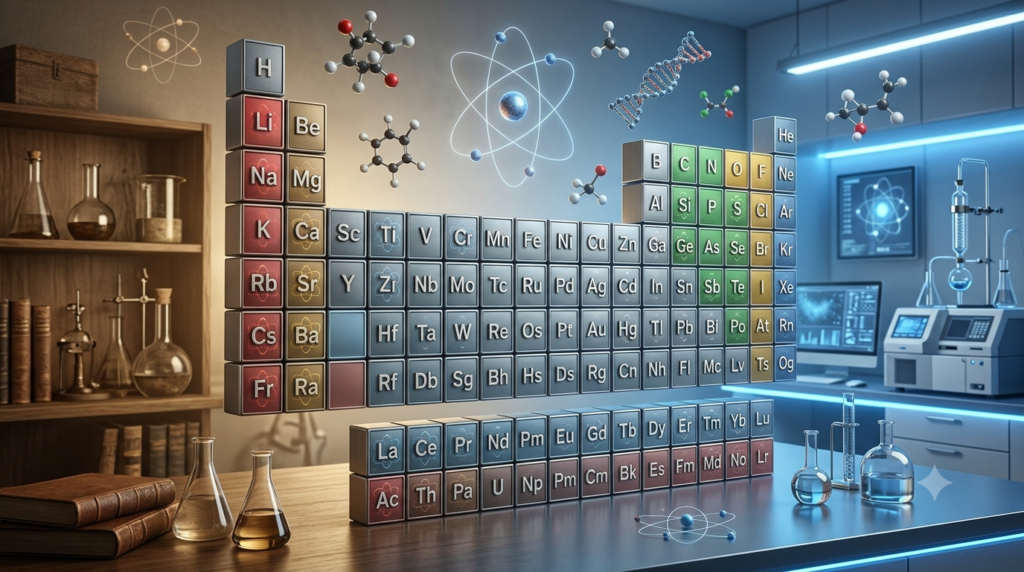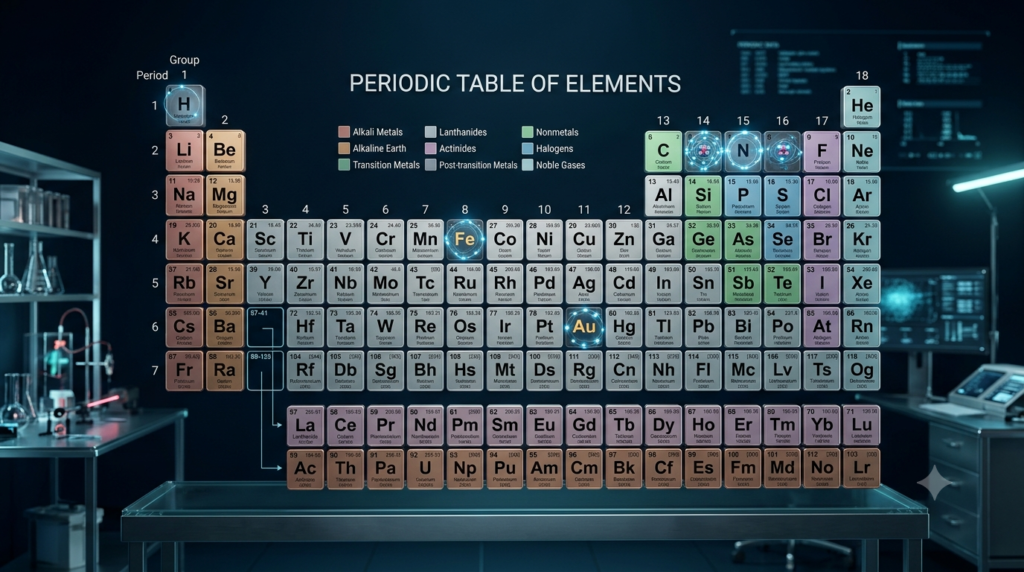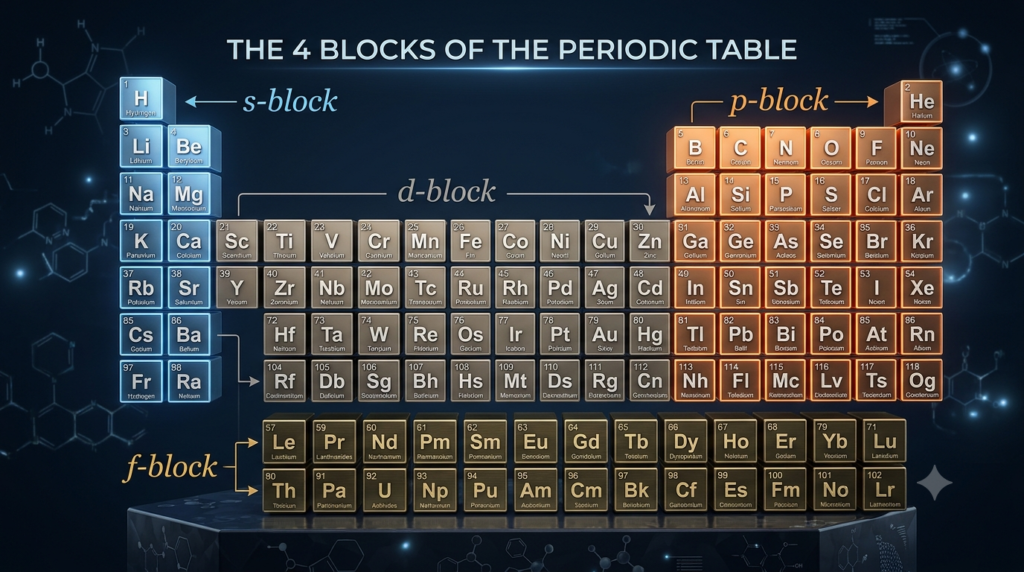
The periodic table is divided into four main blocks: s-block, p-block, d-block, and f-block. These blocks are classified according to the subshell in which the last electron enters during the electronic configuration of an element. The d-block elements occupy the central portion of the periodic table and are located between the s-block and p-block elements.
The d-block elements are commonly known as transition elements because many of them show properties that represent a transition between highly reactive metals and other types of elements. They are generally hard, strong, and lustrous metals with high melting points, high boiling points, and good electrical and thermal conductivity.
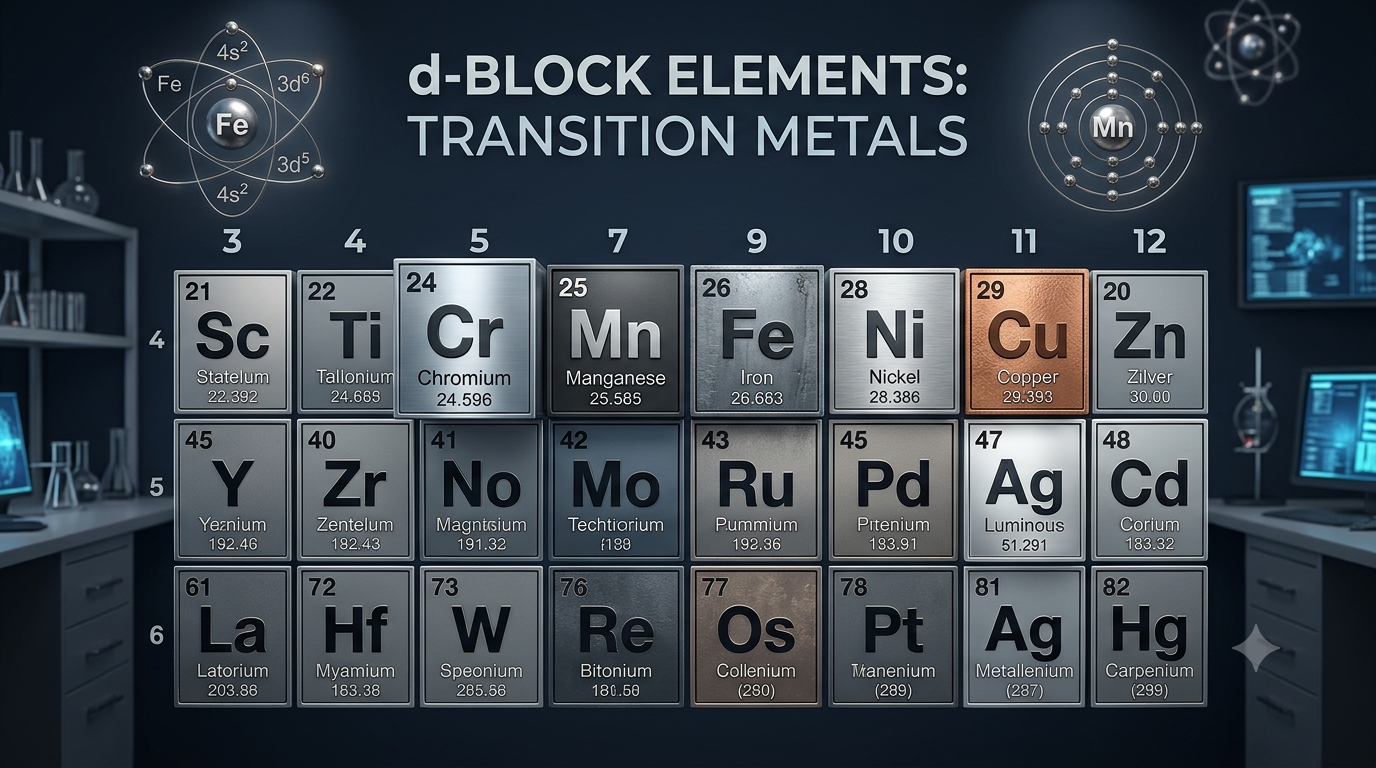
Elements such as iron, copper, nickel, chromium, manganese, and silver are important members of the d-block. They play an essential role in modern industries, construction, electronics, transportation, and chemical manufacturing.
Understanding the d-block elements is important because their unique electronic configurations give rise to several characteristic properties, including variable oxidation states, coloured compounds, magnetic behaviour, catalytic activity, and the formation of complex compounds.
1. What Are d-Block Elements?
The d-block elements are those elements in which the differentiating electron generally enters the d-subshell of the penultimate shell. They are located in Groups 3 to 12 of the periodic table.
In these elements, the general electronic configuration is:
(n − 1)d¹–¹⁰ ns⁰–²
Here:
n represents the outermost principal energy level.
(n − 1)d represents the d-subshell of the penultimate shell.
ns represents the s-subshell of the outermost shell.
The d-subshell can accommodate a maximum of 10 electrons because it contains five orbitals, and each orbital can hold two electrons.
For example, the electronic configuration of iron (Fe), which has atomic number 26, is:
Fe = [Ar] 3d⁶ 4s²
Similarly, the electronic configuration of copper (Cu), which has atomic number 29, is:
Cu = [Ar] 3d¹⁰ 4s¹
These electronic configurations help explain the characteristic chemical and physical properties of d-block elements.
2. Position of d-Block Elements in the Periodic Table
The d-block elements are positioned in the middle of the periodic table, between the s-block and p-block elements.
They occupy Groups 3 to 12 and extend across four periods:
First transition series: 3d series, from Scandium (Sc) to Zinc (Zn).
Second transition series: 4d series, from Yttrium (Y) to Cadmium (Cd).
Third transition series: 5d series, from Hafnium (Hf) to Mercury (Hg), with the lanthanoids occurring before this series.
Fourth transition series: 6d series, beginning with Rutherfordium (Rf).
The first three series contain 10 elements each. The fourth series is associated with the seventh period and includes elements that are mostly synthetic and radioactive.
The d-block elements are generally metallic in nature. Their position in the periodic table reflects the gradual filling of d-orbitals across a period.
3. Transition Elements and d-Block Elements
The terms d-block elements and transition elements are often used together, but they do not have exactly the same meaning.
A transition element is generally defined as an element that has an incomplete d-subshell in its atom or in at least one of its commonly occurring oxidation states.
For example, iron has the electronic configuration [Ar] 3d⁶ 4s². It has an incomplete d-subshell and is therefore a transition element.
However, zinc, cadmium, and mercury have completely filled d-subshells in their atoms and their common oxidation states.
For example:
Zn: [Ar] 3d¹⁰ 4s²
Zn²⁺: [Ar] 3d¹⁰
Since zinc has a completely filled d-subshell in both its atomic and common ionic forms, it is generally not considered a transition element.
The same general distinction applies to cadmium and mercury.
Therefore, all transition elements belong to the d-block, but not all d-block elements are considered transition elements under the strict definition.
4. General Electronic Configuration of d-Block Elements
The electronic configuration of d-block elements is one of the most important factors responsible for their chemical behaviour.
Their general electronic configuration is:
(n − 1)d¹–¹⁰ ns⁰–²
As we move from left to right across a transition series, electrons are gradually added to the d-subshell.
For example, the first transition series has the following electronic configurations:
Scandium (Sc): [Ar] 3d¹ 4s²
Titanium (Ti): [Ar] 3d² 4s²
Vanadium (V): [Ar] 3d³ 4s²
Chromium (Cr): [Ar] 3d⁵ 4s¹
Manganese (Mn): [Ar] 3d⁵ 4s²
Iron (Fe): [Ar] 3d⁶ 4s²
Cobalt (Co): [Ar] 3d⁷ 4s²
Nickel (Ni): [Ar] 3d⁸ 4s²
Copper (Cu): [Ar] 3d¹⁰ 4s¹
Zinc (Zn): [Ar] 3d¹⁰ 4s²
Chromium and copper show exceptional electronic configurations because half-filled and completely filled d-subshells have additional stability.
These configurations are important for understanding their oxidation states, magnetic properties, and chemical reactions.
5. General Properties of d-Block Elements
The d-block elements possess several characteristic physical and chemical properties. These properties are mainly related to their electronic configurations and the participation of d-electrons in bonding.
5.1 Metallic Nature
Most d-block elements are metals. They generally have a shiny appearance and are capable of conducting heat and electricity.
They usually form metallic bonds through the participation of their valence electrons.
Because of their metallic nature, many d-block elements are used in construction, machinery, electrical equipment, and industrial manufacturing.
For example:
Iron is widely used in buildings, bridges, and machinery.
Copper is used in electrical wires.
Nickel is used in alloys and protective coatings.
Chromium is used in stainless steel production.
5.2 High Melting and Boiling Points
Most d-block elements have relatively high melting and boiling points compared with many s-block and p-block metals.
This property is mainly associated with strong metallic bonding involving d-electrons and s-electrons.
A greater contribution of unpaired d-electrons to metallic bonding can increase the strength of bonding between metal atoms.
However, the melting and boiling points are not the same for all d-block elements. Mercury, for example, is liquid at room temperature and has a relatively low melting point.
5.3 High Density
Many d-block elements have high densities because their atoms are relatively heavy and closely packed.
Elements such as osmium, iridium, platinum, and gold have particularly high densities.
Their high density makes some of these metals useful in applications requiring compact and heavy materials.
5.4 Variable Oxidation States
One of the most important chemical properties of transition elements is their ability to show variable oxidation states.
This behaviour occurs because the energies of the outer ns orbitals and the inner (n − 1)d orbitals are relatively close.
As a result, electrons from both types of orbitals can participate in chemical bonding.
For example:
Iron shows +2 and +3 oxidation states.
Copper commonly shows +1 and +2 oxidation states.
Manganese shows several oxidation states, including +2, +4, +6, and +7.
Chromium commonly shows +2, +3, and +6 oxidation states.
Variable oxidation states allow transition elements to form a wide variety of compounds and participate in different chemical reactions.
5.5 Formation of Coloured Compounds
Many transition metal ions form coloured compounds.
This property is mainly associated with electronic transitions between d-orbitals of different energies.
When a transition metal ion is surrounded by ligands, its d-orbitals may split into different energy levels. Electrons can absorb certain wavelengths of visible light and move from a lower energy level to a higher one.
The remaining transmitted or reflected light gives the compound its observed colour.
For example:
Copper(II) sulfate is blue.
Potassium dichromate is orange.
Potassium permanganate is purple.
Nickel(II) compounds are often green.
However, not all d-block compounds are coloured. Ions with completely empty or completely filled d-orbitals are often colourless in simple cases because the usual d–d electronic transitions cannot occur.
For example, Zn²⁺ has a completely filled 3d¹⁰ configuration and its aqueous salts are generally colourless.
5.6 Magnetic Properties
Many transition elements and their compounds show magnetic behaviour because of the presence of unpaired electrons in their d-orbitals.
There are two important types of magnetic behaviour commonly discussed in transition chemistry.
Paramagnetism: Substances containing one or more unpaired electrons are generally attracted by an external magnetic field.
Diamagnetism: Substances in which all electrons are paired are generally weakly repelled by an external magnetic field.
For example:
Iron, cobalt, and nickel are ferromagnetic in their metallic forms under ordinary conditions.
Many iron and manganese ions show paramagnetic behaviour.
Zn²⁺ is diamagnetic because all its electrons are paired.
The magnetic behaviour of transition metal compounds depends on their electronic configuration, oxidation state, and surrounding chemical environment.
5.7 Formation of Complex Compounds
Transition metals have a strong tendency to form complex compounds, also known as coordination compounds.
In these compounds, a central metal atom or ion is surrounded by molecules or ions called ligands. The ligands donate electron pairs to the central metal ion to form coordinate bonds.
For example:
[Cu(NH₃)₄]²⁺
[Fe(CN)₆]³⁻
[Co(NH₃)₆]³⁺
The ability to form complexes is related to factors such as the availability of suitable orbitals, the charge of the metal ion, and its relatively small size.
Complex compounds are important in analytical chemistry, medicine, biological systems, and industrial processes.
5.8 Catalytic Properties
Many d-block elements and their compounds act as effective catalysts.
A catalyst increases the rate of a chemical reaction without being permanently consumed in the overall reaction.
Transition metals can show catalytic activity because they can adopt different oxidation states and provide surfaces or intermediate compounds that help reactions occur more easily.
Some important examples include:
Iron is used as a catalyst in the Haber process for ammonia production.
Vanadium(V) oxide (V₂O₅) is used in the Contact process for manufacturing sulfuric acid.
Nickel is used as a catalyst in the hydrogenation of vegetable oils.
Platinum and palladium are used in catalytic converters to reduce harmful vehicle emissions.
Their catalytic properties make transition metals highly valuable in chemical industries.
5.9 Formation of Alloys
Transition metals readily form alloys with other metals.
An alloy is a homogeneous mixture of two or more elements, at least one of which is a metal.
The similar atomic sizes and metallic bonding characteristics of many transition elements make alloy formation possible.
Examples include:
Stainless steel: Mainly iron, chromium, and often nickel.
Brass: Copper and zinc.
Bronze: Copper and tin.
Nichrome: Mainly nickel and chromium.
Alloys are often stronger, harder, or more resistant to corrosion than their individual components.
5.10 Formation of Interstitial Compounds
Some transition metals form interstitial compounds when small atoms such as hydrogen, carbon, nitrogen, or boron occupy the spaces between metal atoms in a crystal lattice.
Examples include:
Titanium carbide (TiC).
Tungsten carbide (WC).
Iron nitride (Fe₄N).
These compounds are often very hard and have high melting points. Many are useful in cutting tools, protective coatings, and high-temperature applications.
5.11 Formation of Oxides
Transition metals form oxides with different oxidation states.
The chemical nature of these oxides can vary from basic to amphoteric or acidic depending on the metal and its oxidation state.
For example:
MnO is basic.
Cr₂O₃ is amphoteric.
CrO₃ is acidic.
Mn₂O₇ is acidic.
Generally, as the oxidation state of a transition metal increases, the acidic character of its oxide tends to increase.
This behaviour is useful for understanding the chemical reactions of transition metal oxides.
5.12 High Tensile Strength and Hardness
Many d-block metals are strong and hard.
Their strength and hardness are associated with metallic bonding and the arrangement of atoms in their crystal structures.
For example, chromium is a hard metal, while iron is widely used in structural applications because of its mechanical strength and its ability to form strong alloys.
However, hardness varies considerably among d-block elements. Not every element has the same mechanical properties.
6. Trends Across the First Transition Series
The first transition series extends from scandium to zinc. Several physical and chemical properties show gradual changes across this series.
6.1 Atomic and Ionic Radii
The atomic radii generally decrease slightly from scandium to the middle of the series and then remain relatively similar towards the end.
This occurs because the nuclear charge increases as we move across the period. At the same time, added electrons enter the inner 3d-subshell.
The shielding effect of d-electrons does not completely balance the increasing nuclear attraction. Therefore, the atomic size generally decreases, although the trend is not perfectly regular.
6.2 Ionisation Enthalpy
Ionisation enthalpy is the energy required to remove an electron from an isolated gaseous atom.
Across the first transition series, ionisation enthalpy generally increases gradually, but irregularities occur because of the electronic configurations and relative stability of different arrangements.
6.3 Oxidation States
The number of oxidation states generally increases from scandium towards manganese and then tends to decrease towards zinc.
Manganese shows a wide range of oxidation states, with +2 to +7 being particularly important.
This variation is related to the participation of different numbers of 3d and 4s electrons in bonding.
6.4 Metallic Character
All elements of the first transition series are metals.
They generally show metallic bonding, electrical conductivity, and the ability to form positive ions.
Their metallic properties make them important in engineering and manufacturing.
7. Important Exceptions in d-Block Elements
Although d-block elements share many common properties, some elements show unusual behaviour.
Chromium: Its electronic configuration is [Ar] 3d⁵ 4s¹ instead of the expected [Ar] 3d⁴ 4s². This arrangement is associated with the additional stability of a half-filled d-subshell.
Copper: Its electronic configuration is [Ar] 3d¹⁰ 4s¹ instead of [Ar] 3d⁹ 4s². A completely filled d-subshell provides additional stability.
Zinc: Zinc has a completely filled 3d-subshell in both its atomic and common ionic forms. Therefore, it does not show many of the typical properties of transition elements.
Mercury: Mercury is a d-block metal but is liquid at room temperature. This makes it different from most other metals in the block.
These examples show that the properties of d-block elements depend on their detailed electronic structures.
8. Applications of d-Block Elements
D-block elements have numerous applications in everyday life and modern technology.
Some important applications are discussed below.
8.1 Iron in Construction and Manufacturing
Iron is one of the most widely used metals in the world. It is used to manufacture steel, which is essential for buildings, bridges, vehicles, machinery, and industrial equipment.
8.2 Copper in Electrical Equipment
Copper is an excellent conductor of electricity and is widely used in electrical wires, motors, generators, electronic devices, and power transmission systems.
8.3 Chromium in Stainless Steel
Chromium improves the corrosion resistance of steel by helping form a thin protective oxide layer on its surface.
It is therefore an important component of stainless steel.
8.4 Nickel in Alloys and Batteries
Nickel is used in stainless steel, corrosion-resistant alloys, electroplating, and several types of rechargeable batteries.
8.5 Platinum in Catalysis
Platinum is an important catalyst in chemical manufacturing and automotive catalytic converters. It is also used in certain laboratory and industrial applications.
8.6 Titanium in Aerospace Engineering
Titanium is strong, lightweight, and corrosion-resistant. It is used in aircraft, spacecraft, medical implants, and other applications where a high strength-to-weight ratio is important.
8.7 Silver in Electronics
Silver has excellent electrical conductivity. It is used in electrical contacts, electronic components, specialised coatings, and other applications.
8.8 Manganese in Steel Production
Manganese is used in steel manufacturing to improve important properties and to help remove oxygen and sulfur during processing.
These applications demonstrate the importance of d-block elements in modern industrial development.
9. Difference Between d-Block and p-Block Elements
The d-block and p-block elements differ mainly in the subshell into which their differentiating electrons enter.
| Property | d-Block Elements | p-Block Elements |
|---|---|---|
| Position | Groups 3–12 | Groups 13–18 |
| Differentiating electron | d-subshell | p-subshell |
| General configuration | (n − 1)d¹–¹⁰ ns⁰–² | ns² np¹–⁶ |
| Nature | Mostly metals | Metals, non-metals, and metalloids |
| Oxidation states | Often variable | Variable oxidation states are also common |
| Coloured compounds | Common among many transition metal ions | Colour depends on the element and compound |
| Complex formation | Common | Also occurs in several p-block elements |
| Catalytic activity | Common among many transition metals | Present in some elements and compounds |
The comparison helps explain why d-block elements have distinctive properties compared with elements in other regions of the periodic table.
Conclusion
The d-block elements form an important part of the periodic table and are essential to modern chemistry and technology. They are mainly metallic elements characterised by the gradual filling of d-orbitals. Their electronic configurations are responsible for several important properties, including variable oxidation states, coloured compounds, magnetic behaviour, catalytic activity, and the formation of complex compounds.
Elements such as iron, copper, chromium, nickel, manganese, and platinum have extensive applications in construction, electrical equipment, chemical industries, transportation, and advanced technology.
Although most d-block elements share similar characteristics, their properties vary depending on their electronic configurations and chemical environments. Studying these elements provides a better understanding of chemical bonding, periodic trends, and the behaviour of metals in different chemical reactions.
FAQs
1. What are d-block elements?
d-block elements are the elements in which the differentiating electron generally enters the d-subshell of the penultimate energy level. They are located in Groups 3 to 12 of the periodic table. These elements are mainly metals and include iron, copper, nickel, chromium, and manganese. They are known for properties such as variable oxidation states, coloured compounds, magnetic behaviour, catalytic activity, and complex formation. Their unique electronic configurations make them important in chemistry and various industrial applications.
2. Why are d-block elements called transition elements?
d-block elements are commonly called transition elements because they occupy the central region of the periodic table between the s-block and p-block elements. They also show a transition in properties across the periodic table. According to the strict chemical definition, a transition element is an element that has an incomplete d-subshell in its atom or in at least one of its common oxidation states. Therefore, elements such as iron, copper, and chromium are transition elements, whereas zinc is generally not classified as one.
3. What is the general electronic configuration of d-block elements?
The general electronic configuration of d-block elements is (n − 1)d¹–¹⁰ ns⁰–². In this configuration, n represents the outermost principal energy level, while (n − 1)d represents the d-subshell of the penultimate shell. The d-subshell contains five orbitals and can accommodate a maximum of ten electrons. As we move across a transition series, electrons are generally added to the d-subshell. This electronic arrangement is responsible for many characteristic properties, including variable oxidation states and magnetic behaviour.
4. Why do d-block elements show variable oxidation states?
d-block elements show variable oxidation states because the energy difference between their outermost ns orbitals and inner (n − 1)d orbitals is relatively small. Therefore, electrons from both subshells can participate in chemical bonding. Different numbers of electrons can be lost or shared during chemical reactions, resulting in different oxidation states. For example, iron commonly exhibits +2 and +3 oxidation states, while copper shows +1 and +2 oxidation states. This property allows transition elements to form various compounds and participate in different chemical reactions.
5. Why are many d-block compounds coloured?
Many d-block compounds are coloured because of electronic transitions between different d-orbitals. When ligands surround a transition metal ion, its d-orbitals can split into different energy levels. Electrons absorb particular wavelengths of visible light and move from lower to higher energy levels. The remaining light produces the observed colour. For example, copper(II) sulfate is blue, potassium permanganate is purple, and potassium dichromate is orange. However, compounds containing ions with completely filled or empty d-orbitals are often colourless because ordinary d–d electronic transitions cannot occur.
6. Why do d-block elements act as catalysts?
Many d-block elements act as catalysts because they can show variable oxidation states and form intermediate compounds during chemical reactions. Some transition metals also provide active surfaces on which reactants can interact more easily. These properties help reduce the activation energy of certain reactions and increase their rates. For example, iron is used as a catalyst in the Haber process, vanadium(V) oxide is used in the Contact process, and nickel is used in the hydrogenation of vegetable oils. Their catalytic properties make them important in several industrial chemical processes.
7. Why do transition elements form complex compounds?
Transition elements form complex compounds because their metal atoms or ions can accept electron pairs from surrounding molecules or ions called ligands. These electron pairs form coordinate bonds with the central metal ion. Factors such as the charge, size, and available orbitals of the metal ion influence complex formation. Examples include [Cu(NH₃)₄]²⁺, [Fe(CN)₆]³⁻, and [Co(NH₃)₆]³⁺. These coordination compounds have important applications in analytical chemistry, medicine, biological systems, and industrial processes.
8. Why do many transition elements show magnetic properties?
Many transition elements show magnetic properties because they contain unpaired electrons in their d-orbitals. These unpaired electrons produce magnetic moments, which influence how the elements and their compounds respond to an external magnetic field. Substances containing unpaired electrons are generally paramagnetic, while substances with all electrons paired are generally diamagnetic. Iron, cobalt, and nickel are well-known ferromagnetic metals under ordinary conditions. The magnetic behaviour of transition metal compounds depends on their electronic configurations, oxidation states, and surrounding chemical environments.
9. Why are zinc, cadmium, and mercury not considered transition elements?
Zinc, cadmium, and mercury are generally not considered transition elements under the strict definition because their atoms and common +2 ions have completely filled d-subshells. For example, zinc has the electronic configuration [Ar] 3d¹⁰ 4s², while its Zn²⁺ ion has the configuration [Ar] 3d¹⁰. A transition element must have an incomplete d-subshell in its atom or in at least one of its common oxidation states. Although these three elements belong to the d-block, they do not satisfy this definition.
10. What are the important applications of d-block elements?
d-block elements have numerous applications in everyday life, engineering, and modern industries. Iron is used in construction and steel manufacturing, while copper is widely used in electrical wiring because of its excellent conductivity. Chromium improves the corrosion resistance of stainless steel, and nickel is used in alloys and rechargeable batteries. Titanium is important in aerospace engineering because it is strong, lightweight, and corrosion-resistant. Platinum is used in catalytic converters and chemical industries, while manganese plays an important role in steel production. These applications make d-block elements essential to modern technology and industrial development.