Mathematical formulas are often presented as ready-made expressions that we memorize and use to solve problems. However, understanding where a formula comes from is much more useful than simply remembering it. When you learn how to derive a formula, you can understand the relationship between different quantities, remember the formula more easily, and apply it correctly in unfamiliar situations.
A formula is usually derived from basic definitions, known relationships, diagrams, measurements, or logical mathematical steps. The process does not always require advanced mathematics. Many simple formulas can be derived using arithmetic, algebra, geometry, and basic logical reasoning. For example, the formula for the area of a rectangle comes directly from multiplying its length by its width, while the formula for the distance traveled at constant speed can be obtained from the definition of speed.
This article explains how to derive simple mathematical formulas step by step and shows several examples that make the process easier to understand.
What Is a Mathematical Formula?
A mathematical formula is a concise way of expressing a relationship between two or more quantities using numbers, symbols, and mathematical operations.
For example, the area of a rectangle is given by:
A = l × w
where:
A = area of the rectangle
l = length
w = width
Instead of explaining the relationship between length, width, and area in words every time, we can represent it using the formula A = l × w.
Formulas are used throughout mathematics and science. They help us calculate quantities efficiently and show how different variables are related.
What Does It Mean to Derive a Formula?
To derive a formula means to obtain a mathematical relationship logically from definitions, known equations, geometric properties, measurements, or other established relationships.
Derivation is different from memorization. When you memorize a formula, you know what the formula is. When you derive it, you understand why the formula has that particular form.
For example, suppose speed is defined as distance divided by time:
Speed = Distance ÷ Time
If we want to find distance instead, we can rearrange the relationship algebraically:
Distance = Speed × Time
Therefore, the formula:
d = vt
can be derived from the definition of speed.
Here, d represents distance, v represents speed, and t represents time.
Basic Steps for Deriving a Simple Formula
Although different formulas require different approaches, a simple formula derivation usually follows a few common steps.
Step 1: Identify What You Want to Find
First, determine the quantity for which you want to create or derive a formula.
For example, if you know the speed and time but want to calculate distance, the unknown quantity is distance.
Writing down the unknown quantity makes the goal of the derivation clear.
Step 2: Identify the Known Quantities
Next, identify the quantities that are already known or that are related to the unknown quantity.
For the distance example, the known quantities are speed and time.
You can write:
Distance = unknown
Speed = known
Time = known
This helps you determine which mathematical relationship can be used.
Step 3: Start With a Known Relationship
A formula should normally be derived from something already established.
For example, speed is defined as:
v = d ÷ t
where:
v = speed
d = distance
t = time
This is the starting relationship.
Step 4: Rearrange the Equation
Use basic algebra to isolate the quantity you want.
Starting with:
v = d ÷ t
Multiply both sides by t:
v × t = d
Therefore:
d = vt
The required formula has now been derived.
Step 5: Check the Result
After deriving a formula, check whether it makes sense.
For example, if speed increases while time remains constant, the distance should increase. The formula d = vt shows exactly this relationship.
You can also substitute simple values to check the formula.
If a car travels at 20 m/s for 5 seconds:
d = 20 × 5
d = 100 m
The result is reasonable because traveling at 20 meters per second for 5 seconds gives a distance of 100 meters.
Deriving the Formula for the Area of a Rectangle
The area of a rectangle is one of the simplest formulas in mathematics.
Consider a rectangle with length l and width w.
If the rectangle is divided into unit squares, the number of squares along its length is l, and the number along its width is w.
Therefore, the total number of unit squares is:
Area = length × width
So:
A = lw
This is the formula for the area of a rectangle.
Example
Suppose a rectangle has a length of 8 cm and a width of 5 cm.
Using:
A = lw
we get:
A = 8 × 5
A = 40 cm²
Therefore, the area is 40 cm².
This derivation shows that the formula is not an arbitrary rule. It comes from counting equal-sized square units that cover the rectangle.
Deriving the Formula for the Perimeter of a Rectangle
The perimeter of a shape is the total distance around its boundary.
A rectangle has two lengths and two widths.
Therefore:
P = l + w + l + w
Combining like terms gives:
P = 2l + 2w
Taking 2 as a common factor:
P = 2(l + w)
Therefore, the formula for the perimeter of a rectangle is:
P = 2(l + w)
Example
For a rectangle with length 10 cm and width 4 cm:
P = 2(10 + 4)
P = 2 × 14
P = 28 cm
Therefore, the perimeter is 28 cm.
Deriving the Formula for the Area of a Triangle
The area of a triangle can be derived by comparing it with a rectangle or parallelogram.
Consider a parallelogram with base b and height h.
Its area is:
A = bh
A diagonal can divide the parallelogram into two equal triangles.
Therefore, each triangle has half the area of the parallelogram.
So:
Area of triangle = ½ × base × height
Therefore:
A = ½bh
where:
A = area
b = base
h = perpendicular height
Example
Suppose a triangle has a base of 12 cm and a height of 7 cm.
Using:
A = ½bh
we get:
A = ½ × 12 × 7
A = 42 cm²
Therefore, the area of the triangle is 42 cm².
Deriving the Formula for Average
The arithmetic mean, commonly called the average, can also be understood through a simple relationship.
Suppose there are several values:
x₁, x₂, x₃, …, xₙ
To find their average, first add all the values:
Sum = x₁ + x₂ + x₃ + … + xₙ
Then divide the sum by the total number of values, n.
Therefore:
Average = Sum of values ÷ Number of values
In symbolic form:
Average = (x₁ + x₂ + x₃ + … + xₙ) ÷ n
This formula follows directly from the meaning of an average: the total amount distributed equally among all values.
Example
Consider the numbers:
10, 20, 30, 40, 50
Their sum is:
10 + 20 + 30 + 40 + 50 = 150
There are five numbers.
Therefore:
Average = 150 ÷ 5
Average = 30
Deriving the Formula for Distance
The formula for distance can be derived from the definition of speed.
Speed is:
v = d ÷ t
To find distance, multiply both sides by time:
vt = d
Therefore:
d = vt
This formula tells us that distance depends on both speed and time.
If an object moves faster for the same amount of time, it covers more distance. Similarly, if it continues moving for a longer time at the same speed, it also covers more distance.
Example
If a cyclist travels at 6 m/s for 20 seconds:
d = vt
d = 6 × 20
d = 120 m
The cyclist travels 120 meters.
Deriving the Formula for Time
Starting from:
d = vt
we can derive a formula for time.
Divide both sides by v:
d ÷ v = t
Therefore:
t = d ÷ v
This is another example of deriving a formula by rearranging an existing relationship.
For example, if an object travels 200 m at a speed of 10 m/s:
t = 200 ÷ 10
t = 20 s
Therefore, the object takes 20 seconds.
Deriving Formulas From Geometry
Geometry provides many opportunities to derive formulas.
For example, the circumference of a circle is related to its diameter through the constant π.
The relationship is:
π = Circumference ÷ Diameter
Therefore:
Circumference = π × Diameter
Since the diameter is twice the radius:
d = 2r
Substituting this into the relationship gives:
C = π(2r)
Therefore:
C = 2πr
This shows how the familiar circumference formula can be obtained from the relationship between circumference, diameter, and π.
Using Algebra to Derive Formulas
Algebra is one of the most important tools for formula derivation.
Suppose:
y = 3x + 5
If we want to express x in terms of y, we can rearrange the equation.
Subtract 5 from both sides:
y – 5 = 3x
Divide both sides by 3:
x = (y – 5) ÷ 3
Therefore:
x = (y – 5)/3
The same principle works for many mathematical and scientific formulas.
The main goal is to perform the same operation on both sides of an equation while keeping the equality true.
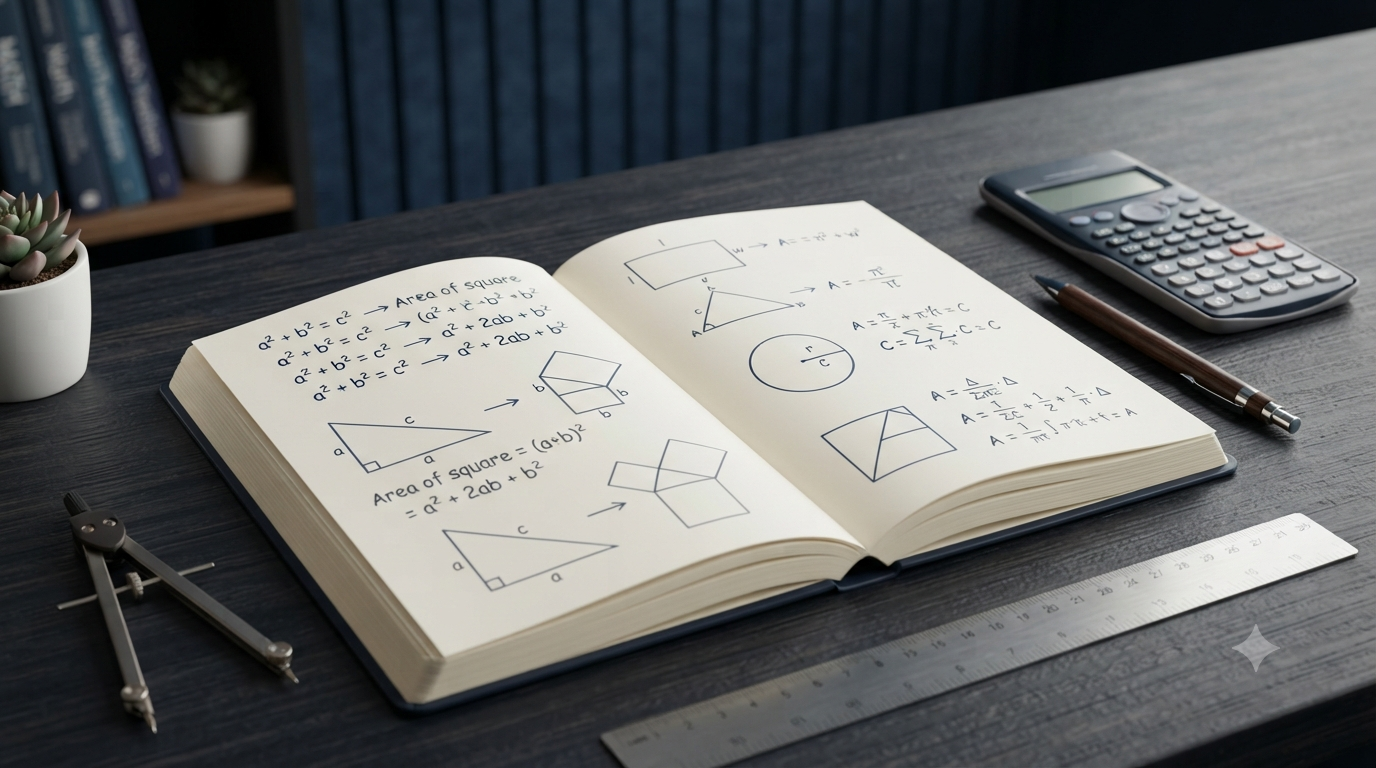
Deriving Formulas Using a Diagram
A diagram can make formula derivation much easier, especially in geometry.
Suppose you want to understand the area of a rectangle. Drawing a rectangle and labeling its length and width makes the relationship visually clear.
Similarly, a right triangle can be used to understand the Pythagorean relationship.
For a right triangle with perpendicular sides a and b and hypotenuse c, the relationship is:
a² + b² = c²
If the hypotenuse is unknown, we can rearrange the equation:
c² = a² + b²
Taking the square root:
c = √(a² + b²)
The diagram helps identify which sides correspond to each variable and prevents confusion during the derivation.
Dimensional Analysis as a Formula Check
Units can provide a useful check after deriving a formula.
Suppose:
d = vt
The unit of speed is meters per second:
m/s
The unit of time is seconds:
s
Therefore:
(m/s) × s = m
The seconds cancel, leaving meters, which is the correct unit for distance.
This does not prove that a formula is correct by itself, but it can reveal many mistakes.
For example, if you derived a supposed distance formula and its units came out as m/s², that would indicate that something is wrong because distance should have units of length.
Why Understanding Formula Derivation Is Important
Learning to derive formulas has several benefits.
It Reduces Memorization
When you understand how a formula is obtained, you do not have to rely entirely on memory. Even if you forget part of a formula, you may be able to reconstruct it from basic relationships.
It Improves Problem-Solving Skills
Formula derivation requires you to identify relationships, manipulate equations, and reason logically. These skills are useful beyond mathematics.
It Helps You Avoid Mistakes
Understanding what each variable represents makes it less likely that you will use the wrong formula or substitute values incorrectly.
It Shows Relationships Between Quantities
A formula does more than provide an answer. It tells you how quantities depend on one another.
For example, in:
A = lw
the area increases when either the length or width increases.
Common Mistakes When Deriving Formulas
Formula derivation is straightforward when each step is performed carefully, but several common mistakes can cause incorrect results.
Using an Incorrect Starting Relationship
A derivation is only as reliable as its starting relationship. Always begin with a known definition, theorem, identity, or established equation.
Performing Different Operations on Each Side
When rearranging equations, the same mathematical operation must be applied to both sides.
For example, if you multiply the left side by 2, you must also multiply the right side by 2.
Ignoring Units
Units provide valuable information. Always check whether the final units match the quantity being calculated.
Confusing Variables
Clearly define every symbol before beginning the derivation. Using the same symbol for different quantities can create unnecessary errors.
Skipping Important Steps
A derivation should be logical and easy to follow. Avoid jumping from the starting equation to the final formula without showing the important intermediate steps.
A Simple Strategy for Learning Formula Derivation
You can develop formula-derivation skills through a simple routine.
First, identify what the formula calculates. Next, write down the definitions or relationships connected to that quantity. Then identify the unknown variable and rearrange the equation to isolate it. After obtaining the formula, check the units and test it with simple values.
For example, when studying a formula for distance, do not simply memorize d = vt. Ask why distance depends on speed and time. Start with the definition of speed, rearrange it, and obtain the distance formula.
With regular practice, this process becomes natural.
Conclusion
Deriving simple mathematical formulas is mainly about understanding relationships and using logical mathematical steps. A formula does not usually appear without reason. It can often be obtained from a definition, a geometric relationship, a known equation, a diagram, or basic algebra.
The general process is simple: identify the quantity you want to find, identify the known quantities, start with an established relationship, rearrange the equation, and check the result. Formulas such as A = lw, P = 2(l + w), A = ½bh, d = vt, and t = d/v can all be understood through this approach.
Once you learn to derive formulas instead of simply memorizing them, mathematics becomes more connected and meaningful. You begin to see formulas as logical descriptions of relationships rather than isolated rules to remember.
FAQs
1. What does it mean to derive a mathematical formula?
To derive a mathematical formula means to obtain a formula logically from known definitions, relationships, equations, diagrams, or mathematical principles. Instead of simply memorizing a formula, derivation explains why the formula has its particular form. For example, the speed formula can be written as v = d/t. By rearranging this equation, we can derive the distance formula d = vt and the time formula t = d/v. Formula derivation usually involves identifying the required quantity, starting with a known relationship, and using mathematical operations to isolate the unknown. This approach helps develop understanding and makes formulas easier to remember and apply.
2. Why is it important to learn how to derive formulas?
Learning how to derive formulas helps you understand the relationships between different mathematical quantities rather than depending only on memorization. When you understand the reasoning behind a formula, you can often reconstruct it if you forget it. Formula derivation also improves algebraic manipulation, logical thinking, and problem-solving skills. It helps you recognize which formula is appropriate for a particular problem and reduces errors caused by using formulas incorrectly. In mathematics and science, many formulas are connected to one another, so understanding their derivations gives you a clearer picture of how different concepts work together.
3. What are the basic steps for deriving a simple formula?
The basic steps are to identify the quantity you want to find, identify the known quantities, and find an established relationship connecting them. Start with the known equation or definition and clearly identify each variable. Then use algebraic operations such as addition, subtraction, multiplication, or division to isolate the required variable. After obtaining the formula, check whether the result makes logical sense. You should also check the units when the formula involves physical quantities. For example, starting with v = d/t, multiplying both sides by t gives d = vt. These simple steps can be applied to many elementary mathematical formulas.
4. Can simple formulas be derived using basic algebra?
Yes, many simple mathematical formulas can be derived using only basic algebra. Algebra allows you to rearrange equations while maintaining equality between both sides. For example, consider y = 3x + 5. To find a formula for x, first subtract 5 from both sides to obtain y − 5 = 3x. Then divide both sides by 3, giving x = (y − 5)/3. The same principle can be used with formulas involving areas, distances, averages, rates, and other quantities. Understanding basic algebra is therefore one of the most useful skills for deriving and rearranging mathematical formulas.
5. How is the area formula of a rectangle derived?
The area of a rectangle can be derived by considering the number of equal-sized square units that cover its surface. Suppose a rectangle has a length l and a width w. If there are l unit squares along the length and w unit squares along the width, the total number of unit squares is found by multiplying these quantities. Therefore, Area = length × width. Using symbols, the formula becomes A = lw. For example, a rectangle measuring 8 cm by 5 cm has an area of 8 × 5 = 40 cm². Thus, the formula follows directly from the arrangement of square units.
6. How can the triangle area formula be derived?
The area formula of a triangle can be derived by comparing a triangle with a parallelogram. A parallelogram with base b and perpendicular height h has an area of bh. A diagonal divides the parallelogram into two equal triangles. Therefore, each triangle has half the area of the parallelogram. This gives Area = ½ × base × height. In symbolic form, the formula is A = ½bh. For example, if a triangle has a base of 10 cm and a height of 6 cm, its area is ½ × 10 × 6 = 30 cm².
7. How can a formula be derived from a definition?
A formula can often be derived directly from the definition of a quantity. First, write the definition as an equation. Then rearrange the equation to make the required quantity the subject. For example, speed is defined as distance divided by time, so v = d/t. If distance is required, multiply both sides by t. This gives vt = d, or d = vt. If time is required, divide both sides by v, giving t = d/v. This shows how several useful formulas can come from one basic definition through simple algebraic rearrangement.
8. How can units help when deriving a formula?
Units can be used as an important check when deriving formulas involving measurable quantities. After obtaining a formula, examine the units of each quantity and determine whether the final units match the quantity being calculated. For example, the distance formula is d = vt. Speed has units of m/s, while time has units of s. Therefore, (m/s) × s = m, which gives the correct unit for distance. Units cannot always prove that a formula is mathematically correct, but they can reveal many errors. If the final units are inappropriate, the derivation or substitution should be checked carefully.
9. What is the difference between deriving and memorizing a formula?
Memorizing a formula means remembering its mathematical expression without necessarily understanding how it was obtained. Deriving a formula means using known relationships, definitions, mathematical principles, or logical steps to obtain the expression. For example, you can memorize d = vt, or you can derive it from the definition of speed, v = d/t. Understanding the derivation provides a reason for the formula and makes it easier to reconstruct when needed. Memorization can still be useful for frequently used formulas, but combining memorization with understanding generally gives a stronger foundation for solving mathematical and scientific problems.
10. How can I improve my formula derivation skills?
You can improve formula derivation skills by regularly practicing with simple relationships before moving to more complicated formulas. Start with familiar examples involving areas, perimeters, averages, speed, distance, and time. For each formula, identify what every variable represents and ask where the relationship comes from. Practice rearranging equations to make different variables the subject. Drawing diagrams can also help with geometry-based formulas. Finally, check your answers using units and simple numerical examples. The goal is not to memorize every derivation but to become comfortable identifying relationships and using algebraic steps to obtain the required formula logically.