
Molar Mass vs Molecular Mass vs Formula Mass

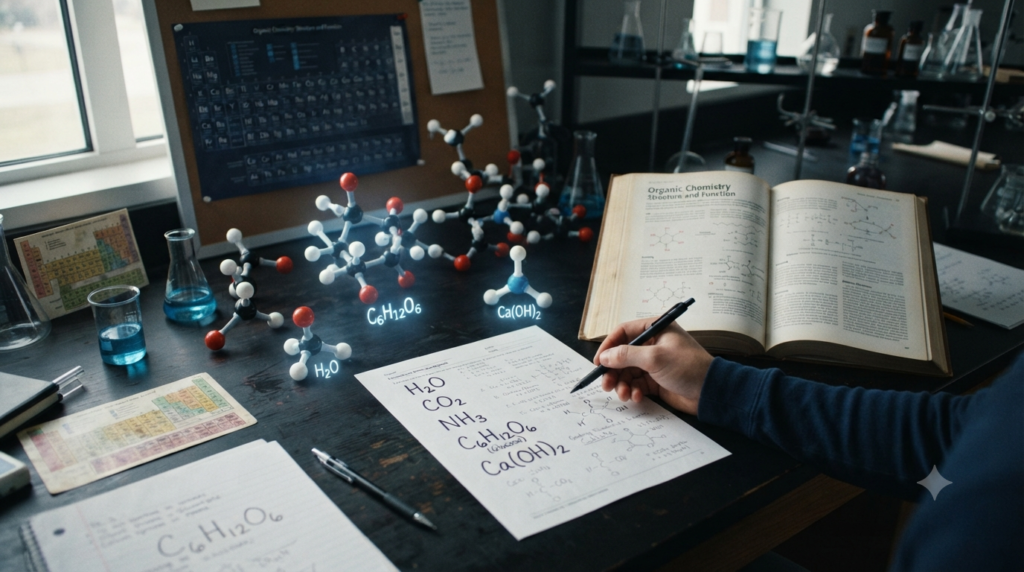
Chemistry study scene explaining molar mass, molecular mass, and formula mass with chemical formulas and molecular models

Chemistry uses several terms to describe the mass of substances, and three of them often cause confusion: molar mass, molecular mass, and formula mass. Although these terms are closely related, they do not mean exactly the same thing. The main difference lies in what is being measured and how the value is expressed.

For example, water is written as H₂O. We can calculate the mass of one H₂O molecule, the mass of one mole of H₂O molecules, or the mass represented by the formula H₂O. These calculations use the same atomic masses, but the meanings and units are different.

Understanding these differences is important because chemistry involves both microscopic particles, such as atoms and molecules, and macroscopic quantities that can be measured in a laboratory. Once the relationship between these three terms becomes clear, many calculations involving chemical formulas, moles, and chemical reactions become much easier.

What Is Molecular Mass?

Molecular mass is the mass of a single molecule of a substance. It is calculated by adding the relative atomic masses of all the atoms present in one molecule.

For example, consider water:

H₂O

A water molecule contains:

  • 2 hydrogen atoms

  • 1 oxygen atom

Using approximate relative atomic masses:

H = 1
O = 16

Therefore:

Molecular mass of H₂O = (2 × 1) + (1 × 16) = 18

The molecular mass of water is therefore 18 u when expressed as a mass of one molecule.

Here, u stands for the unified atomic mass unit, also called the dalton (Da).

Molecular mass is therefore associated with substances that exist as individual molecules. Examples include H₂O, CO₂, CH₄, NH₃, and O₂.

How Is Molecular Mass Calculated?

The basic method is simple:

Molecular mass = Sum of the atomic masses of all atoms in one molecule

Consider carbon dioxide:

CO₂

Carbon = 12
Oxygen = 16

Therefore:

Molecular mass of CO₂ = 12 + (2 × 16) = 44 u

So, one carbon dioxide molecule has a molecular mass of approximately 44 u.

Now consider methane:

CH₄

Molecular mass = 12 + (4 × 1)

Molecular mass = 16 u

The same approach can be used for larger molecules. The important point is to carefully count how many atoms of each element are represented by the chemical formula.

What Is Formula Mass?

Formula mass is the sum of the relative atomic masses of all the atoms represented by a chemical formula.

The term is particularly important for ionic compounds, because ionic compounds generally do not exist as separate molecules. Instead, they form extended crystal lattices made of ions.

For example, sodium chloride is represented by:

NaCl

Sodium = 23
Chlorine = 35.5

Therefore:

Formula mass of NaCl = 23 + 35.5 = 58.5

The formula mass of NaCl is 58.5 u.

It is more appropriate to say “formula mass” rather than “molecular mass” for NaCl because sodium chloride is an ionic compound and does not consist of individual NaCl molecules in the solid crystal.

The formula NaCl represents the simplest whole-number ratio of sodium ions to chloride ions.

Why Do Ionic Compounds Use Formula Mass?

To understand this difference, consider the structure of sodium chloride.

In solid NaCl, Na⁺ and Cl⁻ ions are arranged in a large three-dimensional crystal lattice. There is no separate collection of individual NaCl molecules like there is for water molecules.

The chemical formula NaCl tells us the ratio:

Na⁺ : Cl⁻ = 1 : 1

Therefore, the mass calculated from NaCl represents the mass associated with one formula unit of the compound.

This is why formula mass is commonly used for ionic compounds.

Other examples include:

  • MgO

  • CaCl₂

  • Na₂O

  • KBr

  • Al₂O₃

For example, the formula mass of MgO is:

Mg = 24.3
O = 16

Formula mass = 24.3 + 16 = 40.3 u

What Is Molar Mass?

Molar mass is the mass of one mole of a substance.

A mole contains approximately:

6.022 × 10²³ particles

This number is known as the Avogadro constant.

Unlike molecular mass and formula mass, which describe the mass of individual particles or formula units using atomic mass units, molar mass is normally expressed in:

grams per mole (g/mol)

For water:

Molecular mass of H₂O = 18 u

Molar mass of H₂O = 18 g/mol

The numerical value is the same, but the meaning and units are different.

This relationship is extremely useful in chemistry.

Molecular Mass vs Molar Mass

The easiest way to distinguish molecular mass and molar mass is to ask:

How much substance are we talking about?

Molecular mass describes the mass of one molecule.

Molar mass describes the mass of one mole of molecules.

For example:

H₂O molecular mass = 18 u

H₂O molar mass = 18 g/mol

The numbers are numerically equal because of the way the atomic mass unit and mole are defined, but they represent completely different quantities.

One describes a microscopic particle, while the other describes a macroscopic amount containing an enormous number of particles.

Formula Mass vs Molar Mass

The same relationship exists for ionic compounds.

For NaCl:

Formula mass = 58.5 u

Molar mass = 58.5 g/mol

Again, the numerical value is the same, but the units and meaning differ.

Formula mass refers to the mass represented by one formula unit.

Molar mass refers to the mass of one mole of NaCl formula units.

This distinction is important when performing laboratory calculations.

A Simple Comparison

The three terms can be summarized as follows:

TermWhat it describesCommonly used forUnit
Molecular massMass of one moleculeMolecular substancesu
Formula massMass represented by one formula unitIonic compoundsu
Molar massMass of one mole of a substanceAll substancesg/mol

This table highlights the central difference. Molecular mass and formula mass are particle-level quantities, whereas molar mass is a mole-level quantity.

Examples of Molecular Mass

Let’s calculate a few molecular masses.

Water H₂O

H = 1
O = 16

Molecular mass = (2 × 1) + 16

= 18 u

Carbon Dioxide CO₂

C = 12
O = 16

Molecular mass = 12 + (2 × 16)

= 44 u

Ammonia NH₃

N = 14
H = 1

Molecular mass = 14 + (3 × 1)

= 17 u

Methane CH₄

C = 12
H = 1

Molecular mass = 12 + (4 × 1)

= 16 u

In each case, the calculation involves adding the atomic masses according to the number of atoms shown in the formula.

Examples of Formula Mass

Now consider ionic compounds.

Sodium Chloride NaCl

Na = 23
Cl = 35.5

Formula mass = 23 + 35.5

= 58.5 u

Calcium Chloride CaCl₂

Ca = 40
Cl = 35.5

Formula mass = 40 + (2 × 35.5)

= 111 u

Magnesium Oxide MgO

Mg = 24.3
O = 16

Formula mass = 24.3 + 16

= 40.3 u

Aluminium Oxide Al₂O₃

Al = 27
O = 16

Formula mass = (2 × 27) + (3 × 16)

= 102 u

These values represent the relative mass of the formula unit based on the atoms or ions represented in the chemical formula.

How Molar Mass Is Used in Chemistry

Molar mass is especially important because laboratory measurements are usually made in grams, while chemical equations describe substances in terms of particles and moles.

For example, suppose you need to determine how many moles are present in 36 g of water.

The formula is:

Number of moles = Given mass ÷ Molar mass

For water:

Given mass = 36 g
Molar mass = 18 g/mol

Therefore:

Number of moles = 36 ÷ 18

= 2 mol

This calculation connects the mass measured in the laboratory to the number of moles of the substance.

Molar mass is also used in stoichiometry, concentration calculations, preparation of solutions, gas calculations, and many other areas of chemistry.

The Relationship Between the Three Terms

The three concepts are connected through chemical formulas and atomic masses.

Suppose the substance is carbon dioxide, CO₂.

First, use the chemical formula to identify the atoms:

1 carbon + 2 oxygen atoms

Then calculate the relative mass:

12 + (2 × 16) = 44

Because CO₂ is molecular:

Molecular mass = 44 u

For one mole of CO₂:

Molar mass = 44 g/mol

Now consider calcium oxide, CaO.

Calcium = 40
Oxygen = 16

Formula mass:

40 + 16 = 56 u

Because CaO is ionic:

Formula mass = 56 u

The molar mass is:

56 g/mol

Therefore, the calculation process can be similar even though the terminology is different.

Common Mistakes to Avoid

One common mistake is using “molecular mass” for every chemical compound. This is not always appropriate. Ionic compounds are better described using formula mass because they do not consist of discrete molecules in the same way molecular substances do.

Another mistake is confusing the units.

Molecular mass and formula mass are expressed in u, while molar mass is expressed in g/mol.

For example:

Correct:

H₂O molecular mass = 18 u

H₂O molar mass = 18 g/mol

Incorrectly treating “18 u” and “18 g/mol” as the same physical quantity can lead to confusion.

A third mistake is forgetting subscripts. In CaCl₂, there are two chlorine atoms, so the chlorine atomic mass must be multiplied by 2.

A Quick Way to Remember the Difference

A simple memory trick is:

Molecular mass → one molecule

Formula mass → one formula unit

Molar mass → one mole

The first two are connected with individual microscopic particles or formula units. The third is connected with a specific amount of substance containing Avogadro’s number of entities.

You can also remember the units:

Molecular mass → u

Formula mass → u

Molar mass → g/mol

Conclusion

Molar mass, molecular mass, and formula mass are closely connected concepts, but they describe different things. Molecular mass refers to the mass of a single molecule and is commonly used for molecular substances. Formula mass refers to the mass represented by one formula unit and is especially useful for ionic compounds. Molar mass refers to the mass of one mole of a substance and is expressed in grams per mole.

The numerical value of molecular mass or formula mass often matches the numerical value of molar mass, but their units and meanings are different. Understanding this distinction makes chemical formulas easier to interpret and provides a strong foundation for mole calculations, stoichiometry, and quantitative chemistry.

FAQs

1. What is the difference between molar mass and molecular mass?

Molecular mass is the mass of a single molecule, while molar mass is the mass of one mole of a substance. Molecular mass is expressed in unified atomic mass units (u), whereas molar mass is expressed in grams per mole (g/mol). For example, the molecular mass of water, H₂O, is 18 u. Its molar mass is 18 g/mol. Although the numerical values are the same, they describe different quantities. Molecular mass deals with an individual molecule at the microscopic level, while molar mass describes a measurable amount containing approximately 6.022 × 10²³ particles.

2. What is formula mass in chemistry?

Formula mass is the total of the atomic masses represented by a chemical formula. It is mainly used for ionic compounds, which do not normally exist as separate molecules. For example, sodium chloride has the formula NaCl. Sodium has an atomic mass of approximately 23 u and chlorine has an atomic mass of approximately 35.5 u. Therefore, the formula mass of NaCl is 58.5 u. Formula mass represents the mass associated with one formula unit of an ionic compound. Its numerical value can be used to determine the molar mass, which would be expressed as 58.5 g/mol.

3. Is molecular mass the same as molar mass?

No, molecular mass and molar mass are not the same physical quantity, even though their numerical values are often identical. Molecular mass refers to the mass of one molecule and is expressed in u. Molar mass refers to the mass of one mole of the substance and is expressed in g/mol. For example, carbon dioxide has a molecular mass of 44 u and a molar mass of 44 g/mol. The matching numbers result from the relationship between the atomic mass unit and the mole. Therefore, always consider both the meaning and the unit when distinguishing these terms.

4. Why is formula mass used for ionic compounds?

Formula mass is used for ionic compounds because ionic substances generally form large crystal lattices rather than collections of separate molecules. For example, solid sodium chloride consists of a repeating arrangement of Na⁺ and Cl⁻ ions. The formula NaCl represents the simplest ratio of these ions, not an individual NaCl molecule. Therefore, the mass calculated from NaCl is called formula mass. It is calculated by adding the atomic masses represented in the formula. For NaCl, the formula mass is approximately 58.5 u. The corresponding molar mass is 58.5 g/mol.

5. How do you calculate molecular mass?

To calculate molecular mass, identify the chemical formula and add the atomic masses of all atoms present in one molecule. First, count the atoms of each element using the subscripts in the formula. Then multiply each atomic mass by the number of atoms and add the results. For example, water is H₂O. Hydrogen has an approximate atomic mass of 1 u and oxygen has an atomic mass of 16 u. Therefore, molecular mass = (2 × 1) + 16 = 18 u. The same method can be applied to compounds such as CO₂, NH₃, and CH₄.

6. How do you calculate formula mass?

Formula mass is calculated by adding the atomic masses of all atoms represented by a chemical formula. The subscripts indicate how many atoms of each element must be included. For example, calcium chloride has the formula CaCl₂. Calcium has an approximate atomic mass of 40 u, while chlorine has an atomic mass of 35.5 u. Therefore, formula mass = 40 + (2 × 35.5) = 111 u. This value represents the mass associated with one formula unit of calcium chloride. The corresponding molar mass is 111 g/mol.

7. What is the unit of molar mass?

The standard unit of molar mass is grams per mole (g/mol). It tells us how many grams of a substance are present in one mole. For example, water has a molar mass of approximately 18 g/mol. This means that one mole of water has a mass of approximately 18 grams. Molar mass is particularly useful because laboratory measurements are commonly made in grams, while chemical calculations often use moles. Molecular mass and formula mass, in contrast, are commonly expressed in unified atomic mass units (u). Keeping these units separate helps prevent errors in chemistry calculations.

8. Can formula mass and molecular mass have the same numerical value?

Yes, formula mass and molecular mass can have the same numerical value when calculated from a chemical formula containing the same atoms and quantities. For example, CO₂ has a molecular mass of 44 u because it exists as individual molecules. An ionic compound such as NaCl has a formula mass of 58.5 u because its formula represents a ratio of ions. The calculation method is similar, but the terminology depends on the type of substance. Molecular mass applies to individual molecules, while formula mass applies to formula units, especially in ionic compounds.

9. How is molar mass used in chemistry calculations?

Molar mass connects the mass of a substance measured in grams with the amount of substance measured in moles. It is widely used in stoichiometry, solution preparation, concentration calculations, and chemical reaction calculations. The basic relationship is: Number of moles = Given mass ÷ Molar mass. For example, if 36 g of water is available and its molar mass is 18 g/mol, the number of moles is 36 ÷ 18 = 2 mol. This makes molar mass an important bridge between laboratory measurements and the microscopic particles involved in chemical reactions.

10. What is the easiest way to remember these three terms?

A simple way to remember them is to focus on what each term describes. Molecular mass refers to one molecule. Formula mass refers to one formula unit, particularly for ionic compounds. Molar mass refers to one mole of a substance. Their common units also provide a useful reminder: molecular mass and formula mass are expressed in u, while molar mass is expressed in g/mol. For example, H₂O has a molecular mass of 18 u and a molar mass of 18 g/mol. NaCl has a formula mass of 58.5 u and a molar mass of 58.5 g/mol.

Related Posts

Leave a Comment

Your email address will not be published. Required fields are marked *

Scroll to Top