
How to Determine the Charge of an ion

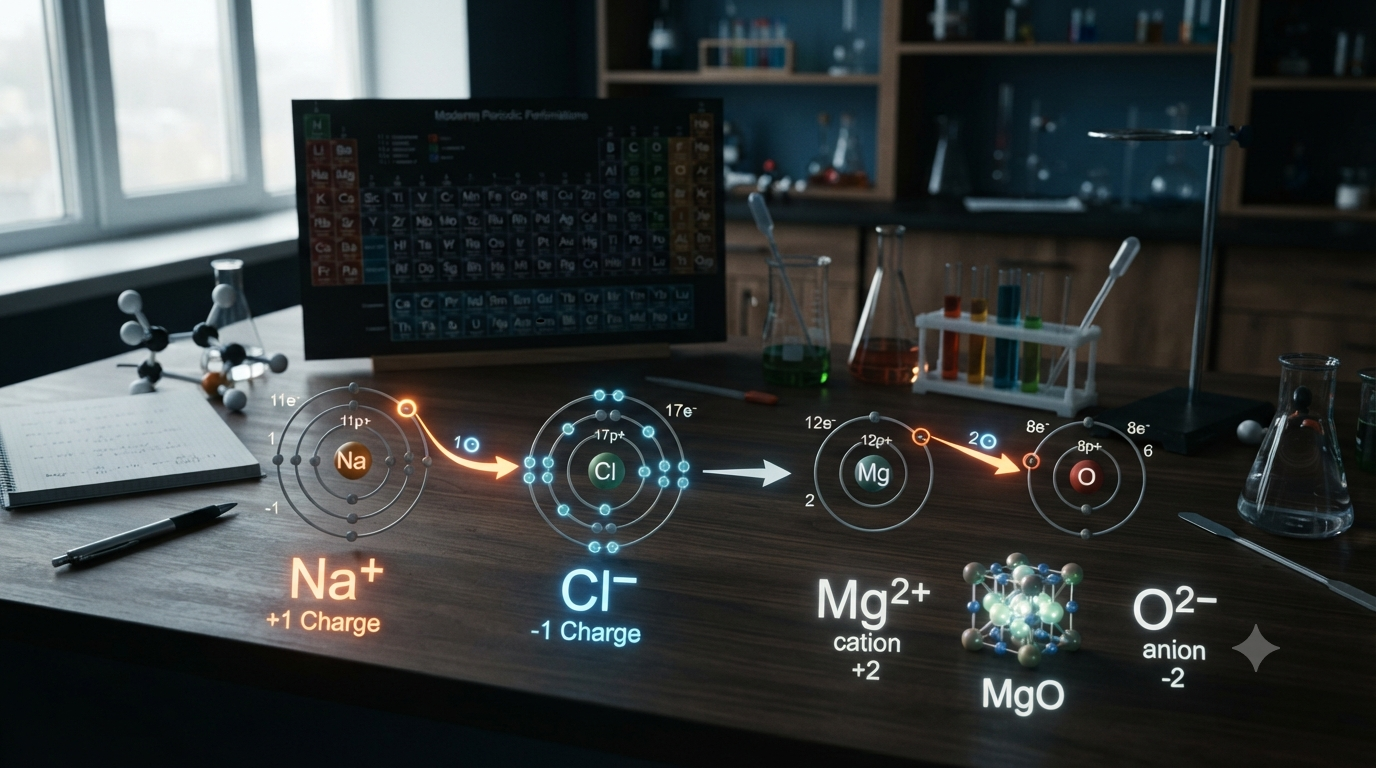
Chemistry illustration showing protons, electrons, cations, anions, and ion charges with atomic models and chemical symbols.

An ion is an atom or group of atoms that carries an electrical charge. Atoms are normally neutral because they contain equal numbers of positively charged protons and negatively charged electrons. When an atom gains or loses electrons, this balance changes, and the atom becomes an ion. Determining the charge of an ion is an important skill in chemistry because ionic charge helps us understand how atoms form compounds, write chemical formulas, and participate in chemical reactions.

The charge of an ion depends mainly on the number of electrons an atom gains or loses. Metals generally lose electrons and form positive ions called cations, while nonmetals generally gain electrons and form negative ions called anions. Some elements, especially transition metals, can form more than one possible charge. By looking at the element, its position in the periodic table, its valence electrons, or the formula of a compound, we can determine the charge of an ion.

What Is an Ion?

An ion is an atom or group of atoms that has a net electrical charge because it has gained or lost one or more electrons.

A neutral atom has the same number of protons and electrons. Since protons have a charge of +1 and electrons have a charge of −1, their charges cancel each other.

For example, a neutral sodium atom has 11 protons and 11 electrons. Its total charge is zero.

When sodium loses one electron, it has 11 protons but only 10 electrons. The positive charge of the protons is now greater than the negative charge of the electrons.

Therefore:

Na → Na⁺ + e⁻

The sodium ion has a charge of +1.

Similarly, chlorine has 17 protons and 17 electrons when neutral. If it gains one electron, it has 18 electrons. It therefore has one more negative charge than positive charge.

Cl + e⁻ → Cl⁻

The chlorine ion has a charge of −1.

Why Do Atoms Form Ions?

Atoms form ions because gaining or losing electrons can give them a more stable electron arrangement.

The electrons in the outermost energy level are called valence electrons. These electrons play a major role in chemical bonding.

Many main-group atoms tend to gain or lose electrons to achieve a stable outer electron arrangement similar to that of a noble gas.

For example, sodium has one valence electron. Losing that electron gives sodium a stable electron arrangement.

Chlorine has seven valence electrons. Gaining one electron gives chlorine a complete outer shell.

This tendency helps explain why sodium commonly forms Na⁺ while chlorine commonly forms Cl⁻.

The Basic Rule for Determining Ion Charge

The simplest rule is:

  • If an atom loses electrons, it becomes positively charged.

  • If an atom gains electrons, it becomes negatively charged.

  • The number of electrons lost or gained determines the magnitude of the charge.

For example:

If an atom loses 1 electron → charge = +1

If an atom loses 2 electrons → charge = +2

If an atom loses 3 electrons → charge = +3

If an atom gains 1 electron → charge = −1

If an atom gains 2 electrons → charge = −2

If an atom gains 3 electrons → charge = −3

Remember that electrons are negative. Therefore, losing negative electrons makes an atom more positive, while gaining negative electrons makes it more negative.

How to Determine the Charge From the Periodic Table

For many main-group elements, the periodic table provides a useful way to predict common ion charges.

The groups of the periodic table are especially helpful.

Group 1 Elements

Group 1 elements have one valence electron. They commonly lose that electron and form ions with a +1 charge.

Examples include:

Li → Li⁺

Na → Na⁺

K → K⁺

Rb → Rb⁺

Cs → Cs⁺

Therefore, Group 1 metals commonly form +1 ions.

Group 2 Elements

Group 2 elements have two valence electrons. They commonly lose both electrons and form ions with a +2 charge.

Examples include:

Mg → Mg²⁺

Ca → Ca²⁺

Ba → Ba²⁺

Therefore, Group 2 metals commonly form +2 ions.

Group 13 Elements

Many Group 13 elements can lose three electrons and form +3 ions.

For example:

Al → Al³⁺

Aluminum commonly forms a +3 ion.

Group 15 Elements

Many Group 15 nonmetals have five valence electrons. They can gain three electrons to complete their outer shell.

Therefore, they commonly form ions with a −3 charge.

For example:

N → N³⁻

Group 16 Elements

Group 16 elements have six valence electrons. They commonly gain two electrons.

Therefore, their common ion charge is −2.

Examples include:

O → O²⁻

S → S²⁻

Group 17 Elements

Group 17 elements have seven valence electrons. They commonly gain one electron.

Therefore, they commonly form −1 ions.

Examples include:

F → F⁻

Cl → Cl⁻

Br → Br⁻

I → I⁻

Group 18 Elements

Noble gases already have stable outer electron arrangements. They generally do not form simple ions under ordinary conditions.

Examples include helium, neon, and argon.

Common Ion Charges

A useful pattern for many main-group elements is:

Periodic Table GroupCommon Ion Charge
Group 1+1
Group 2+2
Group 13+3
Group 15−3
Group 16−2
Group 17−1
Group 18Usually 0

This pattern is a useful starting point, but it does not apply equally to every element.

Determining Charge From the Number of Protons and Electrons

If the numbers of protons and electrons are given, the ion charge can be calculated directly.

The formula is:

Charge = Number of protons − Number of electrons

For example, suppose an ion contains 12 protons and 10 electrons.

Charge = 12 − 10 = +2

Therefore, the ion has a charge of +2.

Now consider an ion containing 17 protons and 18 electrons.

Charge = 17 − 18 = −1

Therefore, the ion has a charge of −1.

This method works for any ion when the numbers of protons and electrons are known.

Determining Charge From Electron Loss or Gain

Sometimes a question tells you how many electrons an atom has lost or gained.

If an atom loses electrons, its charge becomes positive.

For example, if magnesium loses two electrons:

Mg → Mg²⁺ + 2e⁻

Therefore, magnesium forms a +2 ion.

If oxygen gains two electrons:

O + 2e⁻ → O²⁻

Therefore, oxygen forms a −2 ion.

The key is to remember that the charge corresponds to the number of electrons transferred.

How to Determine the Charge of an Ion in an Ionic Compound

The formula of an ionic compound can also help determine an unknown ion charge.

An ionic compound must have an overall electrical charge of zero. Therefore, the positive and negative charges must balance each other.

For example, consider magnesium chloride:

MgCl₂

Chloride has a charge of −1. There are two chloride ions, so their total charge is:

2 × (−1) = −2

Therefore, magnesium must have a charge of +2 to make the compound neutral.

Mg²⁺ + 2Cl⁻ → MgCl₂

Now consider aluminum oxide:

Al₂O₃

Oxide has a charge of −2. Three oxide ions give:

3 × (−2) = −6

There are two aluminum ions, so their total positive charge must be +6.

Therefore:

2 × charge of Al = +6

Charge of Al = +3

So aluminum forms Al³⁺ in aluminum oxide.

Using the Criss-Cross Method Carefully

The criss-cross method can help write formulas when ion charges are already known.

For example, calcium has a +2 charge and chlorine has a −1 charge.

Ca²⁺ and Cl⁻

The charges can be used to determine the subscripts:

CaCl₂

However, the criss-cross method should not be used as a substitute for understanding ion charges. It is important to know the actual charges first and then use the simplest whole-number ratio.

For example, Ca²⁺ and O²⁻ combine in a 1:1 ratio:

CaO

The charges are equal in magnitude and cancel, so there is no need to write Ca₂O₂.

How to Determine the Charge of a Polyatomic Ion

Some ions contain more than one atom. These are called polyatomic ions.

Examples include:

OH⁻ — hydroxide

NO₃⁻ — nitrate

SO₄²⁻ — sulfate

CO₃²⁻ — carbonate

NH₄⁺ — ammonium

The charge belongs to the entire group of atoms.

For example, sulfate is SO₄²⁻. The entire sulfate ion has a charge of −2.

Polyatomic ion charges usually need to be learned because they cannot always be predicted from a simple periodic-table group pattern.

Determining the Charge of Transition Metal Ions

Transition metals require special attention because many of them can form ions with different charges.

For example, iron can form:

Fe²⁺ — iron(II)

Fe³⁺ — iron(III)

Copper can form:

Cu⁺ — copper(I)

Cu²⁺ — copper(II)

Because these metals can have multiple charges, the element’s name or the chemical formula may be needed to determine the correct charge.

For example, iron(III) chloride contains Fe³⁺ and Cl⁻.

Fe³⁺ + 3Cl⁻ → FeCl₃

Iron(II) chloride contains Fe²⁺ and Cl⁻.

Fe²⁺ + 2Cl⁻ → FeCl₂

The Roman numeral in names such as iron(III) directly indicates the charge of the metal ion.

Determining an Unknown Ion Charge From a Compound

Suppose you are given Fe₂O₃ and asked to determine the charge of iron.

First, identify the charge of oxygen.

Oxygen commonly forms O²⁻.

There are three oxygen ions:

3 × (−2) = −6

The two iron ions must therefore provide +6 total charge.

2 × charge of Fe = +6

Charge of Fe = +3

Therefore, iron is Fe³⁺ in Fe₂O₃.

Now consider FeO.

One oxygen contributes −2.

Therefore, iron must contribute +2.

So:

FeO contains Fe²⁺ and O²⁻.

A Step-by-Step Method for Finding Ion Charge

When you need to determine an ion’s charge, follow these steps.

Step 1: Identify the Element

Determine which atom or ion you are working with.

For example, the element might be sodium, oxygen, magnesium, or iron.

Step 2: Determine Whether It Gains or Loses Electrons

Metals generally lose electrons, while nonmetals generally gain electrons.

Step 3: Look at the Valence Electrons

For main-group elements, the number of valence electrons can help predict how many electrons the atom will gain or lose.

Step 4: Determine the Number of Electrons Transferred

The number of electrons lost or gained gives the magnitude of the ion’s charge.

Step 5: Assign the Correct Sign

Electron loss → positive charge.

Electron gain → negative charge.

Step 6: Check the Result

If the ion is part of a compound, check whether the charges balance to produce an overall neutral compound.

Examples of Common Ions

Some common ions include:

Na⁺ — sodium ion

K⁺ — potassium ion

Mg²⁺ — magnesium ion

Ca²⁺ — calcium ion

Al³⁺ — aluminum ion

F⁻ — fluoride ion

Cl⁻ — chloride ion

O²⁻ — oxide ion

S²⁻ — sulfide ion

N³⁻ — nitride ion

These common charges are useful when writing formulas and solving chemical problems.

Common Mistakes When Determining Ion Charge

One common mistake is confusing the number of protons with the number of electrons. Protons determine the identity of the element, while the difference between protons and electrons determines the charge.

Another mistake is forgetting the sign of the charge. Losing electrons creates a positive ion, while gaining electrons creates a negative ion.

A third mistake is assuming that every metal has only one possible charge. Many transition metals can form multiple ions.

It is also important not to confuse the subscript in a chemical formula with the charge of an individual ion. In MgCl₂, the ₂ means there are two chloride ions. It does not mean that chloride has a −2 charge. Each chloride ion has a −1 charge.

Why Ion Charge Is Important in Chemistry

Ion charge is fundamental to understanding ionic compounds and chemical reactions. It determines how ions combine, what chemical formulas look like, and how electrical charge is balanced.

For example, knowing that calcium forms Ca²⁺ and chlorine forms Cl⁻ allows us to determine that calcium chloride has the formula CaCl₂.

Ion charge is also important when studying acids, bases, salts, electrochemistry, solutions, and chemical reactions. Once the charge of an ion is understood, many chemical formulas become much easier to interpret.

Conclusion

Determining the charge of an ion begins with understanding the relationship between protons and electrons. A neutral atom has equal numbers of protons and electrons, but gaining or losing electrons creates a net charge. Metals generally lose electrons and form positive ions, while nonmetals generally gain electrons and form negative ions. The periodic table can help predict common charges for many main-group elements, while the numbers of protons and electrons can be used to calculate an exact charge. For ionic compounds, the total positive and negative charges must balance. With practice, recognizing common ion charges and applying charge-balance rules becomes an essential and straightforward part of learning chemistry.

FAQs

1. What is the charge of an ion?

An ion is an atom or group of atoms that has a net electrical charge because it has gained or lost electrons. A neutral atom contains equal numbers of protons and electrons. When an atom loses electrons, it becomes positively charged and forms a cation. When it gains electrons, it becomes negatively charged and forms an anion. The magnitude of the charge depends on how many electrons are transferred. For example, sodium loses one electron and becomes Na⁺, while chlorine gains one electron and becomes Cl⁻. Therefore, ion charge is determined by the difference between positive protons and negative electrons.

2. How do you determine the charge of an ion?

You can determine an ion’s charge by comparing the number of protons and electrons. Use the relationship: Charge = Number of protons − Number of electrons. If an atom has more protons than electrons, the ion has a positive charge. If it has more electrons than protons, the ion has a negative charge. For example, an ion with 12 protons and 10 electrons has a charge of +2. An ion with 17 protons and 18 electrons has a charge of −1. For common elements, the periodic table can also help predict the usual charge based on the element’s group.

3. How does losing electrons affect an ion’s charge?

Losing electrons makes an atom positively charged because electrons carry a negative charge. When an atom loses one electron, it has one more proton than electron and therefore becomes a +1 ion. If it loses two electrons, it becomes a +2 ion. For example, magnesium has two valence electrons and commonly loses both to form Mg²⁺. The number of electrons lost determines the magnitude of the positive charge. This is why metals commonly form cations. The protons remain inside the nucleus during ordinary chemical reactions, while electrons are transferred between atoms.

4. How does gaining electrons affect an ion’s charge?

Gaining electrons makes an atom negatively charged because each electron contributes a negative charge. If an atom gains one electron, it forms a −1 ion. If it gains two electrons, it forms a −2 ion. For example, chlorine has seven valence electrons and commonly gains one electron to form Cl⁻. Oxygen has six valence electrons and commonly gains two electrons to form O²⁻. Nonmetal atoms often gain electrons because doing so can give them a more stable outer electron arrangement. Therefore, the number of electrons gained determines the magnitude of the negative charge.

5. How can the periodic table help determine ion charge?

The periodic table can help predict common ion charges, especially for main-group elements. Group 1 elements commonly form +1 ions, while Group 2 elements commonly form +2 ions. Group 13 elements often form +3 ions. Group 15 elements commonly form −3 ions, Group 16 elements form −2 ions, and Group 17 elements form −1 ions. Noble gases generally do not form simple ions. These patterns are based largely on valence electrons and the tendency of atoms to achieve stable outer electron arrangements. However, some elements, particularly transition metals, can have multiple possible charges.

6. What is the difference between a cation and an anion?

A cation is a positively charged ion, while an anion is a negatively charged ion. Cations form when atoms lose one or more electrons. For example, sodium loses one electron and forms Na⁺. Anions form when atoms gain one or more electrons. For example, chlorine gains one electron and forms Cl⁻. The terms describe the direction of the electrical charge, not the number of atoms present. Cations are commonly formed by metals, while anions are commonly formed by nonmetals. Both types of ions are important in ionic compounds and many chemical reactions.

7. How do you find an unknown ion charge in a compound?

To find an unknown ion charge, use the fact that an ionic compound is electrically neutral overall. First, identify the known ion and its charge. Then multiply that charge by the number of ions shown in the formula. The unknown ion must provide enough opposite charge to make the total equal to zero. For example, in Al₂O₃, each oxide ion has a −2 charge. Three oxide ions provide −6 total charge. Therefore, two aluminum ions must provide +6, meaning each aluminum ion has a +3 charge. This method is especially useful for compounds containing transition metals.

8. What are common ion charges for main-group elements?

Common ion charges follow useful patterns for many main-group elements. Group 1 elements commonly form +1 ions, such as Na⁺ and K⁺. Group 2 elements commonly form +2 ions, such as Mg²⁺ and Ca²⁺. Aluminum commonly forms Al³⁺. Group 15 nonmetals can form −3 ions, such as N³⁻. Group 16 elements commonly form −2 ions, such as O²⁻ and S²⁻. Group 17 elements commonly form −1 ions, such as F⁻ and Cl⁻. These are common charges rather than rules that apply without exception to every element and chemical situation.

9. Why do transition metals have different ion charges?

Many transition metals can lose different numbers of electrons and therefore form ions with different charges. For example, iron commonly forms Fe²⁺ and Fe³⁺, while copper can form Cu⁺ and Cu²⁺. Because the same element can have more than one common charge, the charge often needs to be specified in the compound’s name or determined from its chemical formula. Roman numerals are commonly used to identify the charge of a transition metal ion. For example, iron(II) represents Fe²⁺, while iron(III) represents Fe³⁺. This is why transition-metal charges require additional attention.

10. Why is knowing ion charge important in chemistry?

Knowing ion charge is important because it helps explain how ionic compounds form and how their chemical formulas are written. Positive and negative ions combine in ratios that produce an overall neutral compound. For example, Mg²⁺ and Cl⁻ combine in a 1:2 ratio to form MgCl₂. Ion charges are also useful when naming compounds, predicting formulas, balancing charge, understanding chemical reactions, and studying solutions and electrochemistry. Once common ion charges are familiar, many chemistry problems become easier to solve. Understanding electron transfer and charge balance provides a strong foundation for learning ionic bonding and chemical formulas.

Related Posts

Leave a Comment

Your email address will not be published. Required fields are marked *

Scroll to Top