Molecular mass is an important concept in chemistry because it helps us understand how heavy a molecule is compared with a standard atomic mass unit. Whenever a chemical formula contains two or more atoms, we can calculate its molecular mass by adding the atomic masses of all the atoms present in the molecule. Although the idea is simple, mistakes can happen when a formula contains brackets, subscripts, or several different elements.
Learning how to calculate molecular mass step by step makes many chemistry problems easier. It is useful when studying chemical formulas, chemical reactions, mole calculations, and the relationship between microscopic particles and measurable quantities in the laboratory. In this article, we will learn a clear method for calculating molecular mass, work through common examples, and understand how to handle formulas with subscripts and brackets.
What Is Molecular Mass?
Molecular mass is the total mass of all the atoms present in a single molecule. It is calculated by adding the atomic masses of the atoms that make up the molecule.
Atomic masses are usually expressed in unified atomic mass units, written as u. Therefore, molecular mass is also expressed in u.
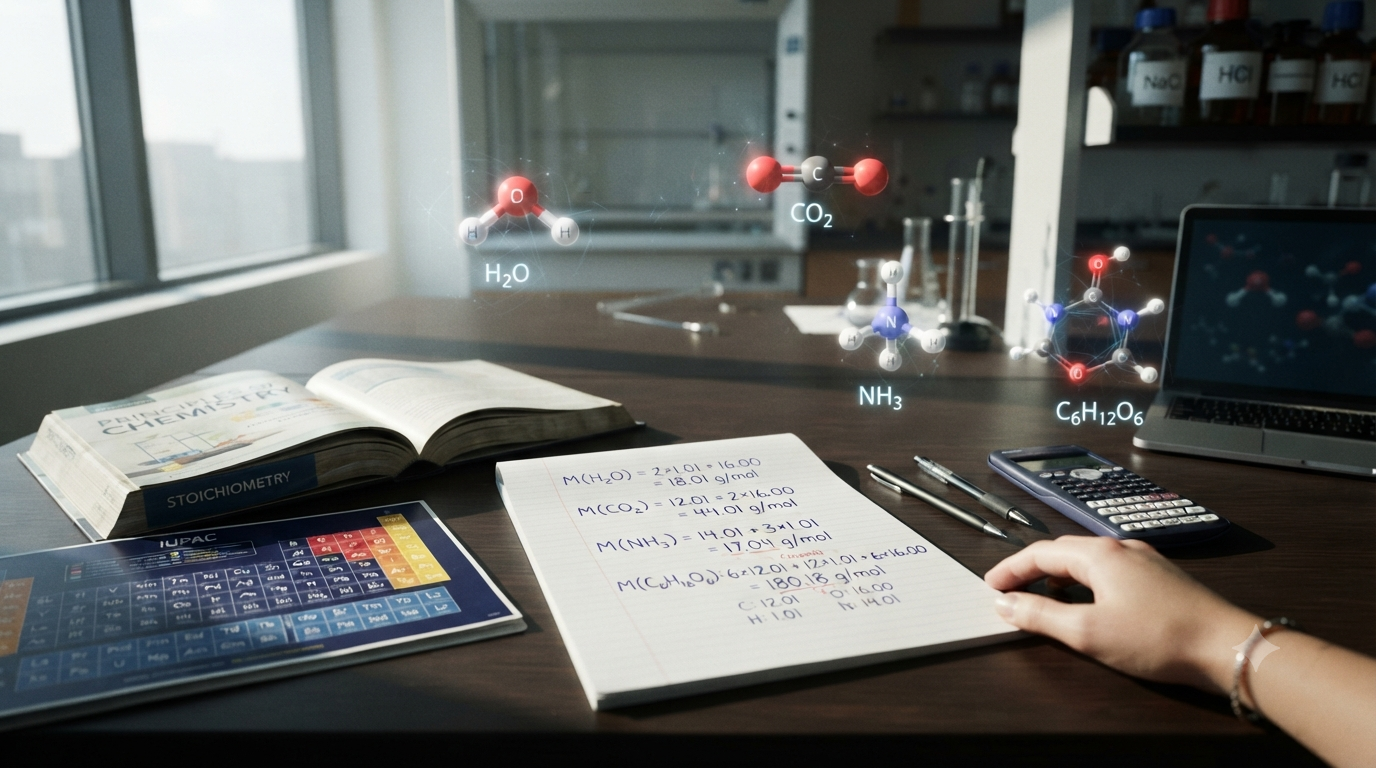
For example, a water molecule has the formula H₂O. It contains two hydrogen atoms and one oxygen atom. If the atomic mass of hydrogen is approximately 1 u and the atomic mass of oxygen is approximately 16 u, then:
Molecular mass of H₂O = (2 × 1) + (1 × 16)
Molecular mass of H₂O = 18 u
So, the molecular mass of water is approximately 18 u.
Molecular Mass and Relative Molecular Mass
Molecular mass and relative molecular mass are closely related but are not exactly the same quantity.
Molecular mass has a unit, usually u, because it represents the mass of one molecule relative to the atomic mass unit.
Relative molecular mass, written as Mᵣ, is a ratio and therefore has no unit. It is calculated by adding the relative atomic masses of all atoms in a molecule.
For many basic chemistry calculations, the numerical values are the same.
For example:
H₂O molecular mass ≈ 18 u
Relative molecular mass of H₂O ≈ 18
The important point is to understand whether a question is asking for molecular mass or relative molecular mass.
What Information Do You Need?
Before calculating molecular mass, you need two things:
The chemical formula of the substance.
The atomic masses of the elements present in the formula.
The atomic masses can usually be found in a periodic table.
For example, some commonly used approximate atomic masses are:
Hydrogen (H) = 1 u
Carbon (C) = 12 u
Nitrogen (N) = 14 u
Oxygen (O) = 16 u
Sodium (Na) = 23 u
Magnesium (Mg) = 24 u
Aluminium (Al) = 27 u
Sulfur (S) = 32 u
Chlorine (Cl) = 35.5 u
Calcium (Ca) = 40 u
In more accurate calculations, use the atomic masses provided in the periodic table or given in the question.
Step 1 Identify the Chemical Formula
The first step is to carefully look at the chemical formula.
Consider carbon dioxide:
CO₂
The formula contains:
C = 1 carbon atom
O₂ = 2 oxygen atoms
Therefore, before doing any calculation, identify every element and count how many atoms of each element are present.
This step is important because the small number written after an element symbol is called a subscript, and it tells you how many atoms of that element are present.
If no subscript is written, the number of atoms is understood to be one.
For example:
CO₂ → 1 C and 2 O
H₂O → 2 H and 1 O
NH₃ → 1 N and 3 H
CH₄ → 1 C and 4 H
Step 2 Find the Atomic Mass of Each Element
After identifying the elements, find their atomic masses.
For example, for carbon dioxide, CO₂:
Carbon (C) = 12 u
Oxygen (O) = 16 u
The formula contains one carbon atom and two oxygen atoms.
Step 3 Multiply Each Atomic Mass by the Number of Atoms
Now multiply the atomic mass of each element by the number of atoms present.
For CO₂:
Carbon contribution = 1 × 12 = 12 u
Oxygen contribution = 2 × 16 = 32 u
This gives the contribution of each element to the total molecular mass.
Step 4 Add All the Contributions
Finally, add the masses contributed by all the atoms.
For CO₂:
Molecular mass = 12 + 32
Molecular mass = 44 u
Therefore, the molecular mass of carbon dioxide is approximately 44 u.
A Simple General Formula
The calculation can be written in a general form:
Molecular mass = Σ(Number of atoms × Atomic mass)
In simple words:
Molecular mass = mass of first type of atom + mass of second type of atom + …
The most important part is counting the atoms correctly.
Example 1 Calculate the Molecular Mass of Water
The chemical formula of water is:
H₂O
Atomic masses:
H = 1 u
O = 16 u
Number of atoms:
H = 2
O = 1
Calculation:
Molecular mass = (2 × 1) + (1 × 16)
Molecular mass = 2 + 16
Molecular mass = 18 u
Therefore, the molecular mass of H₂O is 18 u.
Example 2 Calculate the Molecular Mass of Ammonia
The formula for ammonia is:
NH₃
Atomic masses:
N = 14 u
H = 1 u
Number of atoms:
N = 1
H = 3
Calculation:
Molecular mass = (1 × 14) + (3 × 1)
Molecular mass = 14 + 3
Molecular mass = 17 u
Therefore, the molecular mass of ammonia is 17 u.
Example 3 Calculate the Molecular Mass of Methane
Methane has the formula:
CH₄
Atomic masses:
C = 12 u
H = 1 u
Number of atoms:
C = 1
H = 4
Calculation:
Molecular mass = (1 × 12) + (4 × 1)
Molecular mass = 12 + 4
Molecular mass = 16 u
Therefore, the molecular mass of methane is 16 u.
Example 4 Calculate the Molecular Mass of Sulfur Dioxide
The formula for sulfur dioxide is:
SO₂
Atomic masses:
S = 32 u
O = 16 u
There is one sulfur atom and two oxygen atoms.
Calculation:
Molecular mass = (1 × 32) + (2 × 16)
Molecular mass = 32 + 32
Molecular mass = 64 u
Therefore, the molecular mass of sulfur dioxide is 64 u.
Example 5 Calculate the Molecular Mass of Sodium Chloride
The formula of sodium chloride is:
NaCl
Sodium (Na) = 23 u
Chlorine (Cl) = 35.5 u
There is one sodium atom and one chlorine atom.
Calculation:
Molecular mass = (1 × 23) + (1 × 35.5)
Molecular mass = 23 + 35.5
Molecular mass = 58.5 u
In basic chemistry, sodium chloride is commonly discussed in terms of formula units rather than individual molecules because it is an ionic compound. Therefore, formula mass is the more precise term for NaCl.
How to Handle Larger Chemical Formulas
Some formulas contain several elements and larger subscripts. The same basic method still works.
Consider glucose:
C₆H₁₂O₆
It contains:
6 carbon atoms
12 hydrogen atoms
6 oxygen atoms
Using:
C = 12 u
H = 1 u
O = 16 u
Calculate each contribution:
Carbon = 6 × 12 = 72 u
Hydrogen = 12 × 1 = 12 u
Oxygen = 6 × 16 = 96 u
Now add them:
Molecular mass = 72 + 12 + 96
Molecular mass = 180 u
Therefore, the molecular mass of glucose is approximately 180 u.
How to Calculate Molecular Mass With Brackets
Some chemical formulas contain brackets. In these formulas, the number outside the bracket applies to everything inside the bracket.
For example:
Ca(OH)₂
The subscript ₂ outside the bracket means that the entire OH group occurs twice.
Therefore, the formula contains:
1 calcium atom
2 oxygen atoms
2 hydrogen atoms
Using:
Ca = 40 u
O = 16 u
H = 1 u
Calculation:
Molecular mass = (1 × 40) + (2 × 16) + (2 × 1)
Molecular mass = 40 + 32 + 2
Molecular mass = 74 u
The key idea is that the subscript outside the bracket multiplies every atom inside the bracket.
Example With Nested Groups
A more complicated formula may contain a group with a subscript outside it.
Consider:
Al₂(SO₄)₃
First, identify the atoms.
Al₂ means:
2 aluminium atoms
(SO₄)₃ means the SO₄ group occurs three times.
Therefore:
Al = 2 atoms
S = 3 atoms
O = 12 atoms
Using approximate atomic masses:
Al = 27 u
S = 32 u
O = 16 u
Calculate:
Aluminium = 2 × 27 = 54 u
Sulfur = 3 × 32 = 96 u
Oxygen = 12 × 16 = 192 u
Add the contributions:
Molecular or formula mass = 54 + 96 + 192
= 342 u
This example shows why counting atoms carefully is one of the most important parts of molecular mass calculations.
Common Mistakes to Avoid
Ignoring Subscripts
A common mistake is to use the atomic mass only once even when a subscript indicates multiple atoms.
For H₂O, the two hydrogen atoms must both be included.
Incorrect:
1 + 16 = 17 u
Correct:
2 × 1 + 16 = 18 u
Forgetting the Number Outside a Bracket
In Ca(OH)₂, the ₂ applies to both O and H.
It does not mean that only hydrogen occurs twice.
The correct atom count is:
Ca = 1
O = 2
H = 2
Reading a Chemical Formula Too Quickly
Chemical formulas can contain capital letters, lowercase letters, subscripts, and brackets. For example, NaCl contains two elements: sodium and chlorine. The lowercase “a” is part of the element symbol Na, not a separate element.
Always identify complete element symbols before counting atoms.
Using the Wrong Atomic Mass
Check the periodic table carefully. Some elements have atomic masses that are not whole numbers. Chlorine, for example, is commonly represented as approximately 35.5 u.
Adding Atomic Masses Without Counting Atoms
For a formula such as C₆H₁₂O₆, simply adding 12 + 1 + 16 would be incorrect.
The subscripts must be included:
6 × 12 + 12 × 1 + 6 × 16
Molecular Mass and Molar Mass
Molecular mass and molar mass are related but represent different quantities.
Molecular mass refers to the mass of one molecule and is commonly expressed in u.
Molar mass refers to the mass of one mole of a substance and is expressed in g/mol.
For example, water has a molecular mass of approximately:
18 u
Its molar mass is approximately:
18 g/mol
The numerical values are often the same, but their units and meanings are different.
A Quick Method for Any Molecular Mass Problem
You can use the following four-step method for almost any basic molecular mass calculation:
1. Write the chemical formula.
2. Count the number of atoms of every element.
3. Multiply each atom count by the corresponding atomic mass.
4. Add all the contributions together.
For example, for CO₂:
C = 1 × 12 = 12
O = 2 × 16 = 32
Total = 12 + 32 = 44 u
This method is simple, systematic, and reduces the chance of missing an atom.
Why Molecular Mass Is Important
Molecular mass is more than just a calculation used in chemistry exercises. It provides a connection between the composition of a molecule and measurable quantities.
Chemists use molecular and formula masses when working with chemical equations, moles, molar masses, percentage composition, and quantitative chemical reactions. Once the molecular mass of a substance is known, it becomes easier to move between microscopic descriptions of molecules and laboratory measurements involving grams and moles.
Understanding molecular mass also helps when comparing different substances. For example, methane has a molecular mass of about 16 u, while carbon dioxide has a molecular mass of about 44 u. The difference comes from the types and numbers of atoms present in their molecules.
Final Checklist
Before submitting a molecular mass calculation, check the following:
Have you written the correct chemical formula?
Have you identified every element?
Have you counted all the atoms using the subscripts?
Have you correctly applied numbers outside brackets?
Have you used the correct atomic masses?
Have you multiplied each atomic mass by its number of atoms?
Have you added all contributions carefully?
Have you used the appropriate unit or terminology?
If these steps are followed carefully, most molecular mass calculations become straightforward.
Conclusion
Calculating molecular mass is a simple but fundamental chemistry skill. The basic idea is to find the atomic mass of every element in a molecule, count how many atoms of each element are present, multiply the atomic masses by their respective atom counts, and then add the results. Subscripts and brackets require extra attention because they determine how many atoms are actually present in the formula. With regular practice, even formulas containing several elements and complex groups can be handled systematically. Once this method becomes familiar, it also provides a strong foundation for understanding molar mass, moles, chemical reactions, and other quantitative concepts in chemistry.
FAQs
1. What is molecular mass?
Molecular mass is the total mass of all the atoms present in one molecule of a substance. It is calculated by adding the atomic masses of every atom shown in the chemical formula. For example, water has the formula H₂O. It contains two hydrogen atoms and one oxygen atom. Using hydrogen as 1 u and oxygen as 16 u, its molecular mass is (2 × 1) + 16 = 18 u. Molecular mass is commonly expressed in unified atomic mass units (u). It helps us understand the relative mass of molecules and is also useful when working with molar mass and quantitative chemistry calculations.
2. How do you calculate molecular mass step by step?
To calculate molecular mass, first write the correct chemical formula. Next, identify every element and count the number of atoms using the subscripts. Then find the atomic mass of each element from the periodic table. Multiply each atomic mass by the number of atoms present. Finally, add all the values together. For example, CO₂ contains one carbon atom and two oxygen atoms. Using C = 12 u and O = 16 u, the calculation is (1 × 12) + (2 × 16) = 44 u. This systematic method works for simple formulas as well as formulas containing several elements and brackets.
3. What is the difference between atomic mass and molecular mass?
Atomic mass refers to the mass of an individual atom of an element, while molecular mass refers to the combined mass of all atoms present in a molecule. For example, the atomic mass of oxygen is approximately 16 u. A water molecule contains one oxygen atom and two hydrogen atoms, so its molecular mass is approximately 18 u. Therefore, atomic mass describes one type of atom, whereas molecular mass describes the complete molecule. Molecular mass is calculated by multiplying each element’s atomic mass by the number of atoms present and then adding the resulting values.
4. How do subscripts affect molecular mass calculations?
Subscripts tell you how many atoms of an element are present in a chemical formula. They must always be included when calculating molecular mass. For example, H₂O contains two hydrogen atoms and one oxygen atom. Therefore, the hydrogen contribution is 2 × 1 = 2 u, rather than just 1 u. In C₆H₁₂O₆, the subscripts indicate six carbon atoms, twelve hydrogen atoms, and six oxygen atoms. Each atomic mass must be multiplied by its corresponding subscript before the values are added. If a subscript is missing, the number of atoms is understood to be one.
5. How do brackets work in molecular mass calculations?
A number written outside brackets applies to every atom or group inside those brackets. For example, Ca(OH)₂ contains one calcium atom, two oxygen atoms, and two hydrogen atoms. The subscript ₂ multiplies the entire OH group. Using Ca = 40 u, O = 16 u, and H = 1 u, the calculation is (1 × 40) + (2 × 16) + (2 × 1) = 74 u. When calculating formulas with brackets, first determine how many times the bracketed group occurs. Then count the atoms inside it and multiply their atomic masses accordingly.
6. What is the molecular mass of water?
The chemical formula for water is H₂O. This formula shows that one water molecule contains two hydrogen atoms and one oxygen atom. Using approximate atomic masses of H = 1 u and O = 16 u, calculate the contribution of each element. Hydrogen contributes 2 × 1 = 2 u, while oxygen contributes 1 × 16 = 16 u. Adding these values gives 2 + 16 = 18 u. Therefore, the molecular mass of water is approximately 18 u. The same numerical value is commonly used for the molar mass of water, but the units and meanings are different.
7. What is the molecular mass of carbon dioxide?
Carbon dioxide has the chemical formula CO₂. It contains one carbon atom and two oxygen atoms. The approximate atomic mass of carbon is 12 u, while oxygen has an atomic mass of 16 u. Therefore, the carbon contribution is 1 × 12 = 12 u, and the oxygen contribution is 2 × 16 = 32 u. Adding them gives 12 + 32 = 44 u. Thus, the molecular mass of carbon dioxide is approximately 44 u. The calculation demonstrates why subscripts are important: the subscript ₂ means that the mass of oxygen must be counted twice.
8. Is molecular mass the same as molar mass?
Molecular mass and molar mass are related but represent different quantities. Molecular mass describes the mass of a single molecule and is commonly expressed in unified atomic mass units (u). Molar mass describes the mass of one mole of a substance and is expressed in grams per mole (g/mol). For example, water has a molecular mass of approximately 18 u and a molar mass of approximately 18 g/mol. Their numerical values are often the same, but their units and physical meanings are different. Molecular mass focuses on an individual molecule, while molar mass applies to a mole of particles.
9. Can molecular mass be calculated for compounds with many elements?
Yes, molecular mass can be calculated for compounds containing many different elements. The same basic procedure is used regardless of how complicated the formula appears. First, identify each element and count all its atoms, including atoms affected by subscripts or brackets. Then multiply each atom count by the corresponding atomic mass and add all contributions. For example, C₆H₁₂O₆ contains carbon, hydrogen, and oxygen. Its molecular mass is calculated as (6 × 12) + (12 × 1) + (6 × 16) = 180 u. Careful atom counting makes complex formulas easier to handle.
10. Why is calculating molecular mass important in chemistry?
Calculating molecular mass is important because it connects the composition of a molecule with quantitative chemical calculations. It is used when determining molar mass, converting between mass and moles, studying chemical reactions, and calculating the composition of substances. Molecular mass also helps compare the relative masses of different molecules. To calculate it correctly, you need to understand chemical formulas, atomic masses, subscripts, and brackets. Once the basic calculation method is understood, many chemistry problems become easier to solve. It is therefore an important foundational skill for learning more advanced topics in chemistry and quantitative analysis.
Related Posts
Engineering Notation Converter
Engineering Notation Converter Convert numbers to and from engineering notation quickly and accurately. Conversion Mode Number to Engineering NotationEngineering Notation […]
Read MoreStandard Form to Scientific Notation Converter

Standard Form to Scientific Notation Converter Convert ordinary numbers into scientific notation using a coefficient and a power of 10. […]
Read MoreScientific Notation Converter
Scientific Notation Converter Convert decimal numbers into scientific notation and scientific notation into standard decimal form quickly and accurately. Conversion […]
Read MoreNumber Comparison Calculator

Number Comparison Calculator Enter two numbers to find out which number is greater, smaller, or whether both numbers are equal. […]
Read MoreSum of Geometric Series Calculator

Sum of Geometric Series Calculator Calculate the sum of finite and infinite geometric series with step-by-step solutions. Select Series Type […]
Read MoreSum of Arithmetic Series Calculator

Sum of Arithmetic Series Calculator Calculate the sum of an arithmetic series by entering its first term, common difference, and […]
Read MoreNumber Sequence Generator

Number Sequence Generator Generate number sequences easily using arithmetic, geometric, Fibonacci, or custom patterns. Sequence Type Arithmetic SequenceGeometric SequenceFibonacci SequenceCustom […]
Read MoreOdd or Even Number Checker
Odd or Even Number Checker Enter any whole number to find out whether it is odd or even. Enter a […]
Read MoreDivisibility Checker
Divisibility Checker Check whether a number is divisible by another number without leaving a remainder. Enter Number Enter a positive […]
Read MorePhysical States of Elements in the Periodic Table
The periodic table contains 118 known chemical elements, and each element has its own physical and chemical properties. One important […]
Read MoreRelative Atomic Mass and Its Significance in the Periodic Table
Every element in the periodic table has a unique atomic number and an atomic mass. While the atomic number tells […]
Read MoreIsotopes and Their Relationship with the Periodic Table
Atoms are the basic building blocks of all matter. Every chemical element consists of atoms that contain protons, neutrons, and […]
Read MoreOxidation States of Elements in the Periodic Table
Oxidation state is an important concept in chemistry that helps us understand how atoms behave when they form chemical compounds […]
Read MoreNature of Oxides Across the Periodic Table
Oxides are among the most common and important compounds in chemistry. They are formed when oxygen combines with another element, […]
Read MorePeriodic Trends in the Chemical Reactivity of Elements
The periodic table is one of the most important tools in chemistry because it helps us understand and predict the […]
Read MoreNonmetallic Character and Its Periodic Trend
Elements in the periodic table are generally classified into three major categories: metals, nonmetals, and metalloids. Metals usually lose electrons […]
Read MoreMetallic Character and Its Periodic Trend
The periodic table organizes elements according to their atomic numbers and chemical properties. One of the important properties used to […]
Read MoreElectronegativity and Its Periodic Variation
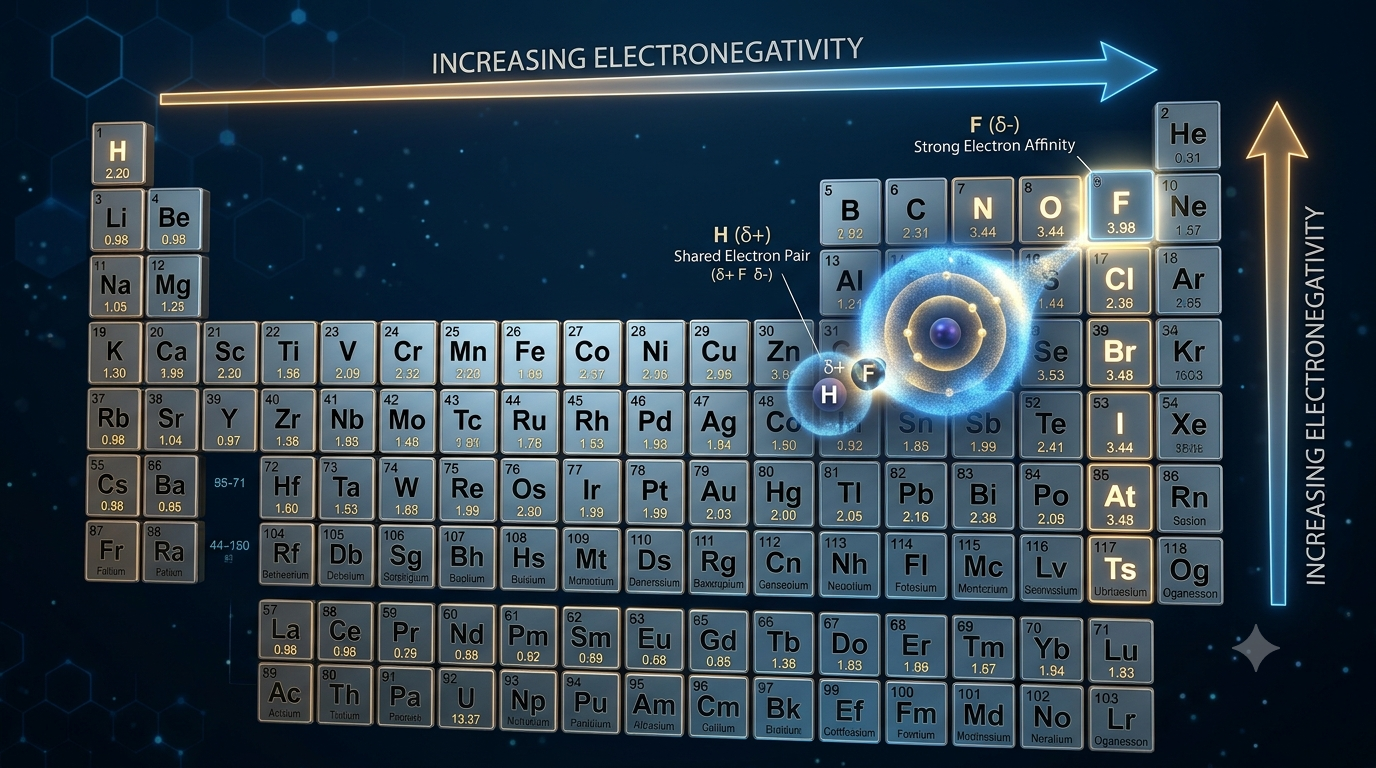
Electronegativity is one of the most important concepts in chemistry because it helps explain how atoms attract shared electrons when […]
Read MoreElectron Affinity and Its Periodic Trend
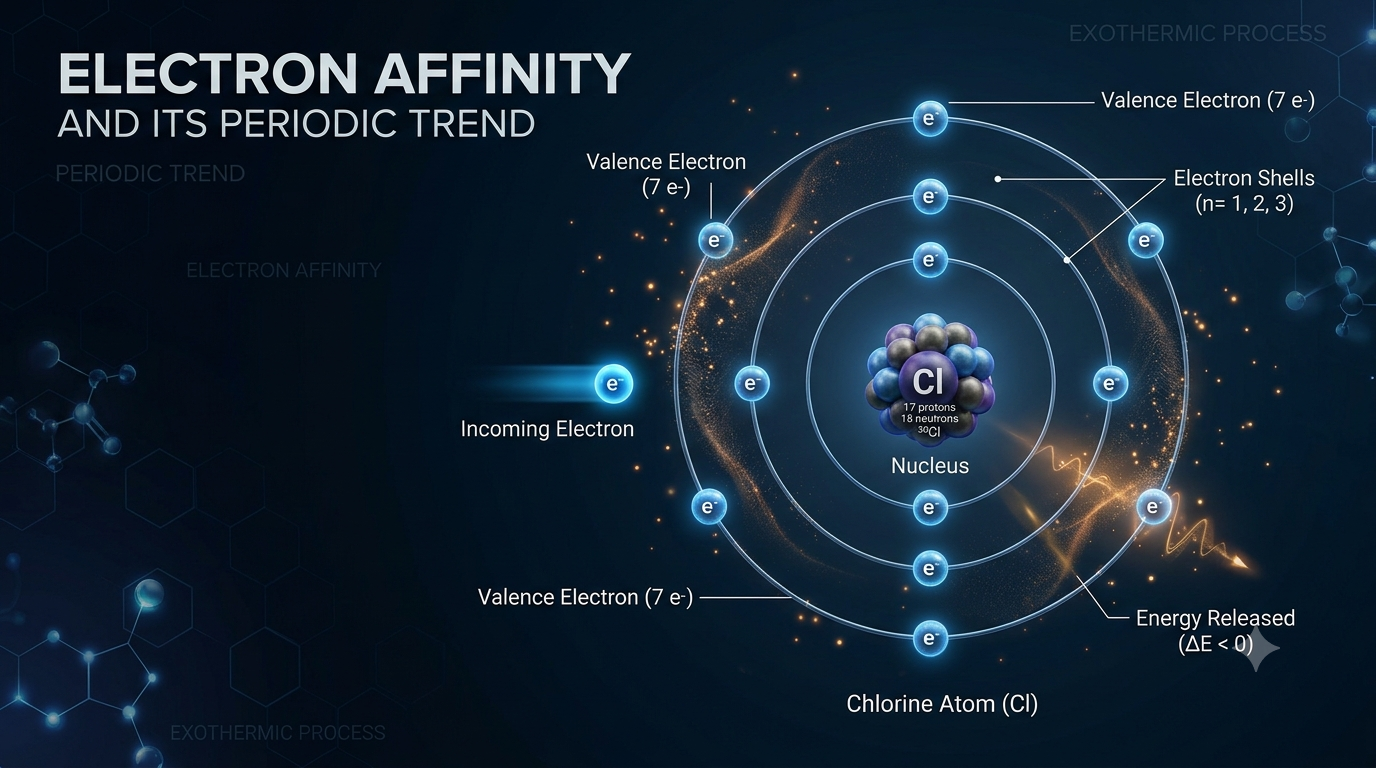
Atoms are constantly involved in chemical reactions, and their ability to gain or lose electrons plays an important role in […]
Read MoreIonization Energy and Its Periodic Trend
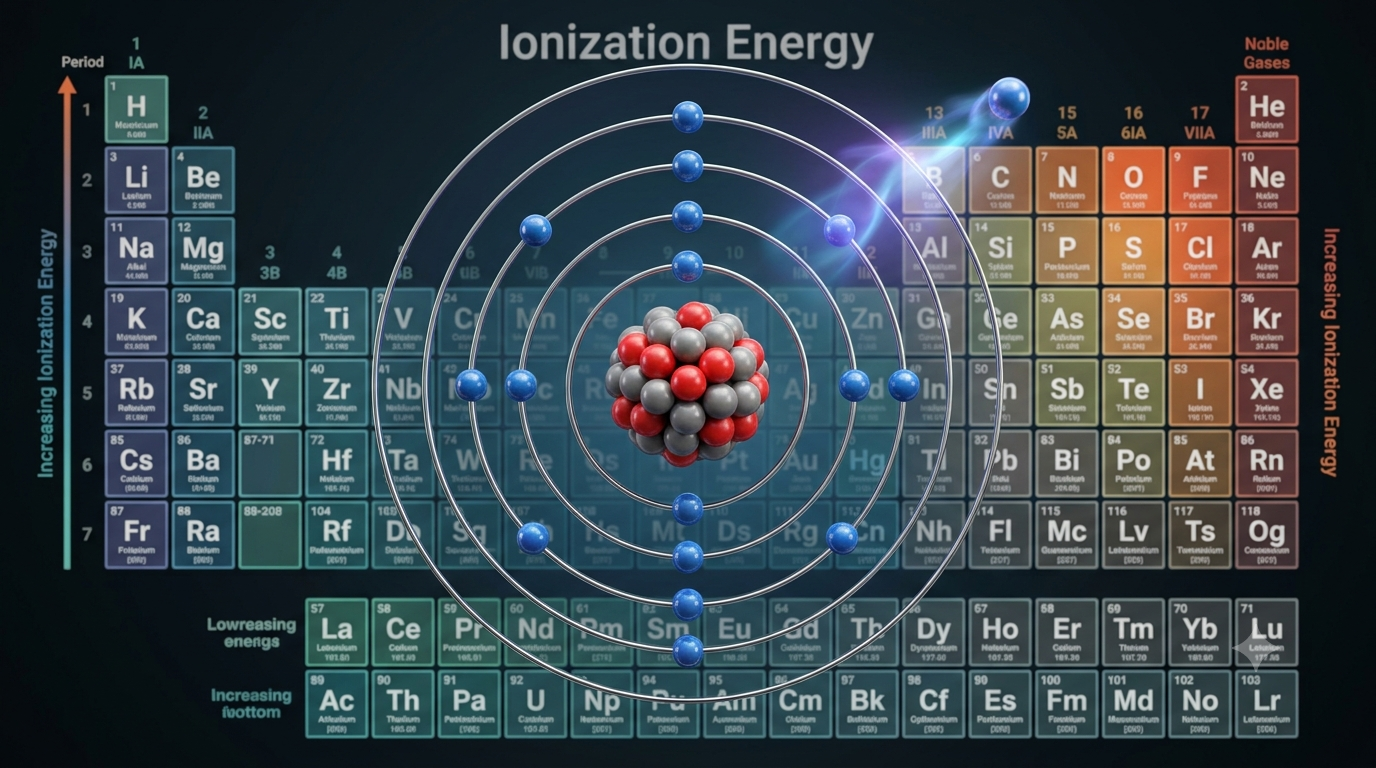
Ionization energy is one of the most important concepts in chemistry because it helps explain how atoms lose electrons and […]
Read MoreIonic Radius and Its Periodic Variation
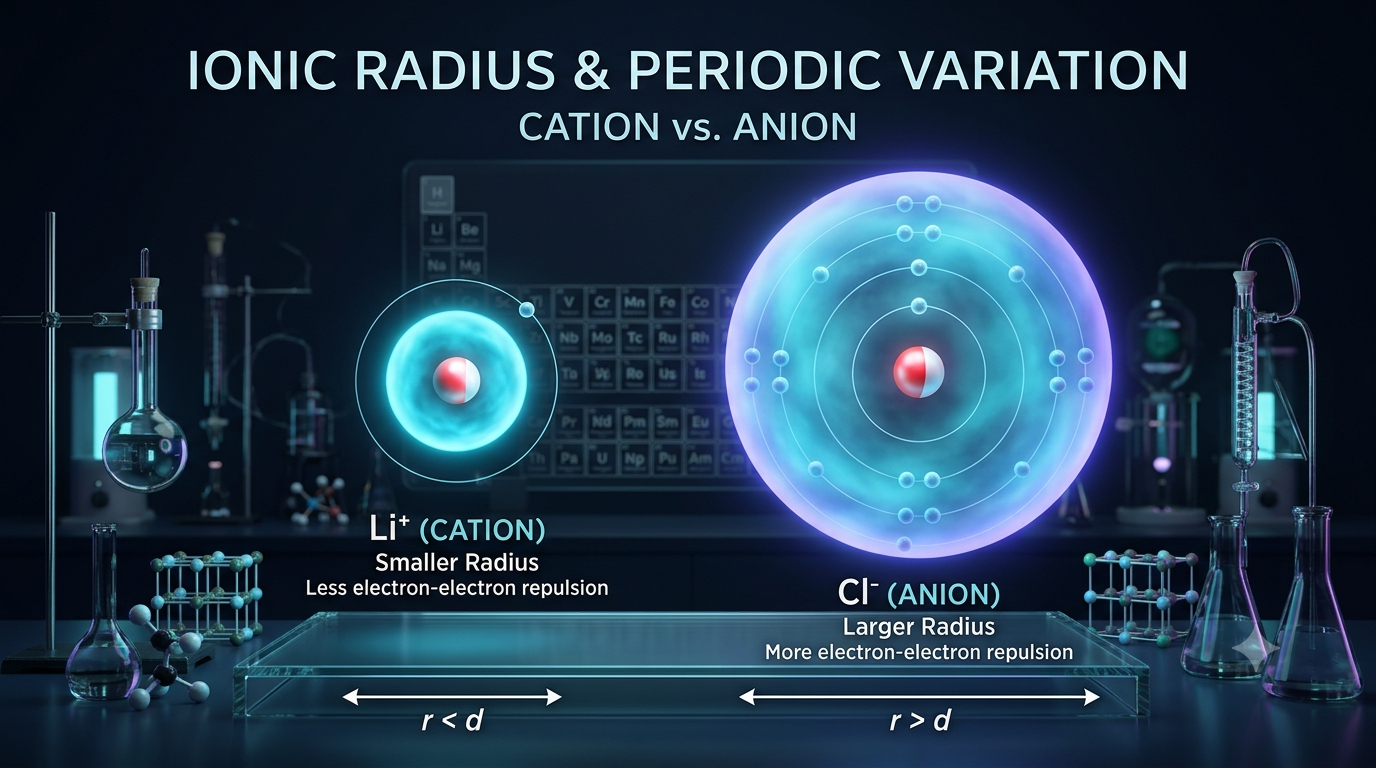
Atoms are made up of protons, neutrons, and electrons. When an atom gains or loses electrons, it becomes an electrically […]
Read MoreAtomic Radius and Its Periodic Variation
Atomic radius is an important concept in chemistry that helps us understand the size of atoms and how their sizes […]
Read MoreIntroduction to Periodic Trends in the Periodic Table
The periodic table is one of the most important tools in chemistry. It organizes all known chemical elements according to […]
Read MoreElectron Shells and Their Arrangement in Elements
Atoms are the basic building blocks of matter. Every atom consists of three main subatomic particles: protons, neutrons, and electrons. […]
Read MoreValency and Its Role in Understanding Elements
Every element in the periodic table has its own chemical properties and behaviour. Some elements combine easily with other elements, […]
Read MoreValence Electrons and Their Importance in Chemical Behaviour
Atoms are the basic building blocks of all matter. Every substance around us, including water, air, metals, minerals, and living […]
Read MoreElectron Configuration and Its Relationship with the Periodic Table
Every atom consists of three main subatomic particles: protons, neutrons, and electrons. While protons determine the identity of an element, […]
Read MoreThe f-Block Elements and Their General Properties
The periodic table is divided into different blocks based on the type of atomic orbital into which the last electron […]
Read MoreThe d-Block Elements and Their General Properties
The periodic table is divided into four main blocks: s-block, p-block, d-block, and f-block. These blocks are classified according to […]
Read MoreThe p-Block Elements and Their General Properties
The periodic table is divided into different blocks based on the electronic configuration of elements. These blocks include the s-block, […]
Read More