Mathematics often presents the same idea in several different forms. Two formulas may look completely different because they use different symbols, arrangements, operations, or ways of expressing a quantity. Yet, when the same values are substituted, both formulas can produce exactly the same result. This is not a coincidence. It happens because mathematical expressions can be transformed without changing their underlying value or meaning.
Understanding why this happens is an important part of learning mathematics. It helps us recognize equivalent expressions, simplify complicated formulas, check calculations, and choose the most convenient formula for a particular problem. In many cases, two formulas that appear unrelated are simply different representations of the same mathematical relationship. By learning how algebraic rules, identities, factoring, expansion, fractions, and substitutions work, we can see the connection between formulas that initially look very different.
What Does It Mean for Two Formulas to Be Equivalent?
Two mathematical formulas are equivalent when they produce the same value for every value of the variables for which both expressions are defined.
For example, consider these two expressions:
a + a
and
2a
They look different, but they always have the same value. If a = 5, then:
a + a = 5 + 5 = 10
and
2a = 2 × 5 = 10
The expressions are therefore equivalent.
Another simple example is:
3(x + 2)
and
3x + 6
The first expression uses multiplication with a bracket, while the second expression has been expanded. Their appearance is different, but the distributive property shows that:
3(x + 2) = 3x + 6
Therefore, both expressions represent the same mathematical quantity.
The important point is that equivalent formulas can look different while preserving exactly the same mathematical relationship.
Mathematical Formulas Can Be Written in Different Forms
A formula is usually designed to express a relationship between quantities. There is often more than one way to express that relationship.
For example, the area of a rectangle can be written as:
A = l × w
It can also be written as:
A = lw
These formulas look slightly different, but multiplication between l and w is understood in both cases.
Similarly, the perimeter of a rectangle can be written as:
P = 2(l + w)
or:
P = 2l + 2w
The first form keeps the common factor 2 outside the brackets. The second form distributes the 2 across both terms. Both give the same result.
This shows why appearance alone is not enough to decide whether two formulas are different. We need to examine their mathematical structure.
The Role of Algebraic Properties
One of the main reasons different-looking formulas can give the same result is that mathematics has rules that allow expressions to be rearranged or transformed.
These rules preserve equality.
The Commutative Property
The commutative property says that the order of certain operations can be changed without changing the result.
For addition:
a + b = b + a
For multiplication:
ab = ba
For example:
7 + 3 = 3 + 7
Both equal 10.
Likewise:
4 × 6 = 6 × 4
Both equal 24.
Because of this property, two formulas may look different simply because their terms appear in a different order.
For example:
x + y + z
and
z + x + y
represent the same quantity.
The Associative Property
The associative property allows the grouping of terms to change.
For addition:
(a + b) + c = a + (b + c)
For multiplication:
(ab)c = a(bc)
For example:
(2 + 3) + 4 = 2 + (3 + 4)
Both sides equal 9.
The grouping may look different, but the result remains unchanged.
The Distributive Property Can Change the Appearance of a Formula
The distributive property is particularly important because it can turn one compact expression into several separate terms.
The basic rule is:
a(b + c) = ab + ac
For example:
5(x + 4) = 5x + 20
The two sides look quite different. One contains a bracket, while the other contains two terms. However, they are mathematically equivalent.
The reverse process is called factoring:
5x + 20 = 5(x + 4)
Therefore, expansion and factoring can create two very different-looking forms of the same expression.
This is one reason formulas in textbooks may not always look identical even when they describe the same relationship.
Factoring Can Reveal Hidden Similarities
Factoring is another powerful way of showing why formulas that look different can be equivalent.
Consider:
x² + 5x + 6
This expression can be factored as:
(x + 2)(x + 3)
At first glance, these expressions appear unrelated. The first contains three terms, while the second contains two brackets multiplied together.
However, expanding the brackets gives:
(x + 2)(x + 3)
= x² + 3x + 2x + 6
= x² + 5x + 6
So both forms represent exactly the same expression.
The factored form may be more useful for solving equations, while the expanded form may be easier for some calculations. Different forms can therefore have different practical advantages even though they are mathematically equivalent.
Fractions Can Also Be Written in Different Forms
Fractions provide many examples of equivalent expressions.
Consider:
1/2
and:
2/4
These look different, but both represent the same value.
Similarly:
3/4 = 6/8 = 9/12
The numerator and denominator may change, but if both are multiplied or divided by the same nonzero number, the value of the fraction remains unchanged.
For example:
3/4 × 2/2 = 6/8
Since 2/2 equals 1, multiplying by it does not change the value.
This idea is frequently used when simplifying algebraic formulas and solving equations.
Algebraic Fractions Can Look Much More Complicated
The same principle applies to algebraic fractions.
Consider:
x/2 + x/2
This can be combined into:
x
because:
x/2 + x/2 = 2x/2 = x
The original expression appears longer, while the simplified expression is much shorter. Both represent the same value.
Another example is:
(x² – 9)/(x – 3)
The numerator can be factored:
x² – 9 = (x – 3)(x + 3)
Therefore:
(x² – 9)/(x – 3) = x + 3
provided x ≠ 3.
This example also shows why conditions matter. Equivalent-looking transformations can involve restrictions on the values for which an expression is defined.
Mathematical Identities Make Different Forms Equal
A mathematical identity is an equality that is true for all allowed values of its variables.
For example:
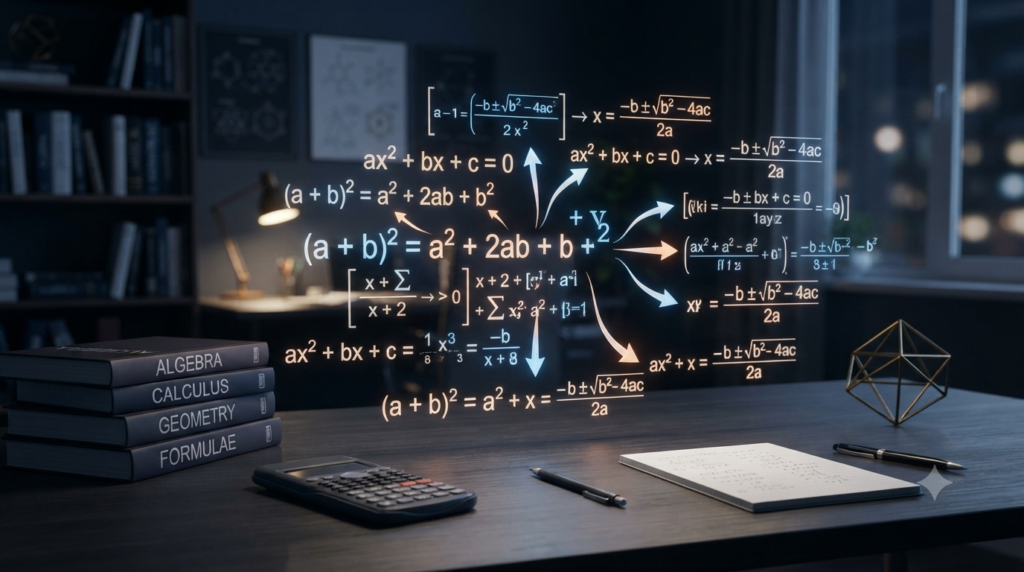
(a + b)² = a² + 2ab + b²
The left side and right side look very different, but they are equal for all values of a and b.
Another important identity is:
a² – b² = (a – b)(a + b)
These identities allow mathematicians to move between different forms of the same expression.
For example:
x² – 25
can be written as:
(x – 5)(x + 5)
The second form can be particularly useful when solving equations or simplifying expressions.
Substitution Can Show That Two Formulas Agree
Sometimes the easiest way to understand whether two formulas produce the same result is to substitute specific values.
Suppose we compare:
2(x + y)
and:
2x + 2y
Let:
x = 3
and:
y = 4
Using the first formula:
2(3 + 4) = 2 × 7 = 14
Using the second formula:
2(3) + 2(4) = 6 + 8 = 14
Both formulas give 14.
Testing values can help us see the equivalence, although testing a few values alone does not prove that two formulas are universally equivalent. A mathematical proof is needed to establish that they always agree.
Different Formulas May Be Rearrangements of the Same Relationship
Sometimes a formula is rearranged to make a different variable the subject.
For example, the formula for speed is:
v = d/t
where v is speed, d is distance, and t is time.
The same relationship can be rearranged to find distance:
d = vt
or time:
t = d/v
These formulas look different, but they describe the same relationship between speed, distance, and time.
If a vehicle travels at 60 km/h for 2 hours, the distance is:
d = vt
d = 60 × 2
d = 120 km
Using the original relationship:
v = d/t
we can also rearrange it:
d = vt
The formulas are not competing formulas. They are different forms of the same relationship designed for different situations.
Why Does the Same Result Appear?
At a deeper level, mathematical equality means that two expressions have the same value under the stated conditions.
When we transform one expression into another using valid mathematical operations, we are not changing its underlying value. We are changing how that value is represented.
This is similar to writing the same number in different forms.
For example:
0.5
1/2
50%
and:
5/10
all represent the same quantity.
Their appearances are different because they use decimals, fractions, percentages, or ratios. The underlying quantity has not changed.
Algebra works in much the same way, except that variables are involved.
Why Different Forms Are Useful
If two formulas are equivalent, why not use only one form?
The reason is that different forms are useful for different purposes.
Consider:
x² – 9
and:
(x – 3)(x + 3)
The expanded form makes the polynomial easy to read and compare with other terms. The factored form makes the roots immediately visible and can make equation solving easier.
Similarly:
2(x + 5)
may be easier to calculate mentally than:
2x + 10
while the expanded form may be more convenient when combining it with another algebraic expression.
A good mathematician does not simply look for one correct form. They learn to choose the form that makes the next step easier.
Equivalent Formulas in Geometry
Geometry contains many examples of equivalent formulas.
The area of a triangle is:
A = 1/2 bh
It can also be written as:
A = bh/2
These expressions look different, but division by 2 and multiplication by 1/2 have the same effect.
Similarly, the circumference of a circle is:
C = 2πr
It can also be written as:
C = πd
because:
d = 2r
Substituting 2r for d gives:
C = π(2r)
C = 2πr
Thus, the two formulas are equivalent even though one uses radius and the other uses diameter.
Equivalent Formulas in Mathematics and Science
Equivalent expressions are not limited to basic mathematics. They are common throughout physics, chemistry, engineering, statistics, and other scientific fields.
For example, kinetic energy is commonly written as:
KE = 1/2 mv²
The factor 1/2 can also be written as:
KE = mv²/2
The appearance changes, but the mathematical meaning remains the same.
In science, formulas are often rearranged depending on what quantity needs to be calculated. This is why students may encounter several versions of what appears to be the same formula.
Recognizing equivalence makes these formulas easier to understand rather than memorizing each version separately.
How to Check Whether Two Formulas Are Equivalent
There are several ways to investigate whether two formulas represent the same mathematical expression.
First, simplify both expressions separately. If they reduce to the same form, they are equivalent under the relevant conditions.
Second, use algebraic identities such as the distributive property, factoring, and exponent rules to transform one expression into the other.
Third, substitute suitable values as a quick check. If the formulas give different results for even one allowed value, they are not equivalent.
Finally, pay attention to restrictions. Expressions involving division, square roots, logarithms, or other operations may have conditions that affect where the formula is defined.
The safest approach is therefore not simply to compare how formulas look, but to examine the mathematical rules connecting them.
A Formula’s Appearance Does Not Determine Its Meaning
One of the most important lessons in mathematics is that visual appearance can be misleading.
For example:
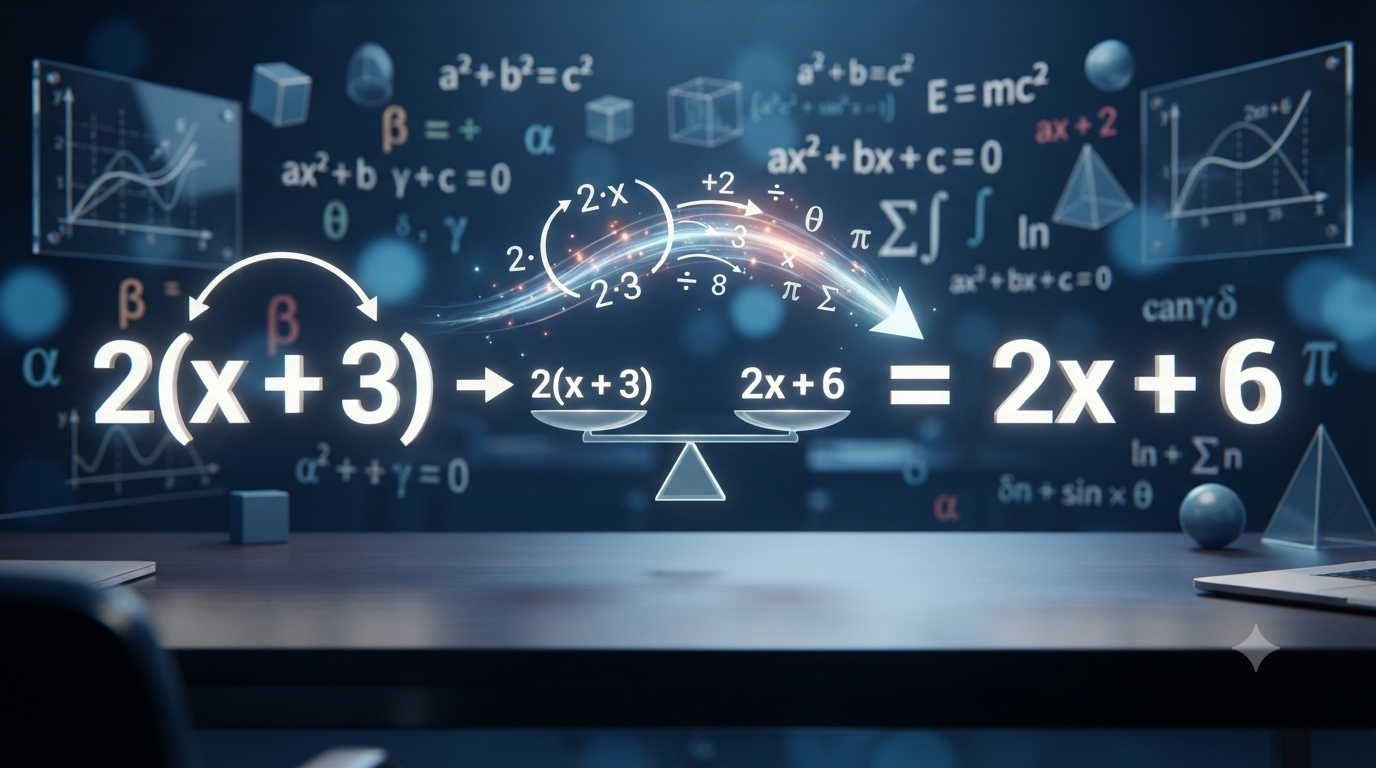
2(x + 3)
and:
2x + 6
look different.
But:
2(x + 3) = 2x + 6
Likewise:
x² – 16
and:
(x – 4)(x + 4)
look completely different.
But:
x² – 16 = (x – 4)(x + 4)
The symbols may be arranged differently, but the mathematical relationship remains unchanged.
Learning to recognize this is a major step from simply calculating with formulas to actually understanding algebra.
Conclusion
Two mathematically different-looking formulas can give the same result because mathematical expressions can often be transformed without changing their value. Properties such as commutativity, associativity, and distributivity, along with factoring, expansion, algebraic identities, fraction rules, and substitution, allow the same relationship to be represented in many forms.
Equivalent formulas are not merely different ways of writing something for appearance. Each form can make a particular calculation, proof, or problem easier to understand. Once you learn to look beyond the surface appearance of a formula and recognize the mathematical operations connecting its terms, many apparently different formulas become much easier to understand.
The key idea is simple: different mathematical forms do not necessarily mean different mathematical meanings. What matters is whether the expressions remain equal under the conditions in which they are defined.
FAQs
1. Why can two different-looking formulas give the same result?
Two formulas can look different but still give the same result because mathematical expressions can be written in different equivalent forms. Rules such as the distributive, commutative, and associative properties allow terms to be rearranged, expanded, or grouped without changing their value. For example, 2(x + 3) and 2x + 6 look different, but both represent the same quantity. Factoring, simplifying fractions, and using mathematical identities can also change the appearance of a formula while preserving its meaning. Therefore, the visual form of a formula does not always determine its mathematical value. What matters is the relationship represented by the expression.
2. What does it mean when two formulas are mathematically equivalent?
Two formulas are mathematically equivalent when they produce the same value for all allowed values of their variables. For example, 3(x + 2) and 3x + 6 are equivalent because applying the distributive property converts the first expression into the second. Equivalence means that the formulas represent the same mathematical quantity or relationship, even though their structures may appear different. However, equivalence can depend on conditions. For example, expressions containing variables in denominators may have restrictions because division by zero is undefined. Therefore, when comparing formulas, it is important to consider both their algebraic form and the conditions under which they are defined.
3. How does the distributive property make formulas look different?
The distributive property allows multiplication to be applied to every term inside a bracket. Its basic form is a(b + c) = ab + ac. For example, 4(x + 5) can be expanded to 4x + 20. These expressions have different appearances because one uses a bracket while the other contains separate terms. However, they always have the same value for the same value of x. The process can also be reversed through factoring: 4x + 20 can be written as 4(x + 5). Therefore, expansion and factoring are common reasons why equivalent mathematical formulas can look completely different.
4. Can rearranging terms change the value of a formula?
For addition and multiplication, rearranging terms does not change the value because of the commutative property. For example, a + b is equal to b + a, and ab is equal to ba. Similarly, several terms can be rearranged without affecting their sum or product. For example, x + 3 + y and y + x + 3 represent the same quantity. However, this rule does not apply in the same way to subtraction and division. For instance, a − b is generally not equal to b − a. Therefore, terms can be rearranged safely only when the mathematical operation permits it.
5. Why do factoring and expansion produce equivalent formulas?
Factoring and expansion are opposite algebraic processes that change how an expression is written without changing its value. For example, x² + 5x + 6 can be factored as (x + 2)(x + 3). If the brackets are expanded again, the original expression is obtained. The factored form is often useful for solving equations and identifying factors, while the expanded form may be useful for combining like terms or comparing polynomial expressions. Since both forms represent the same mathematical quantity, they are equivalent. This demonstrates that a formula’s structure can change significantly while its underlying mathematical meaning remains unchanged.
6. Can fractions represent the same value in different forms?
Yes. Fractions can have different numerators and denominators while representing exactly the same value. For example, 1/2, 2/4, 3/6, and 5/10 are equivalent fractions. This happens because multiplying or dividing both the numerator and denominator by the same nonzero number does not change the value of the fraction. The same idea applies to algebraic fractions. For example, x/2 + x/2 simplifies to x. Although the original expression contains two fractional terms and the simplified form contains only one variable, both represent the same quantity. Equivalent fractions are therefore another common example of different-looking mathematical expressions.
7. Are two formulas always equivalent if they give the same result for a few examples?
No. Getting the same result for a few selected values does not prove that two formulas are equivalent for every allowed value. For example, two unrelated expressions might accidentally produce the same result for one or several values. To establish equivalence, we normally use algebraic reasoning to show that one expression can be transformed into the other using valid mathematical rules. Substituting values is useful as a quick check and can reveal that formulas are not equivalent if they produce different results. However, a mathematical proof or valid algebraic transformation is needed to establish general equivalence.
8. Why are equivalent formulas useful in mathematics?
Equivalent formulas are useful because different forms can make different mathematical tasks easier. One form may be simpler to calculate, while another may make a relationship easier to see. For example, 2(x + 5) and 2x + 10 are equivalent, but the first form may be convenient for substitution, while the second may be easier when combining it with other algebraic terms. Factored expressions can make equation solving easier, while expanded expressions can help with addition or comparison. Learning to move between equivalent forms gives greater flexibility and reduces the need to memorize many separate versions of essentially the same mathematical relationship.
9. Can scientific formulas also have different equivalent forms?
Yes. Scientific formulas are frequently rearranged into different equivalent forms depending on which quantity needs to be calculated. For example, the relationship between speed, distance, and time can be written as v = d/t. Rearranging it gives d = vt and t = d/v. These formulas look different, but they describe the same underlying relationship. Physics and other sciences commonly use algebraic rearrangement to isolate a particular variable. Recognizing equivalent forms is therefore important when working with scientific equations. Instead of memorizing every possible version separately, understanding the original relationship and how to rearrange it can make calculations much easier.
10. How can I tell whether two different-looking formulas are equivalent?
To determine whether two formulas are equivalent, first simplify each expression using valid algebraic rules. You can expand brackets, factor expressions, combine like terms, simplify fractions, or apply mathematical identities. If both expressions reduce to the same form, they are equivalent under the relevant conditions. You can also substitute sample values as a quick check, although this alone does not prove equivalence. Pay particular attention to restrictions involving division by zero, square roots, logarithms, or other operations. The most reliable method is to use algebraic transformations to demonstrate that one formula can be converted into the other without changing its mathematical value.