Angles are one of the most important concepts in mathematics, especially in geometry and trigonometry. They help us describe the direction of objects, measure rotations, understand the shapes of figures, and calculate distances that cannot be measured directly. From the slope of a roof to the movement of a rotating wheel, angles appear in many everyday situations.
In trigonometry, angles play a central role because they connect the measurements of angles with the lengths of sides in triangles. By understanding angles, we can calculate unknown distances, determine heights, study circular motion, and solve a wide range of mathematical problems. Before learning trigonometric ratios such as sine, cosine, and tangent, it is important to understand what angles are, how they are measured, and how different types of angles behave. This article explains these fundamental ideas in a simple and practical way.
What Is an Angle?
An angle is formed when two rays or line segments meet at a common endpoint. The common endpoint is called the vertex, while the two rays are called the arms or sides of the angle.
An angle measures the amount of rotation or separation between its two arms. It is usually measured in degrees or radians. The size of an angle depends on how far one arm turns from the other, not on the lengths of the arms.
For example, when the hands of a clock point in different directions, they form an angle. Similarly, when a door opens, the angle between the door and its closed position changes as the door rotates.
An angle is commonly represented by the symbol ∠. For example, ∠ABC represents an angle whose vertex is B. When three letters are used, the middle letter usually identifies the vertex.
Understanding this basic definition provides the foundation for studying triangles, circles, and trigonometric relationships.
Parts of an Angle
Every angle has a few basic parts that help us describe and measure it correctly.
Vertex
The vertex is the common endpoint where the two arms of an angle meet. In ∠ABC, point B is the vertex.
Arms of an Angle
The arms are the two rays that form the angle. In ∠ABC, the arms are BA and BC. The angle is measured by considering the rotation from one arm to the other.
Interior and Exterior of an Angle
The interior is the region between the two arms of an angle, while the exterior is the region outside that opening. When an angle is drawn on paper, a curved arc is often used to indicate which angle is being discussed.
These parts are important when reading geometric diagrams and identifying angles in triangles. They also help prevent confusion when several angles share the same vertex.
How Are Angles Measured?
Angles can be measured in different units, but degrees and radians are the two most commonly used units in elementary trigonometry.
Measuring Angles in Degrees
A degree is a unit used to measure an angle. One complete rotation is divided into 360 equal parts, and each part represents one degree.
Text block — Degree relationships
360° = one complete rotation
180° = a half rotation
90° = a quarter rotation
45° = half of a right angle
For example, when a person turns through one quarter of a complete circle, the rotation measures 90°. If the person continues turning through another quarter, the total rotation becomes 180°.
Degrees are widely used in school geometry, construction, navigation, and everyday descriptions of direction. A protractor is a common instrument for measuring angles in degrees.
Measuring Angles in Radians
A radian is another unit for measuring angles. It is based on the relationship between the radius of a circle and the length of the arc along that circle.
One radian is the angle at the centre of a circle that subtends an arc whose length is equal to the circle’s radius.
Radians are particularly important in advanced mathematics because they simplify many trigonometric formulas, especially those involving calculus, circular motion, and periodic functions.
Text block — Degree and radian relationships
180° = π radians
360° = 2π radians
90° = π/2 radians
60° = π/3 radians
45° = π/4 radians
30° = π/6 radians
Here, π (pi) is approximately 3.14159. These relationships allow us to convert angle measurements from degrees to radians and from radians to degrees.
Converting Degrees into Radians
To convert an angle measured in degrees into radians, multiply the degree measurement by π and divide by 180.
Text block — Degree-to-radian formula
Angle in radians = Angle in degrees × π / 180
For example, to convert 60° into radians:
60° × π / 180 = π/3 radians
Therefore, 60° is equal to π/3 radians.
Converting Radians into Degrees
To convert radians into degrees, multiply the radian measurement by 180 and divide by π.
Text block — Radian-to-degree formula
Angle in degrees = Angle in radians × 180 / π
For example:
π/4 × 180 / π = 45°
Therefore, π/4 radians is equal to 45°.
Learning these conversions is useful because trigonometry problems may use either degrees or radians. Always check the unit before applying a formula or calculating a trigonometric value.
Types of Angles
Angles are classified according to their measurements. Recognizing these types helps us understand geometric figures and identify important angle relationships.
Acute Angle
An acute angle measures more than 0° but less than 90°. It is smaller than a right angle.
Examples include 20°, 35°, and 75°. Acute angles appear in many triangles, roof structures, and inclined surfaces.
Right Angle
A right angle measures exactly 90°. Its arms are perpendicular to each other.
Right angles are commonly found in the corners of squares and rectangles. In a right-angled triangle, one angle is always 90°, making this type of triangle especially important in trigonometry.
Obtuse Angle
An obtuse angle measures more than 90° but less than 180°.
Examples include 110°, 135°, and 160°. Obtuse angles appear in different geometric shapes and are useful when studying triangle angle relationships.
Straight Angle
A straight angle measures exactly 180°. Its arms point in opposite directions and form a straight line.
Straight angles are important when calculating supplementary angles and understanding rotations.
Reflex Angle
A reflex angle measures more than 180° but less than 360°.
For example, an angle measuring 240° is a reflex angle. Reflex angles are useful for describing larger rotations around a point.
Complete Angle
A complete angle measures 360°. It represents one full rotation, returning to the starting direction.
For example, when a wheel completes one full turn, it rotates through 360°.
Understanding these classifications makes it easier to interpret diagrams, solve geometry questions, and identify the angles used in trigonometric calculations.
Important Angle Relationships
Angles often follow predictable relationships. These relationships are useful in geometry and provide a foundation for solving more complex trigonometry problems.
Complementary Angles
Two angles are complementary when their measurements add up to 90°.
Text block — Complementary angle formula
Angle A + Angle B = 90°
For example, if one angle is 30°, its complementary angle is:
90° − 30° = 60°
Therefore, the two angles are 30° and 60°.
Complementary angles frequently appear in right-angled triangles because the two acute angles of a right-angled triangle always add up to 90°.
Supplementary Angles
Two angles are supplementary when their measurements add up to 180°.
Text block — Supplementary angle formula
Angle A + Angle B = 180°
For example, if one angle is 125°, the supplementary angle is:
180° − 125° = 55°
Supplementary angles commonly appear when two angles form a straight line.
Vertically Opposite Angles
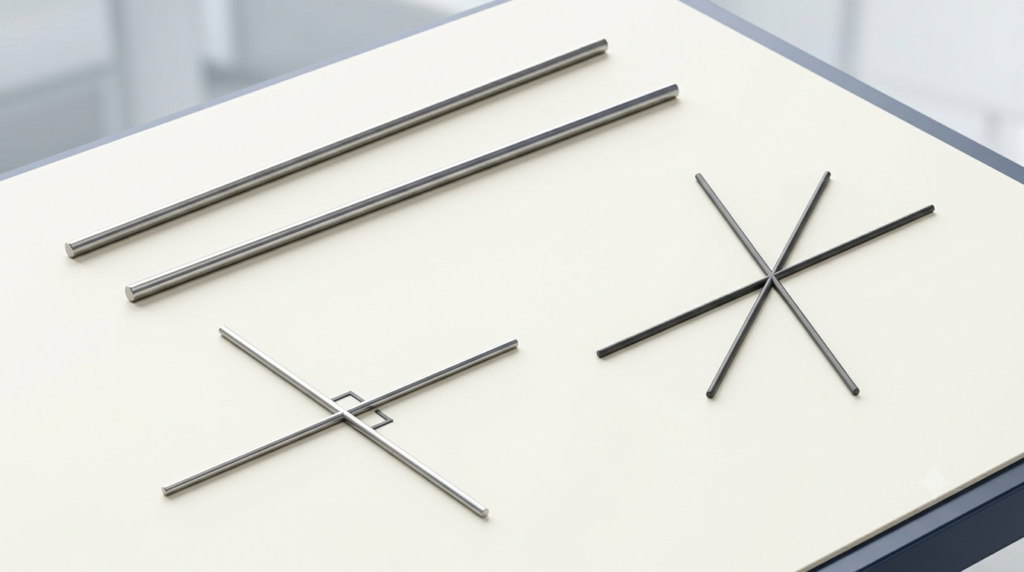
When two straight lines intersect, they form four angles. The angles opposite each other are called vertically opposite angles, and they are equal.
For example, if one angle measures 70°, the angle directly opposite it also measures 70°.
This relationship is useful for finding unknown angles without measuring them directly.
Angles Around a Point
The sum of all angles around a single point is 360°.
Text block — Angles around a point formula
Sum of angles around a point = 360°
For example, if three angles around a point measure 90°, 120°, and 80°, the fourth angle is:
360° − (90° + 120° + 80°) = 70°
These relationships are frequently used in geometry problems and can help determine unknown angles before applying trigonometric ratios.
Angles in Triangles
Triangles are among the most important shapes in trigonometry. Every triangle has three interior angles, and their sum is always 180°.
Text block — Triangle angle-sum formula
A + B + C = 180°
For example, if two angles of a triangle measure 50° and 60°, the third angle is:
180° − (50° + 60°) = 70°
Therefore, the triangle’s angles are 50°, 60°, and 70°.
Triangles can be classified according to their angles. An acute triangle has three acute angles. A right-angled triangle has one right angle. An obtuse triangle has one obtuse angle.
The right-angled triangle is especially important because the basic trigonometric ratios are commonly introduced using its sides and angles.
Why Right-Angled Triangles Matter
A right-angled triangle contains one angle measuring 90°. The side opposite this right angle is called the hypotenuse, and it is the longest side of the triangle.
The other two sides are identified according to the angle being studied. The side opposite the selected angle is called the opposite side, while the side next to the angle, excluding the hypotenuse, is called the adjacent side.
These side relationships form the basis of sine, cosine, and tangent. By knowing an angle and one suitable side length, we can often calculate other unknown side lengths.
The Role of Angles in Trigonometry
Trigonometry is the branch of mathematics that studies relationships between angles and side lengths, particularly in triangles. Angles are central to this subject because they determine the ratios between the sides of a right-angled triangle.
The three basic trigonometric ratios are sine, cosine, and tangent. Each ratio compares two sides of a right-angled triangle relative to a chosen acute angle.
Sine of an Angle
The sine of an angle compares the opposite side with the hypotenuse.
Text block — Sine formula
sin θ = Opposite / Hypotenuse
Here, θ (theta) represents the angle being considered.
For example, if the opposite side measures 3 units and the hypotenuse measures 5 units, the sine of the angle is:
sin θ = 3 / 5 = 0.6
This ratio helps calculate unknown side lengths and angles in right-angled triangles.
Cosine of an Angle
The cosine of an angle compares the adjacent side with the hypotenuse.
Text block — Cosine formula
cos θ = Adjacent / Hypotenuse
For example, if the adjacent side measures 4 units and the hypotenuse measures 5 units:
cos θ = 4 / 5 = 0.8
Cosine is useful for finding horizontal or vertical components of a length, depending on how the angle is defined.
Tangent of an Angle
The tangent of an angle compares the opposite side with the adjacent side.
Text block — Tangent formula
tan θ = Opposite / Adjacent
For example, if the opposite side measures 3 units and the adjacent side measures 4 units:
tan θ = 3 / 4 = 0.75
Tangent is particularly useful in problems involving heights, slopes, and distances.
Understanding the Three Ratios Together
Consider a right-angled triangle with side lengths 3, 4, and 5. If θ is the angle opposite the side of length 3, then the opposite side is 3, the adjacent side is 4, and the hypotenuse is 5.
Text block — Trigonometric ratios for the example
sin θ = 3 / 5 = 0.6
cos θ = 4 / 5 = 0.8
tan θ = 3 / 4 = 0.75
These ratios show how an angle is connected to the relative lengths of the triangle’s sides. The ratios remain the same for similar right-angled triangles with the same acute angle, even when their overall sizes differ.
Angles and the Unit Circle
Trigonometry is not limited to right-angled triangles. It also uses the unit circle to describe angles and define trigonometric functions for a wider range of rotations.
A unit circle is a circle with a radius of exactly one unit. It is usually drawn on a coordinate plane with its centre at the origin, where the horizontal and vertical axes intersect.
An angle is commonly measured from the positive horizontal axis. A counterclockwise rotation is considered positive, while a clockwise rotation is considered negative.
On the unit circle, the horizontal coordinate of a point corresponds to the cosine of the angle, while the vertical coordinate corresponds to its sine.
Text block — Unit circle relationships
x = cos θ
y = sin θ
x² + y² = 1
The unit circle helps explain why sine and cosine values repeat after a complete rotation. It also allows us to study angles greater than 90°, including obtuse angles, reflex angles, and negative angles.
This broader interpretation is essential for understanding trigonometric graphs, periodic motion, waves, and advanced mathematical functions.
Positive and Negative Angles
Angles can be positive or negative depending on the direction of rotation.
A positive angle is generally measured counterclockwise from the starting direction. A negative angle is measured clockwise.
For example, a rotation of 90° counterclockwise represents a positive angle of 90°. A rotation of 90° clockwise represents an angle of −90°.
Angles can also have different measurements while ending in the same direction. Such angles are called coterminal angles.
Text block — Coterminal angle relationship
Coterminal angle = θ + 360° × n
Here, n is any integer.
For example, 30° and 390° are coterminal because:
30° + 360° = 390°
Both angles point in the same final direction after rotation, even though one represents a complete turn more than the other.
Understanding positive, negative, and coterminal angles is useful when studying the unit circle and trigonometric functions.
Angles of Elevation and Depression
Angles are also used to describe the direction of sight when observing objects at different heights.
Angle of Elevation
The angle of elevation is the angle between the horizontal line at an observer’s eye level and the line of sight directed upward toward an object.
For example, when a person looks at the top of a building from the ground, the angle between the horizontal direction and the upward line of sight is the angle of elevation.
Angle of Depression
The angle of depression is the angle between the horizontal line at the observer’s eye level and the line of sight directed downward toward an object.
For example, when a person standing on a balcony looks down at a car on the road, the angle between the horizontal direction and the downward line of sight is the angle of depression.
These angles are important in surveying, navigation, construction, and astronomy. Trigonometric ratios allow us to use them to estimate heights and distances that are difficult to measure directly.
Real-Life Applications of Angles in Trigonometry
Angles are not only theoretical mathematical concepts. They are used in many practical situations.
Architecture and Construction
Architects and engineers use angles to design roofs, stairs, ramps, bridges, and structural supports. Correct angle measurements help ensure that structures fit together properly and meet design requirements.
Navigation and Direction
Pilots, sailors, and navigators use angular measurements to describe directions and changes in heading. Trigonometry can help calculate positions, routes, and distances.
Astronomy and Space Science
Astronomers use angles to measure the apparent positions of stars, planets, and other celestial objects. Angular measurements help describe the separation between objects in the sky and support methods for estimating astronomical distances.
Physics and Engineering
In physics, angles are used to analyze forces, projectile motion, rotating objects, and waves. Engineers also use trigonometry to resolve forces into components and study the movement of mechanical systems.
Computer Graphics and Animation
Computer graphics uses angles to rotate objects, control camera direction, construct three-dimensional scenes, and animate movement. Trigonometric functions help calculate the positions of points as objects rotate.
These applications demonstrate why understanding angles is essential for both mathematics and many scientific and technical fields.
Common Mistakes When Working with Angles
Beginners sometimes make mistakes when learning angles and trigonometry. Recognizing these errors early makes problem-solving easier.
Confusing Degrees and Radians
Degrees and radians are different units. An angle of 90° is equivalent to π/2 radians, not 90 radians. Always check which unit a problem uses.
Choosing the Wrong Triangle Side
The opposite and adjacent sides depend on the angle being considered. If the reference angle changes, the opposite and adjacent sides may switch roles. The hypotenuse remains opposite the right angle.
Using the Wrong Trigonometric Ratio
Sine, cosine, and tangent compare different pairs of sides. Remember their definitions before choosing a formula.
Text block — Quick ratio guide
sin θ = Opposite / Hypotenuse
cos θ = Adjacent / Hypotenuse
tan θ = Opposite / Adjacent
Ignoring the Direction of Rotation
Positive and negative angles represent different rotation directions. This distinction matters when working with coordinate planes and the unit circle.
Forgetting Angle Relationships
Many problems can be simplified by using the fact that angles in a triangle sum to 180°, complementary angles sum to 90°, and supplementary angles sum to 180°. Use these relationships to find missing angles before proceeding to more complicated calculations.
Conclusion
Angles form the foundation of geometry and trigonometry. They describe the separation between lines, the amount of rotation, and the direction of objects. By learning how angles are measured in degrees and radians, recognizing their different types, and understanding relationships such as complementary and supplementary angles, we develop the skills needed to solve more advanced mathematical problems.
In trigonometry, angles connect directly to the lengths of triangle sides through sine, cosine, and tangent. The unit circle extends these relationships to rotations of different sizes and directions. From architecture and navigation to physics, astronomy, and computer graphics, angles help us describe and calculate many real-world situations. A strong understanding of angles makes learning trigonometry easier and provides a reliable foundation for further study in mathematics and science.
FAQs
1. What is an angle in mathematics?
An angle is a figure formed when two rays meet at a common endpoint called the vertex. The two rays are known as the arms or sides of the angle. An angle measures the amount of rotation or separation between these arms. Angles are commonly measured in degrees or radians. For example, a right angle measures 90°, while a straight angle measures 180°. Angles are important in geometry because they help describe shapes, positions, and directions. In trigonometry, angles are used to establish relationships between the side lengths of triangles and to calculate unknown measurements.
2. What are the different types of angles?
Angles are classified according to their measurements. An acute angle measures more than 0° but less than 90°. A right angle measures exactly 90°, while an obtuse angle measures more than 90° but less than 180°. A straight angle measures 180°. A reflex angle measures more than 180° but less than 360°, and a complete angle measures 360°. Each type describes a different amount of rotation or separation between two rays. Recognizing these classifications helps students solve geometry problems, understand triangle properties, and identify the angles used in trigonometric calculations.
3. What is the difference between degrees and radians?
Degrees and radians are two units used to measure angles. A complete rotation measures 360°, which is equivalent to 2π radians. Degrees are commonly used in basic geometry and everyday measurements, while radians are widely used in advanced mathematics, calculus, and physics. The relationship between them is 180° = π radians. To convert degrees into radians, multiply the angle by π and divide by 180. To convert radians into degrees, multiply by 180 and divide by π. Understanding both units is essential because trigonometry problems may express angles in either degrees or radians.
4. Why are angles important in trigonometry?
Angles are essential in trigonometry because they determine the relationships between the sides of triangles. Trigonometric ratios such as sine, cosine, and tangent compare the lengths of different sides relative to a particular angle. These ratios allow us to calculate unknown side lengths and angle measurements. For example, if the angle and one side of a suitable right-angled triangle are known, trigonometry can help determine another side. Angles are also used to describe rotations, circular motion, wave patterns, and directions. Without understanding angles, it would be difficult to learn trigonometric functions or solve many practical mathematical problems.
5. What are complementary and supplementary angles?
Complementary angles are two angles whose measurements add up to 90°. For example, 30° and 60° are complementary angles. Supplementary angles are two angles whose measurements add up to 180°. For example, 110° and 70° are supplementary angles. These relationships help us calculate unknown angles without measuring them directly. Complementary angles commonly appear as the two acute angles of a right-angled triangle, while supplementary angles often occur when two angles form a straight line. Understanding these relationships makes geometry problems easier and provides useful background for solving triangle-related questions in trigonometry.
6. How are angles used to calculate the sides of a triangle?
Angles help calculate triangle side lengths through trigonometric ratios. In a right-angled triangle, sine compares the opposite side with the hypotenuse, cosine compares the adjacent side with the hypotenuse, and tangent compares the opposite side with the adjacent side. Once an angle and a suitable side length are known, these ratios can be rearranged to find an unknown side. For example, if the angle and hypotenuse are known, the sine ratio can help calculate the opposite side. These methods are widely used in geometry, construction, surveying, and engineering to determine distances that may be difficult to measure directly.
7. What is the role of the unit circle in trigonometry?
The unit circle is a circle with a radius of one unit, usually centred at the origin of a coordinate plane. It helps explain how trigonometric functions work for angles beyond the acute angles of a right-angled triangle. For a point on the unit circle, the horizontal coordinate represents the cosine of the angle, while the vertical coordinate represents its sine. The unit circle also helps explain positive and negative angles, coterminal angles, and the repeating patterns of trigonometric functions. It is an important tool for understanding trigonometric graphs, circular motion, periodic phenomena, and advanced mathematical concepts.
8. What are angles of elevation and depression?
An angle of elevation is formed between a horizontal line and an upward line of sight toward an object. For example, when someone looks from the ground toward the top of a tower, the angle between the horizontal direction and the upward line of sight is the angle of elevation. An angle of depression is formed between a horizontal line and a downward line of sight toward an object. Both angles are useful in practical trigonometry. By combining these angles with known distances and trigonometric ratios, we can estimate the heights of buildings, the distances to objects, and other inaccessible measurements.
9. How can angles be measured in everyday life?
Angles can be measured using tools such as a protractor, a compass, or digital measuring instruments. A protractor is commonly used to measure angles in degrees in geometry exercises. In everyday situations, angles appear when opening a door, turning a steering wheel, climbing stairs, or adjusting the position of a screen. Builders measure angles when constructing roofs and ramps, while navigators use angular measurements to determine directions. Digital devices can also calculate angles using sensors and mathematical software. Learning to recognize and measure angles in everyday objects helps develop spatial awareness and makes mathematical concepts easier to understand.
10. What is the best way to learn angles and trigonometry?
The best way to learn angles and trigonometry is to build a strong foundation step by step. Begin by understanding angle definitions, vertices, arms, and the differences between acute, right, obtuse, straight, and reflex angles. Next, practise measuring angles and converting between degrees and radians. Learn important relationships, including complementary angles, supplementary angles, and the angle-sum property of triangles. Then study right-angled triangles and practise using sine, cosine, and tangent. Drawing labelled diagrams and solving simple numerical examples can improve understanding. Regular practice with real-life examples makes trigonometry more meaningful and helps prepare learners for advanced mathematics and science.