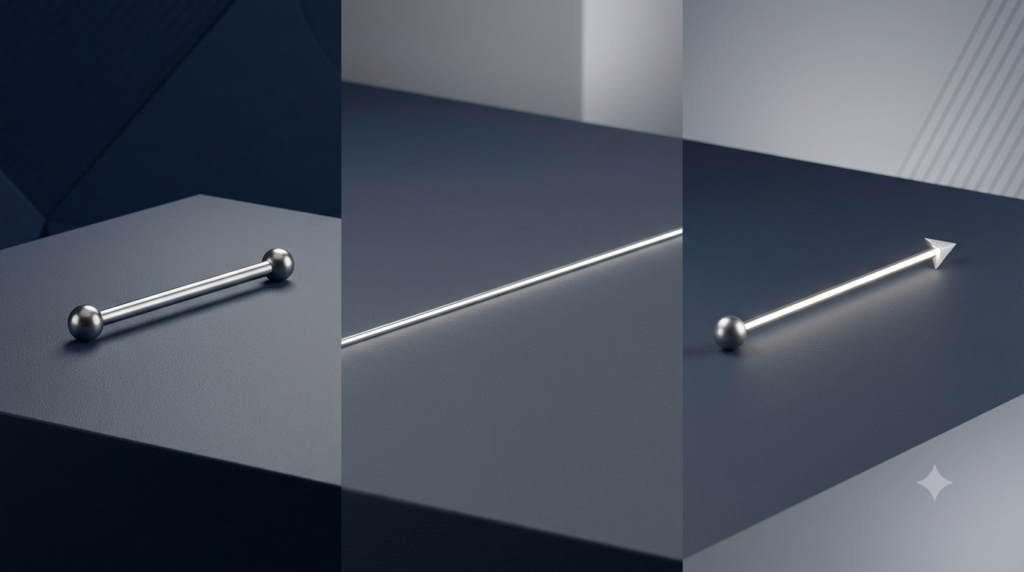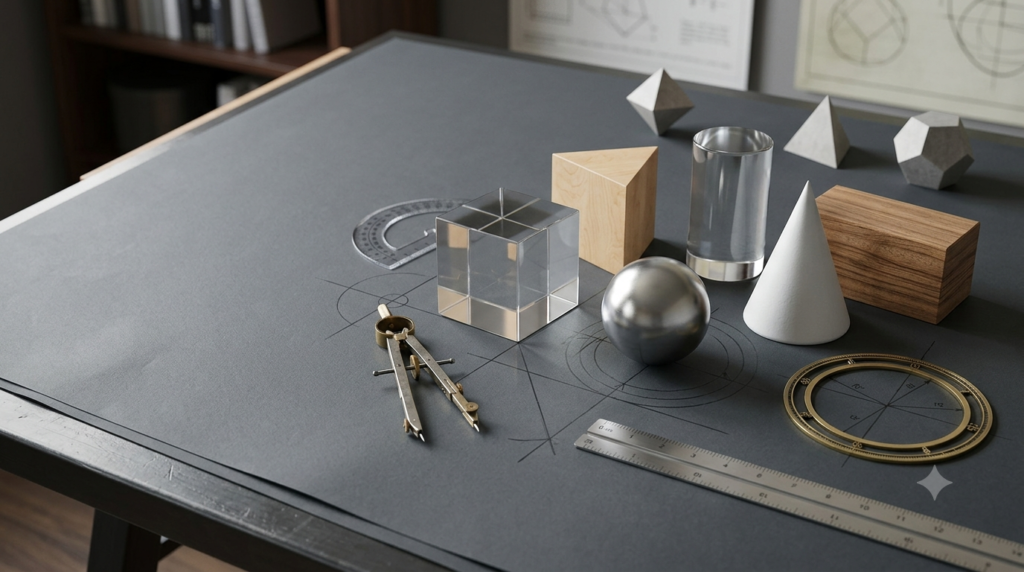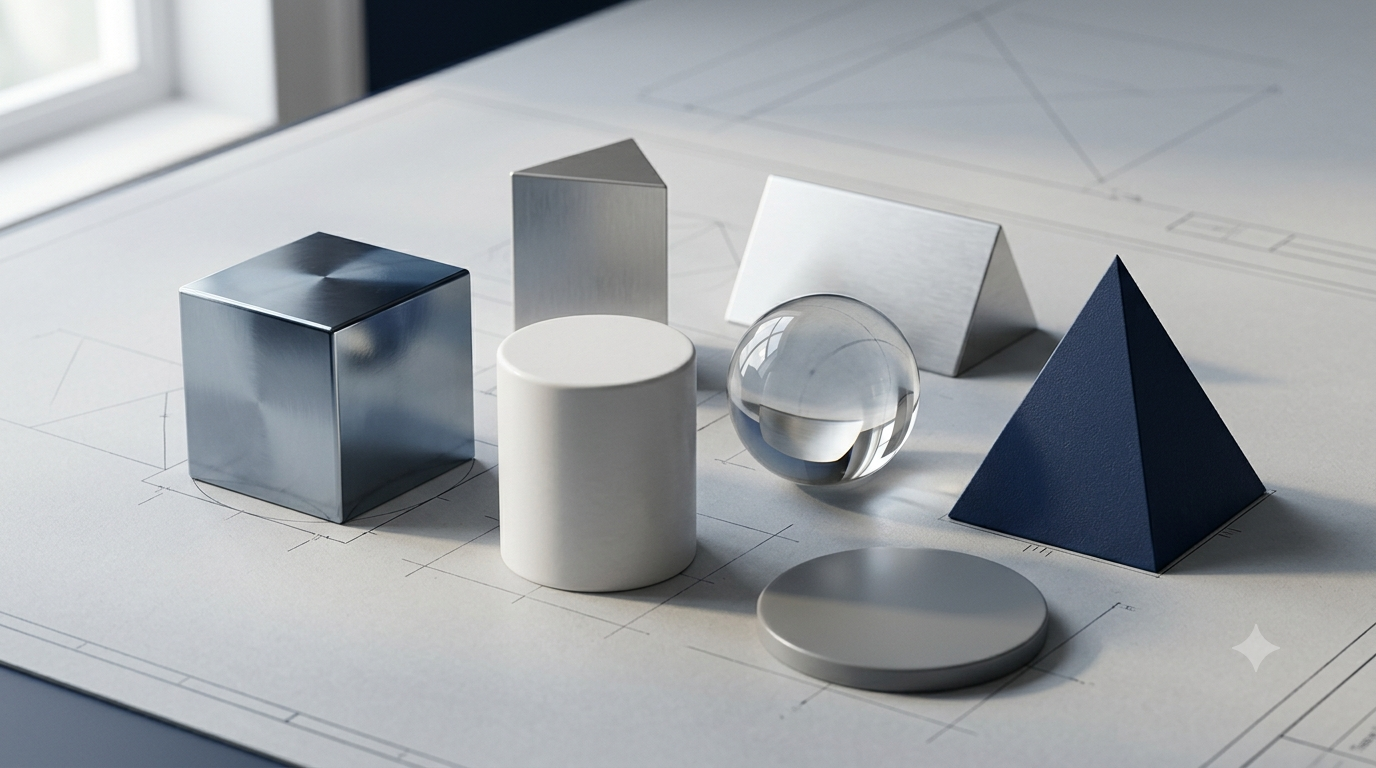
Geometry is an important branch of mathematics that helps us understand the shapes, sizes, positions, and properties of objects around us. From the rectangular screen of a computer to the circular face of a clock and the triangular structure of a bridge, geometric figures are present in everyday life. Learning about these figures makes it easier to recognize patterns, compare objects, solve mathematical problems, and understand how different shapes are constructed.
Geometric figures can be classified into different groups according to their dimensions, boundaries, sides, angles, and other characteristics. Some figures are flat and have only length and width, while others occupy space and have length, width, and height. Each figure has its own properties that distinguish it from other shapes. Understanding these basic characteristics provides a strong foundation for studying more advanced topics such as perimeter, area, surface area, volume, and geometric theorems.
What Are Geometric Figures?
Geometric figures are shapes or arrangements formed by points, lines, curves, and surfaces. They are used to represent objects mathematically and describe their spatial properties. A geometric figure may be simple, such as a straight line, or complex, such as a three-dimensional solid with several faces and curved surfaces.
In elementary geometry, figures are commonly classified as two-dimensional or three-dimensional. Two-dimensional figures exist on a flat surface, whereas three-dimensional figures occupy space.
For example, a square is a two-dimensional figure because it has length and width but no thickness in the mathematical sense. A cube is a three-dimensional figure because it has length, width, and height.
Geometric figures are useful in mathematics, architecture, engineering, construction, design, computer graphics, and many scientific applications. Their properties help people calculate measurements, plan structures, create accurate drawings, and understand the physical world.
Basic Elements of Geometric Figures
Before studying individual shapes, it is useful to understand the fundamental elements from which geometric figures are described.
1. Point
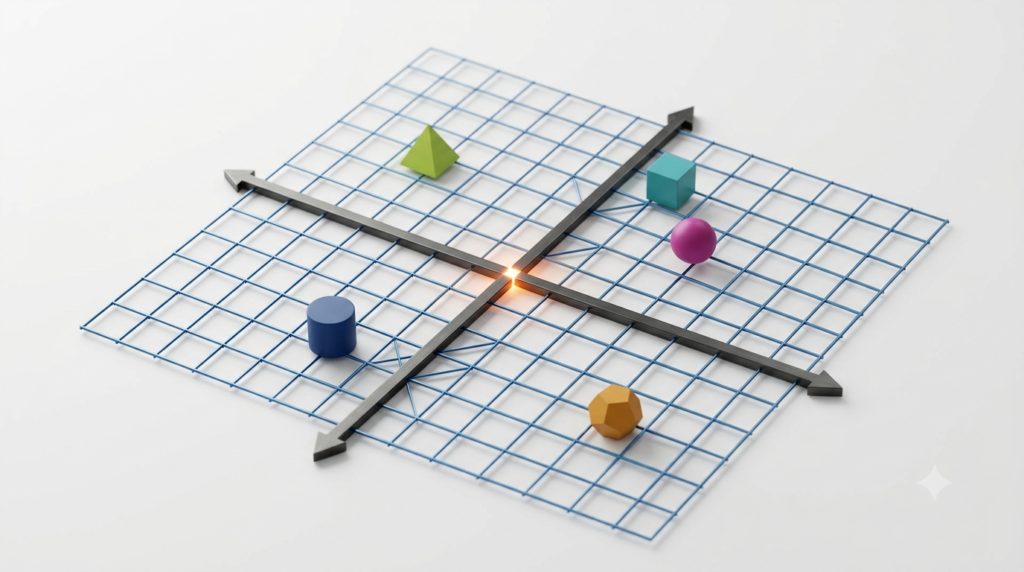
A point represents an exact position in space. It has no length, width, or height. In geometry, points are usually represented by small dots and identified using capital letters such as A, B, or C.
For example, the endpoints of a line segment may be labelled A and B. These points indicate the exact locations where the segment begins and ends.
Points are important because they help define lines, angles, polygons, and other geometric figures.
2. Line
A line is a straight path that extends infinitely in both directions. It has length but no thickness. A line does not have endpoints, so its length cannot be measured as a finite distance.
Two points determine a unique straight line. Lines are commonly used to represent boundaries, directions, and relationships between points.
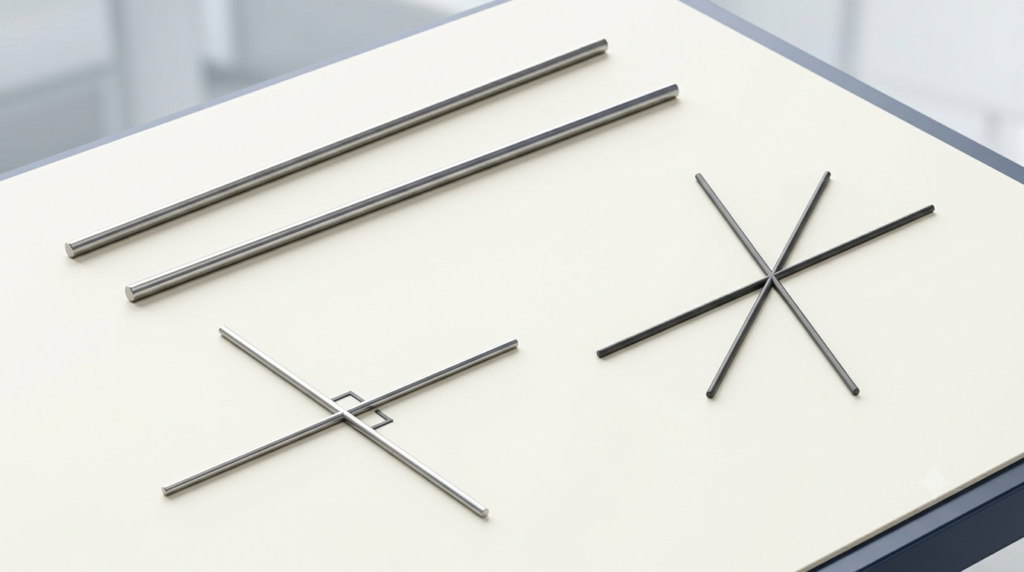
Lines can be parallel, intersecting, or perpendicular. Parallel lines remain the same distance apart and never meet, while intersecting lines cross at a point. Perpendicular lines intersect at an angle of 90°.
3. Line Segment
A line segment is a part of a line that has two fixed endpoints. Unlike a complete line, a line segment has a definite and measurable length.
The edge of a ruler can be used as a practical example of a line segment. Its length can be measured using centimetres, millimetres, or other units.
Line segments form the sides of many geometric figures, including triangles, squares, rectangles, and other polygons.
4. Ray
A ray begins at a fixed point and extends infinitely in one direction. It has one endpoint but no endpoint in the other direction.
Rays are useful for describing angles. Two rays that share a common endpoint form an angle, with the shared endpoint called the vertex.
5. Angle
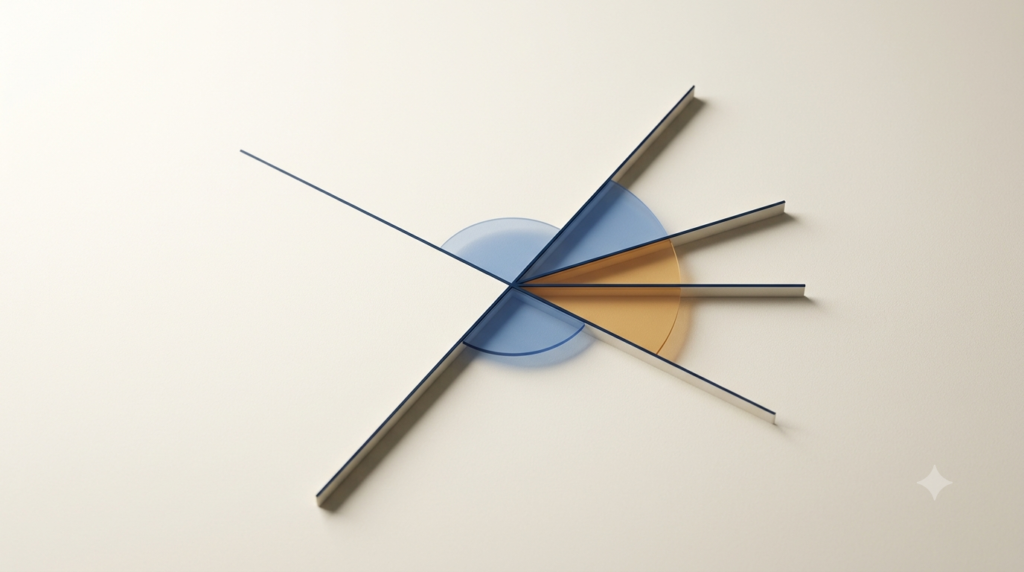
An angle is formed when two rays or line segments meet at a common endpoint. The common endpoint is known as the vertex, and the two rays are called the arms of the angle.
Angles are measured in degrees or radians. According to their measurements, angles may be classified as acute, right, obtuse, straight, or reflex angles.
Understanding angles is essential for studying polygons, triangles, parallel lines, and many other geometric relationships.
Two-Dimensional Geometric Figures
Two-dimensional, or 2D, figures are flat shapes that have length and width. They can be drawn on paper or displayed on a screen. Their measurements may include perimeter, area, side lengths, and angles.
Common two-dimensional figures include triangles, squares, rectangles, circles, parallelograms, rhombuses, trapezoids, and other polygons.
1. Triangle
A triangle is a polygon with three sides, three vertices, and three interior angles. It is one of the simplest closed geometric figures.
The sum of the interior angles of every triangle is 180°. This property remains true regardless of the triangle’s size or shape in ordinary Euclidean geometry.
Triangles can be classified according to their sides or angles.
According to their sides:
Equilateral triangle: All three sides are equal, and each interior angle measures 60°.
Isosceles triangle: Two sides are equal, and the angles opposite those sides are equal.
Scalene triangle: All three sides have different lengths.
According to their angles:
Acute triangle: All three angles are less than 90°.
Right triangle: One angle measures exactly 90°.
Obtuse triangle: One angle is greater than 90°.
Triangles are widely used in construction because triangular arrangements can provide strong and stable structures. They also play an important role in trigonometry, surveying, and engineering.
2. Square
A square is a quadrilateral with four equal sides and four right angles. Each interior angle measures 90°.
The opposite sides of a square are parallel, and its diagonals are equal in length. The diagonals bisect each other at right angles and divide the square into four congruent right triangles.
A square has several important characteristics:
Four equal sides.
Four vertices.
Four right angles.
Two equal diagonals.
Two pairs of parallel sides.
Squares can be seen in floor tiles, chessboards, window designs, and many patterns used in architecture.
Text block — Square formulas
Perimeter = 4 × side
Area = side × side = side²
Here, the side represents the length of any one side of the square.
3. Rectangle
A rectangle is a quadrilateral with four right angles. Its opposite sides are equal in length and parallel to each other, but adjacent sides do not necessarily have the same length.
A square is a special type of rectangle because it has all the properties of a rectangle as well as four equal sides.
The main characteristics of a rectangle include:
Four sides and four vertices.
Four interior angles of 90°.
Equal opposite sides.
Equal diagonals.
Two pairs of parallel sides.
Rectangles are common in doors, books, mobile screens, tables, and computer monitors.
Text block — Rectangle formulas
Perimeter = 2 × (length + width)
Area = length × width
These formulas help calculate the total boundary length and the amount of flat surface covered by a rectangle.
4. Circle
A circle is a two-dimensional figure consisting of all points in a plane that are at a fixed distance from a central point. This fixed distance is called the radius.
The diameter is a straight line segment that passes through the centre and connects two points on the circle. It is twice the radius.
A circle has no straight sides or vertices. Its boundary is a continuous curve, and every point on that boundary is equally distant from the centre.
Important characteristics of a circle include:
Centre: The fixed point inside the circle.
Radius: The distance from the centre to the boundary.
Diameter: The longest straight-line distance across the circle.
Circumference: The total distance around the circle.
Chord: A line segment connecting two points on the circle.
Arc: A part of the circular boundary.
Circles appear in wheels, coins, clock faces, gears, and circular structures.
Text block — Circle formulas
Diameter = 2 × radius
Circumference = 2 × π × radius
Area = π × radius²
The symbol π represents a mathematical constant approximately equal to 3.14159.
5. Parallelogram
A parallelogram is a quadrilateral in which both pairs of opposite sides are parallel. Its opposite sides are equal in length, and its opposite angles are equal.
The adjacent angles of a parallelogram add up to 180°. Its diagonals bisect each other, although they are not necessarily equal or perpendicular.
A rectangle, square, and rhombus are all special types of parallelograms.
Parallelograms can be observed in certain patterns, slanted designs, and structural arrangements.
Text block — Parallelogram formulas
Perimeter = 2 × (base + side)
Area = base × perpendicular height
The perpendicular height is the shortest distance between the two parallel bases, not the length of a sloping side.
6. Rhombus
A rhombus is a quadrilateral with four equal sides. Its opposite sides are parallel, and its opposite angles are equal.
Unlike a square, a rhombus does not need to have right angles. Its shape may appear slanted, depending on the sizes of its interior angles.
The diagonals of a rhombus bisect each other at right angles. They also bisect the interior angles.
A rhombus is often seen in diamond-shaped patterns, decorative designs, and certain geometric diagrams.
Text block — Rhombus formulas
Perimeter = 4 × side
Area = ½ × diagonal₁ × diagonal₂
The two diagonals intersect at right angles, making the diagonal formula useful for calculating the area.
7. Trapezoid
A trapezoid is a quadrilateral with at least one pair of parallel sides under the inclusive definition commonly used in some countries. In other conventions, a trapezoid has exactly one pair of parallel sides.
The parallel sides are called the bases, while the perpendicular distance between them is the height.
Trapezoids may have different side lengths and angles. Some are symmetrical, while others have irregular shapes.
They can be used to describe certain bridge supports, architectural structures, containers, and land boundaries.
Text block — Trapezoid area formula
Area = ½ × (base₁ + base₂) × height
The formula uses the lengths of the two parallel bases and the perpendicular height between them.
8. Polygon
A polygon is a closed two-dimensional figure formed by three or more straight line segments. The segments meet at endpoints and create a closed boundary.
Triangles and quadrilaterals are polygons, but circles are not because their boundaries are curved rather than made of straight line segments.
Polygons are classified according to their number of sides.
Triangle: 3 sides.
Quadrilateral: 4 sides.
Pentagon: 5 sides.
Hexagon: 6 sides.
Heptagon: 7 sides.
Octagon: 8 sides.
Nonagon: 9 sides.
Decagon: 10 sides.
A polygon is called regular when all its sides and all its interior angles are equal. If its sides or angles differ, it is an irregular polygon.
Polygons are widely used in tiling, graphic design, land surveying, computer modelling, and architecture.
Text block — Polygon interior-angle formula
Sum of interior angles = (n − 2) × 180°
Here, n represents the number of sides.
For example, a pentagon has five sides. Its interior angles add up to 540°.
Three-Dimensional Geometric Figures
Three-dimensional, or 3D, figures occupy space and have length, width, and height. Unlike flat shapes, solid figures have volume. Depending on their structure, they may also have flat faces, curved surfaces, edges, and vertices.
Common three-dimensional figures include cubes, cuboids, spheres, cylinders, cones, and pyramids.
1. Cube
A cube is a solid figure with six equal square faces. All its edges have the same length, and each pair of adjacent faces meets at a right angle.
A cube has:
6 square faces.
12 equal edges.
8 vertices.
Equal face dimensions.
Six identical square surfaces.
Dice, certain storage boxes, and cubic building blocks are familiar examples of cube-shaped objects.
Text block — Cube formulas
Volume = side³
Total surface area = 6 × side²
The volume measures the space occupied by the cube, while the total surface area measures the combined area of all six faces.
2. Cuboid
A cuboid is a three-dimensional solid with six rectangular faces. Its opposite faces are equal and parallel, and its edges meet at right angles.
A cuboid has 6 faces, 12 edges, and 8 vertices. Unlike a cube, its length, width, and height may have different measurements.
Books, bricks, cupboards, and rectangular storage boxes are common examples of cuboids.
Text block — Cuboid formulas
Volume = length × width × height
Total surface area = 2 × (length × width + width × height + height × length)
These formulas are useful when calculating the capacity and external surface area of rectangular objects.
3. Sphere
A sphere is a three-dimensional figure whose surface points are all at the same distance from its centre.
A sphere has one continuous curved surface and no flat faces, straight edges, or vertices. Its diameter is twice its radius.
Balls, marbles, and certain planetary models provide familiar examples of spherical shapes.
A sphere looks similar from every direction when viewed from its centre because its surface is perfectly symmetrical.
Text block — Sphere formulas
Volume = ⁴⁄₃ × π × radius³
Surface area = 4 × π × radius²
The volume formula calculates the space enclosed by the sphere, while the surface area formula calculates the area of its outer surface.
4. Cylinder
A cylinder is a three-dimensional solid with two equal, parallel circular bases connected by a curved surface.
A typical right circular cylinder has two flat circular faces and one curved surface. It has no vertices, and its two circular boundaries form the edges where the bases meet the curved surface.
Cans, pipes, cylindrical containers, and many water tanks have cylindrical shapes.
Text block — Cylinder formulas
Volume = π × radius² × height
Curved surface area = 2 × π × radius × height
Total surface area = 2 × π × radius × (radius + height)
The radius is the radius of either circular base, and the height is the perpendicular distance between the bases.
5. Cone
A cone is a three-dimensional figure with a circular base that narrows toward a single point called the apex.
A right circular cone has one flat circular base and one curved surface. The apex is connected to the circular boundary through sloping lines on the surface.
Ice cream cones, certain funnels, and traffic cones illustrate cone-like shapes.
A cone’s height is the perpendicular distance from the apex to the centre of the base. Its slant height is the distance measured along the sloping surface from the apex to the circular boundary.
Text block — Cone formulas
Volume = ⅓ × π × radius² × height
Curved surface area = π × radius × slant height
Total surface area = π × radius × (radius + slant height)
These formulas apply to a right circular cone.
6. Pyramid
A pyramid is a three-dimensional solid with a polygonal base and triangular side faces that meet at a common point called the apex.
Pyramids are named according to the shape of their bases. For example, a square pyramid has a square base, while a triangular pyramid has a triangular base.
A pyramid with a square base has five faces, eight edges, and five vertices. Other pyramids have different numbers of faces, edges, and vertices depending on the shape of the base.
Pyramidal structures are found in architecture, historical monuments, mathematical models, and certain roof designs.
Text block — Pyramid volume formula
Volume = ⅓ × base area × perpendicular height
The base area depends on the shape of the polygon at the bottom of the pyramid.
Important Characteristics Used to Describe Geometric Figures
Although geometric figures differ in appearance, several characteristics help us identify, compare, and classify them.
1. Sides
Sides are the straight line segments that form the boundaries of polygons. The number of sides helps identify a polygon and distinguish it from other figures.
For example, a triangle has three sides, while a hexagon has six. In regular polygons, all sides have equal lengths. In irregular polygons, the side lengths may differ.
Not all geometric figures have straight sides. A circle, for example, has a curved boundary rather than straight sides.
2. Vertices
A vertex is a point where two or more sides, edges, or line segments meet. The plural form is vertices.
A triangle has three vertices, a rectangle has four, and a cube has eight. Vertices help identify the structure of polygons and polyhedra.
A sphere has no vertices because its surface is continuously curved.
3. Angles
Angles describe the amount of rotation between two intersecting rays or line segments. They are usually measured in degrees.
Acute angles are smaller than 90°, right angles measure 90°, and obtuse angles are greater than 90° but smaller than 180°. A straight angle measures 180°.
Angles are important for distinguishing shapes. For example, a rectangle has four right angles, whereas a general parallelogram may have two acute and two obtuse angles.
4. Symmetry
Symmetry describes a balanced arrangement in which a figure remains unchanged under a particular transformation.
A figure has line symmetry when it can be divided by a line into two matching halves. A square has four lines of symmetry, while a non-square rectangle has two.
Rotational symmetry occurs when a figure looks unchanged after being rotated through an angle smaller than 360°. A square, for example, matches its original appearance after rotations of 90°, 180°, and 270°.
Symmetry is important in art, architecture, engineering, natural patterns, and the design of objects.
5. Perimeter
Perimeter is the total distance around a two-dimensional figure. It is calculated by adding the lengths of all the sides of a polygon.
For a rectangle, the perimeter depends on its length and width. For a circle, the corresponding boundary measurement is called circumference.
Perimeter is useful for estimating the amount of fencing required around a field, the border needed for a garden, or the material needed to frame a picture.
6. Area
Area measures the amount of two-dimensional surface enclosed by a boundary. It is expressed in square units, such as square centimetres, square metres, or square kilometres.
Different figures require different area formulas. A rectangle’s area depends on its length and width, while a triangle’s area depends on its base and perpendicular height.
Area calculations are commonly used in construction, flooring, painting, land measurement, and interior design.
7. Surface Area
Surface area describes the total area covering the outside of a three-dimensional object. It is generally expressed in square units.
For a cube, the total surface area is the combined area of its six square faces. For a cylinder, the total surface area includes both circular bases and the curved surface.
Surface area is useful for estimating the amount of paint, wrapping material, sheet metal, or other covering required for an object.
8. Volume
Volume measures the space occupied by a three-dimensional object. It is expressed in cubic units, such as cubic centimetres or cubic metres. Liquids may also be measured using litres and millilitres.
The volume of a cuboid is calculated by multiplying its length, width, and height. Other solids require their own formulas.
Volume is important when determining the capacity of tanks, containers, rooms, packages, and industrial equipment.
The Difference Between Two-Dimensional and Three-Dimensional Figures
Two-dimensional and three-dimensional figures differ mainly in the space they occupy and the measurements used to describe them.
A two-dimensional figure has length and width but no thickness in the mathematical model. Its main measurements include perimeter and area.
A three-dimensional figure has length, width, and height. It occupies space and can have volume and surface area.
For example, a circle is a flat geometric figure, while a sphere is a solid geometric object. Similarly, a square is two-dimensional, whereas a cube is three-dimensional.
It is important to understand that everyday objects may have thickness even when they are described using two-dimensional shapes. A drawing of a rectangle represents a flat mathematical figure, while a rectangular box is a three-dimensional object.
How to Identify and Classify Geometric Figures
Identifying geometric figures becomes easier when their properties are examined systematically.
First, determine whether the figure is flat or solid. A flat figure is generally two-dimensional, while a solid figure is three-dimensional.
Second, examine its boundaries. Count the straight sides and vertices if the figure is a polygon. If it has a curved boundary, determine whether it resembles a circle or another curved shape.
Third, inspect its angles and side lengths. Equal sides, parallel sides, right angles, and symmetry can help distinguish one quadrilateral from another.
Fourth, for three-dimensional figures, examine the faces, edges, vertices, and curved surfaces. A cube has equal square faces, a cuboid has rectangular faces, and a cylinder has two circular bases.
Finally, use the figure’s defining properties rather than relying only on its appearance. A square remains a square even when it is rotated, and a rectangle does not stop being a rectangle simply because it is drawn at an angle.
Applications of Geometric Figures in Everyday Life
Geometric figures are used in many practical situations. Understanding them helps explain how objects are designed, measured, constructed, and arranged.
Architecture and Construction
Architects and engineers use rectangles, triangles, circles, and three-dimensional solids when planning buildings, bridges, roofs, and other structures. Measurements of angles, areas, and volumes help ensure that materials are used accurately and efficiently.
Art and Design
Artists and designers use geometric figures to create patterns, logos, illustrations, furniture, and decorative arrangements. Symmetry and proportion help create balanced and visually appealing designs.
Technology and Computer Graphics
Computer graphics rely heavily on geometric shapes to represent objects on screens. Two-dimensional figures are used in icons and diagrams, while three-dimensional models represent buildings, vehicles, characters, and scientific objects.
Geography and Land Measurement
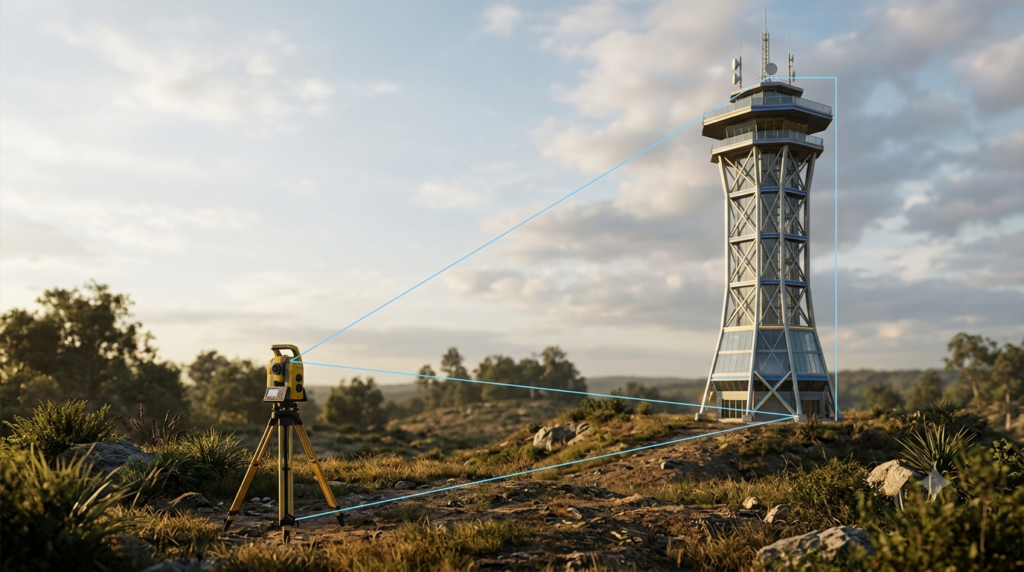
Geometric concepts help measure land boundaries, calculate areas, interpret maps, and estimate distances. Surveyors use geometric principles to determine positions and dimensions accurately.
Science and Engineering
Scientists use geometric figures to describe objects, model physical systems, and analyze measurements. Engineers apply geometric principles when designing machine parts, containers, tools, and structural components.
These applications show that geometry is not limited to classroom exercises. It is a practical mathematical language used across many professions and everyday activities.
Common Mistakes When Studying Geometric Figures
Beginners sometimes confuse figures that look similar but have different mathematical properties. Recognizing these mistakes helps build a stronger understanding of geometry.
One common mistake is assuming that every rectangle is a square. Although every square is a rectangle, not every rectangle has four equal sides.
Another mistake is confusing a circle with a sphere. A circle is a two-dimensional figure, while a sphere is a three-dimensional solid.
Students may also confuse perimeter with area. Perimeter measures the distance around a shape, whereas area measures the surface enclosed within its boundary.
A further mistake is using the sloping side of a triangle or parallelogram as its perpendicular height. In area calculations, height must be measured at a right angle to the chosen base.
Finally, some learners identify shapes only by how they are drawn. A geometric figure can be rotated, enlarged, or reduced without necessarily changing its defining properties. Classification should therefore depend on mathematical characteristics rather than orientation or visual size.
Conclusion
Geometric figures form the foundation of geometry and help us understand the shapes and structures found throughout the world. From simple points, lines, and angles to complex polygons and three-dimensional solids, each figure has characteristics that define its mathematical properties.
Learning about sides, vertices, angles, symmetry, perimeter, area, surface area, and volume makes it easier to identify and compare different figures. It also prepares learners for more advanced topics in mathematics, including coordinate geometry, trigonometry, mensuration, and geometric proofs.
By recognizing geometric figures in everyday objects and practising their basic formulas, learners can develop stronger mathematical reasoning and practical problem-solving skills. A clear understanding of these fundamentals makes geometry easier to learn and demonstrates why it remains an essential part of mathematics, science, technology, engineering, and design.
FAQs
1. What are geometric figures?
Geometric figures are shapes or arrangements formed by points, lines, curves, and surfaces. They help describe the size, shape, position, and structure of objects mathematically. Common geometric figures include triangles, squares, rectangles, circles, cubes, spheres, and cylinders. These figures are classified according to their dimensions and properties. Two-dimensional figures have length and width, while three-dimensional figures have length, width, and height. Geometric figures are used in mathematics, architecture, engineering, computer graphics, and everyday life. Understanding their basic characteristics helps learners recognize shapes, calculate measurements, solve problems, and develop a strong foundation in geometry.
2. What are the main types of geometric figures?
The two main types of geometric figures are two-dimensional figures and three-dimensional figures. Two-dimensional figures are flat shapes that have length and width. Examples include triangles, squares, rectangles, circles, and polygons. Three-dimensional figures occupy space and have length, width, and height. Examples include cubes, cuboids, spheres, cylinders, cones, and pyramids. These categories can be further classified according to their sides, angles, faces, edges, vertices, and curved surfaces. Understanding these classifications makes it easier to compare shapes and identify their properties. It also helps learners select the correct mathematical formulas for calculating perimeter, area, surface area, and volume.
3. What is the difference between two-dimensional and three-dimensional figures?
Two-dimensional and three-dimensional figures differ in their dimensions and the space they occupy. A two-dimensional figure has length and width but no thickness in the mathematical model. Examples include squares, triangles, rectangles, and circles. Their properties are commonly described using perimeter and area. A three-dimensional figure has length, width, and height, so it occupies space. Examples include cubes, cuboids, spheres, cylinders, and cones. These solids can be described using volume and surface area. For example, a circle is a flat shape, whereas a sphere is a solid object. Both types are important in mathematics, science, construction, and design.
4. What are the basic characteristics of geometric figures?
The basic characteristics of geometric figures include sides, vertices, angles, dimensions, symmetry, and boundaries. Three-dimensional figures may also have faces, edges, and curved surfaces. These properties help distinguish one shape from another. For example, a triangle has three sides and three vertices, while a rectangle has four sides and four right angles. A cube has six square faces, twelve edges, and eight vertices. Measurements such as perimeter, area, surface area, and volume provide additional information about a figure’s size. Studying these characteristics helps learners classify shapes accurately, understand geometric relationships, and solve mathematical problems systematically.
5. What is the difference between a square and a rectangle?
A square and a rectangle are both quadrilaterals, meaning they have four sides. Both shapes have four right angles, and their opposite sides are parallel. However, a square has four equal sides, while a rectangle has equal opposite sides but does not necessarily have all four sides equal. The diagonals of both shapes are equal and bisect each other. A square also has four lines of symmetry, whereas a non-square rectangle has two. Every square is a rectangle because it satisfies the defining properties of a rectangle, but not every rectangle is a square. These differences help distinguish the two figures.
6. How are geometric figures classified according to their sides?
Geometric figures with straight sides can be classified according to the number and arrangement of their sides. A triangle has three sides, a quadrilateral has four, a pentagon has five, a hexagon has six, and an octagon has eight. These closed figures belong to a group called polygons. Polygons may be regular or irregular. A regular polygon has equal sides and equal interior angles, while an irregular polygon does not have all sides and angles equal. Circles are not polygons because they have curved boundaries rather than straight sides. Counting sides and examining their arrangement are simple ways to identify and classify polygons.
7. What are perimeter and area in geometry?
Perimeter and area are two important measurements used to describe two-dimensional figures. Perimeter is the total distance around the boundary of a shape. It is measured in linear units, such as centimetres or metres. Area measures the amount of surface enclosed within a shape and is expressed in square units, such as square centimetres or square metres. For a rectangle, perimeter is calculated using 2 × (length + width), while area is calculated using length × width. These measurements have practical applications in construction, gardening, flooring, painting, and land measurement. Understanding their difference helps prevent mistakes when solving geometry problems.
8. What are faces, edges, and vertices in three-dimensional figures?
Faces, edges, and vertices are important characteristics of many three-dimensional geometric figures. A face is a flat surface of a solid, an edge is where two faces meet, and a vertex is a point where edges meet. For example, a cube has six square faces, twelve edges, and eight vertices. A cuboid has the same numbers of faces, edges, and vertices, although its faces are generally rectangular. Curved solids have different characteristics. A sphere has no flat faces, straight edges, or vertices, while a cylinder has two flat circular faces and a curved surface. These properties help identify and compare solid figures.
9. Why are geometric figures important in everyday life?
Geometric figures are important because they help people understand, measure, and design objects and spaces. Architects use rectangles, triangles, and other shapes when planning buildings and bridges. Engineers apply geometric principles to design machines, tools, and structural components. Designers use circles, polygons, and symmetry to create patterns, furniture, and digital graphics. Geometry is also useful for calculating floor areas, estimating the capacity of containers, measuring land, and planning construction projects. In technology, geometric figures help represent objects in computer graphics and three-dimensional modelling. Learning geometry develops spatial awareness, logical thinking, measurement skills, and problem-solving abilities that are useful in everyday activities.
10. How can beginners learn to identify geometric figures easily?
Beginners can learn to identify geometric figures by observing their basic properties and comparing different shapes. Start by distinguishing flat figures from solid objects. Next, count the sides and vertices of polygons and examine whether their sides are equal or parallel. Check the angles to determine whether a figure has right, acute, or obtuse angles. For three-dimensional objects, observe the faces, edges, vertices, and curved surfaces. Using familiar objects such as books, balls, boxes, clocks, and cans makes learning more practical. Drawing shapes, labelling their properties, and practising simple formulas for perimeter, area, and volume can further improve understanding and confidence.