Geometry helps us understand the shapes, sizes, positions, and properties of objects around us. From a simple dot on a piece of paper to a rectangular building or a spherical planet, everything can be described using geometric ideas. One of the most important concepts in geometry is dimension, which tells us how many independent directions are needed to describe a position or measure an object.
We commonly encounter zero-dimensional points, one-dimensional lines, two-dimensional shapes, and three-dimensional objects. Each dimension introduces a new way to understand space, measurement, and shape. For example, a point represents a location, a line has length, a flat shape has length and width, and a solid object has length, width, and height.
In this article, we will learn what dimensions mean in geometry, explore the characteristics of zero, one, two, and three dimensions, and understand how these concepts are connected to everyday life, mathematics, science, and technology.
What Are Dimensions in Geometry?
A dimension is a measurable direction or independent coordinate needed to describe the position of a point or the extent of an object in space. In elementary geometry, dimensions help us distinguish between points, lines, flat shapes, and solid objects.
The number of dimensions determines how much information is needed to describe a location. A point on a line can be located using one coordinate, while a point on a flat surface generally needs two coordinates. A point in ordinary three-dimensional space requires three coordinates.
For example, imagine finding a location on a straight road. You may only need to know how far along the road the location is. If you are locating a place on a map, you need two measurements, such as horizontal and vertical positions. To locate an object inside a room, you may need its position from left to right, front to back, and bottom to top.
These examples demonstrate how dimensions help us describe space systematically.
Zero-Dimensional Geometry
What Is Zero Dimension?
Zero-dimensional geometry begins with the simplest geometric object: a point. A point represents an exact location in space, but it has no length, width, or height.
In mathematical geometry, a point has no physical size. It is not a tiny circle or a small solid object. Even though we may draw a dot on paper to represent a point, the actual mathematical point has no measurable area or volume.
A point can be identified by a name, such as A, B, or P. Its purpose is to indicate a position rather than describe an object’s physical dimensions.
Characteristics of a Zero-Dimensional Point
A point has several important properties:
It has no length.
It has no width.
It has no height.
It has no area or volume.
It represents a specific location.
It does not extend in any direction.
Because a point has no length, it cannot be divided into smaller geometric lengths in the usual sense. It serves as a fundamental building block for defining other geometric objects.
Examples of Zero-Dimensional Geometry
Points appear throughout geometry and mathematics.
A point marked on a sheet of paper can represent a mathematical location. A point on a map can identify a particular place. In a coordinate system, a point can represent a specific value or position.
In computer graphics, points can represent individual locations in a scene. In mathematics, points are used to define the endpoints of line segments, the vertices of polygons, and the centers of circles.
Although these practical representations may be visible or measurable, the ideal mathematical point remains dimensionless.
Why Is Zero Dimension Important?
Zero-dimensional geometry provides the foundation for understanding higher dimensions. A line can be described as a collection of points, a surface can be described using points arranged in two independent directions, and a solid occupies a region of three-dimensional space.
Points also help define distance, position, intersection, and geometric relationships. Without the concept of a point, it would be difficult to describe where lines begin, where shapes meet, or where objects are located.
One-Dimensional Geometry
What Is One Dimension?
One-dimensional geometry involves objects or spaces that can be described using one independent coordinate. A straight line is the standard example of a one-dimensional geometric object.
Unlike a point, a line extends in a direction and has length. However, an ideal geometric line has no width or thickness.
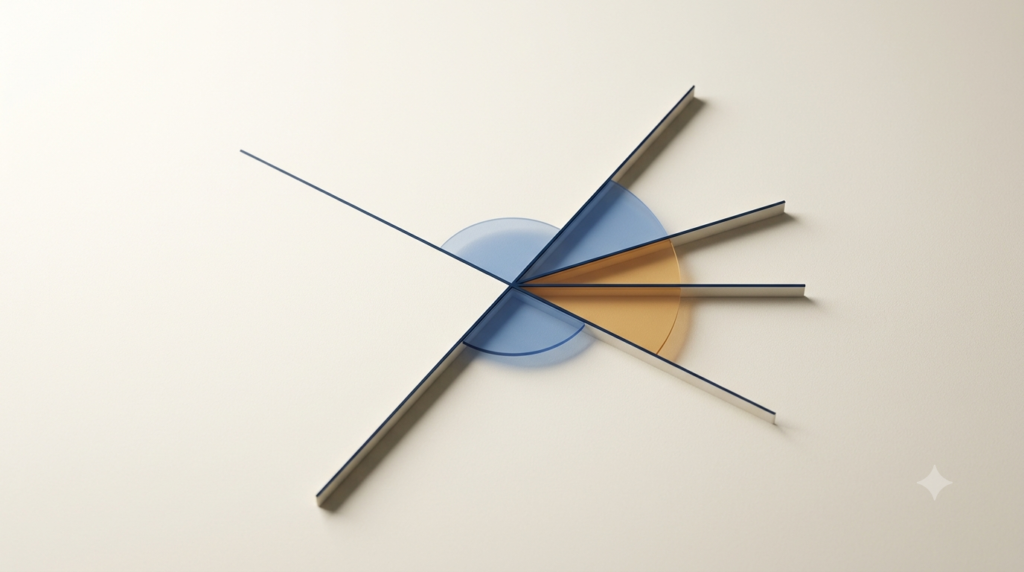
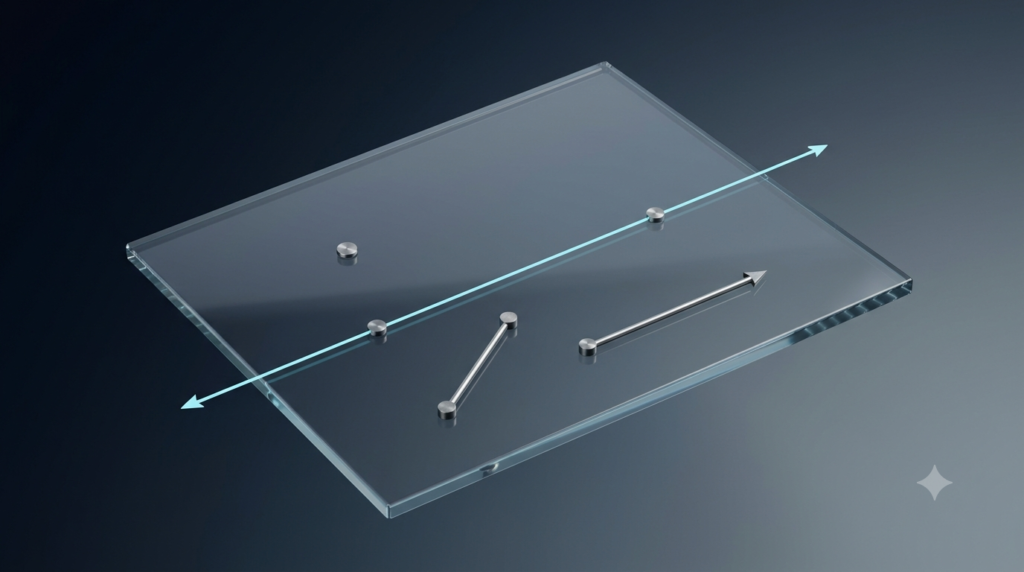
A line continues indefinitely in both directions. A line segment, by comparison, has two endpoints and a definite length. A ray has one endpoint and continues indefinitely in one direction.
These distinctions are important because lines, line segments, and rays are related but are not exactly the same geometric objects.
Characteristics of One-Dimensional Geometry
One-dimensional objects have the following characteristics:
They extend along one independent direction.
Their position can be described using one coordinate in a suitable coordinate system.
Length is their primary measure.
An ideal line has no width or thickness.
Line segments have measurable lengths.
They can be used to connect points and define boundaries.
A one-dimensional object can be straight or curved. For example, a curved path can still be one-dimensional if only one independent parameter is needed to describe positions along it.
Understanding Length
Length measures the distance between two points along a line segment. It is one of the simplest geometric measurements.
For example, if a line segment extends from point A to point B and the distance between them is 8 centimetres, its length is 8 cm.
Formula Text Block
Length = Distance between two endpoints
For points on a number line, the distance between two coordinates can be calculated using the absolute difference between their values.
Formula Text Block
Distance = |x₂ − x₁|
Here, x₁ and x₂ represent the coordinates of the two points. The absolute value ensures that the distance is not negative.
For example, if one point is at coordinate 3 and another is at coordinate 9, the distance between them is 6 units.
Examples of One-Dimensional Geometry
A number line is a familiar example of one-dimensional geometry. Numbers are arranged along a single direction, and each number corresponds to a position.
A straight road can be approximated as one-dimensional when we only care about distance along the road. A thread can also be treated as one-dimensional when its thickness is ignored and only its length matters.
The path followed by a moving object can be described using one-dimensional motion when the object moves along a single straight line.
However, real roads and threads have width and thickness. They are treated as one-dimensional models only when those additional measurements are unnecessary for the problem.
Applications of One-Dimensional Geometry
One-dimensional concepts are used in many fields. In physics, they help describe motion along a straight track. In mathematics, number lines represent numbers and inequalities. In engineering, linear measurements help determine distances between components.
Computer programming also uses one-dimensional arrays to organize data in a sequence. Although a digital array is not itself a geometric line, its single-index structure provides a useful analogy for one-dimensional organization.
Two-Dimensional Geometry
What Is Two Dimension?
Two-dimensional geometry describes positions or shapes using two independent coordinates. The two coordinates are often called x and y.
A flat sheet of paper, a drawing on a screen, or a shape on a flat surface can be studied using two-dimensional geometry. Unlike a line, a two-dimensional shape has both length and width.
Two-dimensional shapes can be enclosed or unbounded. A square, triangle, rectangle, and circle are common examples of bounded two-dimensional shapes. A plane, by contrast, extends indefinitely in every direction within its two-dimensional space.
Characteristics of Two-Dimensional Geometry
Two-dimensional geometry has several important features:
It uses two independent coordinates to locate a point in a plane.
Shapes have length and width.
Flat regions can have measurable area.
Boundaries of shapes may have measurable lengths.
Two-dimensional figures have no thickness in the ideal mathematical model.
Shapes can be classified by their sides, angles, curves, and symmetry.
The word plane refers to an ideal flat surface that extends infinitely in two dimensions. A square drawn on a plane occupies a bounded region, while the plane itself has no boundary.
Understanding the Coordinate Plane
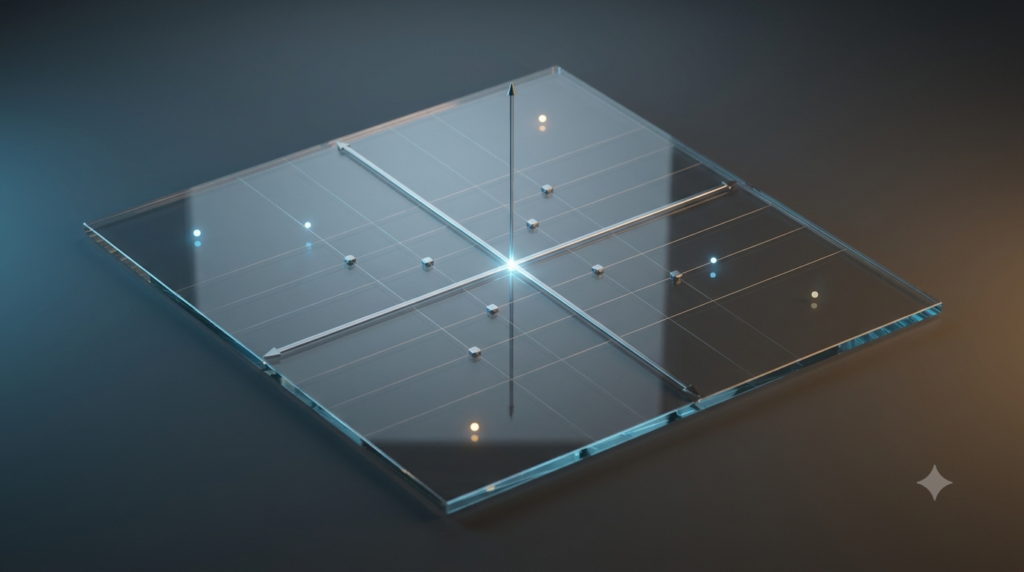
A coordinate plane consists of two perpendicular number lines called the x-axis and the y-axis. They intersect at a point called the origin.
Every point in the plane can be represented by an ordered pair of coordinates, written as (x, y). The first coordinate indicates the horizontal position, while the second indicates the vertical position.
For example, the point (4, 2) is located four units to the right of the origin and two units above it.
Coordinate geometry allows us to calculate distances, determine the positions of points, and describe geometric shapes using numerical relationships.
Area in Two-Dimensional Geometry
Area measures the amount of flat surface enclosed by a shape. Unlike length, which measures one-dimensional extent, area accounts for two-dimensional extent.
Different shapes have different area formulas.
Formula Text Block
Rectangle: A = l × w
Square: A = s²
Triangle: A = ½ × b × h
Circle: A = π × r²
Here, A represents area, l is length, w is width, s is the side length of a square, b is the base of a triangle, h is its perpendicular height, and r is the radius of a circle.
For example, a rectangle with a length of 6 cm and a width of 4 cm has an area of 24 cm².
Formula Text Block
A = 6 × 4 = 24 cm²
The square unit is important because area measures two-dimensional extent. Common units include square centimetres, square metres, and square kilometres.
Perimeter in Two-Dimensional Geometry
The perimeter of a closed two-dimensional shape is the total distance around its boundary. It measures the length of the boundary rather than the area inside it.
Formula Text Block
Rectangle: P = 2 × (l + w)
Square: P = 4 × s
Circle circumference: C = 2 × π × r
For example, a square with each side measuring 5 cm has a perimeter of 20 cm.
Formula Text Block
P = 4 × 5 = 20 cm
Perimeter is useful when calculating the amount of fencing required around a garden, while area is useful for determining how much flooring is needed to cover a room.
Examples of Two-Dimensional Geometry
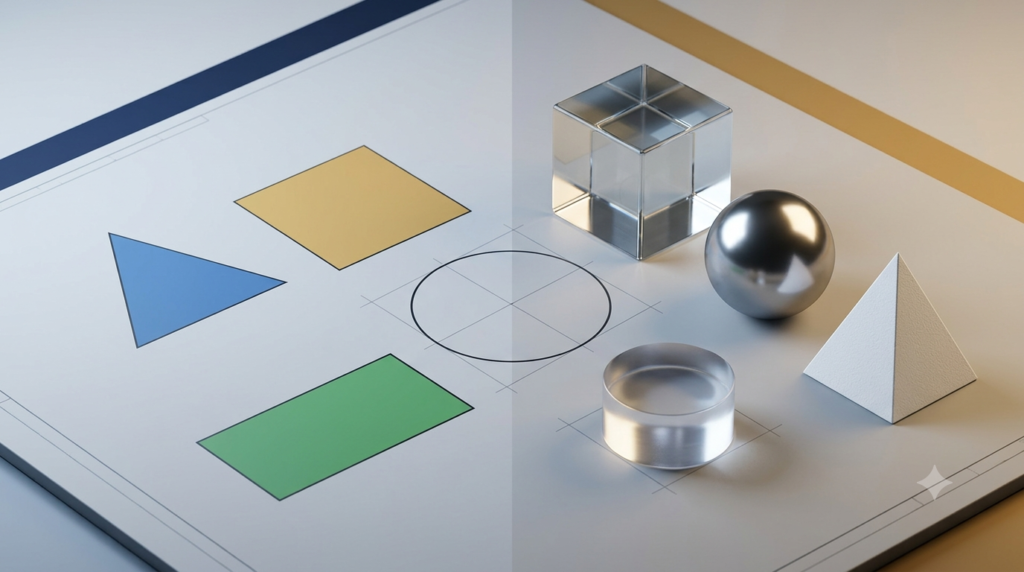
Common two-dimensional shapes include triangles, squares, rectangles, circles, pentagons, and hexagons.
A triangle has three sides, while a quadrilateral has four sides. A circle consists of points in a plane that are all the same distance from a central point.
Maps, floor plans, diagrams, and photographs can also be studied as two-dimensional representations. They show positions and shapes on a flat surface, even when the real objects they represent have depth.
Applications of Two-Dimensional Geometry
Two-dimensional geometry is essential in architecture, graphic design, drawing, mapping, and engineering. Architects use flat plans to represent the arrangement of rooms. Graphic designers use shapes and coordinates to create illustrations. Cartographers use two-dimensional maps to represent Earth’s surface.
In computer graphics, two-dimensional geometry is used to create icons, diagrams, charts, animations, and user interfaces.
It is also important in mathematics because many complex ideas, including graphs of equations, geometric transformations, and coordinate relationships, can be studied on a plane.
Three-Dimensional Geometry
What Is Three Dimension?
Three-dimensional geometry describes objects and positions using three independent coordinates. These coordinates are commonly represented as x, y, and z.
Three-dimensional objects have length, width, and height. They occupy space and may enclose a volume.
A book, a ball, a water bottle, a building, and a box are familiar examples of objects that can be represented using three-dimensional geometry.
Unlike ideal two-dimensional shapes, three-dimensional solids have depth. This additional dimension allows us to describe their volume and the surfaces that surround them.
Characteristics of Three-Dimensional Geometry
Three-dimensional geometry includes the following characteristics:
Three independent coordinates can locate a point in ordinary three-dimensional space.
Objects have length, width, and height.
Solids can enclose measurable volume.
Their surfaces may have measurable area.
Many solids have faces, edges, and vertices.
Objects can have flat surfaces, curved surfaces, or both.
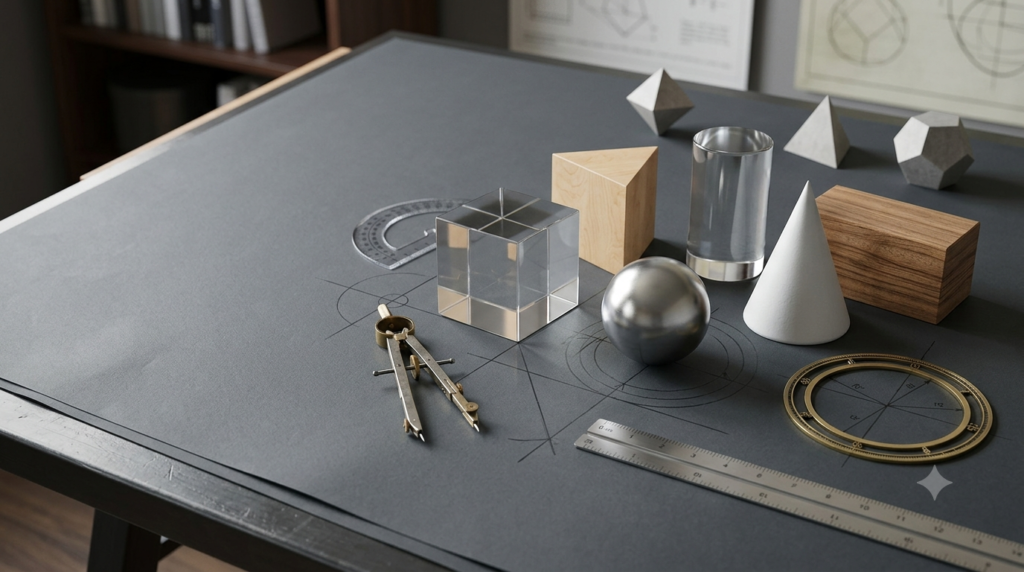
A cube, for example, has six square faces, twelve edges, and eight vertices. A sphere has a curved surface and no edges or vertices in the ordinary geometric sense.
Not every three-dimensional object has flat faces. Cylinders, cones, and spheres are important examples of solids that include curved surfaces.
Understanding Three-Dimensional Coordinates
A three-dimensional coordinate system uses three mutually perpendicular axes: the x-axis, y-axis, and z-axis.
The x-coordinate represents position along one direction, the y-coordinate represents position along a second direction, and the z-coordinate represents position along a third direction.
A point is written as an ordered triple, such as (3, 2, 5).
This point is located three units along the x-direction, two units along the y-direction, and five units along the z-direction from the origin.
Three-dimensional coordinates are especially useful for locating objects inside rooms, describing positions in space, and creating models of physical structures.
Volume in Three-Dimensional Geometry
Volume measures the amount of three-dimensional space occupied by a solid. Different solids require different formulas to calculate their volume.
Formula Text Block
Rectangular prism: V = l × w × h
Cube: V = s³
Cylinder: V = π × r² × h
Sphere: V = ⁴⁄₃ × π × r³
Cone: V = ⅓ × π × r² × h
Here, V represents volume, l is length, w is width, h is perpendicular height, s is the side length of a cube, and r is the radius of a circular base or sphere, as applicable.
For example, a rectangular box with a length of 5 cm, width of 3 cm, and height of 2 cm has a volume of 30 cubic centimetres.
Formula Text Block
V = 5 × 3 × 2 = 30 cm³
Volume is measured in cubic units, such as cm³, m³, and litres. The appropriate unit depends on the object and the measurement system being used.
Surface Area in Three-Dimensional Geometry
Surface area measures the total area covering the outside of a three-dimensional object. It is different from volume because surface area measures the outer covering, while volume measures the space occupied.
For example, painting a box requires an estimate of its surface area, while determining how much water a container can hold requires an estimate of its internal capacity.
Formula Text Block
Cube: SA = 6 × s²
Rectangular prism: SA = 2 × (l × w + l × h + w × h)
Sphere: SA = 4 × π × r²
Cylinder total surface area: SA = 2 × π × r × (r + h)
Here, SA represents surface area, and the other symbols represent the relevant dimensions of each solid.
Surface area is commonly measured in square units, such as cm² or m², even though the object itself is three-dimensional.
Examples of Three-Dimensional Geometry
A cube is a solid with six equal square faces. Dice and some storage boxes approximate cube-shaped objects.
A sphere is a round solid whose surface points are all the same distance from its centre. Balls and idealized planets are examples of spherical objects.
A cylinder has two parallel circular bases joined by a curved surface. Cans and many pipes approximate cylindrical shapes.
A cone has a circular base that narrows toward a single vertex. Certain funnels and traffic cones approximate this shape.
A rectangular prism has six rectangular faces and is commonly used to model books, bricks, and boxes.
Applications of Three-Dimensional Geometry
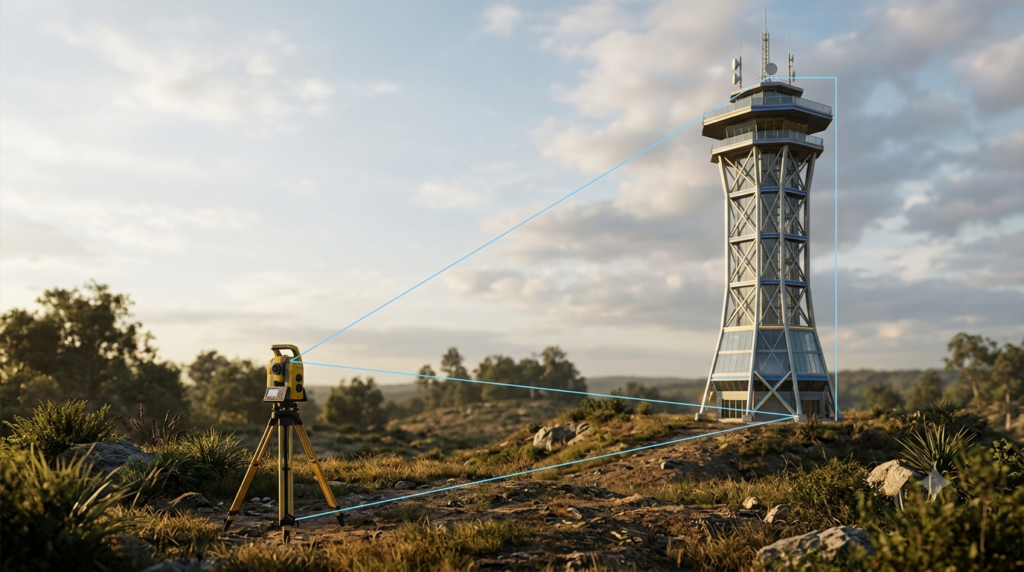
Three-dimensional geometry is widely used in architecture, construction, engineering, manufacturing, and astronomy.
Architects use three-dimensional models to visualize buildings before construction. Engineers calculate volumes, surface areas, and distances when designing machines and structures. Manufacturers use geometric models to produce parts that fit together accurately.
In computer graphics, three-dimensional geometry supports video games, animation, visual effects, and product visualization. Medical imaging can also create three-dimensional representations of internal structures from scans.
Astronomers use three-dimensional coordinates to study the positions and movements of celestial objects. These models help scientists understand the spatial relationships between planets, stars, and galaxies.
Comparing Zero, One, Two, and Three Dimensions
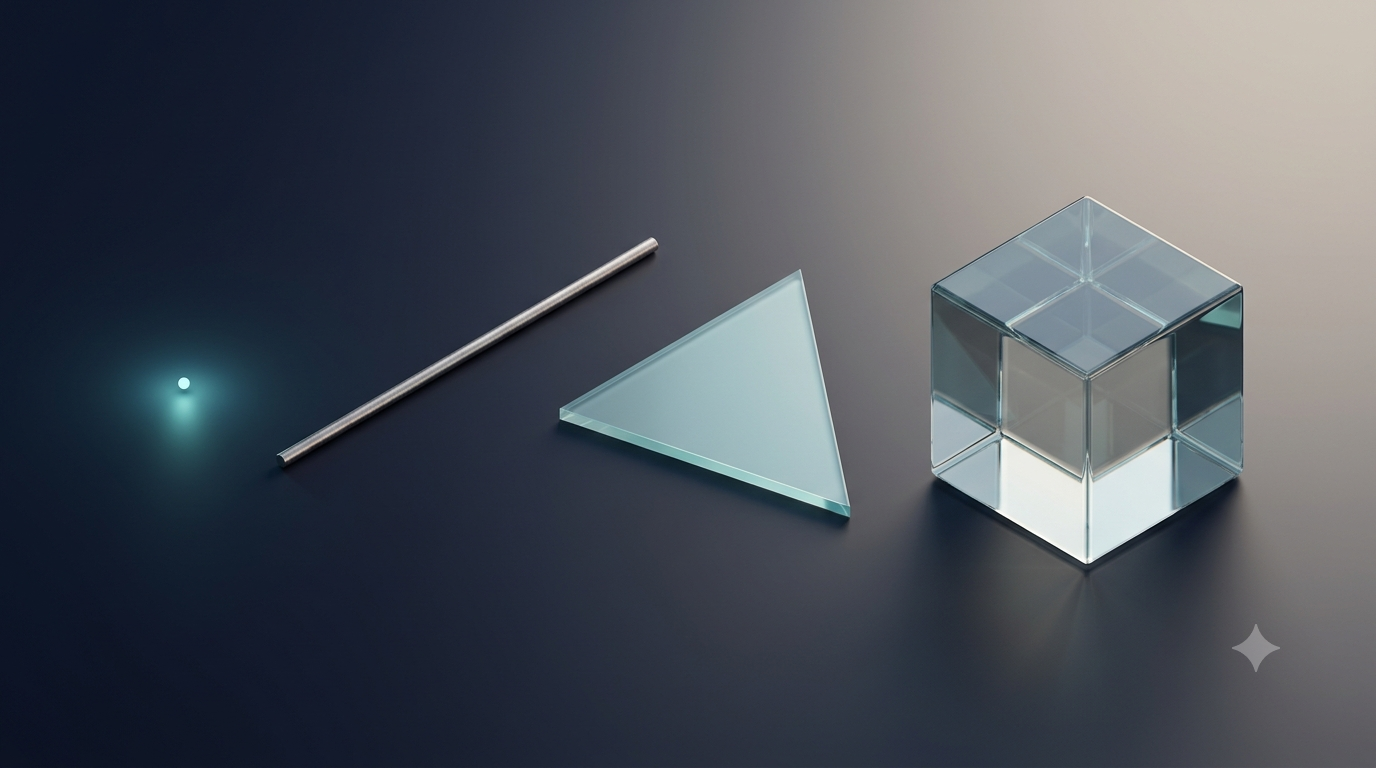
Each dimension introduces a new level of geometric description. Zero dimensions describe a location, one dimension introduces length, two dimensions introduce flat extent, and three dimensions describe space occupied by solids.
The following comparison summarizes the main differences.
Dimension Comparison Text Block
Zero dimension
Basic example: Point
Coordinates needed: 0 within the point’s own abstract space
Geometric extent: No length, area, or volume
One dimension
Basic example: Line
Coordinates needed: 1
Geometric extent: Length
Two dimensions
Basic example: Plane or flat shape
Coordinates needed: 2
Geometric extent: Area
Three dimensions
Basic example: Solid object
Coordinates needed: 3
Geometric extent: Volume
The coordinate count describes the number of independent coordinates needed to locate a point in the corresponding space. A point in three-dimensional space still has three coordinates, even though the point itself has no size.
Similarly, a three-dimensional object may contain lower-dimensional features. The edges of a cube are one-dimensional line segments, and its faces are two-dimensional squares. The cube as a whole occupies three-dimensional space.
How Dimensions Are Connected
Dimensions are not separate concepts that have no relationship to one another. Higher-dimensional geometry builds on ideas introduced in lower dimensions.
A line segment is defined by two endpoints. A polygon is formed by connecting line segments. A three-dimensional polyhedron is built from flat polygonal faces that meet along edges.
This relationship can be understood by examining familiar geometric objects.
A square has four sides and four vertices. When a cube is considered as a geometric solid, its square faces meet along edges and at vertices. The cube therefore combines zero-dimensional vertices, one-dimensional edges, two-dimensional faces, and a three-dimensional interior.
These relationships are useful for understanding how geometric structures are organized.
Another way to understand dimensions is through movement. In one dimension, movement is restricted to a single independent direction. In two dimensions, movement can occur along two independent directions. In three dimensions, movement can occur along three independent directions.
Real-world movement may be more complicated because roads curve, surfaces are uneven, and objects can rotate. However, the dimensional model remains useful for representing position and motion.
Difference Between Dimensions and Measurements
Dimensions and measurements are closely related, but they do not mean exactly the same thing.
A dimension describes an independent direction or coordinate needed to represent a space. A measurement gives a numerical value for a property such as length, area, or volume.
For example, a rectangle is two-dimensional because its shape extends in two independent directions. If its length is 8 cm and its width is 3 cm, these numbers are measurements of its dimensions.
Likewise, a box is three-dimensional because it has length, width, and height. Its dimensions might be 8 cm, 3 cm, and 2 cm.
The term dimension is also used when describing the measurements of an object, as in the phrase “the dimensions of the box.” In this everyday context, it refers to numerical measurements such as length, width, and height.
Understanding the difference prevents confusion between the number of dimensions in a geometric space and the measured size of an object.
Are Real-World Objects Perfectly One-, Two-, or Three-Dimensional?
Mathematical geometry uses ideal models to simplify real-world situations. Most physical objects occupy three-dimensional space, but we can often represent them using fewer dimensions when certain details are unimportant.
For example, a thin wire can be approximated as a one-dimensional line when its thickness is negligible compared with its length. A sheet of paper can be treated as a two-dimensional surface when its thickness does not affect the calculation.
A building, however, generally requires a three-dimensional model when its height, width, and depth are important.
These approximations help scientists and engineers solve problems more efficiently. The best model depends on what needs to be measured or explained.
An important point is that a mathematical model does not need to reproduce every physical detail. It needs to represent the features that matter for the problem being studied.
Dimensions in Mathematics, Science, and Technology
The idea of dimensions extends far beyond elementary geometry.
In algebra, coordinate systems connect numerical values with geometric positions. Graphs of equations help visualize relationships between variables. A graph of a single variable against another commonly uses two coordinate axes, while more complex models may require three-dimensional representations.
In physics, dimensions help describe the position and motion of objects. Scientists also use dimensional analysis to examine the units of physical quantities and check whether equations are consistent.
In computer science, arrays and data structures can be organized in one, two, or three dimensions. A one-dimensional array stores a sequence of values, a two-dimensional array resembles a table, and a three-dimensional array can represent data arranged in layers.
In computer-aided design, three-dimensional models help designers examine objects from different angles. In medical imaging, three-dimensional reconstructions help specialists visualize structures that cannot be fully understood from a single flat image.
These applications show that dimensions are not merely a topic in geometry textbooks. They are fundamental tools for describing and working with information about space.
Conclusion
Dimensions provide a simple but powerful way to understand geometric objects and the space around us. Zero-dimensional geometry describes points with no size. One-dimensional geometry introduces length through lines and line segments. Two-dimensional geometry describes flat shapes with length and width, allowing us to calculate area and perimeter. Three-dimensional geometry extends these ideas into solids with length, width, height, surface area, and volume.
Each dimension builds on concepts introduced by the dimensions before it. Points form the basis of lines, lines help define flat shapes, and flat surfaces contribute to the structure of solid objects.
By understanding dimensions from zero to three, we develop a stronger foundation for geometry, coordinate systems, measurement, physics, engineering, and computer graphics. These concepts help us describe the world more clearly, solve practical problems, and appreciate the mathematical structure behind everyday objects.
FAQs
1. What does dimension mean in geometry?
A dimension in geometry describes an independent direction or coordinate needed to represent a position or the extent of an object. Dimensions help us understand whether a geometric object is a point, line, flat shape, or solid. Zero-dimensional geometry represents points, one-dimensional geometry describes length, two-dimensional geometry deals with length and width, and three-dimensional geometry includes length, width, and height. These concepts are essential for studying shapes, positions, distances, areas, and volumes. Dimensions are also widely used in mathematics, physics, engineering, computer graphics, and architecture to represent and analyze objects and spaces accurately.
2. What is a zero-dimensional object in geometry?
A zero-dimensional object in geometry is a point. A point represents an exact location but has no length, width, height, area, or volume. Although we usually draw a small dot on paper to represent a point, the mathematical point itself has no physical size. Points are commonly named using capital letters, such as A, B, or P. They are important because they define the endpoints of line segments, the vertices of polygons, and positions in coordinate systems. The concept of a point forms the foundation of geometry and helps mathematicians describe relationships between different geometric objects.
3. What is the difference between one-dimensional and two-dimensional geometry?
One-dimensional geometry describes objects that extend along one independent direction, while two-dimensional geometry describes objects that extend along two independent directions. A line or line segment is a common one-dimensional example because its primary measurable property is length. A square, rectangle, or circle is two-dimensional because it has length and width and encloses an area. One-dimensional positions generally require one coordinate, whereas positions on a plane require two coordinates. These differences are useful when calculating distances, studying shapes, and solving mathematical problems. They also help explain how simple geometric structures can be combined to create more complex figures.
4. What are some examples of one-dimensional objects?
A straight line and a line segment are standard examples of one-dimensional geometric objects. A ray is another example because it begins at one endpoint and continues indefinitely in one direction. In practical situations, a thin wire, thread, or straight road can be approximated as one-dimensional when its width and thickness are unimportant. A number line is also a useful example because each position can be identified using a single coordinate. However, real physical objects usually have some thickness. Therefore, they are considered one-dimensional models only when their length is the main feature relevant to the problem being studied.
5. What are the main properties of two-dimensional shapes?
Two-dimensional shapes extend in two independent directions, commonly described as length and width. They can be represented on a flat plane using two coordinates, usually x and y. Examples include triangles, squares, rectangles, circles, and polygons. These shapes can have measurable properties such as perimeter and area. Perimeter represents the total length around a closed shape, while area measures the amount of surface enclosed by its boundary. Two-dimensional geometry is useful in drawing, architecture, mapping, graphic design, and mathematics. Although real drawings may have thickness, ideal two-dimensional shapes have no thickness in the mathematical model.
6. What is three-dimensional geometry, and why is it important?
Three-dimensional geometry studies objects and spaces that can be described using three independent coordinates, usually x, y, and z. These coordinates represent positions along three independent directions. Three-dimensional objects have length, width, and height and can occupy volume. Common examples include cubes, spheres, cylinders, cones, and rectangular prisms. Three-dimensional geometry helps us calculate volume, surface area, distances, and spatial relationships. It is important in construction, architecture, engineering, astronomy, and computer graphics. Designers use three-dimensional models to visualize products and buildings, while scientists use spatial coordinates to describe physical objects and understand their positions in the surrounding space.
7. What is the difference between area and volume?
Area measures the amount of surface enclosed by a two-dimensional shape, whereas volume measures the amount of three-dimensional space occupied by a solid. Area is expressed in square units, such as cm² or m². Volume is expressed in cubic units, such as cm³ or m³. For example, the area of a rectangular floor helps determine how much flooring material is needed, while the volume of a storage box indicates how much space it can hold. Area is commonly calculated for flat shapes, while volume formulas are used for solids such as cubes, cylinders, spheres, and rectangular prisms.
8. How are dimensions used in everyday life?
Dimensions help us describe, measure, design, and organize objects in everyday situations. One-dimensional measurements are useful when determining the length of a rope or the distance along a straight path. Two-dimensional measurements help calculate the area of a floor, the size of a garden, or the dimensions of a photograph. Three-dimensional measurements are important when selecting furniture, designing buildings, packing boxes, or determining the capacity of containers. Dimensions are also used in maps, digital images, engineering drawings, and computer models. Understanding these concepts makes it easier to compare sizes, estimate materials, plan spaces, and solve practical measurement problems.
9. Can a real-world object be considered one-dimensional or two-dimensional?
Yes, a real-world object can be approximated as one-dimensional or two-dimensional when some of its measurements are negligible for a particular problem. For example, a long, thin wire can be modeled as one-dimensional when only its length matters. A sheet of paper can be treated as two-dimensional when its thickness is insignificant compared with its length and width. However, both objects physically occupy three-dimensional space. These simplified models are useful because they reduce unnecessary complexity. Scientists, mathematicians, and engineers choose a suitable dimensional model based on the purpose of their calculations and the accuracy required.
10. How are dimensions used in science and computer technology?
Dimensions are widely used in science and computer technology to represent positions, shapes, and data. In physics, coordinate systems describe the locations and motion of objects. Engineers use dimensional models to design machines, buildings, and other structures. In computer science, one-dimensional arrays organize sequences of values, two-dimensional arrays represent tables or grids, and three-dimensional arrays can store layered data. Computer graphics use three-dimensional geometry to create realistic models, animations, and visual effects. Medical imaging can also produce three-dimensional representations of internal body structures. These applications demonstrate how dimensional concepts connect geometry with scientific research and modern technology.