Trigonometry is an important branch of mathematics that studies the relationships between the angles and sides of triangles. Today, it is widely used in geometry, physics, astronomy, engineering, architecture, navigation, computer graphics, and many other fields. However, trigonometry did not develop in a single place or at one particular moment in history. It grew gradually as ancient civilizations tried to solve practical problems involving land measurement, construction, timekeeping, and the movement of celestial bodies.
The history of trigonometry is closely connected to the development of astronomy. Early mathematicians needed reliable methods to calculate distances and positions that could not be measured directly. Over centuries, scholars from different parts of the world developed mathematical tables, formulas, and techniques that made these calculations easier and more accurate. From ancient Babylonian observations to Greek geometry, Indian mathematical discoveries, Islamic scholarship, and modern scientific applications, trigonometry has undergone remarkable development. Understanding this history helps explain how a practical mathematical tool became an essential part of modern science.
1. The Origins of Trigonometry in Ancient Civilizations
The earliest foundations of trigonometry appeared thousands of years before the subject became a separate branch of mathematics. Ancient civilizations needed mathematical methods to measure land, construct buildings, observe the sky, and develop calendars.
Although these societies did not always use the word trigonometry, many of their mathematical practices involved relationships between angles, distances, and geometric shapes.
Early Developments in Babylon
Ancient Babylonian civilization, located in Mesopotamia, made important contributions to mathematics. Babylonian scholars used a number system based on 60, known as the sexagesimal system. This system later influenced the way angles and time were divided.
For example, a full circle is divided into 360 degrees, an hour into 60 minutes, and a minute into 60 seconds. These divisions reflect the historical influence of ancient mathematical traditions.
Babylonian astronomers carefully observed the positions of the Sun, Moon, planets, and stars. They recorded celestial movements and used numerical methods to predict astronomical events. Such observations encouraged the development of mathematical techniques for understanding angular relationships.
The Babylonians did not develop trigonometry in the same form used today, but their numerical methods and astronomical records helped establish foundations for later mathematical work.
Mathematics in Ancient Egypt
Ancient Egyptians also used geometry extensively. They needed accurate methods to measure agricultural land, construct pyramids, design temples, and organize large building projects.
Egyptian surveyors used practical geometric knowledge to calculate heights, distances, and slopes. Some techniques involved comparing horizontal distances with vertical heights, ideas that are closely related to concepts later studied in trigonometry.
The Rhind Mathematical Papyrus, an important Egyptian mathematical document dating to around 1650 BCE, contains problems involving practical calculations and the slopes of pyramids.
One concept described in discussions of Egyptian pyramid construction is the seked, a measure of a pyramid’s slope based on the horizontal displacement corresponding to a vertical rise. Although the seked is not identical to modern trigonometric ratios, it demonstrates how ancient builders worked with relationships between height and horizontal distance.
These early practices show that the need to solve real-world problems played a major role in the development of mathematical ideas related to trigonometry.
2. The Development of Trigonometry in Ancient Greece
Ancient Greek mathematicians transformed many practical mathematical techniques into more systematic geometric methods. Their work established important foundations for the development of trigonometry as a mathematical discipline.
Greek scholars were particularly interested in astronomy, geometry, and understanding the structure of the universe. To study the movements of celestial objects, they needed ways to calculate distances and positions using angles.
Hipparchus and the Birth of Systematic Trigonometry
Hipparchus, a Greek astronomer and mathematician who lived during the second century BCE, is often associated with the early development of systematic trigonometry.
He studied the positions of celestial bodies and used geometric methods to solve astronomical problems. Historical accounts associate him with the creation of one of the earliest known trigonometric tables.
Rather than using the modern sine and cosine functions, Greek mathematicians commonly worked with chords of circles. A chord is a straight line joining two points on a circle. The length of a chord depends on the angle it subtends at the center of the circle.
By calculating chord lengths for different angles, astronomers could solve problems involving celestial positions and angular measurements.
Hipparchus’s work helped establish a mathematical approach to astronomy in which angles and geometric relationships could be studied systematically. Although many details of his original writings have not survived, his influence on ancient astronomy is widely recognized.
The Chord Method in Greek Mathematics
Greek trigonometry relied heavily on circles rather than the right-triangle ratios commonly taught today.
Imagine a circle with a known radius. If two points on the circumference are connected by a straight line, that line forms a chord. As the angle at the center changes, the chord length also changes.
Greek mathematicians prepared tables showing the relationships between central angles and chord lengths. These tables allowed astronomers to determine unknown geometric quantities without repeatedly carrying out complicated constructions.
The chord method was an important stage in mathematical development because it provided a systematic way to connect angular measurements with lengths.
Over time, similar ideas evolved into the trigonometric functions used in modern mathematics.
Ptolemy and the Almagest
Claudius Ptolemy, a Greek-speaking astronomer and mathematician working in Roman Egypt during the second century CE, made another major contribution to the development of trigonometry.
His influential astronomical work, the Almagest, presented mathematical models of celestial motion and included extensive chord tables.
Ptolemy used geometric relationships to study the positions and movements of the Sun, Moon, planets, and stars. His methods required accurate calculations involving angles and distances.
The Almagest remained influential for many centuries and was translated into several languages. It became an important source of astronomical and mathematical knowledge for scholars in the Middle East, North Africa, and Europe.
Ptolemy’s work demonstrates how trigonometric methods developed in response to the demands of astronomy. It also illustrates the importance of mathematical tables in making complicated calculations more manageable.
3. The Contributions of Ancient Indian Mathematicians
Indian mathematicians played a major role in transforming the methods used in ancient trigonometry. Their work contributed to the development of sine-based calculations that eventually became central to modern trigonometry.
Indian mathematical traditions were closely connected to astronomy, calendar-making, and the prediction of celestial events. Scholars developed methods that made angular calculations increasingly practical.
Aryabhata and the Sine Function
Aryabhata, an Indian mathematician and astronomer who lived in the fifth and sixth centuries CE, was one of the most important early contributors to trigonometry.
In his work Aryabhatiya, written around 499 CE, he presented mathematical techniques for astronomical calculations and included a table of sine values.
The sine function differs from the Greek chord method. In a right triangle, the sine of an angle is defined as the ratio of the length of the opposite side to the length of the hypotenuse.
A Text block containing the basic formula:
sin θ = Opposite side ÷ Hypotenuse
The introduction and development of sine-based methods made it easier to perform many calculations involving triangles and circles. Instead of relying entirely on chord lengths, mathematicians could work with ratios associated with angles.
Aryabhata’s work helped establish a mathematical tradition in which trigonometric functions were represented numerically and used systematically.
The Development of Sine Tables
Sine tables list the values of the sine function for different angles. Such tables were extremely useful before electronic calculators existed.
Indian mathematicians developed numerical methods for calculating and improving trigonometric values. These methods supported astronomical calculations, including the determination of celestial positions.
Over time, other Indian scholars expanded this work. Mathematicians such as Brahmagupta and Bhaskara II contributed to broader developments in mathematics and astronomy, including topics relevant to trigonometric calculations.
Indian mathematical knowledge was later transmitted to other regions through scholarly exchange, translation, and the movement of scientific texts.
The Indian development of sine-based methods was one of the most important stages in the evolution of trigonometry because it helped establish the framework used by later mathematicians.
4. The Development of Trigonometry in the Islamic Golden Age
Between approximately the eighth and fourteenth centuries, scholars working across the Islamic world made substantial contributions to mathematics and astronomy. Their work preserved earlier knowledge while introducing new methods, improving calculations, and expanding the study of trigonometric functions.
Major centers of scholarship included Baghdad, Damascus, Samarkand, and other cities connected by intellectual and commercial networks.
Translation and Preservation of Earlier Knowledge
During the early centuries of the Islamic Golden Age, scholars translated important Greek scientific works into Arabic. Mathematical and astronomical texts associated with authors such as Ptolemy became available to a wider scholarly community.
Indian mathematical and astronomical knowledge also influenced scholars working in this environment.
Translation was only one part of this process. Scholars examined earlier methods, compared mathematical results, prepared new tables, and developed improved techniques for astronomical observation and calculation.
This combination of preservation and innovation helped trigonometry become a more organized mathematical subject.
The Expansion of Trigonometric Functions
Islamic mathematicians extended the use of sine and developed or systematized other trigonometric functions, including cosine, tangent, and cotangent.
These functions provided additional tools for solving geometric and astronomical problems. They also made it possible to express relationships between angles and sides in several different ways.
For example, the tangent of an angle in a right triangle is the ratio of the opposite side to the adjacent side.
A Text block containing the basic formula:
tan θ = Opposite side ÷ Adjacent side
Scholars also developed mathematical methods for working with spherical triangles. Unlike ordinary flat triangles, spherical triangles are formed on the surface of a sphere. They are especially important in astronomy, navigation, and the study of the Earth.
Because celestial objects appear on the sky as positions on an imaginary celestial sphere, spherical trigonometry was particularly useful for astronomical calculations.
Important Scholars and Their Work
Several scholars contributed to these developments. Al-Battani, an astronomer and mathematician who lived during the ninth and tenth centuries, improved astronomical measurements and made important use of trigonometric methods.
Abu al-Wafa al-Buzjani, who lived during the tenth century, contributed to trigonometry and mathematical astronomy. His work included the study of trigonometric relationships and the preparation of useful mathematical tables.
Later scholars continued to refine these methods, helping trigonometry develop into a more independent mathematical discipline.
The work of scholars across the Islamic world was essential in connecting earlier Greek and Indian mathematical traditions with the developments that followed in Europe.
5. The Introduction of Trigonometry to Medieval Europe
Mathematical knowledge developed across different civilizations gradually reached medieval Europe through translations, trade, education, and scholarly contact.
During the Middle Ages, European scholars gained access to important Arabic-language scientific works, including texts that preserved and extended Greek mathematical knowledge.
Translations into Latin made many of these ideas available to European universities and other centers of learning.
The Influence of Translation
The translation movement helped introduce European scholars to mathematical tables, astronomical models, and techniques developed by earlier civilizations.
Trigonometric methods became increasingly useful for astronomers who wanted to calculate the positions of celestial bodies, improve calendars, and understand planetary movements.
Early European mathematics often treated trigonometry mainly as a tool for astronomy. Over time, however, scholars began to study its methods more systematically.
This transition helped prepare the way for trigonometry to become a recognizable subject within mathematics.
Regiomontanus and Trigonometry as a Separate Subject
Johannes Müller, commonly known as Regiomontanus, was a fifteenth-century European mathematician and astronomer who played an important role in the development of trigonometry.
His work De triangulis omnimodis, completed in the fifteenth century, presented a systematic treatment of triangles and their mathematical relationships.
The work examined both plane triangles and spherical triangles. It helped establish trigonometry as a subject that could be studied independently rather than only as a collection of techniques for astronomy.
Regiomontanus also contributed to the preparation and circulation of mathematical tables that supported astronomical calculations.
His work represents an important step toward the more organized treatment of trigonometry that developed during the Renaissance.
6. Trigonometry During the Renaissance and Scientific Revolution
The Renaissance and Scientific Revolution brought major changes to mathematics, astronomy, physics, and scientific thinking. Improved instruments, printed books, and new astronomical theories increased the demand for accurate mathematical calculations.
Trigonometry became an increasingly important tool for understanding the natural world.
The Role of Printing and Mathematical Tables
The invention and spread of printing in Europe made mathematical books and tables easier to reproduce and distribute.
Before printed books became widespread, mathematical knowledge often depended on handwritten manuscripts, which were expensive and difficult to copy. Printing helped more scholars gain access to mathematical methods.
Trigonometric tables became especially valuable because they reduced the amount of repeated calculation required in astronomy, navigation, and surveying.
Mathematicians continued to improve the accuracy of these tables and develop methods for calculating trigonometric values.
Trigonometry and Astronomy
Astronomy remained one of the major forces behind the development of trigonometry.
Astronomers needed to calculate the positions of planets and stars, compare observations, and test mathematical models of the solar system.
Nicolaus Copernicus proposed a Sun-centered model of the planetary system in the sixteenth century. Later, Johannes Kepler developed laws describing planetary motion, while Galileo Galilei used improved observations to investigate the heavens.
These scientific developments depended on mathematical reasoning and precise astronomical measurements. Trigonometry supported many of the calculations needed to compare observed positions with predicted ones.
Although trigonometry alone did not produce the scientific revolution, it provided essential mathematical tools for the study of celestial motion.
7. The Development of Modern Trigonometric Functions
Over time, mathematicians moved beyond treating trigonometry primarily as a method for solving triangles. They increasingly studied trigonometric functions as mathematical relationships that could be represented through equations, graphs, and general rules.
This change broadened the subject and made it useful in many areas of mathematics.
Sine, Cosine, and Tangent
Modern trigonometry commonly introduces six trigonometric functions: sine, cosine, tangent, cosecant, secant, and cotangent.
The three primary functions are sine, cosine, and tangent. In a right triangle, they relate an angle to the lengths of the sides.
A Text block containing the basic formulas:
sin θ = Opposite side ÷ Hypotenuse
cos θ = Adjacent side ÷ Hypotenuse
tan θ = Opposite side ÷ Adjacent side
These ratios allow unknown sides or angles to be calculated when sufficient information is available.
For example, if the angle and one side of a right triangle are known, trigonometric ratios can help determine the length of another side. This is useful in construction, surveying, engineering, and many other practical situations.
The Unit Circle
The unit circle is another important concept in modern trigonometry. It is a circle with a radius of one unit centered at the origin of a coordinate system.
The unit circle helps explain how sine and cosine extend beyond the angles of right triangles. Each point on the circle corresponds to an angle, and its horizontal and vertical coordinates represent the cosine and sine of that angle.
A Text block containing the basic relationship:
x = cos θ
y = sin θ
x² + y² = 1
The unit circle provides a visual and mathematical way to understand trigonometric functions for angles of different sizes, including angles greater than 90 degrees and negative angles.
It also helps explain why sine and cosine repeat their values in regular patterns.
Degrees and Radians
Historically, degrees became widely used for measuring angles, with a full circle divided into 360 degrees. Modern mathematics also uses radians, another important unit of angular measurement.
One complete revolution corresponds to 360 degrees or 2π radians.
A Text block containing the conversion formulas:
180° = π radians
360° = 2π radians
Radians are especially useful in calculus, physics, and advanced mathematics because they simplify many mathematical relationships involving trigonometric functions.
The use of both degrees and radians allows trigonometry to serve practical measurement needs as well as theoretical mathematical analysis.
8. Trigonometry and the Rise of Calculus
The development of calculus during the seventeenth century created new opportunities for the application of trigonometric functions.
Calculus studies quantities that change continuously, including rates of change and accumulated quantities. Trigonometric functions are particularly useful for describing repeating patterns, circular motion, and wave-like behavior.
Mathematicians such as Isaac Newton and Gottfried Wilhelm Leibniz helped establish calculus as a major branch of mathematics.
Trigonometric functions became important in calculus because their derivatives and integrals have useful mathematical relationships.
For example, the derivative of the sine function, when the angle is measured in radians, is the cosine function.
A Text block containing the formula:
d/dx (sin x) = cos x
This relationship is useful for studying oscillations, motion, waves, and many other changing quantities.
The connection between trigonometry and calculus greatly expanded the subject’s role in physics, engineering, and mathematical analysis.
9. The Role of Trigonometry in Modern Science and Technology
Today, trigonometry is used in a wide range of scientific and technological fields. Its importance extends far beyond the original problems of astronomy and land measurement.
Modern applications demonstrate how mathematical ideas developed over centuries continue to support everyday technologies and advanced scientific research.
Engineering and Architecture
Engineers use trigonometry to calculate angles, distances, forces, and dimensions. It helps determine the slopes of roads, the geometry of bridges, the positions of structural components, and the dimensions of mechanical systems.
Architects and construction professionals also use trigonometric relationships when designing roofs, ramps, stairs, and other structures.
These calculations help ensure that designs meet practical requirements and that components fit together accurately.
Navigation and Surveying
Trigonometry is important in navigation because it helps determine positions, directions, and distances.
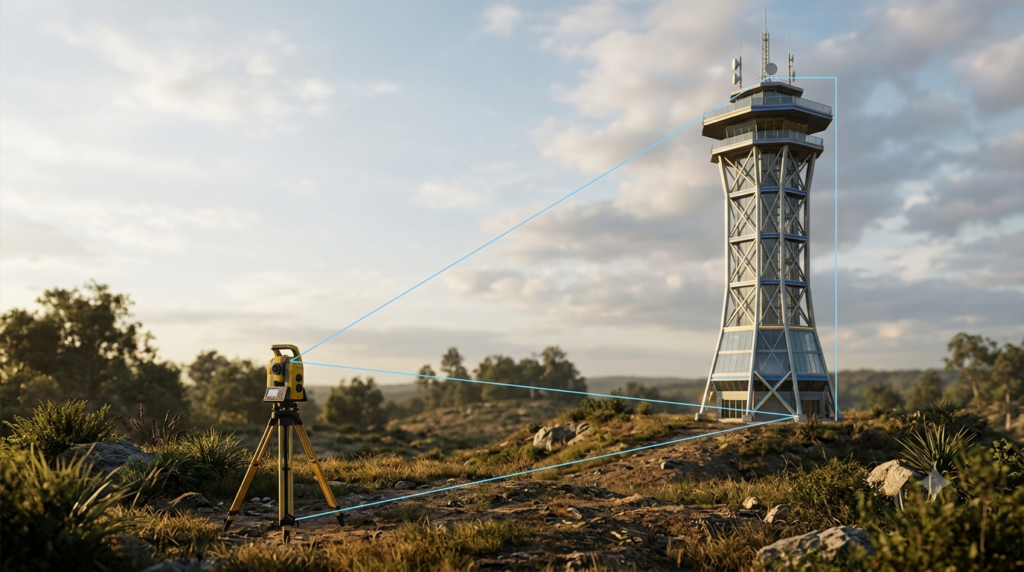
Surveyors use angular measurements and known distances to calculate the positions of points on land. These methods support mapmaking, construction projects, and geographical measurements.
Navigation systems and modern positioning technologies use more complex mathematical models, but geometric relationships and trigonometric calculations remain important in many related tasks.
Physics and Wave Motion
Many physical phenomena can be described using sine and cosine functions.
Sound waves, electromagnetic waves, alternating electrical currents, and periodic motion are common examples. Trigonometric functions help represent how these quantities change over time or across space.
For instance, a simplified mathematical model of a periodic wave can be written as follows.
A Text block containing the formula:
y = A sin(ωt + φ)
In this expression, A represents the amplitude, ω represents the angular frequency, t represents time, and φ represents the phase angle.
Such mathematical models are useful in acoustics, electronics, optics, and many areas of physics.
Computer Graphics and Digital Technology
Trigonometry also plays a major role in computer graphics, animation, robotics, and game development.
Computers use trigonometric relationships to calculate rotations, camera movements, object positions, and directions in two-dimensional and three-dimensional environments.
Robotics systems use geometric calculations to determine how robotic arms should move and how their components relate to one another.
In digital signal processing, trigonometric functions are also closely connected to techniques used to analyze sound, images, and other forms of data.
These applications show how a branch of mathematics that began with geometric and astronomical problems has become part of modern computing.
10. How Trigonometry Has Changed Over Time
The development of trigonometry illustrates how mathematics grows through the contributions of different civilizations and generations of scholars.
In ancient Babylon and Egypt, mathematical practices helped people measure land, construct buildings, and study the sky. Greek mathematicians developed systematic geometric methods and chord tables. Indian scholars made important advances in sine-based calculations. Mathematicians in the Islamic world expanded trigonometric functions and improved astronomical techniques.
Later, European scholars helped establish trigonometry as an independent subject. During the Scientific Revolution, its applications in astronomy and physics became increasingly important. The development of calculus further expanded the mathematical study of trigonometric functions.
In modern times, calculators and computers have made complicated trigonometric calculations much faster. However, the basic ideas remain closely connected to the relationships between angles, lengths, circles, and repeating patterns.
The history of trigonometry is therefore not simply a sequence of discoveries by individual mathematicians. It is an example of how mathematical knowledge develops through observation, practical needs, theoretical reasoning, communication, and the gradual improvement of existing ideas.
Conclusion
The history and development of trigonometry reveal how a practical need to measure distances and understand the sky gradually led to a major branch of mathematics. Ancient civilizations established early foundations through geometry and astronomy. Greek mathematicians developed chord methods, Indian scholars advanced sine-based calculations, and scholars in the Islamic world expanded trigonometric functions and refined mathematical techniques. European mathematicians later helped establish trigonometry as an independent subject, while the rise of calculus and modern science expanded its applications.
Today, trigonometry supports engineering, architecture, astronomy, navigation, physics, computer graphics, and many other fields. Its long history demonstrates the value of combining practical observation with mathematical reasoning. By learning how trigonometry developed, beginners can better understand not only its formulas but also the human curiosity and scientific progress that shaped the subject.
FAQs
1. What is the history of trigonometry?
The history of trigonometry began in ancient civilizations that needed mathematical methods to measure distances, construct buildings, and study celestial movements. Babylonians and Egyptians developed early mathematical techniques related to angles and geometric measurements. Greek mathematicians, including Hipparchus and Ptolemy, introduced systematic methods using chord tables for astronomical calculations. Indian mathematicians later developed important sine-based methods, while scholars in the Islamic world expanded trigonometric functions and improved mathematical tables. European scholars subsequently helped establish trigonometry as an independent branch of mathematics. Today, it is widely used in science, engineering, navigation, and modern technology.
2. Who is known as the father of trigonometry?
Hipparchus, an ancient Greek astronomer and mathematician who lived during the second century BCE, is often regarded as the father of trigonometry. He is associated with developing one of the earliest known systematic trigonometric tables based on chord lengths. These tables helped astronomers calculate the positions of celestial objects and solve geometric problems. Although mathematical techniques related to trigonometry existed before his time, Hipparchus helped organize them into a more systematic approach. His contributions influenced later Greek astronomers, particularly Ptolemy, and helped establish important foundations for the development of trigonometry as a mathematical discipline.
3. How did ancient Babylonians contribute to trigonometry?
Ancient Babylonians contributed to the mathematical foundations of trigonometry through their numerical methods and astronomical observations. They carefully recorded the movements of the Sun, Moon, planets, and stars to develop calendars and predict celestial events. Their number system was based on 60, which influenced the measurement of angles and time. The modern division of a circle into 360 degrees reflects historical traditions associated with ancient mathematics. Although the Babylonians did not use modern trigonometric functions such as sine and cosine, their mathematical records and calculations helped establish knowledge that later civilizations developed into more systematic geometric and trigonometric methods.
4. What contributions did Greek mathematicians make to trigonometry?
Greek mathematicians played a major role in developing systematic methods for solving problems involving angles and distances. Hipparchus is associated with early chord tables, which connected central angles in a circle with the lengths of their chords. Later, Claudius Ptolemy presented extensive chord tables and astronomical calculations in his influential work, the Almagest. These methods helped astronomers predict celestial positions and study planetary movements. Greek mathematicians generally approached trigonometry through geometry and circular relationships rather than the modern sine and cosine functions. Their work established important theoretical foundations that influenced Indian, Islamic, and European mathematical traditions for centuries.
5. What was Aryabhata’s contribution to the development of trigonometry?
Aryabhata was an influential Indian mathematician and astronomer who lived during the fifth and sixth centuries CE. In his work Aryabhatiya, completed around 499 CE, he presented mathematical methods for astronomical calculations and included a table of sine values. This represented an important development because sine-based calculations provided an alternative to the chord methods commonly associated with ancient Greek mathematics. Aryabhata’s work helped establish a tradition of using numerical trigonometric values to solve astronomical problems. His contributions influenced later Indian mathematicians and formed part of the mathematical knowledge that spread to other regions through scholarly exchange and translation.
6. How did Islamic scholars help develop trigonometry?
Scholars working across the Islamic world made important contributions to trigonometry between approximately the eighth and fourteenth centuries. They translated and studied earlier Greek and Indian mathematical works while developing new methods for astronomical calculations. Scholars such as Al-Battani and Abu al-Wafa al-Buzjani contributed to the study of trigonometric functions, mathematical tables, and spherical trigonometry. Their work improved methods for calculating celestial positions and measuring angles. These scholars helped preserve earlier mathematical knowledge while expanding its applications and accuracy. Their achievements also influenced European mathematics through translations and the exchange of scientific ideas across different regions.
7. When did trigonometry become a separate branch of mathematics?
Trigonometry developed gradually as mathematicians moved from using geometric calculations mainly for astronomy toward studying triangle relationships as a systematic mathematical subject. Ancient Greek scholars established important foundations through chord tables, while Indian and Islamic mathematicians expanded sine-based methods and other trigonometric functions. During the fifteenth century, European mathematician Regiomontanus made an important contribution through his work De triangulis omnimodis, which systematically examined plane and spherical triangles. His work helped establish trigonometry as a subject that could be studied independently. However, there was no single moment when trigonometry became a separate branch; its development occurred over many centuries.
8. How did trigonometry change during the Scientific Revolution?
During the Scientific Revolution of the sixteenth and seventeenth centuries, trigonometry became increasingly important in astronomy, navigation, physics, and mathematical research. Improved observational instruments and more accurate astronomical measurements created a greater need for reliable calculations involving angles and distances. Scientists studying planetary motion and the structure of the solar system relied on mathematical methods to compare observations with theoretical predictions. The development of printed mathematical books and trigonometric tables also helped knowledge spread more widely. Later, the development of calculus created new ways to study sine and cosine functions. These changes expanded trigonometry beyond solving triangles and strengthened its role in modern mathematics.
9. What are the main applications of trigonometry today?
Trigonometry has numerous applications in modern science and technology. Engineers use it to calculate forces, angles, distances, and structural dimensions. Architects apply it when designing roofs, ramps, and other building features. Surveyors use trigonometric methods to measure land and determine positions, while astronomers use them to study celestial objects. In physics, sine and cosine functions help describe waves, oscillations, and periodic motion. Computer graphics and animation use trigonometry to calculate rotations, directions, and object positions. It also supports robotics, navigation, electronics, and signal processing. These applications demonstrate how historical mathematical discoveries continue to solve practical problems.
10. Why is learning the history of trigonometry important?
Learning the history of trigonometry helps students understand how mathematical knowledge develops through observation, experimentation, and problem-solving. It shows that mathematical concepts were created and improved over many centuries by scholars from different civilizations. Studying contributions from Babylonian, Egyptian, Greek, Indian, Islamic, and European traditions provides a broader understanding of scientific progress. Historical examples also explain why trigonometry became closely connected with astronomy, navigation, engineering, and physics. Understanding its development can make formulas and mathematical methods more meaningful because learners can see the problems they were designed to solve. This historical perspective encourages curiosity and appreciation for mathematics.