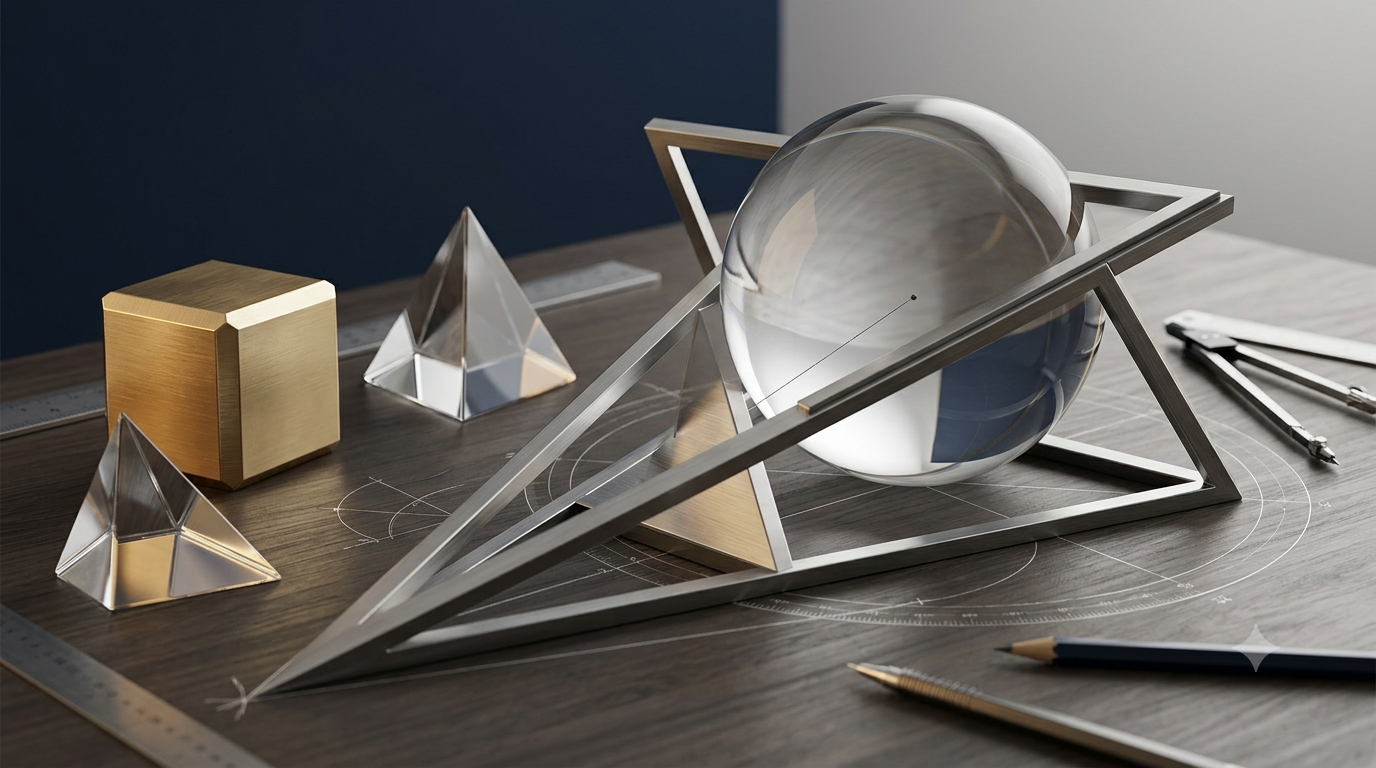
Geometry is one of the most important branches of mathematics because it helps us understand shapes, sizes, positions, distances, and the space around us. From the design of buildings and bridges to the movement of planets and the creation of computer graphics, geometry plays a major role in explaining how objects exist and interact in the real world. It also helps us develop logical thinking, recognize patterns, solve problems, and understand relationships between different mathematical quantities.
The word geometry may remind us of triangles, circles, angles, and formulas, but the subject goes far beyond these basic concepts. It connects mathematics with science, engineering, architecture, technology, and everyday activities. Whether we are measuring a room, reading a map, designing a machine, or studying the shape of the Earth, we use geometric ideas in many ways. Understanding geometry provides a strong foundation for learning advanced mathematics and appreciating the mathematical structure of the world around us.
What Is Geometry?
Geometry is a branch of mathematics that studies the properties, measurements, positions, and relationships of points, lines, angles, surfaces, and solid objects. It helps us describe the shape of an object, calculate its dimensions, determine distances, and understand how different parts of a figure are connected.
For example, geometry explains why a triangle has three sides, how to calculate the area of a rectangle, and how to determine the volume of a cube. It also helps us understand more complex ideas, such as the relationship between the angles of a polygon, the properties of curved surfaces, and the arrangement of objects in three-dimensional space.
Geometry combines visual understanding with mathematical reasoning. Instead of working only with numbers, it allows us to study diagrams, models, and spatial relationships. This makes it useful for solving practical problems as well as theoretical mathematical questions.
Basic Concepts of Geometry
Before studying advanced geometric ideas, it is important to understand several fundamental concepts. These building blocks help us describe and analyze geometric figures accurately.
1. Point
A point represents an exact position in space. It has no length, width, or height, so it has no physical size in geometry. Points are commonly represented by capital letters such as A, B, and C.
For example, a point can represent the location of a city on a simplified map or the position of an object in a coordinate system. Although a point is usually drawn as a small dot, the dot itself is only a visual representation.
2. Line
A line is a straight path that extends infinitely in both directions. It has length but no thickness. A line can pass through any number of points.
Lines are important for describing directions, measuring distances, and studying relationships between geometric figures. In geometry, two lines may intersect, remain parallel, or meet at a right angle.
3. Line Segment
A line segment is a part of a line with two fixed endpoints. Unlike a complete line, a line segment has a definite length.
For example, the edge of a rectangular table can be represented by a line segment. If the endpoints are A and B, the length of the segment can be written as AB = 5 cm.
4. Ray
A ray begins at one fixed point and extends infinitely in one direction. It has one endpoint but no ending point.
Rays are useful for understanding angles, light paths, and directions. An angle, for example, is formed by two rays that share the same endpoint.
5. Angle
An angle is formed when two rays meet at a common endpoint called the vertex. Angles are measured in degrees or radians, depending on the mathematical context.
Common types of angles include:
Acute angle: An angle smaller than 90°.
Right angle: An angle equal to 90°.
Obtuse angle: An angle greater than 90° but smaller than 180°.
Straight angle: An angle equal to 180°.
Reflex angle: An angle greater than 180° but smaller than 360°.
Understanding angles is essential for studying triangles, polygons, construction, navigation, and many other applications.
Major Branches of Geometry
Geometry includes several branches that focus on different aspects of shapes, measurements, and space. Each branch provides tools for understanding particular types of mathematical problems.
1. Euclidean Geometry
Euclidean geometry is the traditional study of points, lines, angles, triangles, circles, and other figures on a flat surface. It is based on principles associated with the ancient Greek mathematician Euclid.
This branch includes many familiar geometric rules, such as the Pythagorean theorem and the formulas used to calculate the area of common shapes. It is widely taught in schools and provides the foundation for many practical applications.
For example, when calculating the diagonal of a rectangular room or determining the angles of a triangle, we often use principles from Euclidean geometry.
2. Analytic Geometry
Analytic geometry connects geometry with algebra by representing points and figures using coordinates and equations. It commonly uses the Cartesian coordinate system, which consists of horizontal and vertical axes.
A point in a two-dimensional coordinate system can be represented as (x, y). These coordinates identify its position relative to the axes.
The distance between two points can be calculated using the following formula.
Text block — Distance Formula
Distance = √[(x₂ − x₁)² + (y₂ − y₁)²]
For example, the distance between the points (1, 2) and (4, 6) is 5 units.
Analytic geometry is useful in graphing equations, studying curves, analyzing motion, and developing computer graphics.
3. Solid Geometry
Solid geometry studies three-dimensional objects that have length, width, and height. These objects occupy space and may have measurable surface areas and volumes.
Common examples include cubes, cuboids, spheres, cylinders, cones, and pyramids.
The volume of a cube can be calculated using the following formula.
Text block — Volume of a Cube
V = a³
Here, V represents volume and a represents the length of one edge.
Solid geometry is particularly useful in architecture, engineering, packaging, manufacturing, and the calculation of storage capacity.
4. Coordinate Geometry in Three Dimensions
Three-dimensional coordinate geometry extends the coordinate system by adding a third axis. A point is represented by three coordinates, written as (x, y, z).
This system allows mathematicians and scientists to describe positions in three-dimensional space. It is useful for modeling objects, studying physical motion, designing structures, and creating realistic computer-generated environments.
For example, 3D modeling software uses coordinate-based methods to position objects and calculate their dimensions.
5. Non-Euclidean Geometry
Non-Euclidean geometry studies geometric systems in which some of the familiar rules of Euclidean geometry do not apply. It is especially important when studying curved spaces.
Two major examples are spherical geometry and hyperbolic geometry.
In spherical geometry, points lie on a spherical surface. The shortest paths between points follow great circles, such as the equator or certain routes used in long-distance navigation. The angles of a spherical triangle can add up to more than 180°.
Non-Euclidean geometry is important in advanced mathematics, astronomy, and the study of space in modern physics.
Important Formulas Used in Geometry
Geometric formulas allow us to calculate lengths, areas, surface areas, and volumes. They turn visual problems into mathematical calculations and help us compare different shapes.
The following formulas are commonly used in elementary geometry.
1. Perimeter of a Rectangle
The perimeter is the total distance around a two-dimensional shape.
Text block — Rectangle Perimeter
P = 2 × (l + w)
Here, P represents perimeter, l represents length, and w represents width.
2. Area of a Rectangle
Area measures the amount of surface enclosed by a two-dimensional figure.
Text block — Rectangle Area
A = l × w
For example, a rectangle with a length of 8 cm and a width of 5 cm has an area of 40 cm².
3. Area of a Triangle
A triangle is a polygon with three sides. Its area depends on the length of its base and the perpendicular height.
Text block — Triangle Area
A = ½ × b × h
Here, b represents the base and h represents the perpendicular height.
4. Area of a Circle
A circle is a two-dimensional shape consisting of all points in a plane that are a fixed distance from a central point. That fixed distance is called the radius.
Text block — Circle Area
A = π × r²
Here, A represents area, r represents radius, and π is approximately 3.14159.
5. Circumference of a Circle
Circumference is the distance around a circle.
Text block — Circle Circumference
C = 2 × π × r
The circumference formula is useful for calculating the distance around circular objects such as wheels, pipes, and round garden beds.
6. Volume of a Cuboid
A cuboid is a three-dimensional object with six rectangular faces.
Text block — Cuboid Volume
V = l × w × h
Here, V represents volume, l represents length, w represents width, and h represents height.
These formulas demonstrate how geometry helps us measure and describe objects mathematically. However, selecting the correct formula also requires understanding the shape and the information provided in a problem.
Why Is Geometry Important in Mathematics?
Geometry is important because it develops mathematical understanding, supports logical reasoning, and provides practical methods for solving problems involving shapes, measurements, and space.
1. It Develops Logical Thinking
Geometry teaches us to analyze information, recognize relationships, and reach conclusions through logical reasoning. Many geometric problems require us to use known facts to prove something that is not immediately obvious.
For example, when proving that two triangles are congruent, we must examine their sides and angles and determine whether they satisfy specific conditions.
This process encourages careful thinking rather than guessing. Students learn to explain why an answer is correct and support their conclusions with mathematical evidence.
These reasoning skills are valuable not only in mathematics but also in science, technology, and everyday decision-making.
2. It Builds a Foundation for Advanced Mathematics
Geometry is closely connected to algebra, trigonometry, calculus, and other branches of mathematics. Many advanced mathematical topics depend on geometric concepts.
For example, coordinate geometry uses algebraic equations to describe lines and curves. Trigonometry studies relationships between angles and side lengths, particularly in triangles. Calculus uses geometric ideas to study areas, slopes, and changing quantities.
A strong understanding of geometry makes these subjects easier to learn because students can connect abstract mathematical expressions with visual representations.
3. It Helps Us Understand Shapes and Space
Geometry improves spatial awareness, which is the ability to understand the positions, sizes, orientations, and relationships of objects.
This skill is useful when interpreting maps, assembling furniture, arranging objects, reading technical drawings, or estimating whether something will fit into a particular space.
For instance, understanding the dimensions of a room helps us determine where a bed, table, or cupboard can be placed. Similarly, recognizing geometric shapes helps us understand the structure of objects in our surroundings.
4. It Makes Measurement Possible
Many practical activities require accurate measurements. Geometry provides the formulas and principles needed to calculate lengths, distances, areas, angles, surface areas, and volumes.
A builder may calculate the area of a floor before purchasing tiles. A farmer may estimate the area of a field. A manufacturer may calculate the volume of a container to determine how much material it can hold.
Without geometric measurement methods, many of these tasks would depend on rough estimates rather than reliable calculations.
5. It Connects Mathematics with Real-World Problems
Geometry demonstrates that mathematics is not limited to textbooks. It provides practical solutions to problems involving physical objects and spaces.
For example, calculating the amount of paint needed for a wall requires knowledge of area. Determining the amount of water a tank can hold requires understanding volume. Planning a road or designing a roof may involve angles, lengths, slopes, and geometric models.
By applying geometric principles, people can make more accurate decisions, reduce material waste, and improve the efficiency of their work.
Applications of Geometry in Everyday Life
Geometry appears in many ordinary activities, often without us realizing it. Its applications range from simple measurements to complex technological systems.
1. Architecture and Construction
Architects and engineers use geometry to plan buildings, bridges, tunnels, roads, and other structures. They calculate dimensions, angles, slopes, areas, and volumes to ensure that designs meet practical requirements.
For example, geometric calculations help determine the amount of concrete required for a foundation or the dimensions of a roof. Geometric models also help professionals visualize how different parts of a structure fit together.
Accurate geometry contributes to efficient planning, material estimation, and structural design, although safety also depends on engineering analysis and other technical considerations.
2. Art and Design
Artists and designers use geometric principles to create patterns, illustrations, logos, furniture, and decorative objects.
Shapes such as circles, triangles, squares, and polygons can be arranged to create balanced compositions. Symmetry helps designers produce visually consistent patterns, while proportions help maintain relationships between different parts of a design.
Geometry is also used in textile design, interior decoration, photography, and digital illustration.
3. Navigation and Mapping
Maps represent geographical locations and distances using mathematical systems. Geometry helps describe directions, positions, angles, and spatial relationships.
Navigation systems use coordinate-based methods to represent locations and calculate routes. In aviation and maritime navigation, spherical geometry and related mathematical techniques are important because the Earth is approximately spherical.
Geometry therefore contributes to understanding location, distance, and movement across the Earth’s surface.
4. Computer Graphics and Video Games
Computer graphics depend heavily on geometry. Digital objects are represented using points, lines, polygons, curves, and surfaces.
In a video game, for example, geometry helps define the shape of characters, buildings, vehicles, and landscapes. A graphics system calculates how these objects appear from different viewpoints and how they interact with their surroundings.
Three-dimensional modeling, animation, virtual reality, and computer-aided design all rely on geometric principles.
5. Astronomy and Space Science
Astronomers use geometry to study the positions and apparent movements of celestial objects. Angular measurements help determine where stars, planets, and other objects appear in the sky.
Geometric methods also contribute to estimating distances through techniques such as parallax. By observing the apparent shift in an object’s position from different viewpoints, astronomers can calculate its distance when the necessary measurements are available.
Geometry is also used in orbital modeling and spacecraft navigation, together with physics and other mathematical methods.
6. Manufacturing and Engineering
Manufacturers use geometry to design machine parts, tools, vehicles, electronic components, and industrial products.
A component may need precise dimensions and angles to fit correctly with other parts. Geometric calculations help engineers check measurements, model surfaces, and create technical drawings.
In computer-aided manufacturing, digital geometric models can guide machines that cut, shape, or assemble materials.
7. Sports and Games
Geometry is useful in sports because playing fields, courts, equipment, and movement paths involve distances and angles.
In football, players consider the angle and direction of a shot. In basketball, the trajectory of a ball depends on its launch conditions and physical forces. In billiards, players use geometric reasoning to estimate how a ball will reflect from a cushion.
Although real sports movements also involve physics, geometry helps describe positions, directions, and spatial relationships.
The Difference Between Geometry and Other Branches of Mathematics
Geometry is closely related to other mathematical subjects, but each branch focuses on different types of questions.
| Branch of mathematics | Main focus | Example |
|---|---|---|
| Arithmetic | Basic numerical operations | Calculating 25 + 15 |
| Algebra | Variables and mathematical relationships | Solving x + 5 = 12 |
| Geometry | Shapes, sizes, angles, and space | Finding the area of a triangle |
| Trigonometry | Relationships between angles and sides | Calculating a triangle’s height |
| Statistics | Collecting and analyzing data | Finding the average of a data set |
| Calculus | Change and accumulation | Calculating the rate of change of a function |
These branches often work together. For example, solving a real-world construction problem may require arithmetic for calculations, algebra for unknown measurements, geometry for dimensions, and trigonometry for slopes and angles.
Understanding their connections helps us recognize mathematics as an interconnected subject rather than a collection of unrelated topics.
How Can Beginners Learn Geometry Effectively?
Learning geometry becomes easier when basic concepts are understood before moving to more advanced formulas and theorems.
1. Start with Basic Shapes
Begin by identifying common two-dimensional shapes, such as triangles, squares, rectangles, and circles. Then study three-dimensional objects, including cubes, cuboids, cylinders, cones, and spheres.
Learn the defining properties of each shape, including the number of sides, vertices, edges, and faces where applicable.
2. Draw Diagrams
Drawing diagrams helps turn abstract concepts into something visible. When solving a problem about a triangle or rectangle, sketch the shape and label its known measurements.
A clear diagram can reveal relationships that may be difficult to recognize from words alone. It also helps reduce mistakes when identifying the appropriate formula.
3. Understand Formulas Before Memorizing Them
Memorizing formulas can be useful, but understanding what they represent is more important.
For example, the area of a rectangle is calculated by multiplying its length by its width because the surface can be divided into equal square units. Understanding this idea makes the formula easier to remember and apply.
Similarly, learning why the area of a triangle is half the area of a related parallelogram gives meaning to the triangle area formula.
4. Practice with Real Objects
Use familiar objects to explore geometric ideas. Measure the length and width of a book, calculate the area of a tabletop, or estimate the circumference of a circular container.
Practical activities help connect mathematical concepts with real measurements and make learning more engaging.
5. Solve Problems Step by Step
Start with simple questions involving one formula. As your confidence improves, move to problems that require multiple steps or combine different concepts.
Write down the known values, identify what needs to be calculated, select the appropriate formula, and check whether the final answer includes the correct unit.
Regular practice helps improve accuracy, reasoning, and confidence.
Conclusion
Geometry is a fundamental branch of mathematics that helps us understand shapes, measurements, positions, and the structure of space. It provides tools for calculating areas and volumes, studying angles, analyzing spatial relationships, and solving problems that arise in everyday life. Its principles support other branches of mathematics, including algebra, trigonometry, and calculus, while also playing important roles in architecture, engineering, astronomy, design, and computer technology.
Learning geometry is not simply about memorizing formulas or identifying shapes. It is about developing the ability to visualize problems, recognize patterns, measure accurately, and think logically. By beginning with basic concepts, practicing with diagrams, and applying formulas to real situations, anyone can build a strong understanding of geometry. This knowledge creates a valuable foundation for further mathematical learning and helps explain the geometric patterns found throughout the world around us.
FAQs
1. What is geometry in mathematics?
Geometry is a branch of mathematics that studies shapes, sizes, angles, positions, distances, and spatial relationships. It helps us understand the properties of two-dimensional figures, such as triangles, circles, and rectangles, as well as three-dimensional objects, such as cubes, spheres, and cylinders. Geometry provides methods for calculating perimeter, area, surface area, and volume. It also explains relationships between points, lines, and angles. Geometry is used in many fields, including architecture, engineering, astronomy, computer graphics, and design. Learning geometry develops logical thinking and helps people solve mathematical problems involving shapes and measurements in everyday life.
2. Why is geometry important in mathematics?
Geometry is important because it helps us understand spatial relationships, measure objects, and solve problems involving shapes and dimensions. It also develops logical reasoning, analytical thinking, and problem-solving skills. Many other branches of mathematics, including algebra, trigonometry, and calculus, use geometric concepts. For example, geometry helps calculate the area of a field, determine the dimensions of a building, and understand the properties of triangles. It also connects mathematical theories with practical applications in science, technology, and engineering. A strong understanding of geometry provides a foundation for advanced mathematics and helps learners recognize mathematical patterns in the world around them.
3. What are the basic concepts of geometry?
The basic concepts of geometry include points, lines, line segments, rays, angles, planes, and geometric shapes. A point represents an exact position, while a line extends infinitely in both directions. A line segment has two fixed endpoints, whereas a ray begins at one endpoint and continues infinitely in one direction. An angle is formed when two rays share a common endpoint. These concepts help describe the relationships between geometric objects. Learners also study triangles, rectangles, circles, polygons, and solid figures. Understanding these fundamentals makes it easier to learn geometric formulas, solve problems, and explore more advanced mathematical topics.
4. What are the main branches of geometry?
The main branches of geometry include Euclidean geometry, analytic geometry, solid geometry, differential geometry, and non-Euclidean geometry. Euclidean geometry studies familiar shapes and figures on flat surfaces. Analytic geometry combines algebra and geometry by using coordinates and equations. Solid geometry focuses on three-dimensional objects, including their surface areas and volumes. Differential geometry studies curved spaces and surfaces using mathematical methods involving calculus. Non-Euclidean geometry explores geometric systems in which certain principles of Euclidean geometry do not apply. Each branch serves different purposes and has applications in mathematics, physics, engineering, astronomy, computer graphics, and other scientific fields.
5. What is the difference between two-dimensional and three-dimensional geometry?
Two-dimensional geometry studies figures that have length and width but no thickness, such as squares, rectangles, triangles, and circles. These figures have measurable properties such as perimeter and area. Three-dimensional geometry studies solid objects that have length, width, and height, such as cubes, cuboids, spheres, cones, and cylinders. These objects occupy space and can have surface area and volume. For example, a circle is a two-dimensional figure, while a sphere is a three-dimensional object. Understanding the difference helps learners select appropriate formulas and calculate measurements accurately in practical situations involving flat surfaces and solid objects.
6. What are the most commonly used formulas in geometry?
Common geometric formulas are used to calculate perimeter, area, circumference, surface area, and volume. The perimeter of a rectangle is P = 2 × (l + w), and its area is A = l × w. The area of a triangle is A = ½ × b × h, where b is the base and h is the perpendicular height. The area of a circle is A = π × r², while its circumference is C = 2 × π × r. The volume of a cube is V = a³. Understanding these formulas and their variables helps learners solve geometry problems involving measurements and shapes.
7. How is geometry used in everyday life?
Geometry is used in everyday life whenever people measure, design, arrange, or construct objects. For example, calculating the area of a room helps determine how many floor tiles are required. Measuring angles and lengths is important when building furniture, installing shelves, or planning home improvements. Geometry also helps people interpret maps, estimate distances, arrange objects efficiently, and understand patterns in art and nature. In cooking and packaging, geometric measurements can help determine container capacity. Even activities such as playing sports and navigating unfamiliar places involve spatial reasoning. These applications show that geometry is a practical mathematical skill rather than only a classroom subject.
8. How is geometry connected to algebra and trigonometry?
Geometry, algebra, and trigonometry are closely connected branches of mathematics. Geometry studies shapes and spatial relationships, while algebra uses variables and equations to represent mathematical relationships. Analytic geometry combines both subjects by describing geometric figures using coordinates and equations. Trigonometry focuses on relationships between angles and side lengths, particularly in triangles. For example, geometry can represent a triangular structure, algebra can express an unknown side using an equation, and trigonometry can help calculate its height using an angle and a known distance. Learning these connections makes it easier to solve complex problems in mathematics, physics, engineering, architecture, and other technical fields.
9. How can beginners learn geometry easily?
Beginners can learn geometry effectively by starting with basic shapes, points, lines, angles, and simple measurements. Drawing diagrams and labeling their parts helps make abstract concepts easier to understand. It is also useful to learn the meaning of each formula before memorizing it. For example, measuring a rectangular book and calculating its area provides a practical way to understand the rectangle area formula. Regularly solving simple problems builds confidence and accuracy. Learners should gradually move toward more challenging topics, such as triangles, circles, coordinate geometry, and geometric proofs. Consistent practice and real-world examples make geometry easier to understand and remember.
10. What careers use geometry?
Geometry is useful in many careers that involve measurement, design, spatial reasoning, and technical problem-solving. Architects use it to plan buildings and calculate dimensions, while civil engineers apply geometric principles when designing roads, bridges, and other structures. Mechanical engineers use geometry to design machine parts, and graphic designers use it to create balanced visual compositions. Surveyors apply geometric methods to measure land, while astronomers use geometric techniques to study celestial positions and estimate distances. Geometry is also important in computer animation, video game development, robotics, manufacturing, and geographic information systems. A strong understanding of geometry can support further education and professional work in these fields.