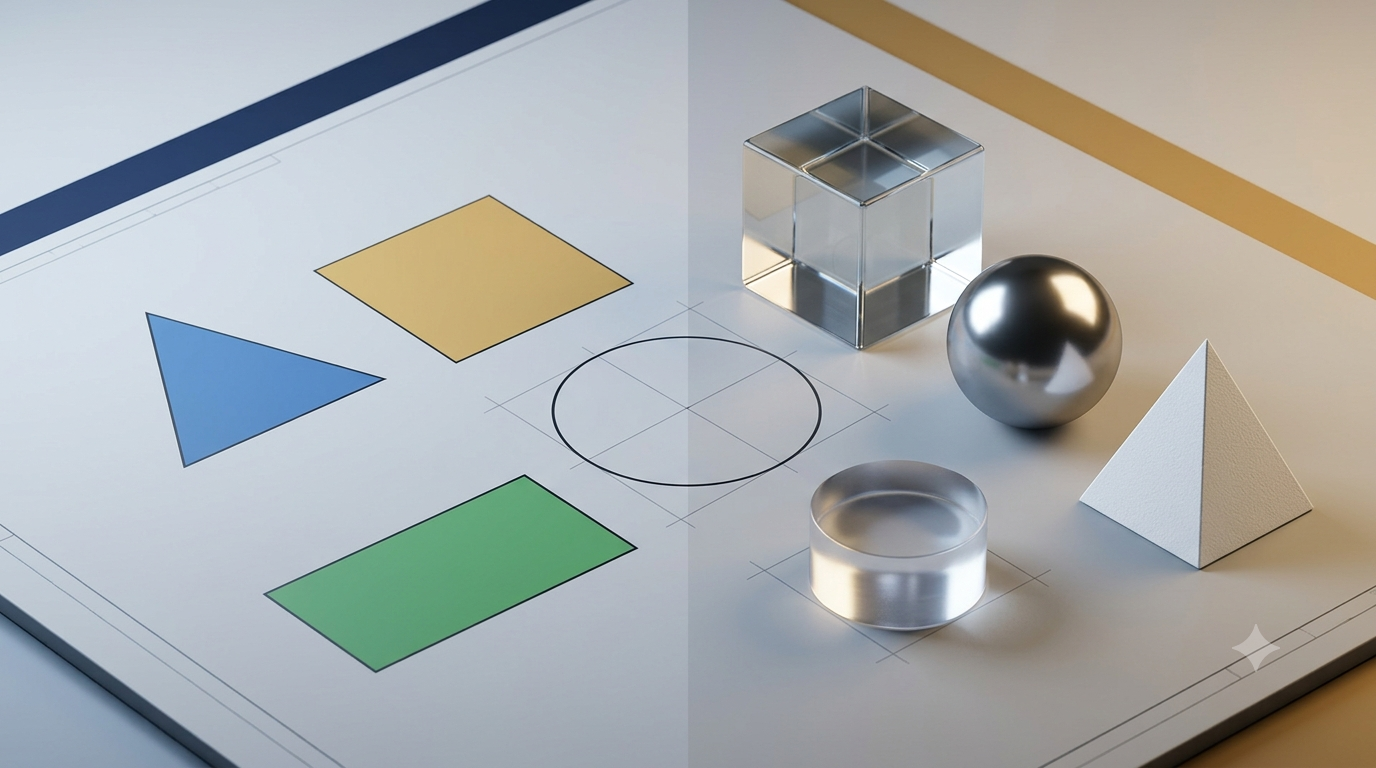
Geometry is an important branch of mathematics that helps us understand shapes, sizes, positions, distances, and the relationships between different objects. From the design of buildings and roads to the measurement of land and the creation of three-dimensional models, geometry plays a significant role in everyday life. Although geometry includes many different areas of study, two of its fundamental branches are plane geometry and solid geometry.
Plane geometry focuses on flat, two-dimensional shapes such as triangles, squares, circles, and rectangles. Solid geometry, on the other hand, deals with three-dimensional objects such as cubes, spheres, cylinders, cones, and pyramids. Both branches help us describe and measure shapes, but they differ in the dimensions they study, the properties they examine, and the formulas they use.
Understanding the difference between plane geometry and solid geometry makes it easier to solve mathematical problems and recognize how geometric principles apply to the world around us. In this article, we will explore their meanings, characteristics, formulas, examples, applications, and major differences.
What Is Plane Geometry?
Plane geometry is the branch of geometry that studies shapes and figures on a flat surface. A plane is a perfectly flat, two-dimensional surface that extends infinitely in all directions. Plane geometry focuses on figures that have length and width but no thickness.
Common examples of plane geometric figures include triangles, squares, rectangles, circles, parallelograms, and polygons. These figures are usually represented on paper, a blackboard, a computer screen, or another flat surface.
Plane geometry examines several important properties, including the lengths of sides, sizes of angles, perimeters, areas, and relationships between lines. It also helps explain concepts such as parallel lines, perpendicular lines, symmetry, congruence, and similarity.
For example, when calculating the area of a rectangular floor plan drawn on paper, we use plane geometry. Similarly, measuring the angles of a triangle or finding the circumference of a circular design involves the principles of plane geometry.
Main Characteristics of Plane Geometry
Plane geometry has several defining characteristics that distinguish it from other branches of geometry.
1. Two-dimensional figures: Plane geometry deals with shapes that have two dimensions: length and width.
2. Flat surfaces: The figures are studied on a flat plane rather than as three-dimensional objects.
3. No thickness: Ideal plane figures do not have thickness or depth.
4. Perimeter and area: Common measurements include perimeter, which represents the total boundary length, and area, which represents the amount of surface enclosed by a figure.
5. Lines and angles: Plane geometry studies straight lines, curved lines, angles, intersections, parallel lines, and perpendicular lines.
6. Simple geometric shapes: Triangles, circles, rectangles, squares, and other polygons are central to this branch.
Common Shapes in Plane Geometry
The following are some important shapes studied in plane geometry.
Triangle: A triangle is a polygon with three sides and three interior angles. The sum of its interior angles is 180°.
Square: A square has four equal sides and four right angles. Its opposite sides are parallel.
Rectangle: A rectangle has four right angles, with opposite sides equal and parallel.
Circle: A circle consists of all points in a plane that are at a fixed distance from a central point. This fixed distance is called the radius.
Parallelogram: A parallelogram is a quadrilateral in which both pairs of opposite sides are parallel.
Polygon: A polygon is a closed, two-dimensional figure formed by straight line segments. Triangles, quadrilaterals, pentagons, and hexagons are examples.
Important Formulas in Plane Geometry
Plane geometry uses formulas to calculate lengths, perimeters, circumferences, and areas. These formulas are useful for solving mathematical problems involving flat shapes.
The following formulas are among the most commonly used.
Area of a square
A = s²Here, A represents the area and s represents the side length.
Perimeter of a square
P = 4 × sArea of a rectangle
A = l × wHere, l represents the length and w represents the width.
Perimeter of a rectangle
P = 2 × (l + w)Area of a triangle
A = ½ × b × hHere, b represents the base and h represents the perpendicular height.
Area of a circle
A = π × r²Here, r represents the radius and π is approximately 3.14159.
Circumference of a circle
C = 2 × π × rThese formulas help us calculate the dimensions and measurements of two-dimensional figures without needing to construct them physically.
What Is Solid Geometry?
Solid geometry is the branch of geometry that studies three-dimensional objects. Unlike plane geometry, which deals with length and width, solid geometry considers length, width, and height or depth.
Three-dimensional objects occupy space and have measurable volume. Many also have surfaces, edges, and vertices. Examples include cubes, cuboids, spheres, cylinders, cones, and pyramids.
Solid geometry helps us understand the shapes and dimensions of physical objects. A water tank, a football, a storage box, a drinking glass, and a building can all be studied using the principles of solid geometry.
For example, calculating how much water a cylindrical tank can hold requires finding its volume. Determining how much material is needed to cover a spherical object involves calculating its surface area.
Solid geometry also includes the study of the relationships between faces, edges, and vertices, as well as the properties of three-dimensional figures.
Main Characteristics of Solid Geometry
Solid geometry has several important characteristics.
1. Three-dimensional objects: It studies figures with length, width, and height or depth.
2. Occupies space: Solid objects have volume and occupy a measurable amount of three-dimensional space.
3. Surface area: The total area covering the outside of an object can be calculated using surface area formulas.
4. Volume: Volume measures the amount of space enclosed by a three-dimensional object.
5. Faces, edges, and vertices: Many solid figures contain flat or curved faces, edges, and vertices.
6. Flat and curved surfaces: Solid geometry includes objects with flat surfaces, curved surfaces, or combinations of both.
7. Three-dimensional relationships: It studies how points, lines, planes, and surfaces relate to one another in space.
Common Shapes in Solid Geometry
Solid geometry includes a wide range of three-dimensional shapes.
Cube: A cube has six equal square faces, twelve edges, and eight vertices. All its edges have the same length.
Cuboid: A cuboid is a three-dimensional object with six rectangular faces. A rectangular box is a common example.
Sphere: A sphere is a three-dimensional object whose surface points are all at the same distance from its centre. A ball is a familiar example.
Cylinder: A cylinder has two parallel, equal circular bases connected by a curved surface. Many cans and cylindrical containers have this shape.
Cone: A cone has a circular base and a curved surface that narrows toward a single vertex. An ice cream cone is a familiar example.
Pyramid: A pyramid has a polygonal base and triangular side faces that meet at a common vertex.
Prism: A prism has two parallel, congruent polygonal bases connected by side faces. The shape of its bases determines the type of prism.
Important Formulas in Solid Geometry
Solid geometry uses formulas to calculate the volume and surface area of three-dimensional objects.
Volume of a cube
V = a³Here, V represents volume and a represents the edge length.
Total surface area of a cube
TSA = 6 × a²Volume of a cuboid
V = l × w × hHere, l is the length, w is the width, and h is the height.
Total surface area of a cuboid
TSA = 2 × (l × w + w × h + h × l)Volume of a sphere
V = ⁴⁄₃ × π × r³Surface area of a sphere
SA = 4 × π × r²Volume of a cylinder
V = π × r² × hHere, r is the radius of the circular base and h is the height.
Total surface area of a cylinder
TSA = 2 × π × r × (r + h)Volume of a cone
V = ⅓ × π × r² × hThese formulas are essential for measuring containers, calculating material requirements, designing structures, and solving practical problems involving three-dimensional objects.
Key Differences Between Plane Geometry and Solid Geometry
Plane geometry and solid geometry share many mathematical principles, but their main differences relate to dimensions, measurements, shapes, and spatial properties.
1. Number of Dimensions
The most fundamental difference is the number of dimensions each branch studies.
Plane geometry deals with two dimensions: length and width. A triangle drawn on a sheet of paper is an example of a plane figure.
Solid geometry deals with three dimensions: length, width, and height or depth. A triangular prism, for example, has a three-dimensional structure.
2. Types of Shapes
Plane geometry focuses on flat figures such as circles, squares, triangles, and polygons.
Solid geometry focuses on three-dimensional objects such as cubes, spheres, cones, cylinders, and pyramids.
Although a cube has square faces, the cube itself is a solid object rather than a plane figure.
3. Measurements
Plane geometry commonly deals with perimeter, circumference, and area. Perimeter and circumference measure boundary lengths, while area measures the surface enclosed by a two-dimensional figure.
Solid geometry commonly deals with surface area and volume. Surface area measures the exterior covering of an object, while volume measures the space it occupies.
4. Thickness and Depth
Ideal plane figures have no thickness or depth. They are represented as flat mathematical objects.
Solid figures have three dimensions and extend through space. Their depth or height contributes to their overall size and volume.
5. Faces, Edges, and Vertices
Plane figures have sides and vertices. For example, a triangle has three sides and three vertices.
Solid figures may have faces, edges, and vertices. A cube has six faces, twelve edges, and eight vertices. A sphere, however, has a curved surface and no edges or vertices.
6. Formulas
Plane geometry formulas generally calculate lengths, angles, perimeters, circumferences, and areas.
Solid geometry formulas generally calculate volumes and surface areas, in addition to certain lengths and angles.
For example, the area of a circle is calculated using A = π × r², while the volume of a sphere is calculated using V = ⁴⁄₃ × π × r³.
7. Practical Applications
Plane geometry is useful in map drawing, floor plans, graphic design, land measurement, and the study of flat patterns.
Solid geometry is important in architecture, construction, manufacturing, packaging, engineering, and the design of three-dimensional objects.
8. Visualization
Plane geometry is generally easier to represent on a flat sheet of paper because its figures have only two dimensions.
Solid geometry often requires drawings, models, diagrams, or computer-generated representations to show depth and spatial relationships clearly.
Plane Geometry vs Solid Geometry Comparison Table
| Feature | Plane Geometry | Solid Geometry |
|---|---|---|
| Dimensions | Two-dimensional | Three-dimensional |
| Main measurements | Perimeter and area | Surface area and volume |
| Common shapes | Triangle, square, circle, rectangle | Cube, cuboid, sphere, cylinder, cone |
| Thickness | No thickness | Has three-dimensional extent |
| Space occupied | No volume as an ideal plane figure | Occupies measurable volume |
| Boundary features | Sides and vertices | Faces or surfaces, edges, and vertices where applicable |
| Typical formulas | A = l × w | V = l × w × h |
| Common uses | Maps, drawings, flat designs | Buildings, containers, machines |
| Representation | Flat diagrams | Models and three-dimensional drawings |
| Main focus | Shapes on a plane | Objects in space |
Examples That Explain the Difference
Practical examples make it easier to understand how plane geometry and solid geometry differ.
Example 1: A Square and a Cube
A square is a two-dimensional shape with four equal sides and four right angles. Its area tells us how much flat surface it covers.
Suppose each side of a square measures 5 cm.
Formula:
A = s²Calculation:
A = 5²
The area of the square is 25 cm².
A cube, on the other hand, is a three-dimensional object with six square faces. If each edge measures 5 cm, its volume is calculated as follows.
Formula:
V = a³Calculation:
V = 5³
The cube has a volume of 125 cm³.
This example shows that plane geometry measures the area of a flat square, while solid geometry measures the space occupied by a cube.
Example 2: A Circle and a Sphere
A circle is a two-dimensional figure. It has a centre, radius, diameter, and circumference. Its area measures the flat region enclosed by its boundary.
A sphere is a three-dimensional object. A ball is a common example of a spherical shape.
For a circle with a radius of 3 cm, its area is:
A = π × r²
For a sphere with the same radius, its volume is:
V = ⁴⁄₃ × π × r³
The circle’s area is measured in square centimetres, while the sphere’s volume is measured in cubic centimetres. The different units reflect the different quantities being measured.
Example 3: A Rectangle and a Cuboid
A rectangle is a flat figure with four sides and four right angles. It is commonly used to represent the shape of a page, a tabletop viewed from above, or a floor plan.
A cuboid is a three-dimensional object with length, width, and height. A cardboard box is a familiar example.
A rectangle measuring 8 cm in length and 4 cm in width has an area of:
A = l × w
A cuboid with a length of 8 cm, width of 4 cm, and height of 3 cm has a volume of:
V = l × w × h
The rectangle describes a flat surface, whereas the cuboid describes an object with depth.
Relationship Between Plane Geometry and Solid Geometry
Although plane geometry and solid geometry study different dimensions, they are closely connected. Many three-dimensional objects contain two-dimensional shapes as their faces or cross-sections.
For example, a cube has six square faces. Each face can be studied using plane geometry, while the complete cube is studied using solid geometry.
Similarly, a cylinder has circular bases. The area of each circular base can be calculated using plane geometry, and the cylinder’s volume can then be calculated using the base area and height.
The relationship can be expressed through the following formula.
Volume of a prism or cylinder
V = B × hHere, B represents the area of the base and h represents the perpendicular height.
This formula demonstrates how a two-dimensional measurement, the base area, helps determine a three-dimensional measurement, the volume.
Plane geometry also contributes to understanding nets, which are flat arrangements of shapes that can be folded to form solid objects. For example, a cube net consists of six connected squares. Each square is a plane figure, but folding the net produces a three-dimensional cube.
Understanding both branches therefore provides a more complete picture of geometric relationships.
Real-Life Applications of Plane Geometry
Plane geometry is used in many practical situations because flat shapes are common in drawings, plans, and measurements.
Architecture and floor planning: Architects use plane geometry to design room layouts, calculate floor areas, and organize spaces before construction begins.
Land surveying: Surveyors use geometric principles to measure boundaries, calculate areas, and prepare maps.
Graphic design: Designers use circles, rectangles, polygons, angles, and symmetry to create logos, illustrations, layouts, and visual compositions.
Road and map design: Maps represent geographical features on flat surfaces, making geometric relationships useful for measuring distances and interpreting positions.
Art and patterns: Geometric shapes are used in decorative designs, mosaics, textiles, and artistic compositions.
Mathematics education: Plane geometry introduces learners to important concepts such as angles, congruence, similarity, symmetry, and geometric proofs.
Real-Life Applications of Solid Geometry
Solid geometry is essential whenever the size, shape, capacity, or surface of a three-dimensional object must be understood.
Architecture and construction: Engineers and architects use solid geometry to model buildings, determine dimensions, estimate material requirements, and visualize structures.
Packaging: Manufacturers calculate the volume of boxes and containers to determine capacity and improve storage and transportation.
Mechanical engineering: Solid geometry helps engineers design machine components, tools, pipes, gears, and other physical structures.
Manufacturing: Three-dimensional models support the production of products by defining their shapes, dimensions, and surfaces.
Storage and transportation: Calculating the volume of containers, warehouses, and cargo spaces helps improve the use of available space.
Science and technology: Solid geometry is used in computer-aided design, 3D printing, robotics, medical imaging, and scientific modelling.
Everyday measurements: People use solid geometry when estimating how much water a tank can hold, how much paint is needed to cover a surface, or whether an object will fit inside a box.
Common Mistakes When Learning Plane and Solid Geometry
Learners sometimes confuse plane geometry with solid geometry because both branches use similar shapes and measurements. Recognizing a few common mistakes can make the subject easier to understand.
Confusing area with volume: Area measures a two-dimensional surface and is expressed in square units, such as cm² or m². Volume measures three-dimensional space and is expressed in cubic units, such as cm³ or m³.
Using the wrong formula: The area formula for a circle cannot be used directly to calculate the volume of a sphere. Always identify the object and the quantity being measured before choosing a formula.
Ignoring units: A result of 24 cm² represents an area, while 24 cm³ represents a volume. The units must match the calculation.
Forgetting height or depth: When calculating the volume of a cuboid, all three dimensions are required. Multiplying only length and width gives the area of a rectangular base, not the volume.
Assuming every solid has flat faces: Cubes and cuboids have flat faces, but spheres have curved surfaces. Cylinders and cones combine flat and curved surfaces.
Misunderstanding diagrams: A drawing of a cube on paper is a two-dimensional representation of a three-dimensional object. The drawing itself does not mean that the cube is a plane figure.
Avoiding these mistakes helps learners choose appropriate formulas and interpret geometric problems correctly.
Conclusion
Plane geometry and solid geometry are two fundamental branches of mathematics that help us understand shapes and space. Plane geometry focuses on two-dimensional figures such as triangles, squares, rectangles, and circles. It mainly deals with lengths, angles, perimeters, circumferences, and areas. Solid geometry studies three-dimensional objects such as cubes, cuboids, spheres, cylinders, and cones, focusing on their surfaces, dimensions, and volumes.
The main difference is that plane geometry examines flat figures, while solid geometry examines objects that occupy three-dimensional space. However, the two branches are closely related because many solid objects contain plane shapes as their faces or bases.
Learning both branches makes it easier to solve mathematical problems, understand physical objects, and apply geometric principles in science, architecture, engineering, design, and everyday life. Once you understand their dimensions and measurements, distinguishing between plane geometry and solid geometry becomes much simpler.
FAQs
1. What is the main difference between plane geometry and solid geometry?
The main difference between plane geometry and solid geometry is the number of dimensions they study. Plane geometry deals with two-dimensional figures that have length and width but no thickness, such as squares, triangles, and circles. Solid geometry focuses on three-dimensional objects that have length, width, and height or depth, such as cubes, spheres, and cylinders. Plane geometry commonly involves calculating perimeter, circumference, and area, whereas solid geometry focuses on surface area and volume. Both branches are important in mathematics and help us understand the shapes, sizes, and properties of objects in everyday life.
2. What are the examples of plane geometry?
Examples of plane geometry include triangles, squares, rectangles, circles, parallelograms, rhombuses, trapezoids, and other polygons. These shapes are two-dimensional because they have length and width but no thickness. Plane geometry helps us calculate their areas, perimeters, angles, and side lengths. For example, it can be used to determine the area of a rectangular floor plan or the circumference of a circular garden. Plane geometry also studies parallel lines, perpendicular lines, symmetry, and relationships between angles. These concepts are useful in mathematics, architecture, drawing, graphic design, mapmaking, and many other practical applications.
3. What are the examples of solid geometry?
Examples of solid geometry include cubes, cuboids, spheres, cylinders, cones, prisms, and pyramids. These objects have three dimensions: length, width, and height or depth. Unlike flat geometric figures, solid objects occupy space and have measurable volume. For example, a dice resembles a cube, a football resembles a sphere, and a storage box resembles a cuboid. Solid geometry helps calculate the volume of containers, the surface area of objects, and the dimensions of three-dimensional structures. It is widely used in architecture, engineering, manufacturing, packaging, computer modelling, and everyday activities involving physical objects.
4. How many dimensions are studied in plane geometry and solid geometry?
Plane geometry studies two dimensions: length and width. Its figures are flat and do not have thickness in the mathematical sense. Solid geometry studies three dimensions: length, width, and height or depth. These dimensions allow solid objects to occupy space and have volume. For example, a rectangle has length and width, while a rectangular box has length, width, and height. Understanding dimensions is essential when choosing the correct geometric formula. Two-dimensional figures are generally measured using square units for area, while the volume of three-dimensional objects is measured using cubic units.
5. What is the difference between area and volume in geometry?
Area and volume measure different properties of geometric figures. Area measures the amount of surface enclosed by a two-dimensional shape, such as a square, rectangle, or circle. It is expressed in square units, including cm² and m². Volume measures the amount of three-dimensional space occupied by a solid object. It is expressed in cubic units, such as cm³ and m³. For example, calculating the area of a square determines the size of its flat surface, while calculating the volume of a cube determines how much space it occupies. Area is commonly associated with plane geometry, while volume is central to solid geometry.
6. Which formulas are commonly used in plane geometry?
Plane geometry uses formulas to calculate the area, perimeter, and circumference of two-dimensional shapes. For example, the area of a square is A = s², where s represents its side length. The area of a rectangle is A = l × w, where l is the length and w is the width. The area of a triangle is A = ½ × b × h, where b represents the base and h represents the perpendicular height. The area of a circle is A = π × r², where r is the radius. These formulas help solve problems involving flat surfaces, shapes, and measurements.
7. Which formulas are commonly used in solid geometry?
Solid geometry uses formulas to calculate the volume and surface area of three-dimensional objects. For example, the volume of a cube is V = a³, where a represents the edge length. The volume of a cuboid is V = l × w × h, where l, w, and h represent its length, width, and height. The volume of a cylinder is V = π × r² × h, where r is the radius and h is the height. The volume of a sphere is V = ⁴⁄₃ × π × r³. These formulas are useful for measuring containers, estimating material requirements, and understanding three-dimensional objects.
8. How are plane geometry and solid geometry related?
Plane geometry and solid geometry are closely related because many three-dimensional objects contain two-dimensional shapes. For example, a cube has six square faces, while a cylinder has two circular bases. The properties of these faces and bases can be studied using plane geometry. Solid geometry combines these measurements with information about height or depth to calculate volume and surface area. The volume of a cylinder, for instance, can be found by multiplying the area of its circular base by its height. Understanding plane geometry provides a foundation for learning solid geometry and solving more complex problems involving three-dimensional objects.
9. Where are plane geometry and solid geometry used in everyday life?
Plane geometry is used in activities involving flat shapes and surfaces, including drawing floor plans, designing graphics, measuring land, creating patterns, and calculating the area of floors or walls. Solid geometry is useful when working with three-dimensional objects, such as boxes, tanks, buildings, pipes, and machine components. It helps determine the capacity of containers, the amount of material required to construct an object, and the space needed for storage. Architects, engineers, designers, and manufacturers use both branches of geometry. Even everyday tasks, such as choosing an appropriately sized box or measuring a room, can involve geometric principles.
10. Which is more difficult, plane geometry or solid geometry?
The difficulty of plane geometry and solid geometry depends on the learner’s mathematical background and spatial reasoning skills. Plane geometry is often easier to visualize initially because it deals with flat figures and familiar concepts such as angles, triangles, and circles. Solid geometry may require additional effort because learners must understand three-dimensional shapes, visualize depth, and interpret drawings of objects in space. However, both branches include simple and advanced concepts. Learning plane geometry first can make solid geometry easier because many solid figures contain familiar two-dimensional shapes. Regular practice, clear diagrams, and understanding formulas help learners develop confidence in both subjects.