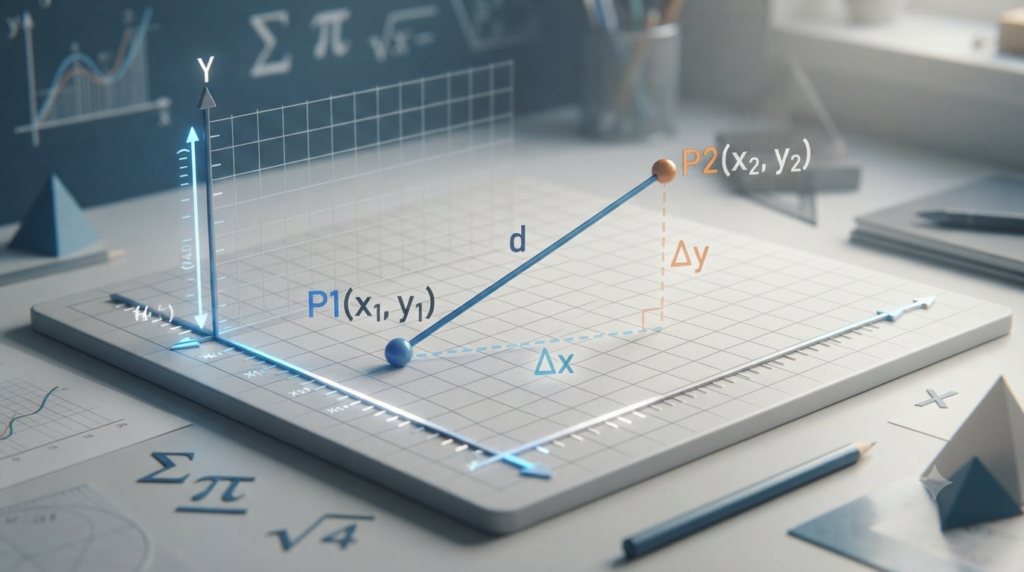
The midpoint formula is an important concept in coordinate geometry used to find the exact point that lies halfway between two given points. It provides a simple mathematical method for locating the center of a line segment when the coordinates of its two endpoints are known. The formula is useful in many areas of mathematics because it connects algebraic calculations with geometric ideas.
In a coordinate plane, a line segment can be represented by two points such as A(x₁, y₁) and B(x₂, y₂). Instead of measuring the segment and finding its center manually, we can use the midpoint formula to calculate the coordinates directly. This makes the process quick, accurate, and useful for solving a wide variety of coordinate geometry problems.
The midpoint formula is especially useful when studying line segments, triangles, quadrilaterals, symmetry, distance, and coordinate-based geometric constructions. Understanding how the formula works also helps build a strong foundation for more advanced topics in analytical geometry.
What Is a Midpoint?
A midpoint is the point that divides a line segment into two equal parts. If a line segment has endpoints A and B, its midpoint is the point exactly halfway between A and B.
For example, suppose a line segment has endpoints A and B. If M is its midpoint, then:
AM = MB
This means that the distance from A to M is exactly the same as the distance from M to B.
On a number line, finding the midpoint is straightforward. If two numbers are 4 and 10, their midpoint is 7 because 7 is equally distant from both numbers:
4 → 7 → 10
The same idea applies to points in a two-dimensional coordinate plane. The difference is that each point has both an x-coordinate and a y-coordinate. Therefore, we find the average of the x-coordinates and the average of the y-coordinates separately.
Midpoint Formula
If the endpoints of a line segment are:
A(x₁, y₁)
and
B(x₂, y₂)
then the coordinates of the midpoint M are:
M = ((x₁ + x₂)/2, (y₁ + y₂)/2)
In words, the midpoint is found by taking the average of the two x-coordinates and the average of the two y-coordinates.
Therefore:
Midpoint x-coordinate = (x₁ + x₂) / 2
Midpoint y-coordinate = (y₁ + y₂) / 2
This formula works for points located in any quadrant of the coordinate plane, including points with positive, negative, or zero coordinates.
Why Does the Midpoint Formula Work?
The midpoint formula is based on the idea of taking an average.
Consider two points on a number line with coordinates x₁ and x₂. The point halfway between them is their arithmetic mean:
(x₁ + x₂) / 2
For a two-dimensional point, the same principle is applied independently to both coordinates. The x-coordinate of the midpoint is the average of the x-coordinates of the endpoints, while the y-coordinate is the average of their y-coordinates.
For example, consider:
A(2, 4)
B(8, 10)
The midpoint’s x-coordinate is:
(2 + 8) / 2 = 5
The midpoint’s y-coordinate is:
(4 + 10) / 2 = 7
Therefore, the midpoint is:
M(5, 7)
The point (5, 7) lies halfway between A and B.
How to Find the Midpoint Step by Step
Using the midpoint formula is a simple process.
Step 1: Identify the Coordinates
First, identify the coordinates of the two endpoints.
Suppose:
A(x₁, y₁) = (3, 5)
B(x₂, y₂) = (11, 9)
Step 2: Add the x-Coordinates
Add the two x-values:
3 + 11 = 14
Step 3: Divide by 2
Divide the result by 2:
14 / 2 = 7
So, the x-coordinate of the midpoint is 7.
Step 4: Add the y-Coordinates
Add the two y-values:
5 + 9 = 14
Step 5: Divide by 2
Divide the result by 2:
14 / 2 = 7
Therefore, the midpoint is:
M(7, 7)
This method can be used for any two points on a coordinate plane.
Example 1: Midpoint of Two Positive Points
Find the midpoint of:
A(4, 6)
and
B(10, 12)
Using the formula:
M = ((x₁ + x₂)/2, (y₁ + y₂)/2)
Substitute the coordinates:
M = ((4 + 10)/2, (6 + 12)/2)
M = (14/2, 18/2)
M = (7, 9)
Therefore, the midpoint is:
M(7, 9)
The result shows that the point (7, 9) is exactly halfway between the two given points.
Example 2: Points With Negative Coordinates
The midpoint formula also works when coordinates are negative.
Find the midpoint of:
A(-6, 4)
and
B(8, -2)
For the x-coordinate:
(-6 + 8) / 2 = 2 / 2 = 1
For the y-coordinate:
(4 + (-2)) / 2 = 2 / 2 = 1
Therefore:
M(1, 1)
The important step here is to carefully handle the signs when adding negative numbers.
Example 3: Points in Different Quadrants
Consider:
A(-5, -3)
and
B(7, 9)
The midpoint is:
M = ((-5 + 7)/2, (-3 + 9)/2)
M = (2/2, 6/2)
M = (1, 3)
Therefore, the midpoint is:
M(1, 3)
This example demonstrates that the two endpoints can be located in completely different parts of the coordinate plane. The same formula still applies.
Midpoint Formula on a Number Line
The midpoint formula is not limited to two-dimensional coordinate geometry. It can also be used on a one-dimensional number line.
If two points have coordinates a and b, their midpoint is:
M = (a + b) / 2
For example, the midpoint between 12 and 20 is:
M = (12 + 20) / 2
M = 32 / 2
M = 16
Thus, 16 is exactly halfway between 12 and 20.
The two-dimensional midpoint formula simply extends this idea by applying the average separately to the x- and y-coordinates.
Applications of the Midpoint Formula
The midpoint formula has several important applications in mathematics and coordinate geometry.
Finding the Center of a Line Segment
The most direct application is finding the exact center of a line segment when its endpoints are known.
Instead of drawing a coordinate plane and estimating the center visually, the formula gives the precise coordinates.
This is especially useful when the coordinates contain fractions, negative numbers, or large values.
Finding the Center of a Geometric Figure
The midpoint formula can help identify central points in geometric figures.
For example, in a rectangle, the midpoint of a diagonal can provide the center of the rectangle. Since the diagonals of a rectangle bisect each other, their common midpoint represents the center of the figure.
The same principle can be applied to parallelograms because their diagonals also bisect each other.
Checking Whether a Point Bisects a Line Segment
Suppose three points are given and we want to determine whether one point is the midpoint of a line segment.
For example:
A(2, 3)
B(10, 7)
C(6, 5)
First find the midpoint of AB:
M = ((2 + 10)/2, (3 + 7)/2)
M = (6, 5)
Since C is (6, 5), point C is the midpoint of AB.
Therefore:
AC = CB
This provides a coordinate-based way to verify whether a segment has been divided into two equal parts.
Finding Missing Coordinates
The midpoint formula can also be rearranged to find an unknown coordinate.
Suppose the midpoint of a segment is M(5, 8), and one endpoint is A(2, 6). Let the other endpoint be B(x, y).
Using the x-coordinate:
5 = (2 + x) / 2
10 = 2 + x
x = 8
Using the y-coordinate:
8 = (6 + y) / 2
16 = 6 + y
y = 10
Therefore, the missing endpoint is:
B(8, 10)
This application is useful in coordinate geometry problems where the midpoint and one endpoint are known.
Studying Symmetry
The midpoint formula can be used to understand symmetry in coordinate geometry.
If two points are equally far from a central point and that central point is their midpoint, the two points are symmetric with respect to that point.
For example, the points:
A(2, 4)
and
B(8, 10)
have midpoint:
M(5, 7)
Therefore, A and B are positioned symmetrically around M along their connecting segment.
This idea is useful when studying transformations and geometric symmetry.
Solving Geometry Problems
Many geometry problems involving triangles and quadrilaterals can be solved using the midpoint formula.
For instance, if the coordinates of the endpoints of a triangle’s side are known, its midpoint can be calculated directly. This can then be used to construct medians, verify geometric properties, or solve coordinate-based proofs.
The midpoint formula therefore acts as a bridge between algebra and geometry.
Midpoint Formula and Triangles
The midpoint formula is particularly useful when working with triangles.
A median of a triangle is a line segment drawn from a vertex to the midpoint of the opposite side. Therefore, if the coordinates of the three vertices are known, the midpoint formula can be used to find the midpoint of the opposite side.
Suppose a triangle has vertices:
A(2, 8)
B(10, 4)
C(6, 12)
To find the midpoint of BC:
M = ((10 + 6)/2, (4 + 12)/2)
M = (16/2, 16/2)
M = (8, 8)
The median from A can then be represented by the segment joining A(2, 8) to M(8, 8).
This method makes coordinate geometry problems involving medians much easier to solve.
Midpoint Theorem and the Midpoint Formula
The midpoint formula should not be confused with the midpoint theorem.
The midpoint formula is an algebraic formula used to calculate the coordinates of the midpoint of a line segment.
The midpoint theorem is a geometric theorem concerning a triangle. It states that the segment joining the midpoints of two sides of a triangle is parallel to the third side and has half its length.
Although these are different concepts, the midpoint formula can be used to locate the midpoints required when applying the midpoint theorem in coordinate geometry.
Common Mistakes When Using the Midpoint Formula
Although the formula is simple, several common mistakes can lead to incorrect answers.
Forgetting to Divide by 2
A frequent error is adding the coordinates but forgetting to divide the result by 2.
For example:
(4 + 10) / 2 = 7
not 14.
Mixing x and y Coordinates
The x-coordinates must be averaged together, and the y-coordinates must be averaged together.
Correct:
M = ((x₁ + x₂)/2, (y₁ + y₂)/2)
Do not combine an x-coordinate with a y-coordinate.
Making Sign Errors
Negative coordinates require careful attention.
For example:
-8 + 4 = -4
not 12.
Writing the coordinates clearly before performing calculations can help prevent sign errors.
Switching the Coordinates
If the midpoint is written as (x, y), the x-coordinate should come first and the y-coordinate second.
Keeping the coordinate order consistent avoids confusion.
Midpoint Formula vs. Distance Formula
The midpoint formula and distance formula are both used with two points, but they answer different questions.
The midpoint formula finds the point halfway between two endpoints.
The distance formula finds the length of the segment connecting two points.
For points A(x₁, y₁) and B(x₂, y₂), the distance is:
d = √[(x₂ – x₁)² + (y₂ – y₁)²]
The midpoint formula, on the other hand, uses averages:
M = ((x₁ + x₂)/2, (y₁ + y₂)/2)
Understanding the difference between these formulas is important because they are often used together in coordinate geometry.
Using the Midpoint Formula in Real-World Situations
The midpoint concept can also be applied outside purely mathematical exercises.
Suppose two locations are represented by coordinates on a simplified map. Finding the midpoint can identify a central location between them. In an idealized coordinate system, this could help describe a meeting point, central position, or balanced location.
In computer graphics, coordinate-based systems use mathematical points to position objects. Finding the center between two coordinates is a basic operation that can be useful when positioning or aligning elements.
Similarly, in engineering and design, midpoint calculations can help identify the center of a line, segment, or geometric component.
These applications demonstrate how a simple mathematical average can have practical value.
How to Check a Midpoint Answer
After finding a midpoint, you can check whether it is correct by verifying that the midpoint divides the segment into two equal parts.
Suppose:
A(2, 4)
B(10, 8)
and the calculated midpoint is:
M(6, 6)
Using the distance formula:
AM = √[(6 – 2)² + (6 – 4)²]
AM = √(16 + 4)
AM = √20
Similarly:
MB = √[(10 – 6)² + (8 – 6)²]
MB = √(16 + 4)
MB = √20
Since:
AM = MB
the point M is correctly identified as the midpoint.
For simple problems, checking the average of the coordinates is usually sufficient, but the distance method provides an additional verification.
Key Points to Remember
The midpoint formula provides a direct way to find the point halfway between two coordinates.
For endpoints A(x₁, y₁) and B(x₂, y₂):
M = ((x₁ + x₂)/2, (y₁ + y₂)/2)
The x-coordinates are averaged separately from the y-coordinates. The formula works with positive, negative, and zero coordinates.
The midpoint formula can be used to find the center of line segments, identify triangle medians, check whether a point bisects a segment, find missing coordinates, study symmetry, and solve coordinate geometry problems.
It is also closely connected with other important concepts such as the distance formula, geometric transformations, and the properties of triangles and quadrilaterals.
Conclusion
The midpoint formula is one of the most useful and straightforward formulas in coordinate geometry. It allows us to find the exact point halfway between two given points by calculating the average of their x-coordinates and y-coordinates separately. Because the method is based on the simple idea of averaging, it works consistently across different types of coordinate problems.
Beyond finding the center of a line segment, the midpoint formula can be applied to triangles, quadrilaterals, symmetry, missing coordinates, and geometric constructions. Learning how to use this formula correctly provides a strong foundation for understanding more advanced topics in analytical and coordinate geometry. Once the relationship between coordinates and geometric positions becomes clear, the midpoint formula becomes a simple but powerful mathematical tool.
FAQs
1. What is the midpoint formula?
The midpoint formula is a mathematical formula used to find the exact point halfway between two points on a coordinate plane. If the endpoints of a line segment are A(x₁, y₁) and B(x₂, y₂), the midpoint is calculated by taking the average of the x-coordinates and the average of the y-coordinates. The formula is M = ((x₁ + x₂)/2, (y₁ + y₂)/2). The resulting point divides the line segment into two equal parts. The midpoint formula is commonly used in coordinate geometry, especially when solving problems involving line segments, triangles, quadrilaterals, symmetry, and missing coordinates.
2. How do you calculate the midpoint between two points?
To calculate the midpoint between two points, first identify the x- and y-coordinates of both endpoints. Add the two x-coordinates and divide their sum by 2. Then add the two y-coordinates and divide their sum by 2. For example, consider A(2, 4) and B(8, 10). The x-coordinate is (2 + 8)/2 = 5, while the y-coordinate is (4 + 10)/2 = 7. Therefore, the midpoint is M(5, 7). The important thing is to calculate the x and y coordinates separately. This method works for positive, negative, and zero coordinates.
3. Why do we divide the coordinates by 2 in the midpoint formula?
We divide by 2 because the midpoint represents the average of two coordinates. When a line segment is divided into two equal parts, the point in the center must be equally distant from both endpoints. On a number line, the point halfway between two numbers is found by adding them and dividing by 2. The same principle applies to both coordinates on a coordinate plane. Therefore, the x-coordinate of the midpoint is the average of the two x-coordinates, and the y-coordinate is the average of the two y-coordinates. Dividing by 2 gives the exact halfway position.
4. Can the midpoint formula be used with negative coordinates?
Yes, the midpoint formula can be used with negative coordinates. The formula remains exactly the same regardless of whether the coordinates are positive, negative, or zero. For example, consider A(-6, 4) and B(8, -2). The midpoint is calculated as M = ((-6 + 8)/2, (4 + (-2))/2). This gives M = (1, 1). When working with negative coordinates, the main thing to remember is to handle the signs carefully during addition. Parentheses can make calculations clearer. Negative coordinates do not require a different formula; they are simply substituted into the standard midpoint formula.
5. What are the main applications of the midpoint formula?
The midpoint formula has many applications in coordinate geometry. It can be used to find the exact center of a line segment and to determine whether a point divides a segment into two equal parts. It is also useful for finding the midpoint of a side of a triangle, locating the endpoints of a segment when one endpoint and its midpoint are known, and studying symmetry. In quadrilaterals such as parallelograms and rectangles, midpoint calculations can help identify the center of the figure. The formula is also useful in coordinate-based geometric proofs and practical applications involving positions and central points.
6. How can the midpoint formula help find a missing coordinate?
The midpoint formula can be rearranged to find an unknown coordinate when the midpoint and one endpoint are known. Suppose one endpoint is A(2, 6), and the midpoint is M(5, 8). Let the other endpoint be B(x, y). Using the x-coordinate equation, 5 = (2 + x)/2, which gives x = 8. For the y-coordinate, 8 = (6 + y)/2, which gives y = 10. Therefore, the missing endpoint is B(8, 10). This application shows that the midpoint formula is not only useful for finding midpoints but also for solving unknown coordinate problems.
7. How is the midpoint formula used in triangles?
The midpoint formula is frequently used when solving coordinate geometry problems involving triangles. One important application is finding the midpoint of a triangle’s side. This midpoint can then be connected to the opposite vertex to form a median. For example, if the coordinates of two vertices are known, the midpoint formula can determine the midpoint of the side between them. The third vertex can then be connected to this midpoint. The formula is also useful when working with the midpoint theorem, where the midpoints of two sides of a triangle are used to study parallel lines and proportional lengths.
8. What is the difference between the midpoint formula and the distance formula?
The midpoint formula and distance formula are both used with two points, but they calculate different quantities. The midpoint formula finds the coordinates of the point halfway between two endpoints. For points A(x₁, y₁) and B(x₂, y₂), it is M = ((x₁ + x₂)/2, (y₁ + y₂)/2). The distance formula finds the length of the line segment connecting the two points. It is d = √[(x₂ – x₁)² + (y₂ – y₁)²]. Therefore, use the midpoint formula when you need the central point and the distance formula when you need the length between two points.
9. How can you check whether a point is the midpoint of a line segment?
To check whether a given point is the midpoint of a line segment, calculate the midpoint using the coordinates of the two endpoints. Then compare the calculated coordinates with the coordinates of the given point. For example, consider A(2, 3) and B(10, 7). Their midpoint is M((2 + 10)/2, (3 + 7)/2) = (6, 5). If the given point is C(6, 5), then C is the midpoint of AB. Another way to verify the result is to use the distance formula and check that the distances from C to A and from C to B are equal.
10. Why is the midpoint formula important in coordinate geometry?
The midpoint formula is important because it provides a simple and accurate way to connect algebraic calculations with geometric positions. Instead of estimating the center of a line segment from a graph, the formula gives its exact coordinates. It is useful for solving problems involving triangles, quadrilaterals, symmetry, line segments, medians, and missing coordinates. The formula also helps students understand the concept of averages in a geometric setting. Because it is easy to apply and has many uses, the midpoint formula is an important foundation for coordinate geometry. Understanding it can also make more advanced geometric problems easier to solve.