Physics formula-based problems become much easier when you understand what a formula means and how to use it correctly. Many learners find numerical problems difficult because they try to remember formulas without understanding the physical quantities involved. In reality, solving a physics problem is usually a step-by-step process: understand the question, identify the known and unknown quantities, choose the correct formula, substitute the values with proper units, and check whether the answer makes physical sense. Developing this method can make even unfamiliar problems more manageable. Whether you are working with motion, force, work, energy, pressure, electricity, or waves, the same basic approach can be applied.
Understand What the Problem Is Asking
The first step is to read the entire problem carefully. Do not immediately search for a formula. First determine what the question wants you to find.
For example, a problem may ask you to calculate speed, acceleration, force, work, power, or energy. The wording of the question often gives an important clue about the required physical quantity.
Ask yourself:
What information is given?
What quantity needs to be calculated?
Which physical quantities are related to it?
Are all the given values expressed in compatible units?
Understanding the question prevents you from selecting a formula simply because it looks familiar.
Write Down the Given Quantities
After understanding the problem, list the information provided in the question. This makes the problem more organized and helps you identify the relationship between the quantities.
For example, suppose a moving object has an initial velocity of 5 m/s, an acceleration of 2 m/s², and moves for 4 seconds.
You can write:
Initial velocity, u = 5 m/s
Acceleration, a = 2 m/s²
Time, t = 4 s
Final velocity, v = ?
Writing the known quantities clearly separates the information you have from the quantity you need to find.
Identify the Unknown Quantity
The next step is to identify the unknown quantity. Usually, the question directly tells you what needs to be calculated.
If a question asks, “What is the final velocity of the object?” then the unknown quantity is final velocity, represented by v.
If it asks for force, the unknown quantity is F. If it asks for work, the unknown quantity is W.
Knowing the unknown quantity helps you select a formula that contains that quantity.
Choose the Correct Formula
Once you know the given and unknown quantities, select a formula connecting them.
For example, if initial velocity, acceleration, and time are given and final velocity is required, the appropriate equation is:
v = u + at
This formula connects all four quantities.
For a force problem, you may use:
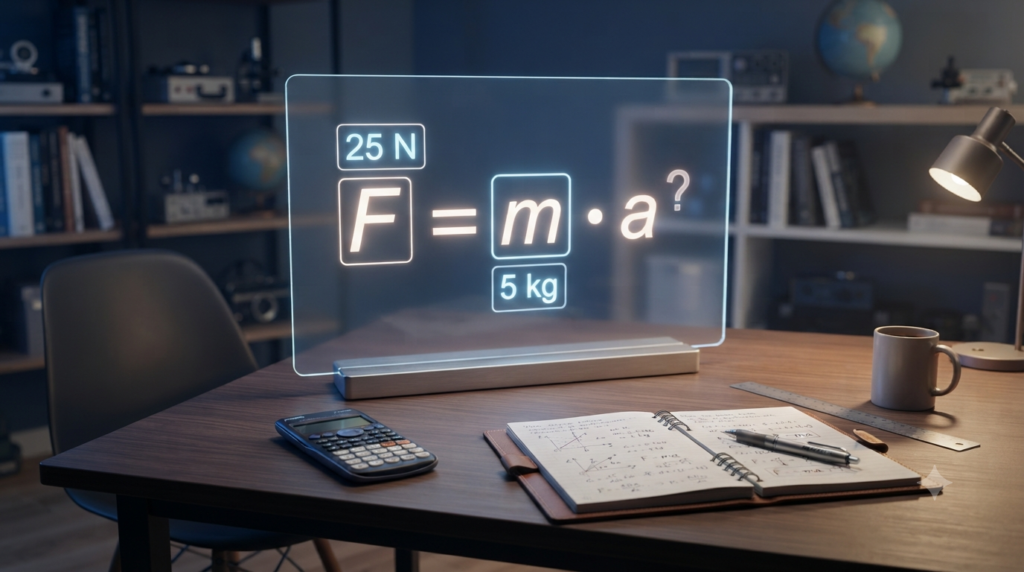
F = ma
For work done when force and displacement are in the same direction:
W = Fs
For power:
P = W/t
The important point is that you should choose a formula based on the information in the problem, not simply based on memorization.
Check the Units Before Substitution
Units are an important part of physics calculations. Before putting numbers into a formula, check whether the units are compatible.
For example, if a formula requires time in seconds but the problem gives time in minutes, convert the time first.
1 minute = 60 seconds
Similarly:
1 km = 1000 m
1 hour = 3600 s
For many physics problems, using SI units makes calculations simpler and reduces mistakes.
For example, velocity is commonly expressed in m/s, acceleration in m/s², force in newtons, work in joules, and power in watts.
Rearrange the Formula When Necessary
Sometimes the required quantity is not directly isolated in the formula. In that situation, rearrange the equation before substituting values.
For example, from:
F = ma
If mass is unknown:
m = F/a
If acceleration is unknown:
a = F/m
Similarly, from:
v = u + at
If acceleration is required:
a = (v – u)/t
Rearranging the formula first usually makes the calculation clearer and reduces algebraic mistakes.
Substitute the Values Carefully
After selecting and rearranging the formula, substitute the known values.
Consider the example:
An object starts with a velocity of 5 m/s and accelerates at 2 m/s² for 4 seconds. Find its final velocity.
The formula is:
v = u + at
Substitute the values:
v = 5 + (2 × 4)
Therefore:
v = 13 m/s
The final velocity is 13 m/s.
Writing the substitution step is useful because it shows exactly how the answer was obtained.
Follow the Correct Mathematical Order
Physics formulas often contain several mathematical operations. Perform them in the correct order.
For example:
s = ut + ½at²
If u = 4 m/s, a = 2 m/s², and t = 3 s:
s = (4 × 3) + ½ × 2 × 3²
First calculate the square:
3² = 9
Then:
s = 12 + ½ × 2 × 9
s = 12 + 9
s = 21 m
Following the order of operations helps prevent calculation errors.
Pay Attention to Positive and Negative Signs
Signs are especially important in physics. Positive and negative values can represent direction.
For example, velocity in one direction may be considered positive, while velocity in the opposite direction may be negative.
Suppose an object has:
u = 10 m/s
and acceleration:
a = -2 m/s²
The negative sign indicates that the acceleration is opposite to the chosen positive direction.
Using:
v = u + at
for t = 3 s:
v = 10 + (-2 × 3)
v = 4 m/s
Ignoring the negative sign could produce an incorrect result.
Check the Final Unit
After completing the calculation, always check the unit of the answer.
For example:
Distance → metre (m)
Displacement → metre (m)
Speed → metre per second (m/s)
Velocity → metre per second (m/s)
Acceleration → metre per second squared (m/s²)
Force → newton (N)
Work → joule (J)
Power → watt (W)
Pressure → pascal (Pa)
A missing or incorrect unit can indicate a problem with the calculation or formula.
Check Whether the Answer Makes Sense
A numerical answer should not simply be accepted because the calculator produced it. Ask whether the result is physically reasonable.
For example, if you calculate the speed of a walking person and obtain 50,000 m/s, something is probably wrong. The mistake could be in unit conversion, formula selection, substitution, or arithmetic.
This final check is especially useful in complicated problems.
Use Dimensional Analysis to Check Formulas
Dimensional analysis can help determine whether an equation is physically consistent.
For example, consider:
v = u + at
Velocity has dimensions of [LT⁻¹].
The term u has dimensions [LT⁻¹].
Acceleration has dimensions [LT⁻²], while time has dimensions [T].
Therefore:
[at] = [LT⁻²][T] = [LT⁻¹]
Both terms have the same dimensions, so the equation is dimensionally consistent.
Dimensional analysis does not prove that a formula is completely correct, but it can help detect many errors.
Avoid Common Mistakes
Several mistakes appear frequently in formula-based physics problems.
Using the Wrong Formula
A familiar formula is not necessarily the correct formula. Always compare the given quantities with the variables in the equation.
Mixing Units
Do not substitute kilometres with metres or hours with seconds without conversion when the formula requires SI units.
Forgetting Units
Always include the correct unit with the final answer.
Ignoring Signs
Positive and negative signs may represent direction and should not be removed casually.
Substituting Too Early
Rearrange the formula first when necessary. This makes the calculation easier to follow.
Rounding Too Soon
Avoid excessive rounding during intermediate calculations. Keep suitable significant figures and round the final answer appropriately.
Develop a Consistent Problem-Solving Method
A reliable method can be summarized as:
Read the problem carefully.
Identify what is given.
Identify what must be found.
Write the relevant quantities with units.
Choose the appropriate formula.
Rearrange the formula if necessary.
Convert units when required.
Substitute the values.
Perform the calculation carefully.
Write the final answer with the correct unit.
Check whether the answer is physically reasonable.
Following these steps repeatedly can turn formula-based problem solving into a structured habit.
Conclusion
Solving physics formula-based problems is not simply about remembering equations. It involves understanding the physical situation, identifying the relevant quantities, selecting the correct relationship, handling units, performing the mathematics carefully, and checking the final result. A formula becomes much more useful when you understand what each variable represents and why the quantities are connected. With regular practice, you can learn to approach unfamiliar numerical problems systematically instead of guessing which equation to use. The goal is not just to obtain an answer, but to understand how the answer follows from the physics involved.

FAQs
1. What is the first step in solving a physics formula-based problem?
The first step is to read the entire problem carefully and understand what it is asking. Identify the physical situation and determine the quantity that needs to be calculated. Then list the information given in the question, including numerical values and units. For example, if a problem gives mass, acceleration, and asks for force, identify each quantity before selecting a formula. Avoid immediately choosing an equation simply because it looks familiar. Understanding the problem first helps you connect the given information with the required quantity and makes the rest of the calculation more organized and accurate.
2. How do I choose the correct formula in physics?
Choose a physics formula by comparing the quantities given in the problem with the quantities involved in possible equations. First identify the unknown quantity you need to calculate. Then look for a formula that connects that unknown with the known quantities. For example, if mass and acceleration are given and force is required, F = ma is appropriate. Understanding what each variable represents is more useful than memorizing formulas without context. Sometimes more than one equation may be relevant, so select the formula that allows you to reach the required quantity using the information available in the problem.
3. Why are units important when solving physics problems?
Units are important because they describe what a numerical value represents and help maintain consistency during calculations. Many physics formulas require quantities to be expressed in compatible units, commonly SI units. For example, if time is required in seconds but the problem provides minutes, the value should be converted before substitution. Similarly, kilometres may need to be converted into metres. Incorrect units can produce an incorrect final result even when the mathematical calculation is correct. Therefore, always write the unit beside each given quantity, convert incompatible units when necessary, and include the appropriate unit with your final answer.
4. Should I rearrange a physics formula before substituting values?
Yes, rearranging a formula before substituting values is often the clearest approach when the required quantity is not already isolated. For example, from F = ma, if you need to calculate acceleration, rearrange the equation to a = F/m. You can then substitute the known values directly into the rearranged equation. This reduces confusion and makes the mathematical steps easier to follow. It also helps you see the relationship between the quantities involved. However, the important point is to rearrange the equation correctly. A small algebraic mistake during rearrangement can lead to an incorrect final answer even when the later arithmetic is accurate.

5. How can I avoid mistakes while substituting values?
To avoid substitution mistakes, write the formula first and then replace each variable with its corresponding value. Do not mix up quantities or units. For example, if v = u + at, clearly identify u, a, and t before putting their numerical values into the equation. Keep brackets around negative numbers and values involving calculations. Check whether the units are compatible before substitution. It is also helpful to perform calculations step by step instead of entering a complicated expression into a calculator immediately. Finally, compare the result with the expected physical situation to identify unusually large, small, or unrealistic answers.
6. What should I do if a physics problem has too much information?
Not every piece of information in a physics problem is necessarily required for the final calculation. Begin by identifying exactly what the question asks you to find. Then list the given quantities and determine which ones are connected to the unknown through a suitable formula. Some information may be unnecessary, while other information may be needed in an intermediate step. Avoid trying to use every number simply because it appears in the question. Focus on the physical relationships between the quantities. Drawing a simple diagram or writing the known and unknown variables separately can also help you organize a problem containing a large amount of information.
7. How can I check whether my physics answer is correct?
You can check your answer in several ways. First, verify that you used the appropriate formula and substituted the correct values. Next, check the mathematical calculation and make sure the final unit is correct. Consider whether the magnitude of the answer is physically reasonable. For example, an extremely large speed for an ordinary everyday situation may indicate a calculation or unit-conversion error. You can also use dimensional analysis to check whether an equation is dimensionally consistent. If possible, solve the problem using another method or estimate the expected result. These checks can help identify errors before you accept the final answer.
8. What is dimensional analysis and how does it help?
Dimensional analysis is a method of checking relationships between physical quantities using their dimensions. It can help identify errors in formulas and calculations. For example, velocity has dimensions [LT⁻¹], acceleration has dimensions [LT⁻²], and time has dimension [T]. In the equation v = u + at, the term at has dimensions [LT⁻²][T] = [LT⁻¹], which matches the dimension of velocity. This shows that the terms being added have compatible dimensions. Dimensional analysis cannot prove that a formula is completely correct, but it is a useful tool for detecting dimensional inconsistencies and checking whether a physics equation is physically possible.
9. Why do negative signs matter in physics calculations?
Negative signs often carry physical meaning in physics, particularly when quantities involve direction. A negative velocity may indicate motion opposite to the chosen positive direction, while negative acceleration may represent acceleration in the opposite direction. For example, in v = u + at, if acceleration is -2 m/s², the negative sign should be retained during substitution. Removing it can completely change the result. Before solving a problem, establish the direction convention when necessary and assign signs consistently. A negative answer is not automatically an error; its meaning depends on the physical quantity and the direction chosen for the problem.
10. How can I become better at solving physics numerical problems?
Improving at physics numerical problems requires regular practice combined with understanding. Instead of memorizing formulas alone, learn what each variable means, what conditions the formula applies to, and how the quantities are related. Use a consistent method: understand the question, list the given values, identify the unknown, choose the formula, check units, rearrange if necessary, substitute values, calculate, and verify the result. Start with simple problems and gradually work toward more challenging ones. When you make a mistake, identify whether it came from formula selection, units, algebra, substitution, or arithmetic. This approach turns problem solving into a repeatable skill.
Related Posts
Why does XOR behave differently from OR when both inputs are true?
Logical operators are essential in computer science because they help computers make decisions, compare conditions, and process information. Among the […]
Read MoreHow are Boolean algebra and digital logic gates related?
Boolean algebra and digital logic gates are two fundamental concepts in computer science and digital electronics. They work together to […]
Read MoreWhy can Boolean expressions be simplified without changing their logical result?
Boolean expressions are an essential part of computer science, digital electronics, programming, and information technology. They are used to represent […]
Read MoreHow does Boolean algebra simplify decisions made by computer programs?
Every computer program makes decisions. A website decides whether to allow a user to log in, a mobile application checks […]
Read MoreWhy does character encoding affect the amount of storage required for text?
Text may look simple when we read it on a screen, but computers must represent every character using numerical data. […]
Read MoreHow can the size of a file be estimated from the number of stored bytes?
Every digital file occupies a certain amount of storage space on a computer, smartphone, or other digital device. Whether it […]
Read MoreWhy are storage measurements sometimes calculated differently using decimal and binary units?
Have you ever purchased a 500 GB hard drive and noticed that your computer reports a slightly different storage capacity? […]
Read MoreWhat happens when a numerical value exceeds the range available in its data representation?
Computers store numerical values using a limited number of bits. Every data type, such as an 8-bit integer, a 32-bit […]
Read MoreWhy does the maximum value of a fixed-width integer depend on its number of bits?
Computers store and process information using binary digits, commonly called bits. Each bit can hold one of two values: 0 […]
Read MoreHow does a signed number differ from an unsigned number at a fundamental level?
Computers use binary numbers to represent and process information. Every number stored in a computer occupies a certain number of […]
Read MoreWhy are powers of two so common in computer memory and digital systems?
Computers store, process, and transmit information using binary digits, commonly known as bits. Unlike the decimal number system, which uses […]
Read MoreHow can the same number of bits represent different types of information?
Computers process many different types of information, including numbers, letters, images, sounds, videos, and instructions. Although these forms of information […]
Read MoreWhy does one additional bit double the number of possible binary combinations?
Computers use binary numbers to store, process, and communicate information. Unlike the decimal system, which uses ten digits from 0 […]
Read MoreHow does increasing the number of binary digits affect the range of representable values?
Binary is the number system used by digital computers to represent and process information. It uses only two digits, 0 […]
Read MoreWhy does digital hardware use binary instead of the decimal system?
Digital devices are part of almost every aspect of modern life. Computers, smartphones, calculators, televisions, digital cameras, and communication systems […]
Read MoreHow does a computer represent zero and other numbers using binary?
Computers perform calculations, store information, and process instructions using a system called binary. Unlike humans, who commonly use decimal numbers […]
Read MoreWhy does the order of operations matter when a computer evaluates an expression?
Computers perform millions of calculations every second, from calculating the total cost of an online purchase to processing scientific data […]
Read MoreHow does integer arithmetic differ from real-number arithmetic in computing?
Arithmetic is one of the fundamental parts of computing. Computers perform calculations in programming, data processing, scientific simulations, financial applications, […]
Read More