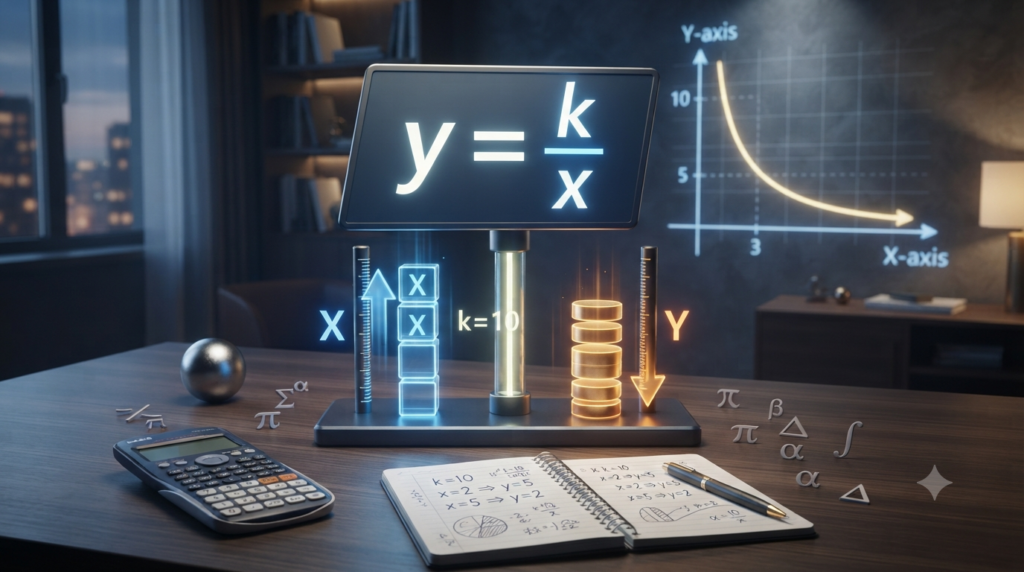

Physics is the study of how the natural world works, from the motion of objects to the behavior of light, heat, electricity, and matter. To describe these phenomena clearly, physicists use formulas. A physics formula is more than a mathematical expression. It represents a relationship between physical quantities and shows how changing one quantity can affect another. By reading formulas carefully, we can understand patterns in nature, make predictions, and solve practical problems.
What Is a Physical Relationship?
A physical relationship describes how two or more measurable quantities are connected. For example, speed describes the relationship between distance and time. If an object travels a certain distance in a certain amount of time, its speed can be calculated using the formula:
v = s/t
Here, v represents speed, s represents distance, and t represents time. The formula tells us that speed depends on both distance and time. If the distance increases while the time remains the same, the speed increases. If the same distance takes more time, the speed decreases.
This is how formulas turn observations about the physical world into precise mathematical relationships.
How Formulas Show Connections Between Quantities
One of the most useful features of a physics formula is that it shows how quantities are connected.
Consider Newton’s second law:
F = ma
This formula describes the relationship between force, mass, and acceleration. It tells us that the force acting on an object depends on its mass and acceleration.
If the mass remains constant and acceleration increases, the required force also increases. Similarly, if acceleration remains constant but mass increases, the force increases.
A formula therefore allows us to understand not only the values of quantities but also how they change relative to one another.
Direct Relationships in Physics
Some formulas describe a direct relationship between quantities. In a direct relationship, increasing one quantity causes another quantity to increase when the other factors remain constant.
For example:
F = ma
If mass is constant, force is directly related to acceleration. Doubling the acceleration doubles the force.
Another example is the relationship between distance and time when an object moves at constant speed:
s = vt
If speed remains constant, increasing the time allows the object to travel a greater distance. Doubling the time doubles the distance traveled.
These relationships help physicists predict what will happen when a physical condition changes.
Inverse Relationships in Physics
Not every physical relationship is direct. Some quantities have an inverse relationship, meaning that when one quantity increases, another decreases under fixed conditions.
A simple example is:
v = s/t
If the distance is fixed, increasing the time taken to travel that distance causes the average speed to decrease.
For example, suppose an object travels 100 meters. If it takes 10 seconds, its speed is 10 m/s. If it takes 20 seconds, its speed becomes 5 m/s.
The formula makes this relationship clear. It allows us to predict the result without performing the physical experiment every time.
Formulas Can Show Multiple Relationships
Many physics formulas contain more than two quantities. This allows one formula to describe several relationships at once.
Consider the kinetic energy formula:
KE = ½mv²
Kinetic energy depends on both mass and velocity. Increasing the mass increases the kinetic energy. However, velocity has an even stronger effect because it is squared.
If the velocity doubles, the kinetic energy becomes four times greater, assuming the mass remains constant.
This shows why understanding the mathematical structure of a formula is important. The powers, multiplication, and division symbols are not just mathematical details. They tell us how strongly different quantities influence one another.
Formulas Help Explain Changes
Physics is often concerned with changes. A formula can show how one physical quantity responds when another changes.
For example, acceleration is given by:
a = Δv/Δt
This means acceleration describes how quickly velocity changes with time.
A large change in velocity over a short period produces greater acceleration. A smaller change in velocity over a longer period produces less acceleration.
The formula therefore provides a mathematical way to describe motion that changes over time.
Formulas Connect Mathematics With Physical Reality
A physics formula becomes meaningful only when its mathematical symbols represent real physical quantities.
For example:
P = F/A
This formula describes pressure as force acting over an area. If the same force acts over a smaller area, the pressure increases. If the force is spread over a larger area, the pressure decreases.
This relationship explains many everyday situations. A sharp object can produce a large pressure because its force is concentrated over a small area. A wide surface distributes the force over a larger area and produces less pressure.
The formula connects an abstract mathematical relationship with something that can be observed in the real world.
Formulas Allow Predictions
One of the greatest strengths of physics formulas is their ability to make predictions.
Suppose we want to determine how far an object travels when it moves at a constant velocity. We can use:
s = vt
If the velocity is 5 m/s and the time is 8 seconds:
s = 5 × 8 = 40 m
The formula allows us to predict that the object will travel 40 meters.
This predictive ability is essential in science and technology. Engineers, researchers, and scientists use physical relationships to design systems, test ideas, and predict how objects and processes will behave.
Formulas Can Be Rearranged to Reveal Different Relationships
A physics formula can often be rearranged to find different quantities.
Starting with:
v = s/t
We can rearrange it to find distance:
s = vt
Or time:
t = s/v
The physical relationship has not changed. Only the mathematical form has been rearranged to make a different quantity the subject.
Learning to rearrange formulas is therefore an important physics skill. It helps us see that the same physical relationship can be used in different ways.
Units Help Confirm Physical Relationships
Units provide another important clue about the relationship represented by a formula.
For example:
v = s/t
Distance is measured in meters and time in seconds, so velocity has the unit:
m/s
Similarly, from:
F = ma
mass is measured in kilograms and acceleration in meters per second squared. Therefore, force has the unit:
kg·m/s²
which is called the newton (N).
Checking units can help identify mistakes and confirm whether a formula is physically meaningful.
Formulas Are Models of Nature
A physics formula is a mathematical model of a physical relationship. It does not simply provide an answer to a numerical problem. It represents a pattern that has been observed, tested, and expressed mathematically.
For example, Newton’s laws describe relationships involving motion and force, while equations for electrical circuits describe relationships between quantities such as voltage, current, and resistance.
These mathematical models allow scientists to describe complicated physical behavior in a concise form.
How to Read a Physics Formula
When you encounter a physics formula, do not immediately substitute numbers. First understand the relationship.
Start by identifying what each symbol represents. Then determine which quantities are multiplied or divided, and check whether any quantity is raised to a power.
Next, ask how changing one quantity would affect the others. Finally, check the units.
For example, when reading:
E = mc²
you should notice that energy depends on mass and that the speed of light is squared. Even without calculating a value, the formula communicates an important physical relationship between mass and energy.
Conclusion
Physics formulas provide a powerful language for describing relationships in nature. They show how physical quantities depend on one another, whether the relationship is direct, inverse, or influenced by a power. Formulas also allow scientists to calculate unknown quantities, make predictions, test physical models, and connect mathematical ideas with real-world observations. Learning physics formulas effectively is therefore not about memorizing equations alone. It is about understanding what each formula means, how its quantities are connected, and what happens when those quantities change. Once this way of thinking becomes familiar, physics formulas become much more than mathematical expressions—they become tools for understanding how the physical world works.
FAQs
A physics formula expresses a relationship between physical quantities in mathematical form. It shows how one quantity depends on another and allows us to calculate unknown values. For example, the formula v = s/t connects speed, distance, and time. By using the formula, we can determine how quickly an object moves when its distance and time are known. Formulas also help us understand patterns in nature rather than simply memorizing numerical values. They are used to describe motion, force, energy, pressure, electricity, heat, waves, and many other physical phenomena. In this way, formulas provide a precise language for describing the physical world.
Physics formulas describe relationships by showing how physical quantities are mathematically connected. Consider F = ma, where force depends on mass and acceleration. If mass stays constant and acceleration increases, force increases proportionally. Similarly, if acceleration remains unchanged while mass increases, the required force also increases. Mathematical operations such as multiplication, division, and powers indicate how quantities influence each other. Reading a formula this way gives more information than simply calculating an answer. It helps us predict what will happen when one physical quantity changes. Therefore, understanding the relationship represented by a formula is an important part of learning physics.
A direct relationship occurs when two quantities increase or decrease together under fixed conditions. For example, the formula s = vt describes distance traveled at constant velocity. If velocity remains constant, increasing the time increases the distance traveled. Doubling the time results in twice the distance. Similarly, when mass remains constant in F = ma, force is directly related to acceleration. Direct relationships help physicists predict how changes in one quantity affect another. Recognizing them can also make calculations easier because you can often predict the general direction of the answer before performing the calculation. This provides a useful way to check whether your result makes physical sense.
An inverse relationship occurs when one quantity increases while another decreases under specific conditions. A simple example is v = s/t when distance is fixed. If the same distance is traveled in less time, the speed is greater. If the time increases, the speed decreases. Pressure also provides an example through P = F/A. When force remains constant, reducing the area increases pressure, while increasing the area decreases pressure. Understanding inverse relationships helps explain many physical situations. It also allows you to predict changes without immediately calculating exact values. The division of quantities in a formula often provides an important clue about inverse behavior.
Powers show that a physical quantity may have a stronger or nonlinear influence on another quantity. For example, kinetic energy is given by KE = ½mv². Here, velocity is squared, while mass is not. If the mass stays constant and velocity doubles, the kinetic energy becomes four times larger. This is different from a simple direct relationship, where doubling one quantity would only double another. Powers therefore provide important information about how strongly quantities are connected. Whenever you see a square, cube, or another exponent in a physics formula, you should consider how changes in that quantity affect the final result.
Physics formulas allow us to predict the behavior of physical systems using known quantities. For example, the formula s = vt can be used to predict how far an object will travel at a constant velocity over a certain time. If an object moves at 10 m/s for 5 seconds, the distance is 50 m. This prediction can be made before measuring the actual distance. Scientists and engineers use formulas in much more complex situations to predict motion, energy, electrical behavior, waves, and other phenomena. The ability to make reliable predictions is one of the main reasons mathematical relationships are so important in physics.
Yes. A single formula can describe several related connections between physical quantities. For example, F = ma connects force, mass, and acceleration. If force and mass are known, acceleration can be found. If mass and acceleration are known, force can be calculated. If force and acceleration are known, mass can be determined. The same relationship can therefore answer different questions depending on which quantity is unknown. Rearranging a formula does not change the physical relationship; it simply changes which quantity is isolated. Understanding this makes formulas more flexible and reduces the need to memorize separate equations for every situation.
Units show what physical quantities represent and help determine whether a formula or calculation is consistent. For example, in v = s/t, distance may be measured in meters and time in seconds, giving velocity the unit m/s. In F = ma, kilograms multiplied by meters per second squared gives kg·m/s², which is the newton. Checking units can reveal calculation mistakes and help confirm whether quantities have been combined correctly. Units also make numerical answers meaningful. A number without a physical unit often does not tell us enough about what has actually been measured. Therefore, units are an essential part of interpreting physics formulas.
Physics formulas transform observations into mathematical relationships that can be tested and used. For example, P = F/A explains why the pressure produced by a force changes when the area changes. This relationship can be observed when comparing a sharp object with a broad surface. Similarly, equations describing motion connect measured distance, time, velocity, and acceleration. The mathematics is therefore not separate from physical reality. It represents patterns that can be observed through experiments and measurements. Once a relationship has been established, the formula can be used to explain observations, calculate unknown quantities, and predict outcomes in new situations.
Understanding should come before memorization. Memorizing formulas can help with calculations, but knowing what a formula represents makes it much more useful. When you understand the physical meaning of each symbol, the relationship between quantities, the units involved, and how changes affect the result, you can apply the formula in different situations. For example, understanding F = ma allows you to recognize how force changes when mass or acceleration changes. It also makes it easier to remember the equation naturally. Physics becomes more meaningful when formulas are treated as descriptions of physical relationships rather than isolated mathematical expressions to memorize.
Related Posts
How can the number of possible combinations be estimated before designing a digital system?
Before designing a digital system, engineers need to understand how many possible states, inputs, outputs, or arrangements the system may […]
Read MoreWhy does the number of possible states increase exponentially with the number of bits?

Computers represent information using bits, the smallest units of digital data. A bit can have one of two possible values: […]
Read MoreWhen is De Morgan’s law useful when working with logical expressions?
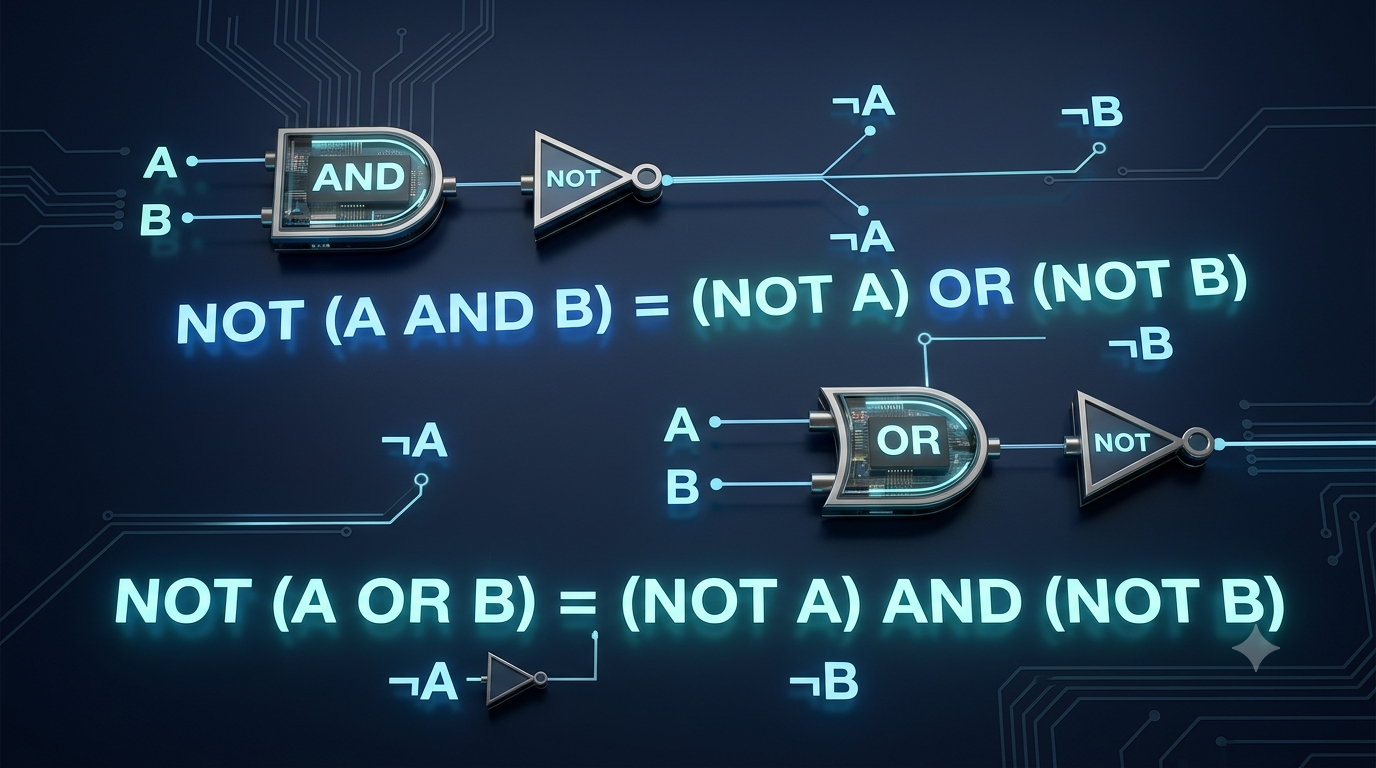
Logical expressions are used in mathematics, computer science, digital electronics, programming, and many other technical fields. They help us describe […]
Read MoreHow can a truth table reveal whether two Boolean expressions are equivalent?
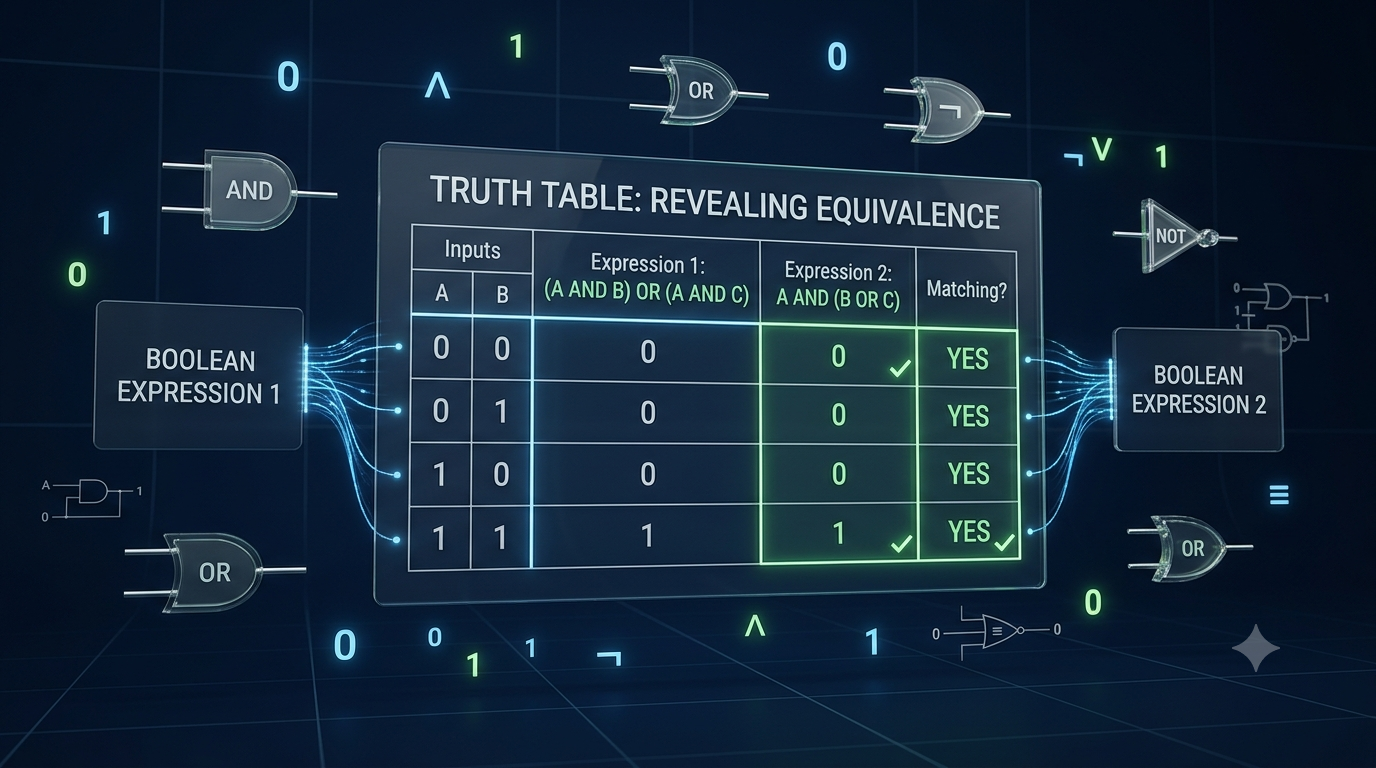
Boolean algebra is an important part of computer science, digital electronics, programming, and logic design. It deals with values that […]
Read MoreWhy does XOR behave differently from OR when both inputs are true?

Logical operators are essential in computer science because they help computers make decisions, compare conditions, and process information. Among the […]
Read MoreHow are Boolean algebra and digital logic gates related?
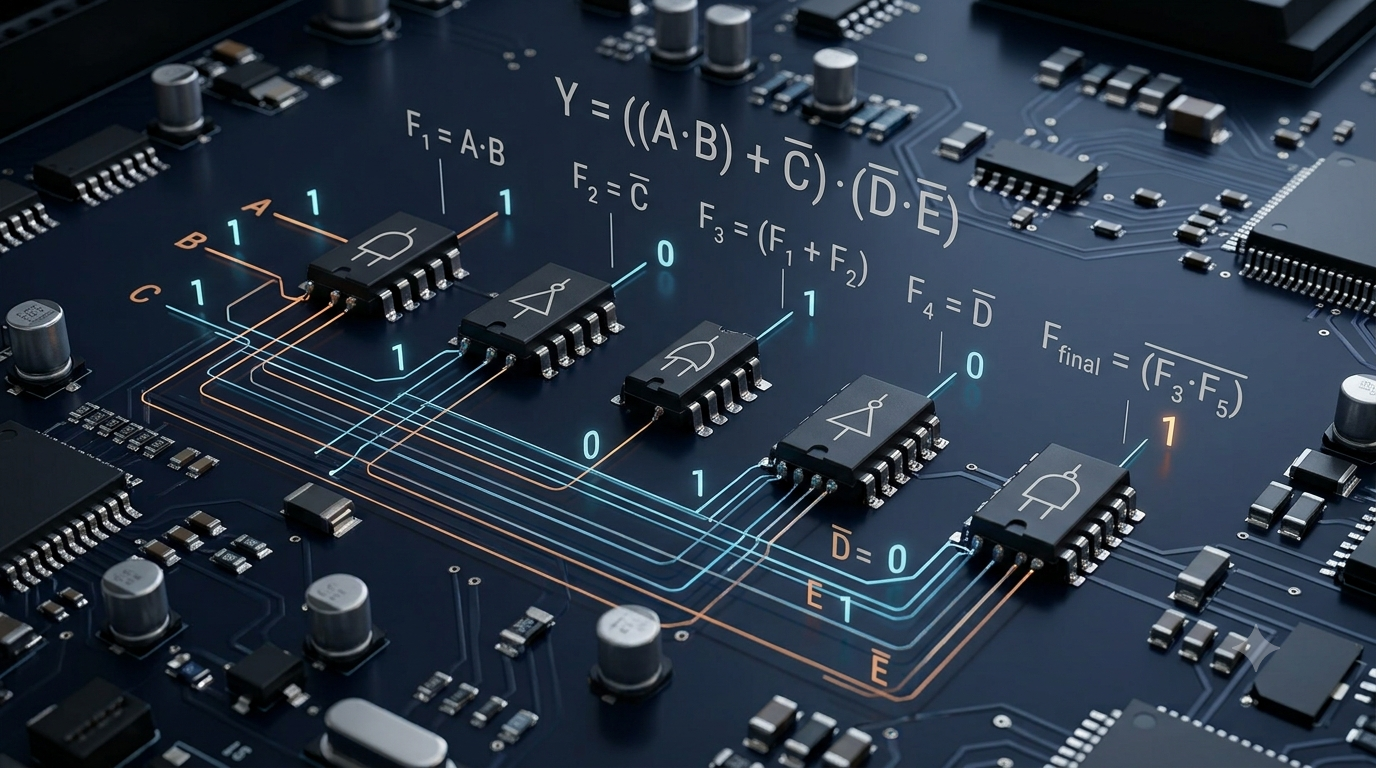
Boolean algebra and digital logic gates are two fundamental concepts in computer science and digital electronics. They work together to […]
Read MoreWhy can Boolean expressions be simplified without changing their logical result?

Boolean expressions are an essential part of computer science, digital electronics, programming, and information technology. They are used to represent […]
Read MoreHow does Boolean algebra simplify decisions made by computer programs?

Every computer program makes decisions. A website decides whether to allow a user to log in, a mobile application checks […]
Read MoreWhy does character encoding affect the amount of storage required for text?

Text may look simple when we read it on a screen, but computers must represent every character using numerical data. […]
Read MoreHow can the size of a file be estimated from the number of stored bytes?

Every digital file occupies a certain amount of storage space on a computer, smartphone, or other digital device. Whether it […]
Read MoreWhy are storage measurements sometimes calculated differently using decimal and binary units?

Have you ever purchased a 500 GB hard drive and noticed that your computer reports a slightly different storage capacity? […]
Read MoreWhat happens when a numerical value exceeds the range available in its data representation?

Computers store numerical values using a limited number of bits. Every data type, such as an 8-bit integer, a 32-bit […]
Read MoreWhy does the maximum value of a fixed-width integer depend on its number of bits?

Computers store and process information using binary digits, commonly called bits. Each bit can hold one of two values: 0 […]
Read MoreHow does a signed number differ from an unsigned number at a fundamental level?

Computers use binary numbers to represent and process information. Every number stored in a computer occupies a certain number of […]
Read MoreWhy are powers of two so common in computer memory and digital systems?

Computers store, process, and transmit information using binary digits, commonly known as bits. Unlike the decimal number system, which uses […]
Read MoreHow can the same number of bits represent different types of information?

Computers process many different types of information, including numbers, letters, images, sounds, videos, and instructions. Although these forms of information […]
Read MoreWhy does one additional bit double the number of possible binary combinations?

Computers use binary numbers to store, process, and communicate information. Unlike the decimal system, which uses ten digits from 0 […]
Read MoreHow does increasing the number of binary digits affect the range of representable values?

Binary is the number system used by digital computers to represent and process information. It uses only two digits, 0 […]
Read More