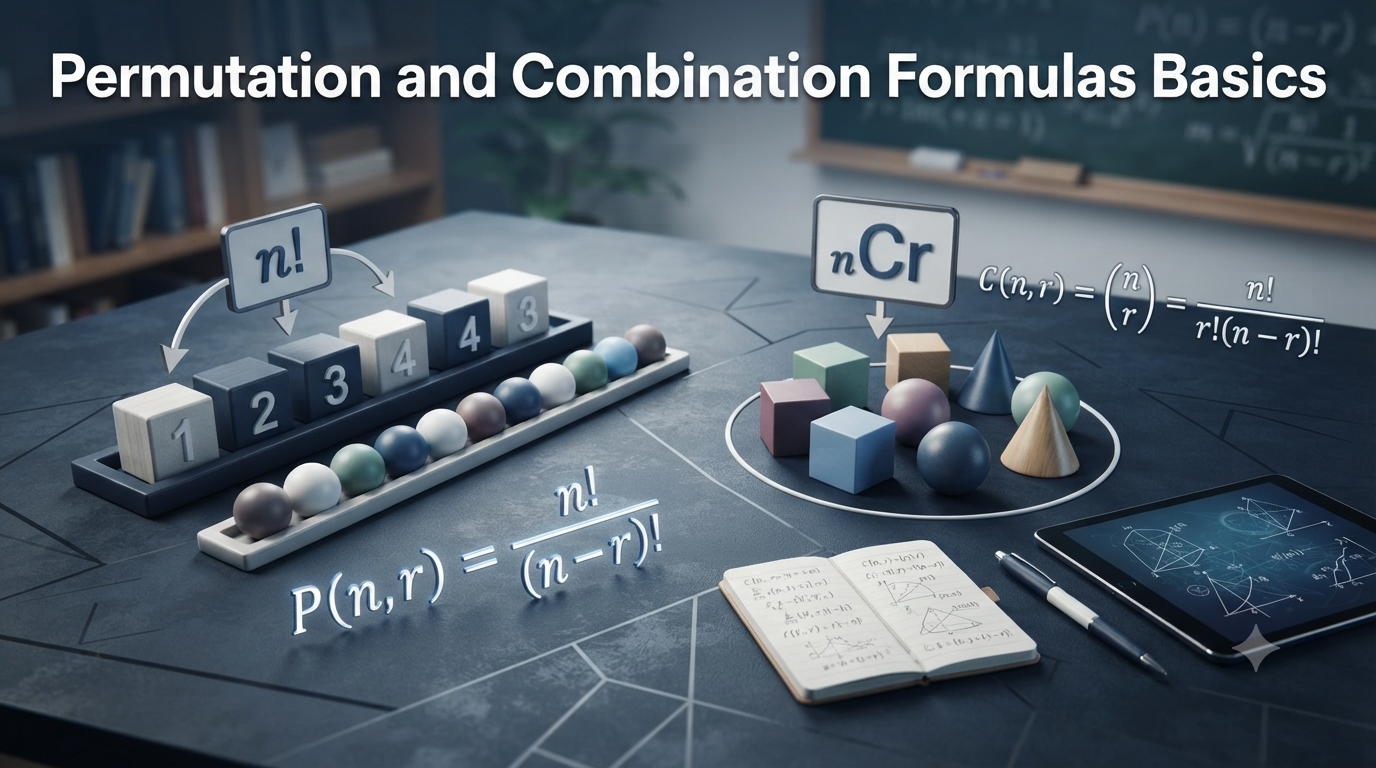
Permutation and combination are two important concepts in mathematics used to count the number of possible arrangements and selections without listing every possibility. They are especially useful when a problem involves choosing objects, arranging people, forming groups, or creating different orders from a given set of items.
Although permutation and combination are closely related, they answer different questions. Permutation is used when the order of objects matters, while combination is used when the order does not matter. For example, arranging three students in different positions is a permutation problem, whereas selecting three students for a team is a combination problem.
Understanding the basic formulas of permutation and combination provides a strong foundation for probability, statistics, counting problems, and many applications in mathematics. This article explains the fundamental formulas, their meanings, and how to use them in simple situations.
What Is a Permutation?
A permutation is an arrangement of objects in a particular order. In a permutation problem, changing the order of the selected objects creates a different arrangement.
For example, suppose there are three letters: A, B, and C. If all three letters are arranged, the possible arrangements are:
ABC, ACB, BAC, BCA, CAB, CBA
There are six different arrangements. Notice that ABC and BAC are considered different because their order is different.
Therefore, permutations are used when order matters.
Basic Permutation Formula
The number of ways to arrange (n) different objects taken (r) at a time is:
nPr = n! / (n − r)!
Here:
n = total number of objects
r = number of objects being arranged
! = factorial symbol
nPr = number of permutations of (n) objects taken (r) at a time
For example, if five different books are available and you want to arrange three of them on a shelf, then:
5P3 = 5! / (5 − 3)!
5P3 = 5! / 2!
5P3 = (5 × 4 × 3 × 2 × 1) / (2 × 1)
5P3 = 60
Therefore, the three books can be arranged in 60 different ways.
What Is a Combination?
A combination is a selection of objects where order does not matter.
Suppose you have three students: A, B, and C, and you need to select two students for a group. The possible groups are:
AB, AC, BC
The arrangements AB and BA represent the same group because the order in which the students are mentioned does not matter.
Therefore, combinations are used when order does not matter.
Basic Combination Formula
The number of ways to select (r) objects from (n) different objects is:
nCr = n! / [r!(n − r)!]
Here:
n = total number of objects
r = number of objects selected
! = factorial symbol
nCr = number of combinations of (n) objects taken (r) at a time
For example, suppose there are five students and you want to select three students for a team.
5C3 = 5! / [3!(5 − 3)!]
5C3 = 5! / (3! × 2!)
5C3 = 10
Therefore, there are 10 different ways to select three students.
Understanding Factorial
Factorial is an important part of both permutation and combination formulas.
The factorial of a positive integer (n), written as n!, means multiplying all positive integers from (n) down to 1.
For example:
5! = 5 × 4 × 3 × 2 × 1 = 120
Similarly:
4! = 4 × 3 × 2 × 1 = 24
3! = 3 × 2 × 1 = 6
2! = 2 × 1 = 2
By definition:
0! = 1
This special value is important because it makes many permutation and combination formulas work correctly.
Difference Between Permutation and Combination
The main difference between permutation and combination is whether order matters.
In a permutation, different orders are counted as different arrangements. In a combination, different orders of the same selected objects are counted as one selection.
For example, consider selecting two letters from A, B, and C.
For permutations:
AB, BA, AC, CA, BC, CB
There are six arrangements.
For combinations:
AB, AC, BC
There are only three selections.
Therefore:
Permutation → order matters
Combination → order does not matter
A useful way to remember this is to ask:
“Am I arranging the objects or simply selecting them?”
If you are arranging them, permutation is generally used. If you are selecting them, combination is generally used.
Relationship Between Permutation and Combination
Permutation and combination are directly related.
The relationship is:
nPr = nCr × r!
This formula makes sense because a combination first selects (r) objects from (n) objects, and then those selected objects can be arranged in (r!) different ways.
Starting with the formulas:
nCr = n! / [r!(n − r)!]
and
r! × nCr = r! × n! / [r!(n − r)!]
The (r!) terms cancel:
r! × nCr = n! / (n − r)!
Therefore:
nPr = nCr × r!
This relationship is useful for converting between permutation and combination calculations.
Important Permutation Formulas
Several basic permutation formulas are commonly used in mathematics.
Permutation of All Objects
When all (n) different objects are arranged, the number of arrangements is:
nPn = n!
For example, four different books can be arranged in:
4! = 4 × 3 × 2 × 1 = 24
ways.
Permutation of n Objects Taken r at a Time
The standard formula is:
nPr = n! / (n − r)!
This is used when (r) objects are selected from (n) objects and arranged in order.
Permutations With Repeated Objects
When some objects are identical, the basic (n!) formula needs to be adjusted.
If there are (n) total objects, with repeated groups containing (p), (q), and (r) identical objects, the number of distinct arrangements is:
n! / (p!q!r!)
For example, consider the word LEVEL.
There are five letters in total. The letter L occurs twice and the letter E occurs twice.
The number of distinct arrangements is:
5! / (2! × 2!)
= 120 / 4
= 30
Therefore, the letters of LEVEL can be arranged in 30 distinct ways.
Important Combination Formulas
The standard combination formula is:
nCr = n! / [r!(n − r)!]
There are also several useful properties of combinations.
Symmetry Property
One important property is:
nCr = nC(n − r)
For example:
8C3 = 8C5
Both expressions have the same value.
This property is useful when (r) is larger than half of (n), because calculating the smaller value can be easier.
For example, instead of calculating:
10C8
you can calculate:
10C2
because:
10C8 = 10C2
Combination When r = 0
The number of ways to select zero objects from (n) objects is:
nC0 = 1
There is one way to select nothing: select no objects.
Combination When r = n
The number of ways to select all (n) objects is:
nCn = 1
There is only one way to select all the objects.
How to Identify a Permutation Problem
A problem is usually a permutation problem when the position, order, rank, or sequence is important.
Common examples include:
Arranging people in seats
Creating a sequence of letters
Assigning different positions to people
Arranging books on a shelf
Creating codes or ordered numbers
Determining first, second, and third positions
For example, if five runners compete in a race and you want to know how many ways the first three positions can be occupied, the problem involves permutation because first, second, and third positions are different.
The relevant formula is:
5P3 = 5! / (5 − 3)! = 60
How to Identify a Combination Problem
A problem is generally a combination problem when you are choosing or forming a group, and the order of selection does not matter.
Common examples include:
Selecting students for a team
Choosing committee members
Selecting questions from a question bank
Choosing items from a collection
Selecting players for a group
Forming a set of objects
For example, if five students are available and three students must be selected for a committee, the order does not matter.
Therefore:
5C3 = 10
There are 10 possible committees.
Permutation and Combination Examples
Consider a group of six people.
Example 1: Arranging People
Suppose three people must stand in three different positions.
Because the positions are different, order matters.
Therefore:
6P3 = 6! / (6 − 3)!
= 6! / 3!
= 6 × 5 × 4
= 120
There are 120 possible arrangements.
Example 2: Selecting People
Now suppose three people must be selected from the same group of six to form a team.
The order does not matter.
Therefore:
6C3 = 6! / [3!3!]
= 20
There are 20 possible teams.
The difference between these answers demonstrates why identifying whether order matters is essential.
Permutation and Combination in Real Life
Permutation and combination are not limited to textbook exercises. They are useful in many real-world situations.
Permutations can be used when arranging schedules, assigning seats, creating passwords, determining rankings, and organizing objects in specific orders.
Combinations can be used when forming committees, selecting teams, choosing groups of products, designing samples for research, and calculating possible selections in probability.
In computer science, counting arrangements and selections can also help with algorithm design, search problems, optimization, and analyzing possible configurations.
Common Mistakes to Avoid
One of the most common mistakes is using permutation when the problem actually requires combination, or vice versa.
The first question should always be:
Does order matter?
If changing the order creates a different result, use permutation.
If changing the order does not create a different result, use combination.
Another common mistake is forgetting factorials in the denominator of the combination formula. The formula is:
nCr = n! / [r!(n − r)!]
It is also important to remember that factorial applies to the entire number. For example:
5! = 120
not 25.
Students sometimes calculate (nCr) and (nPr) using the same formula. Although the two formulas look similar, their denominators are different.
Permutation:
nPr = n! / (n − r)!
Combination:
nCr = n! / [r!(n − r)!]
The extra r! in the combination formula accounts for the fact that different orders of the same selected objects are not counted separately.
Quick Formula Summary
The most important formulas can be summarized as follows:
Factorial:
n! = n × (n − 1) × (n − 2) × … × 1
0! = 1
Permutation:
nPr = n! / (n − r)!
Permutation of all objects:
nPn = n!
Combination:
nCr = n! / [r!(n − r)!]
Relationship:
nPr = nCr × r!
Symmetry property:
nCr = nC(n − r)
These formulas form the basic foundation for solving counting problems involving arrangements and selections.
Conclusion
Permutation and combination formulas provide a systematic way to count possible arrangements and selections without having to list every possibility. The key difference is simple: permutation deals with arrangements where order matters, while combination deals with selections where order does not matter.
The main permutation formula is nPr = n! / (n − r)!, while the main combination formula is nCr = n! / [r!(n − r)!]. Understanding factorials and the relationship between these formulas makes more advanced counting and probability problems easier to solve.
When facing a new problem, first identify what is being done. If objects are being placed in specific positions or orders, think about permutation. If objects are simply being selected to form a group, think about combination. This simple distinction is the foundation for using permutation and combination formulas correctly.
FAQs
1. What is a permutation in mathematics?
A permutation is an arrangement of objects in a specific order. In permutation problems, the order of the selected objects matters, so changing their positions creates a different arrangement. For example, arranging the letters A, B, and C gives ABC, ACB, BAC, BCA, CAB, and CBA. The basic permutation formula is nPr = n! / (n − r)!, where n represents the total number of objects and r represents the number of objects being arranged. Permutations are commonly used in problems involving seating arrangements, rankings, positions, schedules, codes, and ordered sequences. The key idea is that order matters.
2. What is a combination in mathematics?
A combination is a selection of objects where the order does not matter. If the same objects are selected, changing their order does not create a new combination. For example, selecting A and B is the same selection as selecting B and A. The basic combination formula is nCr = n! / [r!(n − r)!], where n is the total number of objects and r is the number selected. Combinations are commonly used when forming teams, committees, groups, or samples. The most important idea to remember is that combination means selection without considering the order of the selected objects.
3. What is the main difference between permutation and combination?
The main difference between permutation and combination is whether the order of objects matters. In a permutation, order matters, so different arrangements of the same objects are counted separately. In a combination, order does not matter, so different arrangements of the same selected objects are treated as one selection. For example, choosing A and B and arranging them as AB and BA gives two permutations. However, choosing A and B as a group gives only one combination. Therefore, use permutation for arrangements, positions, and rankings, while combination is generally used for selections, teams, committees, and groups.
4. What is the formula for permutation?
The basic formula for the number of permutations of n different objects taken r at a time is nPr = n! / (n − r)!. Here, n represents the total number of available objects and r represents the number of objects that will be arranged. The factorial symbol means multiplication of all positive integers down to 1. For example, the number of ways to arrange three objects selected from five objects is 5P3 = 5! / 2! = 60. This formula is appropriate when the order or position of the selected objects creates different outcomes.
5. What is the formula for combination?
The basic combination formula is nCr = n! / [r!(n − r)!]. Here, n represents the total number of objects and r represents the number of objects being selected. Unlike permutation, combination does not consider the order of the selected objects. For example, if three students are selected from five students, the number of possible groups is 5C3 = 5! / (3! × 2!) = 10. This formula is useful for problems involving teams, committees, groups, selections, and samples. The presence of r! in the denominator prevents different orders of the same selection from being counted separately.
6. Why is factorial important in permutation and combination?
Factorial is important because it is used in both permutation and combination formulas. The factorial of a positive integer n, written as n!, means multiplying all positive integers from n down to 1. For example, 5! = 5 × 4 × 3 × 2 × 1 = 120. Factorials help count the possible arrangements of objects and form the basis of the formulas nPr = n! / (n − r)! and nCr = n! / [r!(n − r)!]. It is also important to remember that 0! = 1, which allows many mathematical formulas and counting relationships to work correctly.
7. How do you know whether to use permutation or combination?
To decide between permutation and combination, ask one simple question: Does order matter? If changing the order creates a different result, use permutation. For example, assigning people to first, second, and third positions involves permutation because each position is different. If changing the order does not change the result, use combination. For example, selecting three people to form a team involves combination because the order in which they are selected is irrelevant. Therefore, arrangements, rankings, positions, and sequences usually involve permutations, while teams, groups, committees, and selections usually involve combinations.
8. What is the relationship between permutation and combination?
Permutation and combination are closely related. Their relationship is given by nPr = nCr × r!. A combination first selects r objects from n objects without considering their order. Once those r objects have been selected, they can be arranged in r! different ways. Multiplying the number of combinations by r! therefore gives the number of permutations. For example, 5C3 = 10, and the three selected objects can be arranged in 3! = 6 ways. Therefore, 5P3 = 5C3 × 3! = 10 × 6 = 60. This relationship connects selection and arrangement.
9. What does nCr = nC(n − r) mean?
The identity nCr = nC(n − r) is known as the symmetry property of combinations. It means that selecting r objects from n objects gives the same number of possibilities as leaving out n − r objects. For example, 8C3 = 8C5 because selecting three objects is equivalent to deciding which five objects are not selected. This property can make calculations easier because you can use whichever value, r or n − r, is smaller. The symmetry property is useful when working with large combination values and is an important relationship to remember when solving counting problems.
10. Where are permutation and combination formulas used?
Permutation and combination formulas are used whenever we need to count possible arrangements or selections. Permutations can be used for seating arrangements, rankings, schedules, passwords, codes, and assigning objects to specific positions. Combinations can be used for forming teams, selecting committee members, choosing samples, and creating groups. These concepts are also important in probability, statistics, computer science, and other areas of mathematics. For example, probability problems often require calculating the number of possible outcomes before finding a probability. Learning when to use permutation and when to use combination provides a useful foundation for solving more advanced counting and probability problems.