Computers have become an essential part of modern life. They help people communicate, study, conduct scientific research, manage businesses, and solve complex problems. Today, computers are used in homes, schools, hospitals, factories, laboratories, and space missions. Smartphones, laptops, smart appliances, and powerful supercomputers are all examples of computing technology.
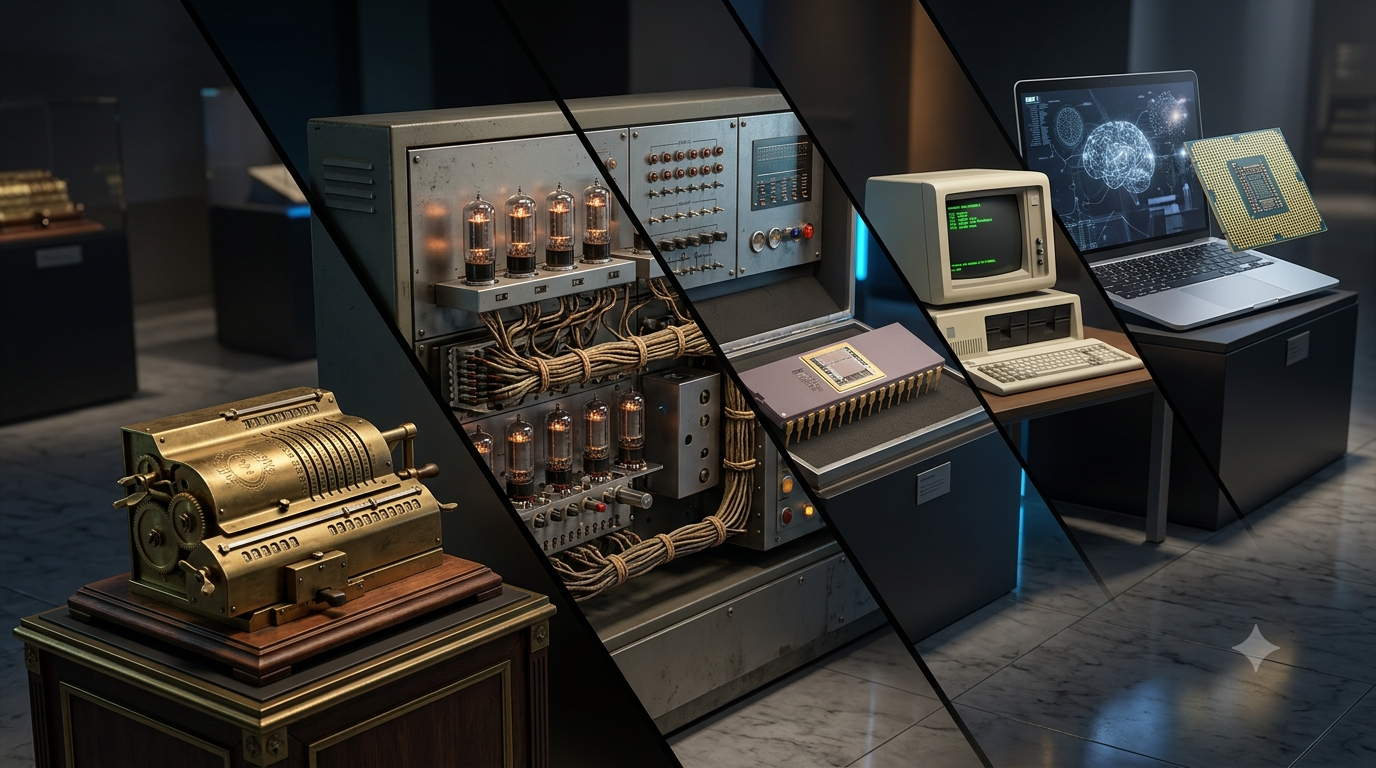
However, computers did not develop overnight. Their history began with simple counting tools and mechanical calculators. Over time, inventors introduced machines that could perform calculations automatically, process large amounts of information, and follow programmed instructions. The invention of electronic components during the twentieth century made computers faster and more reliable. Later, microprocessors, personal computers, the internet, cloud computing, and artificial intelligence transformed the way people use technology.
Understanding the history and evolution of computers helps us appreciate the scientific discoveries and engineering achievements behind modern digital systems.
1. Early Calculating Devices
Before modern computers existed, people needed ways to count objects, measure quantities, calculate prices, and solve mathematical problems. They initially relied on their fingers, stones, counting marks, and other simple methods. As trade, astronomy, engineering, and mathematics developed, more efficient calculating tools became necessary.
1.1 The Abacus
The abacus is one of the oldest known calculating devices. It consists of beads or counters arranged on rods or wires within a frame. By moving the beads according to specific rules, users can perform arithmetic operations such as addition, subtraction, multiplication, and division.
Different forms of the abacus appeared in several ancient civilizations. It became particularly important in parts of Asia, where it was used for trade, accounting, education, and everyday calculations.
Although the abacus is not an electronic computer, it introduced an important principle: a physical device can represent numbers and help people process information systematically.
1.2 Napier’s Bones
In the early seventeenth century, Scottish mathematician John Napier developed a calculating aid known as Napier’s bones. It consisted of numbered rods that helped simplify multiplication and division.
Instead of calculating every result through lengthy multiplication, users could arrange the rods and read the required values. This reduced the effort needed to perform repeated mathematical calculations.
Napier also contributed to the development of logarithms, which became important tools for simplifying calculations before electronic calculators were widely available.
1.3 The Slide Rule
The slide rule developed from mathematical principles associated with logarithms. It uses specially marked scales that slide against one another to perform multiplication, division, and other scientific calculations.
For centuries, engineers, architects, scientists, and students used slide rules to solve practical problems. They were especially valuable in engineering and scientific research.
However, slide rules generally provided approximate results rather than the exact results available from many digital calculators. Their popularity declined as affordable electronic calculators became widely available.
2. The Beginning of Mechanical Computing
Mechanical calculating machines represented an important step toward automated computation. These devices used gears, wheels, levers, and other mechanical components to perform mathematical operations.
2.1 Blaise Pascal’s Pascaline
In 1642, French mathematician Blaise Pascal developed a mechanical calculating machine called the Pascaline. He designed it partly to help his father, who worked as a tax official and needed to perform many calculations.
The Pascaline used interconnected wheels to represent digits. When one wheel completed a full rotation, it moved the next wheel forward, allowing the machine to carry numbers during addition.
Its principal operations were addition and subtraction. Although the machine was innovative, it was expensive to manufacture and had limited practical use.
The Pascaline demonstrated that a mechanical device could perform arithmetic operations automatically, reducing the need for manual calculations.
2.2 Gottfried Wilhelm Leibniz’s Stepped Reckoner
In the late seventeenth century, German mathematician Gottfried Wilhelm Leibniz developed a mechanical calculator known as the Stepped Reckoner.
Its mechanism was designed to support addition, subtraction, multiplication, and division. It used a stepped drum to carry out repeated operations, making it more versatile than many earlier calculating devices.
Leibniz also promoted the binary number system, which represents numbers using only two digits: 0 and 1. This system later became fundamental to digital computing because electronic circuits can represent two distinct logical states.
Although mechanical limitations affected the reliability of his machine, Leibniz made important contributions to the mathematical foundations of computing.
3. Charles Babbage and the Programmable Computer
Charles Babbage, an English mathematician and inventor, is widely regarded as one of the pioneers of modern computing. His designs introduced concepts that closely resemble the structure of present-day computers.
3.1 The Difference Engine
During the nineteenth century, mathematical tables were essential for navigation, astronomy, engineering, and scientific research. Preparing these tables manually was time-consuming, and human errors could produce incorrect results.
Babbage designed the Difference Engine to calculate mathematical tables automatically using a method known as finite differences.
The machine relied on mechanical components to perform repeated arithmetic operations. Although the original project was not completed as initially planned during Babbage’s lifetime, later reconstructions demonstrated that important parts of the design could work.
The Difference Engine showed how mechanical machinery could automate a specific class of mathematical calculations.
3.2 The Analytical Engine
Babbage later proposed the Analytical Engine, a more advanced machine designed to perform different calculations according to programmed instructions.
Its proposed structure included components that resemble several parts of modern computers:
Store: Intended to hold numbers and intermediate results, similar to memory.
Mill: Designed to perform arithmetic operations, comparable to a processor’s computational unit.
Input: Intended to provide data and instructions.
Output: Designed to present the results.
Control: Responsible for determining the sequence of operations.
The Analytical Engine was designed to use punched cards to control its operations. This idea was influenced by punched-card systems used in automated textile machinery.
Although Babbage never completed the full machine, his design introduced the idea of a general-purpose programmable computer rather than a calculator limited to one particular task.
3.3 Ada Lovelace and Computer Programming
Ada Lovelace, an English mathematician, studied the Analytical Engine and recognized that a programmable machine could potentially manipulate symbols according to rules rather than merely calculate numbers.
In notes published in 1843, she described a method for calculating Bernoulli numbers using the proposed machine. This work is widely regarded as an early example of computer programming.
Lovelace also considered the possibility that such a machine could process other forms of information if they could be represented symbolically.
Her work anticipated an important feature of modern computing: computers can process numbers, text, images, sound, and many other types of data by following instructions.
4. The Development of Electromechanical Computers
During the late nineteenth and early twentieth centuries, advances in electricity and mechanical engineering made more sophisticated calculating machines possible. Electromechanical computers combined mechanical components with electrical relays and switches.
4.1 Herman Hollerith and Punched Cards
Herman Hollerith developed a punched-card tabulating system to process large amounts of statistical information. His technology was used to help process data from the 1890 United States census.
Information was represented by holes in cards, which machines could read and use for counting and classification. This approach reduced the time and labor required to process census records.
Hollerith’s work demonstrated that machines could do more than calculate numbers. They could also organize and process large collections of information.
His business later became part of the corporate history that led to the formation of IBM, or International Business Machines.
4.2 Relay-Based Computing Machines
Electromechanical computers used electrical relays to control circuits and perform programmed operations. Relays could open or close electrical connections, allowing a machine to process information according to a defined sequence.
These systems were generally slower than later electronic computers because their mechanical components required time to move. Nevertheless, they helped establish practical methods for automated computation.
During the 1930s and 1940s, researchers developed several electromechanical machines that bridged the gap between mechanical calculators and fully electronic computers.
5. The First Electronic Computers
The development of electronic computers during the 1940s marked a major turning point. Instead of depending primarily on moving mechanical components, these machines used electronic circuits to perform calculations much more rapidly.
5.1 Colossus
Colossus was developed in Britain during the Second World War to assist with cryptanalysis, particularly the analysis of encrypted German communications produced by the Lorenz cipher system.
It became operational in 1944 and used electronic valves, also called vacuum tubes, to process information at high speed.
Colossus was an important early electronic digital computing system. However, it was designed for a specialized purpose rather than as a general-purpose computer like those used today.
Its wartime role remained secret for many years, so its contribution to computing history became widely known only later.
5.2 ENIAC
ENIAC stands for Electronic Numerical Integrator and Computer. Developed by John Mauchly and J. Presper Eckert, it was completed in 1945 and publicly announced in 1946.
ENIAC used thousands of vacuum tubes and occupied a large room. It could perform numerical calculations much faster than many earlier mechanical and electromechanical machines.
Initially, programming ENIAC involved configuring switches and cables. Changing its operation could therefore require considerable manual effort.
Despite these limitations, ENIAC demonstrated the potential of electronic computing for scientific research, engineering, and complex numerical calculations.
5.3 The Stored-Program Concept
Early computers often required physical changes to switch between tasks. Researchers recognized that storing instructions in electronic memory would make computers more flexible.
The stored-program concept allows a computer to hold instructions and data in memory, retrieve instructions, and execute them in sequence.
The EDVAC project was associated with the development of this approach. In 1948, the Manchester Baby successfully ran a program stored electronically in memory. EDSAC followed in 1949 and became one of the earliest practical stored-program electronic computers.
This development established a foundation for most modern general-purpose computer systems.
6. The Generations of Computers
Computer history is often divided into five generations according to major technological developments. These categories are useful for understanding the evolution of hardware, although the periods overlap and the fifth generation does not have a universally accepted technical boundary.
6.1 First Generation: Vacuum Tube Computers
Approximate period: 1940s to mid-1950s
First-generation electronic computers used vacuum tubes to control electrical signals. These components made high-speed electronic computation possible, but they consumed substantial electricity and generated considerable heat.
The computers were large, expensive, and difficult to maintain. Many required specialized rooms and skilled operators. Programming often involved machine language, switches, and punched cards.
Despite their limitations, these computers established electronic computing as a practical technology.
6.2 Second Generation: Transistor Computers
Approximate period: mid-1950s to mid-1960s
The invention of the transistor at Bell Laboratories in 1947 changed the future of electronics. Transistors could perform many of the functions of vacuum tubes while being smaller, more energy-efficient, and generally more reliable.
During the second generation, transistors increasingly replaced vacuum tubes in computers. This reduced the size and power requirements of many systems and improved reliability.
High-level programming languages such as FORTRAN and COBOL also became important. They allowed programmers to write instructions in forms closer to mathematical notation or human-readable language.
Transistor-based computers expanded the use of computing in scientific research, engineering, business, and government.
6.3 Third Generation: Integrated Circuit Computers
Approximate period: 1960s to early 1970s
An integrated circuit combines multiple electronic components on a small semiconductor chip. Its development allowed computer manufacturers to build increasingly complex circuits in less space.
Third-generation computers used integrated circuits, improving performance and reliability while reducing the size of many systems.
Operating systems also became more sophisticated. Features such as multiprogramming and time-sharing allowed computers to handle multiple tasks or support several users more effectively.
As these systems improved, computing became more accessible to universities, research institutions, government agencies, and large businesses.
6.4 Fourth Generation: Microprocessor Computers
Approximate period: 1970s onward
The microprocessor brought a major change by placing the central processing functions of a computer onto a single integrated circuit.
Intel introduced the 4004 microprocessor in 1971. It was an important early commercial microprocessor and demonstrated the potential of highly integrated computing components.
As microprocessors improved, computers became smaller, more affordable, and more powerful. This development supported the growth of personal computers, portable devices, and embedded systems.
Personal computers became increasingly popular during the late 1970s and 1980s. The Apple II, introduced in 1977, and the IBM Personal Computer, introduced in 1981, helped expand personal computing.
Graphical user interfaces, computer mice, and more capable operating systems made computers easier for many people to use.
6.5 Fifth Generation: Artificial Intelligence and Advanced Computing
Approximate period: 1980s onward, continuing today
The fifth generation is often associated with artificial intelligence, parallel processing, advanced computing methods, and natural language interaction. Unlike earlier generations, it does not represent one universally accepted hardware boundary.
Modern computer development includes machine learning, robotics, AI accelerators, advanced processors, and large-scale data processing.
Artificial intelligence systems can recognize patterns, analyze images, process speech, generate content, and assist with scientific research.
However, modern computers still rely on technologies developed during earlier generations, including transistors, integrated circuits, microprocessors, memory systems, and stored-program architecture.
7. The Rise of Personal Computers
Before personal computers became common, computing was largely concentrated in universities, government organizations, research laboratories, and large businesses. Computers were expensive and often required specialized facilities.
Microprocessors made it possible to build smaller and less expensive systems. During the 1970s, hobbyist computers and early commercial personal computers began attracting public interest.
The Apple II became an influential personal computer after its introduction in 1977. The IBM Personal Computer followed in 1981 and helped establish a widely adopted platform for business and personal use.
Personal computers became useful for word processing, spreadsheets, education, accounting, programming, graphic design, and entertainment.
Graphical interfaces allowed people to interact with computers through windows, icons, menus, and pointing devices. These developments made computers more accessible to people without specialized technical training.
Personal computers transformed homes and workplaces by allowing individuals to perform tasks that once required larger computing systems or specialized equipment.
8. The Internet and the Networked Computer Era
The development of computer networks transformed independent computers into connected systems capable of sharing information across great distances.
ARPANET, which began operating in 1969, was an important predecessor to the modern internet. It helped researchers explore ways to exchange information between computers located in different places.
The adoption of TCP/IP protocols by ARPANET in 1983 was an important milestone because these protocols allowed different networks to communicate using a common set of rules.
Tim Berners-Lee proposed the World Wide Web in 1989. Its development during the early 1990s made it easier for people to access interconnected information through web pages and browsers.
As internet access expanded, computers became central to email, online education, digital banking, electronic commerce, scientific research, entertainment, and global communication.
Today, computers exchange information with servers, cloud platforms, smartphones, and connected devices. This connectivity has created many opportunities, but it has also introduced challenges involving cybersecurity, privacy, and data protection.
9. The Evolution of Laptops, Smartphones, and Embedded Systems
Computing technology has expanded beyond traditional desktop computers. Advances in semiconductor design, battery technology, wireless communication, and miniaturization have made computers portable and allowed them to be built into everyday objects.
9.1 Laptop Computers
Laptops combine a display, keyboard, pointing device, battery, processor, memory, and storage in a portable form.
They allow people to work, study, communicate, and create digital content from different locations. Improvements in energy efficiency and processing performance have made laptops useful for everyday tasks, programming, graphic design, and scientific work.
9.2 Smartphones and Tablets
Smartphones are compact computing systems that combine processing power, memory, storage, cameras, sensors, communication hardware, and touchscreens.
They can run applications, access the internet, navigate using satellite positioning, record videos, support online learning, and conduct digital transactions.
Tablets offer similar capabilities with larger touchscreens, making them useful for reading, drawing, presentations, and educational activities.
These devices demonstrate how computing has become part of everyday communication and information access.
9.3 Embedded Computers and the Internet of Things
Embedded computers are built into devices to control specific functions. They are found in vehicles, washing machines, medical equipment, industrial machinery, and home appliances.
The Internet of Things, or IoT, connects physical devices through communication networks so they can exchange data and sometimes respond automatically to changing conditions.
For example, a smart thermostat can use temperature measurements to regulate heating, while industrial sensors can help detect equipment problems before a failure occurs.
These applications show that computers are no longer limited to devices that resemble traditional desktop machines.
10. Modern Computer Systems and Cloud Computing
Modern computer systems include desktops, laptops, servers, workstations, smartphones, supercomputers, and specialized devices. Each type is designed for particular performance, portability, reliability, or energy requirements.
10.1 Cloud Computing
Cloud computing allows users to access computing resources over a network instead of relying entirely on their own devices.
These resources may include online storage, processing power, databases, software, and development platforms. Organizations can use cloud services to expand their computing capacity without purchasing and maintaining every physical server themselves.
Cloud computing supports online file storage, collaborative work, website hosting, application development, and large-scale data analysis.
However, it also creates considerations involving internet connectivity, service availability, cost, data privacy, and cybersecurity.
10.2 Supercomputers
Supercomputers are designed to perform extremely demanding calculations. They often use many processors working in parallel to solve large problems.
They support weather forecasting, climate modeling, molecular research, astrophysics, engineering simulations, and other scientific tasks.
Instead of relying on a single processor to complete every calculation, supercomputers can divide large problems into smaller tasks that are processed simultaneously.
Their capabilities continue to develop as processors, memory systems, networking technologies, and cooling methods improve.
10.3 Quantum Computing
Quantum computing explores a different approach to information processing based on principles of quantum mechanics.
Classical computers represent information using bits, each with a value of 0 or 1. Quantum computers use quantum bits, or qubits, which can be prepared in quantum states involving superposition and can participate in quantum entanglement.
Researchers are investigating quantum computing for selected problems in quantum chemistry, materials science, and certain mathematical applications.
However, quantum computing remains an emerging technology. Current systems face challenges involving noise, error correction, scaling, and the development of practical applications that outperform classical computers.
Quantum computers are not universal replacements for traditional computers. Classical systems remain essential for everyday applications and most current computing tasks.
11. The Role of Artificial Intelligence in Modern Computing
Artificial intelligence has become one of the most significant areas of modern computer development. AI systems use algorithms and computational resources to perform tasks such as pattern recognition, prediction, language processing, image analysis, and content generation.
Machine learning allows computers to identify patterns from data rather than relying exclusively on explicitly programmed rules. Deep learning uses multilayer neural networks to model complex relationships in data.
Generative AI systems can produce text, images, audio, video, and computer code based on patterns learned during training. These systems are increasingly used in education, research, software development, design, and business operations.
AI depends on several underlying computer technologies, including processors, memory, storage, networking, and specialized hardware such as graphics processing units.
Despite its potential, AI has limitations. Its outputs may contain errors, reflect biases in training data, or fail to account for important context. Responsible use therefore requires careful evaluation, human judgment, privacy protection, and appropriate security measures.
12. How Modern Computers Process Information
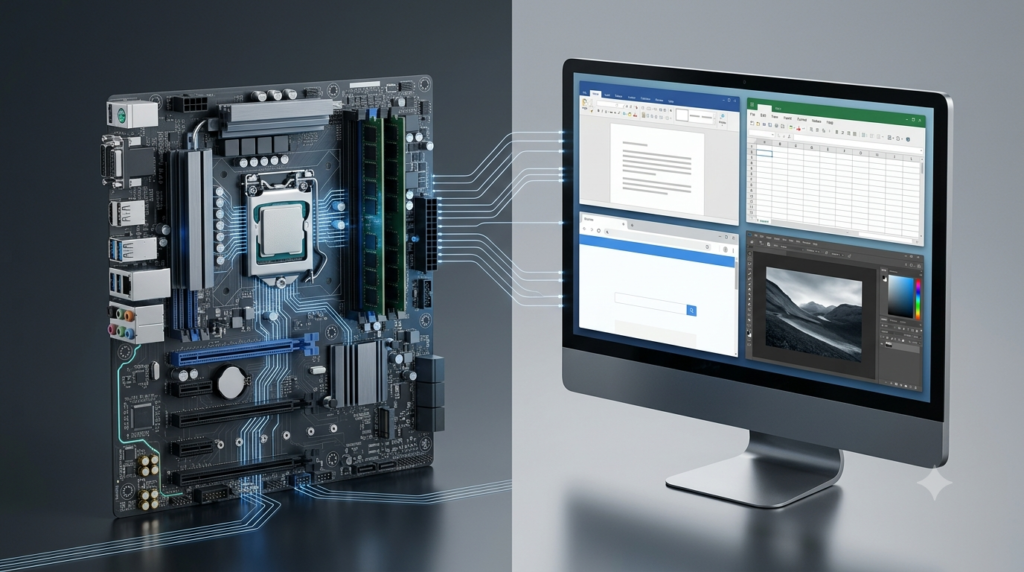
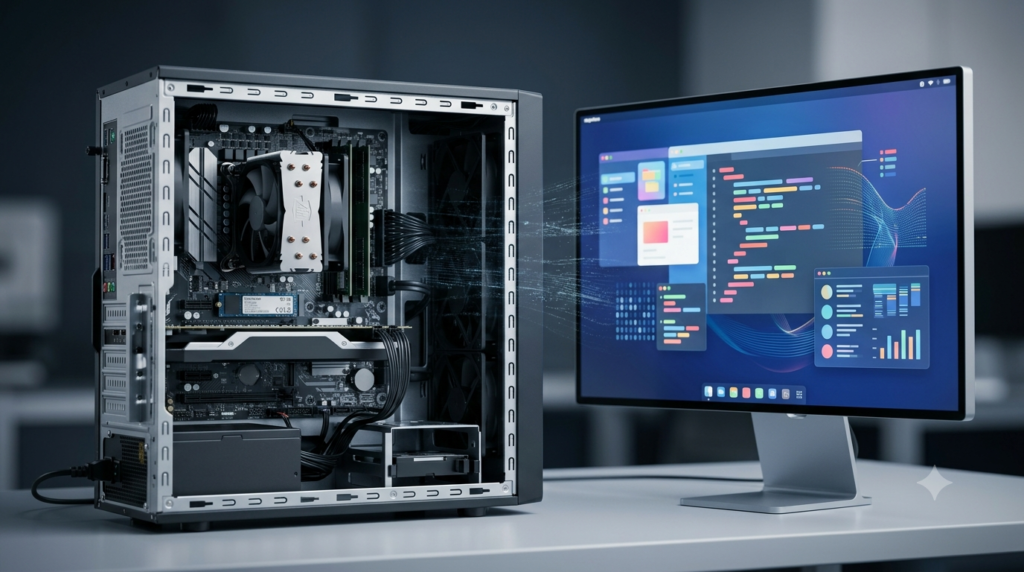
Although computer hardware has changed considerably over time, the fundamental process of accepting input, processing data, storing information, and producing output remains central to general-purpose computing.
12.1 Input
Input refers to the data and instructions supplied to a computer. Examples include keyboard entries, mouse movements, touchscreen actions, microphone recordings, camera images, and sensor measurements.
12.2 Processing
The central processing unit, or CPU, executes instructions and performs operations required by software. It handles tasks such as arithmetic calculations, logical comparisons, and instruction control.
Modern systems may also use graphics processing units, AI accelerators, and other specialized processors for particular workloads.
12.3 Memory and Storage
Memory and storage serve different purposes. Random access memory, or RAM, temporarily holds data and instructions that the system is actively using. It is generally volatile, meaning its contents are lost when power is removed.
Storage devices, including solid-state drives and hard disk drives, retain information for longer periods. They hold operating systems, applications, documents, photographs, and other files.
12.4 Output
Output is the information produced by a computer after processing. It may appear as text on a screen, printed documents, sound through speakers, images, control signals, or data transmitted to another device.
Together, input, processing, memory, storage, and output allow computers to perform a wide range of tasks.
13. Basic Computer Calculation and Binary Representation
Modern digital computers represent and process information using binary digits, called bits. Each bit has a value of 0 or 1. Groups of bits can represent numbers, characters, instructions, images, sound, and other forms of information.
Binary representation works well with digital electronic circuits because those circuits can distinguish between two defined logical states.
The following formulas illustrate basic relationships used in computer science.
Text block: Binary Representation and Data Size Formulas
Binary place-value formula:
N = bₙ × 2ⁿ + bₙ₋₁ × 2ⁿ⁻¹ + … + b₁ × 2¹ + b₀ × 2⁰
Here, each b represents a binary digit with a value of 0 or 1.
Example of binary-to-decimal conversion:
(1011)₂ = 1 × 2³ + 0 × 2² + 1 × 2¹ + 1 × 2⁰
(1011)₂ = 8 + 0 + 2 + 1
(1011)₂ = (11)₁₀
Basic data-size relationship:
1 byte = 8 bits
Number of possible patterns using n bits:
Number of patterns = 2ⁿ
Example:
Using 4 bits, the number of possible patterns is:
2⁴ = 16
These principles explain how computers represent information internally. The same binary foundation supports arithmetic operations, logical decisions, memory addressing, and digital communication.
14. The Future of Computers
The future of computing will likely involve improvements in processing performance, energy efficiency, accessibility, reliability, and the ability to handle increasingly complex tasks.
Artificial intelligence is expected to continue developing, while specialized processors may make AI applications more efficient on personal devices and in data centers.
Research into new semiconductor materials, advanced chip packaging, neuromorphic computing, photonic technologies, and quantum systems may provide alternative ways to improve particular aspects of computing. The practical impact of these technologies will depend on further research and engineering progress.
Edge computing is also becoming important. Instead of sending all information to distant data centers, edge systems process some data closer to where it is collected. This can reduce communication delays and support applications that require rapid responses, including industrial automation and certain safety systems.
Future computer development must also address cybersecurity, electronic waste, energy consumption, data privacy, unequal access to technology, and the responsible use of artificial intelligence.
The most successful future systems will not necessarily be the largest or fastest. They will also need to be secure, efficient, dependable, and useful to people.
Conclusion
The history and evolution of computers demonstrate how human creativity and scientific progress transformed simple calculating tools into powerful information-processing systems. The journey began with devices such as the abacus and mechanical calculators, advanced through the pioneering designs of Charles Babbage and Ada Lovelace, and accelerated with electromechanical and electronic computers during the twentieth century.
The invention of transistors, integrated circuits, and microprocessors made computers smaller, faster, more reliable, and more affordable. Personal computers, the internet, smartphones, cloud computing, and artificial intelligence subsequently expanded their role in everyday life.
Today, computers support science, medicine, education, communication, engineering, business, and entertainment. As new technologies emerge, computing will continue to change how people understand the world and solve problems. Learning about its history provides a foundation for understanding both the technology we use now and the possibilities that may shape the future.
FAQs
1. What is the history of computers?
The history of computers refers to the development of calculating devices and information-processing machines from ancient tools to modern digital systems. It began with devices such as the abacus, which helped people perform arithmetic calculations. Mechanical inventions, including Pascal’s Pascaline and Charles Babbage’s Analytical Engine, introduced more advanced methods of calculation and automation. During the twentieth century, electromechanical and electronic computers transformed computing. The invention of transistors, integrated circuits, and microprocessors made computers smaller, faster, and more affordable. Today, computers include personal computers, smartphones, supercomputers, cloud systems, and AI-powered machines used in many fields.
2. Who is known as the father of the computer?
Charles Babbage is widely known as the father of the computer because of his pioneering designs for mechanical calculating machines. In the nineteenth century, he designed the Difference Engine to calculate mathematical tables and later proposed the Analytical Engine, a more advanced machine capable of performing different operations according to instructions. His design included concepts resembling modern computer memory, processing, input, output, and program control. Although the Analytical Engine was never completed during his lifetime, his ideas influenced the development of computing. Ada Lovelace also made important contributions by describing an algorithm intended for the Analytical Engine.
3. What are the five generations of computers?
The five generations of computers are commonly classified according to major technological developments. First-generation computers used vacuum tubes, while second-generation computers used transistors. Third-generation computers introduced integrated circuits, which improved reliability and reduced physical size. Fourth-generation computers developed around microprocessors, supporting personal computers and many modern digital devices. Fifth-generation computing is commonly associated with artificial intelligence, advanced parallel processing, and knowledge-based systems. These categories provide a useful overview of computer evolution, but their time periods overlap. Modern computers combine technologies from several generations, and the fifth generation does not have one universally accepted technological definition.
4. What was the first electronic computer?
There is no single answer because early computers differed in their purposes and capabilities. Colossus, which became operational in Britain in 1944, was an early electronic digital computing system designed for codebreaking. ENIAC, completed in 1945 and publicly announced in 1946, became one of the best-known early general-purpose electronic digital computers. Other pioneering machines included the Atanasoff-Berry Computer and the Z3, which had different architectures and levels of programmability. Therefore, identifying the first electronic computer depends on whether the definition emphasizes electronic operation, programmability, general-purpose computation, or practical operation.
5. How did computers evolve from mechanical machines to electronic systems?
Computers evolved through several stages of technological development. Early calculating tools, such as the abacus and slide rule, helped people perform mathematical operations. Mechanical calculators introduced gears and wheels to automate arithmetic. During the nineteenth century, Charles Babbage proposed machines that could follow instructions to perform different calculations. Electromechanical systems later combined mechanical parts with electrical relays. In the 1940s, electronic computers began using vacuum tubes to process information rapidly. Transistors subsequently replaced many vacuum tubes, followed by integrated circuits and microprocessors. These advances made computers increasingly powerful, compact, reliable, and accessible.
6. What is the difference between first-generation and modern computers?
First-generation computers used vacuum tubes and were generally large, expensive, power-hungry, and difficult to maintain. They often required specialized rooms and technical operators. Modern computers use highly integrated semiconductor circuits, advanced processors, and sophisticated software. They can fit into smartphones, laptops, and wearable devices while providing enormous computing capabilities. Modern systems also support high-speed networking, graphical interfaces, cloud services, and artificial intelligence applications. Their memory and storage capacities are much greater, and their energy efficiency has improved substantially. However, powerful servers and supercomputers can still require significant electricity and specialized cooling systems.
7. How did the invention of the microprocessor change computers?
The microprocessor revolutionized computing by placing the central processing functions of a computer onto a single integrated circuit. Intel introduced the 4004 microprocessor in 1971, helping demonstrate the potential of this technology. Microprocessors reduced the need for large collections of separate processing components and made smaller, more affordable computer designs possible. This development supported the growth of personal computers, laptops, embedded systems, and many digital devices. As microprocessors improved, computers became capable of handling more complex software and everyday tasks. Today, specialized processors also power smartphones, vehicles, industrial equipment, and artificial intelligence systems.
8. What role did the internet play in computer evolution?
The internet transformed computers by connecting them into a global network for communication and information sharing. Early networking projects, including ARPANET, helped establish the foundations of modern internet technology. The adoption of TCP/IP protocols enabled different networks to communicate, while the World Wide Web made online information easier to access. Computers could then support email, websites, online education, digital banking, electronic commerce, and video communication. Internet connectivity also enabled cloud computing, allowing users to access remote storage, software, and processing resources. Today, networked computers support global collaboration, scientific research, connected devices, and many essential digital services.
9. How has artificial intelligence changed modern computers?
Artificial intelligence has expanded the capabilities of modern computers by enabling systems to perform tasks involving pattern recognition, prediction, language processing, and content generation. Machine learning allows computers to identify patterns in data, while deep learning uses multilayer neural networks to solve complex problems. AI applications can assist with medical research, education, software development, image recognition, translation, and scientific analysis. Specialized processors and cloud infrastructure support many demanding AI workloads. However, AI systems can make mistakes, produce misleading information, and reflect biases in their training data. Human supervision, careful evaluation, privacy protection, and responsible use remain important.
10. What is the future of computer technology?
The future of computer technology will likely involve advances in artificial intelligence, semiconductor design, robotics, cloud computing, and energy-efficient processing. Researchers are also exploring quantum computing, neuromorphic systems, and photonic technologies for specialized applications. Edge computing may allow devices to process information closer to where it is collected, reducing delays and dependence on distant servers. Computers are also expected to become more integrated into transportation, healthcare, manufacturing, and everyday environments. However, future development must address cybersecurity threats, electronic waste, energy consumption, and data privacy. Progress will depend on creating systems that are not only powerful but also reliable, accessible, and responsible.