Living organisms are made up of cells, the basic structural and functional units of life. In multicellular organisms, such as humans, animals, and plants, cells do not work independently. Instead, groups of cells work together to perform specific functions. These organized groups are called tissues. Tissues help organisms grow, repair damaged parts, transport substances, protect internal structures, and carry out essential life processes. Although cells within a tissue often share similar characteristics, they may differ slightly in shape, size, and function depending on their roles. Understanding tissues is an important step in learning how living organisms are organized, from the smallest living units to complex organ systems. In this article, we will explore what tissues are, how they form, their major types, and how they are organized in plants and animals.
What Are Tissues in Biology?
A tissue is a group of similar or related cells that work together to perform a particular function. These cells may have a similar structure, originate from related developmental pathways, or cooperate to carry out a shared task. Tissues also include extracellular material, which is the substance found between cells and helps support, connect, or protect them.
For example, muscle tissue contains specialized cells that contract to produce movement. Nervous tissue contains cells that receive and transmit signals. In plants, vascular tissue transports water, minerals, and food to different parts of the organism.
Tissues allow multicellular organisms to divide their work among specialized groups of cells. Instead of every cell performing every function, different tissues carry out specific tasks efficiently.
In biology, the study of tissues is called histology. Scientists and medical professionals examine tissues using microscopes to understand their structures, functions, and changes caused by injury or disease.
How Are Tissues Formed?
Tissues develop through a process of cell division, growth, and differentiation. In multicellular organisms, a single fertilized egg can develop into an organism containing millions or trillions of specialized cells.
During development, cells divide to produce new cells. As development continues, many of these cells undergo differentiation, a process in which they acquire particular structures and functions. For example, some cells become muscle cells, while others become nerve cells or epithelial cells.
Cells with compatible functions become organized into tissues. Their arrangement, connections, and surrounding materials help them perform their roles effectively.
The formation of tissues can be understood through the following stages:
Cell division: Existing cells divide to produce new cells.
Cell differentiation: Cells develop specialized structures and functions.
Cell organization: Specialized cells arrange themselves in patterns suited to their roles.
Tissue development: Organized cells and their surrounding materials work together as a functional unit.
These processes are regulated by genetic instructions and signals from neighboring cells and the surrounding environment.
The Levels of Biological Organization
Tissues are one level in the organization of life. In complex multicellular organisms, cells, tissues, organs, and organ systems work together to maintain life.
The main levels of organization are:
1. Cells
Cells are the basic structural and functional units of living organisms. They carry out essential activities such as obtaining energy, producing proteins, removing waste, and responding to their surroundings.
Examples include red blood cells, nerve cells, muscle cells, and plant guard cells.
2. Tissues
Tissues consist of groups of cells that cooperate to perform particular functions. Different tissues may work together within the same organ.
For example, muscle tissue and nervous tissue cooperate to help control body movements.
3. Organs
An organ is a structure made of two or more tissue types working together to perform specific functions.
The human heart contains cardiac muscle tissue, connective tissue, nervous tissue, and epithelial tissue. Together, these tissues allow the heart to pump blood throughout the body.
Plant leaves are also organs. They contain several tissues that work together to carry out photosynthesis, gas exchange, and water regulation.
4. Organ Systems
An organ system consists of multiple organs that cooperate to perform major body functions.
For example, the human digestive system includes the mouth, esophagus, stomach, intestines, and other organs. These structures work together to process food, absorb nutrients, and eliminate undigested material.
5. Organism
An organism is a complete living individual. Its cells, tissues, organs, and organ systems work together to support survival, growth, reproduction, and other life processes.
The general sequence is:
Cell → Tissue → Organ → Organ System → Organism
This sequence describes the organization of complex multicellular organisms. Single-celled organisms do not have tissues or organs, and some multicellular organisms have simpler levels of organization.
Types of Tissues in Animals
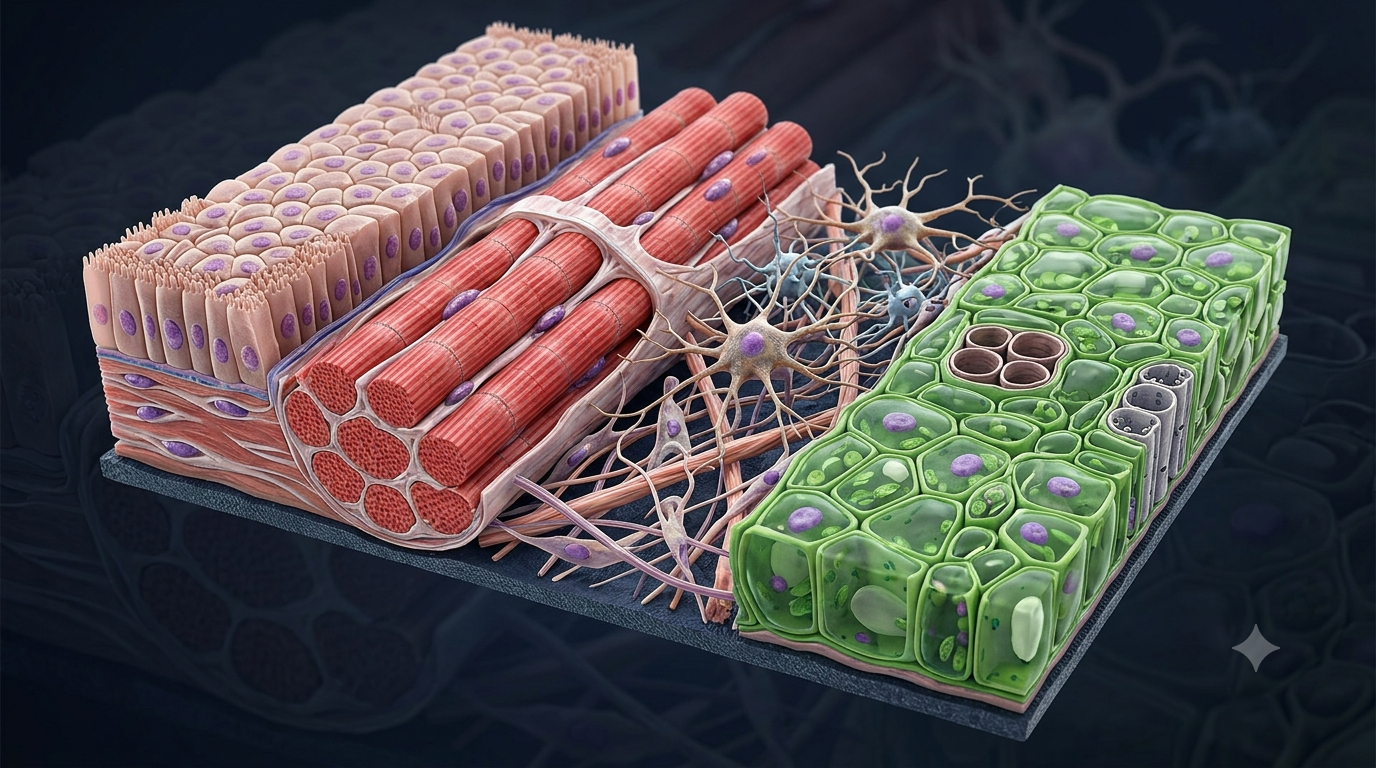
Animal tissues are commonly classified into four major types: epithelial, connective, muscle, and nervous tissue. Each type has specialized characteristics that help it perform particular functions.
1. Epithelial Tissue
Epithelial tissue covers body surfaces, lines internal cavities and organs, and forms many glands. It creates protective barriers and also performs functions such as absorption, secretion, and filtration.
The cells of epithelial tissue are usually closely packed together, with very little space between them. They are supported by a thin layer called the basement membrane, which separates the epithelium from underlying tissues.
Epithelial tissue can be classified according to the shape of its cells and the number of cell layers.
Common types of epithelial tissue include:
Squamous epithelium: Contains thin, flat cells. It is found in structures such as the air sacs of the lungs and the lining of blood vessels, where thin barriers support diffusion or exchange.
Cuboidal epithelium: Contains cube-shaped cells. It occurs in structures such as kidney tubules and some glands, where it supports absorption and secretion.
Columnar epithelium: Contains elongated cells. It lines much of the digestive tract, where it helps absorb nutrients and produce secretions.
Ciliated epithelium: Contains cells with hair-like structures called cilia. In parts of the respiratory tract, cilia help move mucus and trapped particles.
Epithelial tissue protects underlying structures from injury, harmful substances, and microorganisms. Its other functions depend on its location and specialization.
2. Connective Tissue
Connective tissue supports, connects, protects, and sometimes transports materials throughout the body. Unlike epithelial tissue, connective tissue often contains abundant extracellular matrix, a material made of ground substance and protein fibers surrounding its cells.
The composition of this matrix varies according to the tissue’s function. Some connective tissues are flexible, while others are firm or hard.
Major types of connective tissue include:
Areolar tissue: A loose connective tissue that supports and connects neighboring structures.
Adipose tissue: Stores fat, provides insulation, and cushions organs.
Dense connective tissue: Contains many collagen fibers and forms structures such as tendons and ligaments.
Cartilage: Provides flexible support and reduces friction at certain joints.
Bone: Provides structural support, protects organs, and stores minerals.
Blood: A fluid connective tissue that transports oxygen, nutrients, hormones, and waste products.
Connective tissues help maintain body structure and allow different tissues and organs to work together. Their functions range from mechanical support to transport and energy storage.
3. Muscle Tissue
Muscle tissue consists of specialized cells that contract and generate force. This force produces movement, maintains posture, and helps move substances through the body.
There are three main types of muscle tissue.
Skeletal muscle tissue
Skeletal muscle is usually attached to bones by tendons. Its contractions allow voluntary movements, such as walking, lifting objects, and writing. Skeletal muscles also contribute to posture and heat production.
Its cells are long, cylindrical, and contain multiple nuclei. Under a microscope, they show visible stripes called striations.
Smooth muscle tissue
Smooth muscle is found in the walls of many internal organs and blood vessels. It contracts without conscious control.
For example, smooth muscle helps move food through the digestive tract and regulates the diameter of blood vessels. Its cells are spindle-shaped and lack the prominent striations seen in skeletal and cardiac muscle.
Cardiac muscle tissue
Cardiac muscle is found in the heart. Its rhythmic contractions pump blood through the circulatory system.
Cardiac muscle cells are branched and striated, and they connect through specialized junctions that help coordinate contractions. Unlike skeletal muscle, cardiac muscle normally contracts involuntarily.
4. Nervous Tissue
Nervous tissue receives information, processes signals, and coordinates responses throughout the body. It is found in the brain, spinal cord, and peripheral nerves.
Nervous tissue contains two major groups of cells: neurons and glial cells.
Neurons are specialized cells that receive and transmit information through electrical and chemical signals. A typical neuron has a cell body, dendrites that receive many incoming signals, and an axon that carries signals away from the cell body.
Glial cells, also called neuroglia, support, protect, nourish, and regulate neurons. Some glial cells produce insulating myelin around axons, while others help maintain the chemical environment required for nervous system activity.
Together, neurons and glial cells allow the body to sense its environment, control movements, form memories, and regulate many internal processes.
Types of Tissues in Plants
Plants also contain specialized tissues that help them grow, obtain resources, transport materials, and maintain structural support. Plant tissues are commonly divided into meristematic tissue and permanent tissue.
1. Meristematic Tissue
Meristematic tissue contains actively dividing cells responsible for plant growth. These cells produce new cells that can later differentiate into specialized tissues.
Meristematic tissues are found in regions where plants grow.
Apical meristems
Apical meristems are located at the tips of roots and shoots. They are responsible for primary growth, which increases the length of roots and stems.
For example, the growth of a young plant toward sunlight involves the activity of tissues in the shoot system.
Lateral meristems
Lateral meristems contribute to secondary growth, which increases the thickness of stems and roots in many plants.
The vascular cambium produces secondary vascular tissues, while the cork cambium produces protective tissues. These processes are particularly important in woody plants.
Intercalary meristems
Intercalary meristems occur near the bases of leaves or internodes in certain plants, especially grasses. They allow continued growth from these regions and help grasses regrow after grazing or cutting.
2. Permanent Tissue
Permanent tissues develop when cells produced by meristems differentiate and become specialized. Many permanent tissue cells have limited or no ability to divide, although some retain the capacity to divide under suitable conditions.
Permanent tissues are generally classified into simple permanent tissues and complex permanent tissues.
Simple Permanent Tissue
Simple permanent tissues consist mainly of one type of cell.
Parenchyma
Parenchyma consists of living cells that commonly perform storage, photosynthesis, and tissue repair. In leaves, parenchyma cells containing chloroplasts carry out much of the photosynthesis.
Parenchyma may also store starch, water, and other substances.
Collenchyma
Collenchyma provides flexible support to growing plant parts. Its living cells have unevenly thickened cell walls, allowing them to strengthen stems and leaves without preventing growth.
Sclerenchyma
Sclerenchyma provides strong mechanical support. Many sclerenchyma cells develop thick, lignified cell walls and are dead at maturity.
Fibers and sclereids are common examples. They help strengthen plant structures and protect certain seeds and fruits.
Complex Permanent Tissue
Complex permanent tissues contain different types of cells that cooperate to perform a shared function. The two main types are xylem and phloem.
Xylem
Xylem transports water and dissolved mineral substances from the roots toward the stems and leaves. It also contributes to structural support.
Xylem contains conducting elements, such as vessel elements and tracheids, along with supporting and storage cells. In most mature conducting elements, the cells are dead and have specialized walls.
Phloem
Phloem transports sugars and other organic substances from sources, where they are produced or released, to sinks, where they are used or stored.
For example, sugars produced by photosynthesis in mature leaves may be transported to growing roots, developing fruits, or storage organs. Phloem contains living conducting cells and associated cells that support transport.
Xylem and phloem work together to distribute essential materials throughout the plant.
How Are Tissues Organized into Organs?
Tissues do not operate independently. They combine in specific arrangements to form organs that carry out complex functions.
In animals, the stomach provides a useful example. Its epithelial tissue produces protective secretions and helps regulate the exchange of substances. Connective tissue supports the stomach wall and contains blood vessels. Smooth muscle tissue contracts to mix food and move it toward the small intestine. Nervous tissue helps coordinate these activities.
The stomach functions effectively because its tissues are organized and cooperate with one another.
Plants show the same principle. A leaf contains an epidermis, mesophyll tissue, and vascular tissues. The epidermis protects the leaf, the mesophyll performs most photosynthesis, and the vascular tissues transport water, minerals, and sugars.
In both plants and animals, the position and arrangement of tissues are closely related to their functions. The organization allows an organ to perform tasks that individual cells cannot accomplish as efficiently on their own.
Why Are Tissues Important?
Tissues are essential because they make complex multicellular life possible. Their specialization improves the efficiency and coordination of biological activities.
Division of labor: Different tissues perform specific tasks, allowing organisms to carry out many activities simultaneously.
Protection: Epithelial tissues protect internal structures, while plant epidermal tissues help reduce water loss and defend against environmental hazards.
Movement: Muscle tissues produce movement in animals, while specialized plant tissues support growth and changes in plant position.
Transport: Blood transports substances in animals, while xylem and phloem distribute water, minerals, and organic nutrients in plants.
Growth and repair: Specialized cells produce new tissues during growth, and many tissues contain cells that help repair damage.
Coordination: Nervous tissue coordinates rapid communication in animals, while signaling between plant cells helps regulate growth and responses to environmental conditions.
Tissue organization also has medical importance. Many diseases affect particular tissues or change their normal structure. For example, damage to heart muscle can impair pumping, while changes in epithelial cells may contribute to certain cancers. Studying tissues helps scientists understand how diseases develop and how treatments may work.
What Is the Difference Between Cells, Tissues, and Organs?
Cells, tissues, and organs represent different levels of biological organization.
A cell is the smallest structural and functional unit of life. A tissue is a group of cells and associated materials working together to perform a function. An organ is a structure made of multiple tissue types that cooperate to carry out one or more functions.
For example, a muscle cell is a specialized cell. Many muscle cells organized with supporting structures form muscle tissue. Different tissues combine to form an organ, such as the heart, which pumps blood throughout the body.
The key difference is the level of organization. Cells form tissues, and tissues combine to form organs in complex multicellular organisms.
Conclusion
Tissues are organized groups of cells that cooperate to perform specific functions in multicellular organisms. They form through cell division, differentiation, and the coordinated arrangement of specialized cells. Animals have four major tissue types: epithelial, connective, muscle, and nervous tissue. Plants have meristematic and permanent tissues, including parenchyma, collenchyma, sclerenchyma, xylem, and phloem. These tissues combine to form organs, which work together within organ systems to support the life of an organism. Understanding tissue organization helps explain how living things grow, repair damage, transport materials, respond to their surroundings, and maintain normal functions. It also provides a foundation for studying anatomy, physiology, plant biology, and many aspects of medicine and biological research.
FAQs
1. What are tissues in biology?
Tissues are groups of similar or related cells that work together to perform specific functions in an organism. They are important building blocks of multicellular organisms, including plants and animals. Cells within a tissue often have specialized structures that help them carry out particular tasks efficiently. For example, muscle tissue produces movement, nervous tissue transmits signals, and epithelial tissue protects body surfaces. Tissues also contain extracellular materials that support and connect their cells. Different tissues combine to form organs, and organs work together in organ systems. This organization allows complex organisms to perform essential life processes efficiently.
2. What are the four main types of animal tissues?
The four main types of animal tissues are epithelial, connective, muscle, and nervous tissue. Epithelial tissue covers body surfaces, lines internal organs, and performs functions such as protection, absorption, and secretion. Connective tissue supports and connects body structures and includes bone, cartilage, blood, and adipose tissue. Muscle tissue contracts to produce movement and includes skeletal, smooth, and cardiac muscle. Nervous tissue receives, processes, and transmits information through neurons and supporting glial cells. Each tissue type has specialized structures suited to its functions. Together, these tissues form organs and help maintain the normal functioning of the animal body.
3. What is the difference between a cell and a tissue?
A cell is the basic structural and functional unit of life, while a tissue is an organized group of cells that work together to perform a particular function. Cells are generally smaller and represent a lower level of biological organization. Tissues contain multiple cells and associated materials that cooperate to perform specialized tasks. For example, an individual muscle cell can contract, but many muscle cells organized into muscle tissue generate coordinated force. Similarly, individual nerve cells transmit signals, while nervous tissue supports communication throughout the body. Cells form tissues, and different tissues combine to form organs in complex multicellular organisms.
4. What are the main types of plant tissues?
Plant tissues are commonly classified into meristematic tissue and permanent tissue. Meristematic tissue contains actively dividing cells responsible for plant growth. Apical meristems increase the length of roots and shoots, while lateral meristems contribute to increased thickness. Permanent tissues develop when cells differentiate and become specialized. Simple permanent tissues include parenchyma, collenchyma, and sclerenchyma. Parenchyma performs functions such as storage and photosynthesis, collenchyma provides flexible support, and sclerenchyma provides strength. Complex permanent tissues include xylem and phloem. Xylem transports water and minerals, while phloem distributes sugars and other organic substances throughout the plant.
5. How are tissues organized into organs?
Tissues are organized into organs when different tissue types combine and cooperate to perform specific functions. Each tissue contributes a particular role according to its structure and location. For example, the human heart contains cardiac muscle tissue that contracts to pump blood, connective tissue that provides support, epithelial tissue that lines internal surfaces, and nervous tissue that helps regulate activity. These tissues work together to maintain effective circulation. Similarly, a plant leaf contains protective epidermal tissue, photosynthetic mesophyll tissue, and vascular tissues for transport. The coordinated arrangement of different tissues allows organs to perform complex functions that individual cells or tissues cannot accomplish independently.
6. What is the difference between simple and complex permanent tissues in plants?
Simple permanent tissues consist mainly of one type of cell, whereas complex permanent tissues contain different types of cells working together to perform a shared function. Parenchyma, collenchyma, and sclerenchyma are the three main examples of simple permanent tissues. They perform functions such as storage, photosynthesis, and mechanical support. Xylem and phloem are complex permanent tissues. Xylem contains specialized conducting and supporting cells that transport water and minerals. Phloem contains conducting and associated cells that transport sugars and other organic substances. Both tissues are essential for distributing materials throughout plants and supporting their growth, development, and survival.
7. What is the role of epithelial tissue in the human body?
Epithelial tissue covers external body surfaces, lines internal organs and cavities, and forms glands. Its primary functions include protection, absorption, secretion, filtration, and exchange of substances. For example, the outer layer of the skin protects the body from physical damage and harmful environmental agents. Epithelial tissue lining the small intestine absorbs nutrients from digested food. In the respiratory tract, specialized ciliated epithelial cells help move mucus and trapped particles out of the airways. Glandular epithelial cells produce substances such as mucus, enzymes, and hormones. The structure of epithelial tissue varies according to the function it performs in each location.
8. Why is connective tissue important?
Connective tissue is important because it supports, connects, protects, and maintains the structure of the body. It commonly contains cells embedded in an extracellular matrix, whose composition varies depending on the tissue’s function. Bone provides structural support and protects internal organs, while cartilage offers flexible support and helps reduce friction at joints. Tendons connect muscles to bones, and ligaments connect bones to other bones. Adipose tissue stores energy, provides insulation, and cushions organs. Blood, another type of connective tissue, transports oxygen, nutrients, hormones, and waste products. These varied functions help maintain body structure and support the activities of other tissues.
9. What is the role of meristematic tissue in plants?
Meristematic tissue is responsible for plant growth because its cells actively divide to produce new cells. These newly formed cells can grow and differentiate into specialized tissues. Apical meristems occur at the tips of roots and shoots, increasing their length through primary growth. Lateral meristems contribute to secondary growth, increasing the thickness of stems and roots in many plants. Intercalary meristems occur near the bases of leaves or internodes in certain plants, especially grasses, and support continued growth from these regions. Meristematic activity allows plants to develop new leaves, roots, stems, and other structures throughout their lives.
10. Why is the study of tissues important in biology?
The study of tissues helps scientists understand how living organisms are structured and how their bodies function. It explains how specialized cells cooperate to perform activities such as movement, protection, transport, growth, and communication. Tissue study, known as histology, is also important in medicine because changes in tissue structure can indicate injury, infection, or disease. Medical professionals may examine tissue samples under microscopes to help diagnose certain conditions, including cancers. In plant biology, tissue studies explain growth, water transport, photosynthesis, and structural support. Understanding tissues provides a foundation for learning anatomy, physiology, pathology, developmental biology, and other scientific fields.