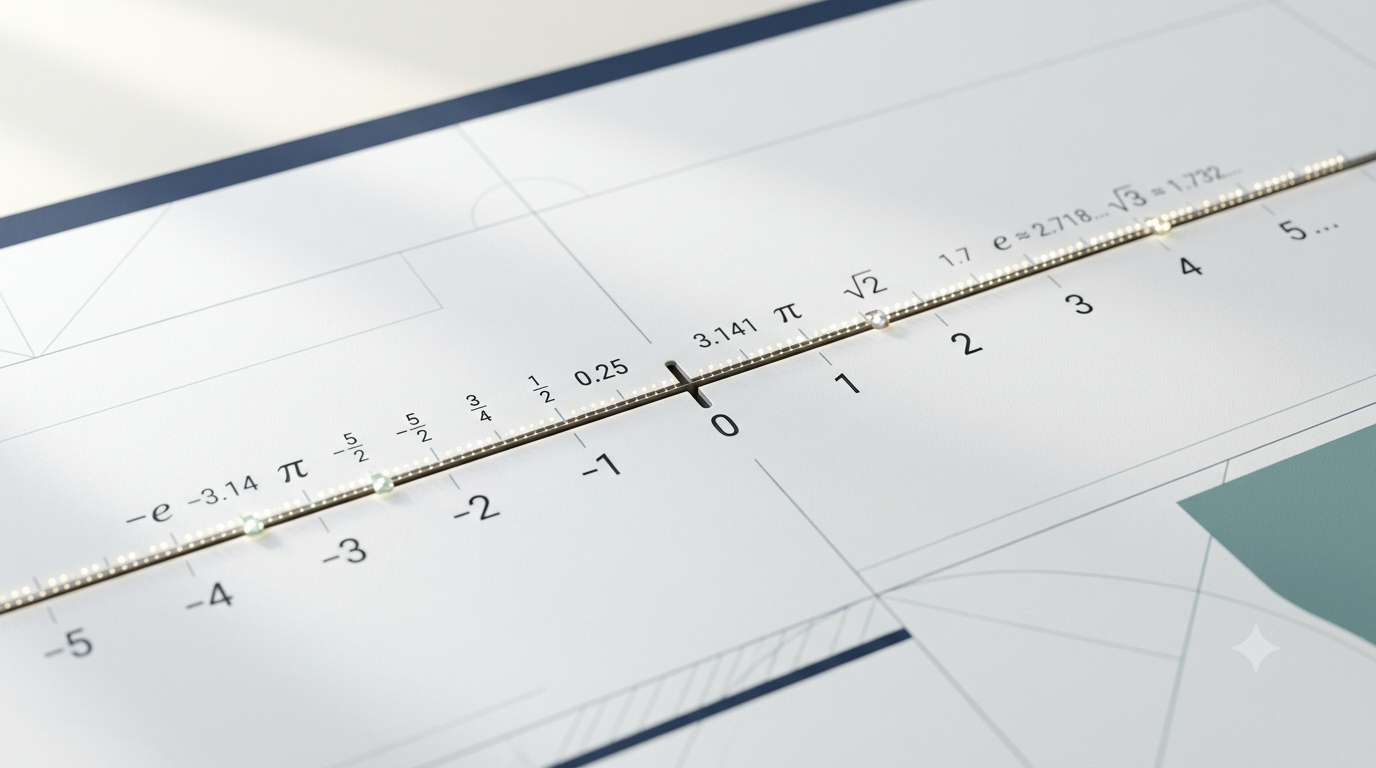
Real numbers are an essential part of mathematics because they represent almost every quantity we measure, calculate, or compare in everyday life. From counting objects and measuring distances to calculating temperatures, studying geometry, and solving algebraic equations, real numbers help us describe the world using mathematical values. They include natural numbers, whole numbers, integers, rational numbers, and irrational numbers. All these numbers can be represented on a single continuous line called the real number line.
The real number line provides a clear visual way to understand the relationship between numbers, their order, and the distances between them. Every point on this line corresponds to exactly one real number, and every real number has a unique position on it. In this article, we will learn what real numbers are, how they are classified, what makes the number line complete, and how these ideas are used in mathematics.
What Are Real Numbers?
Real numbers are all the numbers that can be represented as points on a continuous number line. They include both rational and irrational numbers.
Rational numbers can be expressed as the ratio of two integers, provided that the denominator is not zero. Examples include integers, fractions, and terminating or repeating decimals. Irrational numbers cannot be expressed as a ratio of two integers. Their decimal expansions continue indefinitely without repeating a fixed pattern.
Real numbers are commonly represented by the symbol ℝ.
Text block — Formula
ℝ = ℚ ∪ (ℝ \ ℚ)
Here, ℝ represents the set of real numbers, and ℚ represents the set of rational numbers. The expression means that real numbers consist of rational numbers together with irrational numbers.
For example, 5, −3, 2/7, 0.75, √2, and π are all real numbers. They may look different, but each has a definite position on the real number line.
Real numbers are important because they allow us to work with whole quantities, fractional quantities, negative values, and numbers that arise from measurements and geometric calculations.
Classification of Real Numbers
Real numbers can be divided into two major groups: rational numbers and irrational numbers. Rational numbers can be expressed as fractions of integers, whereas irrational numbers cannot.
1. Natural Numbers
Natural numbers are the counting numbers used to count objects. In many elementary mathematics contexts, they begin with 1, although some mathematical conventions include 0.
Examples include 1, 2, 3, 4, 5, and so on.
Natural numbers are used when counting books, people, trees, or other objects. They are a basic part of the number system.
Text block — Formula
ℕ = {1, 2, 3, 4, 5, …}
This definition uses the convention that natural numbers begin with 1.
2. Whole Numbers
Whole numbers include all natural numbers together with zero. They do not include negative numbers or fractions.
Examples include 0, 1, 2, 3, 4, and 5.
Whole numbers are useful when representing quantities that cannot be negative, such as the number of items in a box.
Text block — Formula
W = {0, 1, 2, 3, 4, 5, …}
Every natural number is a whole number, but zero is a whole number that is not included in the convention for natural numbers used above.
3. Integers
Integers include positive whole numbers, negative whole numbers, and zero. They do not include fractions or non-integer decimal values.
Examples include −5, −4, −3, −2, −1, 0, 1, 2, 3, and 4.
Integers are useful for describing quantities such as temperatures below zero, financial losses, and changes in elevation relative to a reference point.
Text block — Formula
ℤ = {…, −3, −2, −1, 0, 1, 2, 3, …}
The symbol ℤ represents the set of integers.
4. Rational Numbers
A rational number is any number that can be written as a fraction of two integers, with a nonzero denominator.
Text block — Formula
r = a/b, where a, b ∈ ℤ and b ≠ 0
In this formula, a is the numerator and b is the denominator.
Examples of rational numbers include:
1/2
−3/4
7
0
0.25
0.333…
Every integer is rational because it can be written as a fraction with denominator 1. For example, 7 can be written as 7/1.
Rational numbers may have terminating decimal expansions, such as 0.25, or repeating decimal expansions, such as 0.333… . Both types belong to the rational number system.
5. Irrational Numbers
Irrational numbers are real numbers that cannot be expressed as a ratio of two integers. Their decimal expansions are non-terminating and non-repeating.
Examples include √2, √3, π, and e.
For example, √2 is approximately 1.41421356, but its decimal expansion continues indefinitely without repeating. Similarly, π is approximately 3.14159 and has infinitely many non-repeating decimal digits.
Irrational numbers are important in geometry, algebra, calculus, and scientific calculations. The diagonal of a unit square has a length of √2, while π is used in calculations involving circles.
Understanding the Real Number Line
The real number line is a straight line on which every point represents a real number. It extends indefinitely in both directions.
Zero is placed at the center of the reference system, with positive numbers to its right and negative numbers to its left. The distance between consecutive integers is equal when the line is drawn using a consistent scale.
Text block — Number Line
<---------|---------|---------|---------|--------->
The diagram above illustrates the general idea of a number line, but the spacing should be kept equal between all consecutive integers when drawing it accurately.
On a real number line:
Positive numbers lie to the right of zero.
Negative numbers lie to the left of zero.
Zero separates positive numbers from negative numbers.
Numbers farther to the right are greater than numbers to the left.
Every real number has a unique position on the line.
For example, 4 is to the right of 2, so 4 is greater than 2. Similarly, −1 is to the right of −4, meaning −1 is greater than −4.
The real number line is not limited to integers. Fractions, decimals, square roots, and other irrational numbers also occupy positions between or beyond integers.
Positive Numbers, Negative Numbers, and Zero
The position of a real number relative to zero determines whether it is positive, negative, or equal to zero.
Positive Numbers
Positive real numbers are greater than zero. They appear to the right of zero on the number line.
Examples include 1, 2.5, 3/4, √2, and π.
Positive numbers can represent quantities such as profit, height above sea level, or temperature above zero.
Negative Numbers
Negative real numbers are less than zero. They appear to the left of zero.
Examples include −1, −4, −2.5, and −7/3.
Negative numbers are useful for describing debts, temperatures below zero, and positions below a reference level.
Zero
Zero represents neither a positive nor a negative number. It separates the positive and negative portions of the number line.
Zero is also an integer, a rational number, and a real number. It can represent the absence of a quantity, a balance point, or a reference value.
How to Represent Real Numbers on the Number Line
Representing real numbers on a number line involves identifying the correct position of each value. The process depends on whether the number is an integer, fraction, decimal, or irrational number.
Representing Integers
Integers can be placed directly on the number line using equal intervals.
For example, to represent −3, start at zero and move three equal units to the left. To represent 4, move four equal units to the right.
The greater the absolute value of an integer, the farther it lies from zero.
Representing Fractions
Fractions are placed between integers according to their numerical values.
Consider the fraction 1/2. It lies halfway between 0 and 1 because its value is 0.5.
Text block — Formula
1/2 = 0.5
To represent 3/4, divide the interval between 0 and 1 into four equal parts. The third division from zero represents 3/4.
Negative fractions are placed on the left side of zero. For example, −1/2 lies halfway between −1 and 0.
Representing Decimal Numbers
Decimal numbers can be placed by identifying the interval in which they belong and then locating their precise position.
For example, 2.7 lies between 2 and 3. It is seven-tenths of the distance from 2 to 3.
Similarly, −1.4 lies between −2 and −1.
Decimal values make it easier to represent measurements and quantities that fall between whole numbers.
Representing Irrational Numbers
Irrational numbers can also be represented on the number line, although their exact decimal expansions cannot be written completely.
For example, √2 lies between 1 and 2 because its approximate value is 1.414.
Text block — Formula
1² < 2 < 2²
Therefore, 1 < √2 < 2.
A more accurate decimal approximation can be used to locate √2 closer to its exact position. The point represents √2 itself, not merely its rounded decimal approximation.
The number π lies between 3 and 4 and can be placed using its approximate value of 3.14159.
Comparing Real Numbers
The real number line provides a simple way to compare two real numbers. A number positioned farther to the right is always greater than a number positioned farther to the left.
For example:
Text block — Formula
5 > 2
−1 > −4
0 > −3
These comparisons demonstrate that positive numbers are greater than negative numbers and that a negative number closer to zero is greater than a negative number farther from zero.
Fractions and decimals can be compared in the same way. For example, 0.8 is greater than 0.5 because 0.8 lies farther to the right.
Text block — Formula
0.8 > 0.5
When comparing irrational numbers, decimal approximations or other mathematical methods can help establish their order. For example, √3 is greater than √2 because both are positive and 3 is greater than 2.
Text block — Formula
√3 > √2
Understanding comparisons is useful in inequalities, coordinate geometry, measurement, and algebra.
The Distance Between Real Numbers
The distance between two real numbers is the length of the interval separating their positions on the number line. Distance is always non-negative, even when one or both numbers are negative.
The absolute value of the difference between two numbers gives their distance.
Text block — Formula
Distance between a and b = |a − b|
For example, the distance between 2 and 7 is 5 units.
Text block — Formula
|7 − 2| = |5| = 5
The distance between −3 and 4 is 7 units.
Text block — Formula
|4 − (−3)| = |7| = 7
Notice that the distance between −3 and 4 is the same regardless of which number is subtracted from the other, because absolute value removes the negative sign.
Distance on the number line is especially useful when studying absolute value, equations, inequalities, and coordinate geometry.
What Does a Complete Number Line Mean?
The word complete has a special mathematical meaning when used to describe the real number line. It does not simply mean that the line contains many numbers. It means that the real number system has no missing points corresponding to finite positions on the line.
The rational numbers alone do not form a complete number line. Although rational numbers can be found between any two distinct real numbers, there are also positions on the line that cannot be represented by rational numbers.
For example, the point corresponding to √2 cannot be represented by any fraction of two integers. However, √2 is still a real number, so its point belongs to the real number line.
The real number system includes these irrational values and fills the gaps that would remain if we considered rational numbers alone.
The Completeness Property
A key property of the real numbers is that every nonempty set of real numbers that has an upper bound has a least upper bound, also called its supremum.
An upper bound is a number that is greater than or equal to every member of a set. The least upper bound is the smallest number with that property.
Consider all real numbers greater than or equal to 0 whose squares are less than 2. The numbers in this set approach √2 from below. The least upper bound of this set is √2, even though √2 is not rational.
This property is one of the foundations of real analysis and is essential for understanding limits, continuity, and calculus.
The completeness of the real numbers ensures that mathematical processes involving converging sequences, bounded sets, and continuous functions can be described rigorously.
Rational Numbers and Irrational Numbers on the Complete Line
Rational and irrational numbers are mixed throughout the real number line. There is no interval between two distinct real numbers that contains only rational numbers or only irrational numbers.
In fact, both types of numbers are dense in the real number line. This means that between any two distinct real numbers, there is at least one rational number and at least one irrational number.
For example, between 1 and 2, we can find rational numbers such as 3/2 and irrational numbers such as √2.
Text block — Formula
1 < √2 < 3/2 < 2
This ordering is correct because √2 is approximately 1.414, while 3/2 equals 1.5.
The existence of both rational and irrational numbers in every interval shows that the real number line is much richer than a sequence of evenly spaced integers. It contains infinitely many numbers between any two distinct points.
Important Properties of Real Numbers
Real numbers follow several fundamental mathematical properties. These properties make calculations consistent and allow complicated expressions to be simplified.
Closure Property
Real numbers are closed under addition, subtraction, and multiplication. Dividing one real number by another also produces a real number when the divisor is not zero.
Text block — Formula
If a, b ∈ ℝ, then:
a + b ∈ ℝ
a − b ∈ ℝ
a × b ∈ ℝ
a ÷ b ∈ ℝ, provided b ≠ 0
Commutative Property
Addition and multiplication are commutative, meaning the order of the numbers does not change the result.
Text block — Formula
a + b = b + a
a × b = b × a
Subtraction and division are not generally commutative.
Associative Property
Addition and multiplication are associative, meaning the grouping of numbers does not change the result.
Text block — Formula
(a + b) + c = a + (b + c)
(a × b) × c = a × (b × c)
Distributive Property
Multiplication distributes over addition and subtraction.
Text block — Formula
a(b + c) = ab + ac
a(b − c) = ab − ac
These properties are widely used in arithmetic, algebra, equations, and mathematical proofs.
The Relationship Between Real Numbers and Other Number Systems
The number systems studied in elementary mathematics are connected through inclusion.
Natural numbers are contained within whole numbers. Whole numbers are contained within integers. Integers are contained within rational numbers, and rational numbers are contained within real numbers.
Irrational numbers also belong to the real numbers, but they are not rational.
Text block — Formula
ℕ ⊆ W ⊆ ℤ ⊆ ℚ ⊆ ℝ
This relationship uses the convention that natural numbers begin with 1.
The symbol ⊆ means that every element of the set on the left also belongs to the set on the right.
For example, 6 is a natural number, a whole number, an integer, a rational number, and a real number. However, √5 is irrational and real, but it is not rational.
Understanding these relationships helps prevent common classification errors and provides a foundation for more advanced mathematics.
Applications of the Real Number Line
The real number line is not just a theoretical mathematical concept. It is useful in many practical situations.
Measurement and Everyday Life
Measurements such as height, weight, distance, and time often involve fractions or decimal values. A number line helps us compare these values and understand the differences between them.
For example, a length of 2.5 metres lies between 2 and 3 metres.
Temperature
Temperatures may be positive, negative, or zero. The number line helps us compare temperatures and calculate changes.
For example, a temperature of −5°C is lower than −2°C because −5 lies farther to the left.
Finance
Positive and negative numbers can represent profits and losses, credits and debts, or increases and decreases in a balance.
A number line can help illustrate how a financial value changes when money is added or removed.
Geometry
Irrational numbers occur naturally in geometry. The diagonal of a unit square has length √2, while the circumference of a circle involves π.
These values can be located on the real number line and used in geometric calculations.
Algebra and Calculus
The real number line is essential for understanding inequalities, intervals, absolute value, limits, and continuous functions.
In calculus, completeness helps establish important results about convergence and continuity. It provides the mathematical foundation for many methods used in science, engineering, economics, and applied mathematics.
Common Mistakes to Avoid
When learning about real numbers and the number line, several mistakes are common.
First, do not assume that all decimal numbers are irrational. Terminating decimals and repeating decimals are rational numbers. For example, 0.125 equals 1/8.
Second, remember that negative numbers closer to zero are greater than negative numbers farther from zero. For example, −2 is greater than −5.
Third, zero is neither positive nor negative, although it belongs to the integers, rational numbers, and real numbers.
Fourth, do not confuse a decimal approximation with an exact irrational number. The decimal 1.414 is a rational number, while √2 is irrational.
Finally, do not assume that rational numbers alone fill the number line. Irrational numbers are essential to the completeness of the real number system.
Conclusion
Real numbers form the foundation of much of mathematics. They include rational and irrational numbers, covering integers, fractions, terminating decimals, repeating decimals, square roots of certain numbers, and constants such as π. The real number line gives every real number a unique position and allows us to compare values, measure distances, and represent mathematical relationships visually.
The completeness of the real number system is especially important because it ensures that every finite position on the line corresponds to a real number, including positions associated with irrational values. By understanding the classification of real numbers, their order, their properties, and their representation on a complete number line, learners can develop a strong foundation for algebra, geometry, calculus, and many scientific applications.
FAQs
1. What are real numbers?
Real numbers are all numbers that can be represented as points on the real number line. They include rational numbers, such as integers, fractions, and terminating or repeating decimals, as well as irrational numbers, such as √2 and π. Real numbers can be positive, negative, or zero. They are used to represent quantities such as distance, temperature, time, and measurements. The symbol ℝ represents the set of real numbers. Understanding real numbers is essential for learning algebra, geometry, calculus, and other branches of mathematics.
2. What are the different types of real numbers?
Real numbers are classified into two main groups: rational and irrational numbers. Rational numbers can be expressed as a fraction of two integers with a nonzero denominator. They include natural numbers, whole numbers, integers, fractions, and repeating decimals. Irrational numbers cannot be expressed as a ratio of two integers and have non-terminating, non-repeating decimal expansions. Examples include √2, √3, and π. Together, rational and irrational numbers form the complete set of real numbers. This classification helps learners understand how different number systems are connected.
3. What is the real number line?
The real number line is a straight line that represents every real number as a unique point. Zero is the reference point, positive numbers lie to its right, and negative numbers lie to its left. The distance between consecutive integers is equal when the line uses a consistent scale. Fractions, decimals, and irrational numbers also occupy positions on this line. The real number line helps us compare values, calculate distances, and understand inequalities. It is an important visual tool for learning arithmetic, algebra, coordinate geometry, and other mathematical concepts.
4. Why is the real number line called complete?
The real number line is called complete because the real number system contains all the points corresponding to finite real values, including those associated with irrational numbers. Mathematically, completeness means that every nonempty set of real numbers with an upper bound has a least upper bound within the real numbers. For example, √2 is the least upper bound of the set of nonnegative real numbers whose squares are less than 2. This property distinguishes the real numbers from the rational numbers alone and provides an essential foundation for mathematical analysis, limits, and calculus.
5. What is the difference between rational and irrational numbers?
Rational numbers can be written as fractions of two integers, provided the denominator is not zero. Their decimal expansions either terminate or repeat a pattern. Examples include 1/2, −3, 0.75, and 0.333… . Irrational numbers cannot be written as such fractions. Their decimal expansions continue indefinitely without repeating a fixed pattern. Examples include √2, √5, and π. Both rational and irrational numbers belong to the real number system. They are found throughout the number line, and there are infinitely many of both types between any two distinct real numbers.
6. How do you represent fractions and decimals on a number line?
To represent a fraction or decimal, first identify the two numbers between which it lies. Then divide the interval into equal parts according to the value being represented. For example, 1/2 lies halfway between 0 and 1, while 3/4 lies three-quarters of the way from 0 to 1. Similarly, 2.6 lies between 2 and 3, six-tenths of the way from 2. Negative fractions and decimals are placed to the left of zero. Accurate spacing and a consistent scale help ensure that each number is placed correctly.
7. Can every real number be represented exactly on a number line?
Yes. Every real number corresponds to exactly one point on the real number line, and every point on the line corresponds to exactly one real number. This includes integers, fractions, decimals, and irrational numbers. However, drawing or marking a number physically may involve limited precision. For example, √2 has an exact position, but its decimal expansion cannot be written completely. Using the approximation 1.414 helps locate it, although this decimal is not exactly equal to √2. The mathematical number line represents the exact value, regardless of the limitations of a drawing or measurement.
8. How do you compare two real numbers using a number line?
To compare two real numbers, locate both numbers on the number line. The number farther to the right is greater, while the number farther to the left is smaller. For example, 4 is greater than 1 because it lies to the right of 1. Similarly, −2 is greater than −5 because −2 is closer to zero and lies farther to the right. This method works for positive numbers, negative numbers, fractions, decimals, and irrational numbers. Comparing real numbers is useful when solving inequalities, ordering measurements, and determining which of two quantities has a greater value.
9. What is the distance between two real numbers?
The distance between two real numbers is the non-negative length separating their positions on the number line. It can be calculated by taking the absolute value of their difference. For example, the distance between 3 and 8 is 5 units. The distance between −4 and 2 is 6 units. Distance is always zero or positive because it measures separation rather than direction. This concept is closely connected to absolute value and is used in geometry, algebra, measurement, and coordinate systems. It also helps explain how far a number lies from zero or another reference value.
10. Why are real numbers important in mathematics and everyday life?
Real numbers are important because they allow us to represent and calculate a wide variety of quantities. Integers describe whole-number changes, fractions represent parts of a whole, decimals express precise measurements, and irrational numbers appear in geometry and scientific formulas. Real numbers are used in financial calculations, temperature measurements, engineering, physics, and computer-based scientific models. The real number line makes their relationships easier to understand by showing order and distance visually. Learning about real numbers and their completeness provides a strong foundation for advanced mathematics, including algebra, calculus, mathematical analysis, and many practical applications.








