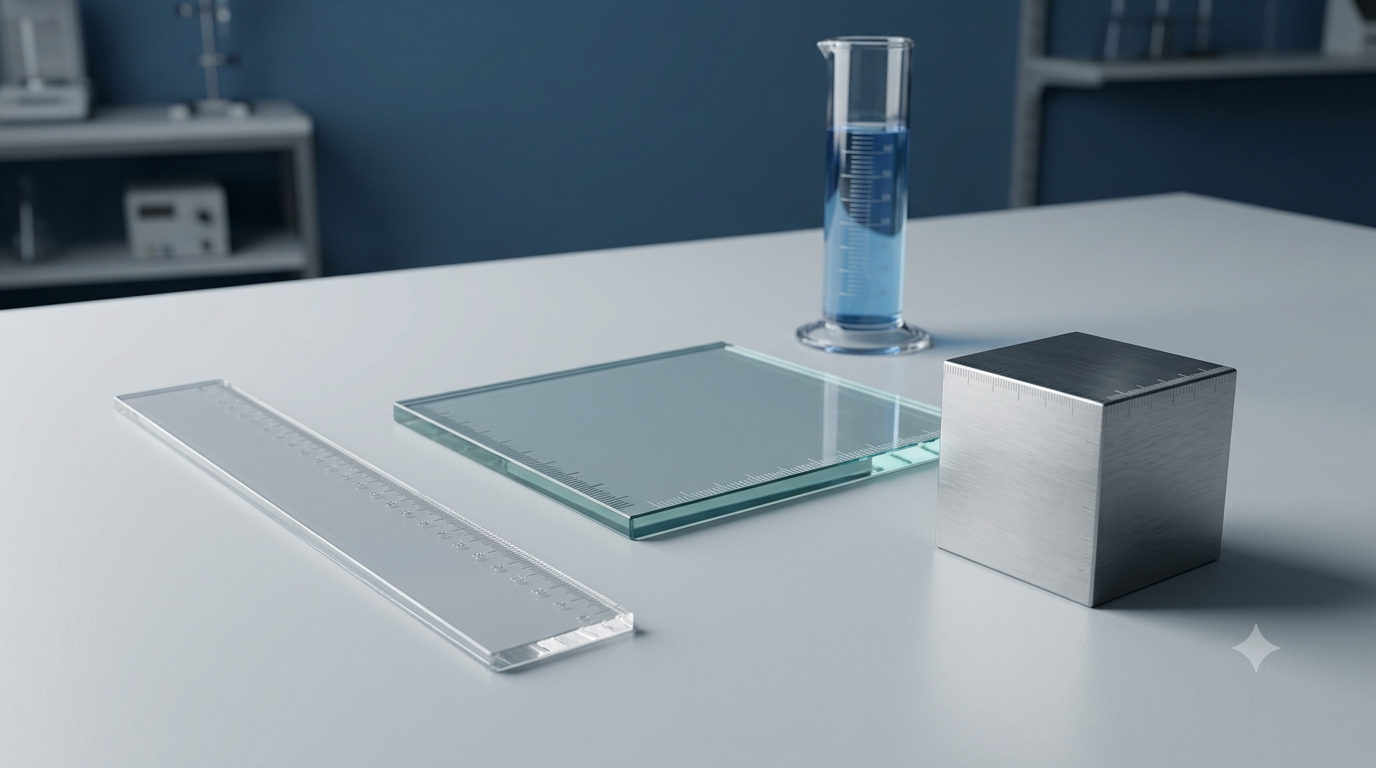
Measurements are an important part of mathematics and everyday life. We use units of length to measure distances, units of area to describe surfaces, and units of volume to determine how much space an object occupies. However, measurements are not always expressed in the same units. A road may be measured in kilometres, a classroom in metres, a book in centimetres, and the thickness of a sheet in millimetres. Similarly, land may be measured in square metres or hectares, while water and other liquids may be measured in litres or millilitres.
Converting units helps us compare measurements, solve mathematical problems, and communicate quantities accurately. Although length, area, and volume are related, their conversion methods are different. Length involves one dimension, area involves two dimensions, and volume involves three dimensions. In this article, you will learn how to convert units of length, area, and volume, understand the rules behind these conversions, and apply them to practical examples.
1. Understanding Units of Measurement
A unit of measurement is a standard quantity used to express the size, distance, area, volume, or another measurable property of something. Without standard units, it would be difficult to compare measurements or communicate results accurately.
The International System of Units (SI) provides widely used standard units for scientific measurements. The metre is the SI base unit of length, the square metre is the SI-derived unit of area, and the cubic metre is the SI-derived unit of volume.
Different units are useful for different situations. For example, kilometres are convenient for measuring distances between cities, centimetres are useful for measuring the dimensions of small objects, and millimetres are suitable for measuring thin materials.
The same principle applies to area and volume. Square metres are commonly used for floors and rooms, while square kilometres are suitable for large regions. Cubic centimetres are useful for small solid objects, whereas cubic metres are appropriate for larger spaces and quantities.
Understanding the relationships between these units makes conversion easier and reduces errors in calculations.
2. How to Convert Units of Length
Length measures the distance between two points or the size of an object in one dimension. Common metric units of length include kilometres, metres, centimetres, and millimetres.
The metric system follows a decimal structure, so converting between these units involves multiplying or dividing by powers of 10.
Common Length Conversion Relationships
Text block — Length Conversion Formulas
1 kilometre (km) = 1,000 metres (m)
These relationships form the foundation of length conversion. Once you know them, you can convert between many units by multiplying or dividing by the appropriate factor.
Converting Larger Units into Smaller Units
When converting a larger unit into a smaller unit, multiply the given measurement by the conversion factor.
For example, one metre contains 100 centimetres. Therefore, a measurement expressed in metres becomes a larger numerical value when written in centimetres.
Text block — Example 1
Convert 5 metres into centimetres.
Therefore, 5 metres is equal to 500 centimetres.
Consider another example involving kilometres.
Text block — Example 2
Convert 3.5 kilometres into metres.
The answer is 3,500 metres.
Converting Smaller Units into Larger Units
When converting a smaller unit into a larger unit, divide the measurement by the conversion factor.
For example, since 100 centimetres equal one metre, a measurement in centimetres must be divided by 100 to express it in metres.
Text block — Example 3
Convert 450 centimetres into metres.
Therefore, 450 centimetres is equal to 4.5 metres.
Text block — Example 4
Convert 2,750 millimetres into metres.
The result is 2.75 metres.
A Simple Rule for Length Conversion
Remember the following rule:
Larger unit to smaller unit: multiply.
Smaller unit to larger unit: divide.
For example, converting kilometres to metres requires multiplication by 1,000, while converting metres to kilometres requires division by 1,000.
This rule works because the units measure the same physical quantity: length.
3. How to Convert Units of Area
Area measures the amount of surface covered by a two-dimensional shape. It is commonly used to measure floors, walls, fields, gardens, and plots of land.
Unlike length, area involves two dimensions: length and width. This is why area conversion factors are squared.
For example, one metre equals 100 centimetres. However, one square metre does not equal 100 square centimetres. Instead, it equals 10,000 square centimetres.
To understand why, consider a square measuring one metre on each side. Each side is 100 centimetres long. The area is calculated by multiplying the length by the width.
Text block — Area Calculation
Area of a square = side × side
This demonstrates why area conversion factors must account for both dimensions.
Common Area Conversion Relationships
Text block — Area Conversion Formulas
1 square kilometre (km²) = 1,000,000 square metres (m²)
These conversions are especially useful in geometry, construction, agriculture, land measurement, and property planning.
Converting Larger Units of Area into Smaller Units
When converting a larger area unit into a smaller one, multiply by the appropriate squared conversion factor.
Text block — Example 5
Convert 4 square metres into square centimetres.
Therefore, 4 square metres equals 40,000 square centimetres.
Notice that the conversion factor is 10,000 rather than 100. This is because area has two dimensions.
Text block — Example 6
Convert 2.5 square kilometres into square metres.
The answer is 2,500,000 square metres.
Converting Smaller Units of Area into Larger Units
To convert a smaller area unit into a larger one, divide by the appropriate conversion factor.
Text block — Example 7
Convert 75,000 square centimetres into square metres.
Therefore, 75,000 square centimetres equals 7.5 square metres.
Text block — Example 8
Convert 35,000 square metres into hectares.
The result is 3.5 hectares.
Why Area Conversion Factors Are Squared
The conversion factor for area is squared because area is calculated using two lengths.
If each length is multiplied by 100 during conversion from metres to centimetres, the area is multiplied by 100 × 100, which equals 10,000.
The general relationship is:
Text block — Area Conversion Rule
1 m = 100 cm
When converting square kilometres to square metres, the length conversion factor is 1,000. Squaring it gives 1,000 × 1,000, or 1,000,000.
Understanding this principle helps you calculate area conversions instead of memorising every conversion factor.
4. How to Convert Units of Volume
Volume measures the amount of three-dimensional space occupied by an object or substance. It is used to describe the capacity of containers, the size of solid objects, and the amount of liquids or gases.
Common metric units of volume include cubic metres, cubic centimetres, and cubic millimetres. Litres and millilitres are also widely used for liquid capacity.
Volume conversion factors are cubed because volume involves three dimensions: length, width, and height.
For example, a cube measuring one metre along each edge has a volume of one cubic metre. Each edge is 100 centimetres long, so its volume in cubic centimetres is calculated by multiplying all three dimensions.
Text block — Volume Calculation
Volume of a cube = side × side × side
Therefore, one cubic metre equals one million cubic centimetres.
Common Volume Conversion Relationships
Text block — Volume Conversion Formulas
1 cubic metre (m³) = 1,000,000 cubic centimetres (cm³)
These relationships are useful in science laboratories, cooking, medicine, engineering, manufacturing, and everyday measurements.
Converting Larger Units of Volume into Smaller Units
When converting a larger cubic unit into a smaller cubic unit, multiply by the appropriate cubed conversion factor.
Text block — Example 9
Convert 3 cubic metres into cubic centimetres.
Therefore, 3 cubic metres equals 3,000,000 cubic centimetres.
Text block — Example 10
Convert 2.4 litres into millilitres.
The answer is 2,400 millilitres.
Converting Smaller Units of Volume into Larger Units
When converting a smaller volume unit into a larger one, divide by the appropriate conversion factor.
Text block — Example 11
Convert 850,000 cubic centimetres into cubic metres.
Therefore, 850,000 cubic centimetres equals 0.85 cubic metres.
Text block — Example 12
Convert 3,600 millilitres into litres.
The result is 3.6 litres.
Why Volume Conversion Factors Are Cubed
Volume is calculated by multiplying three dimensions. Consequently, a conversion factor for length must be applied three times when converting cubic units.
For example, when converting metres into centimetres, the factor is 100. For cubic metres, the factor becomes 100 × 100 × 100, which equals 1,000,000.
Text block — Volume Conversion Rule
1 m = 100 cm
This is the key difference between length, area, and volume conversion.
5. The Difference Between Length, Area, and Volume Conversion
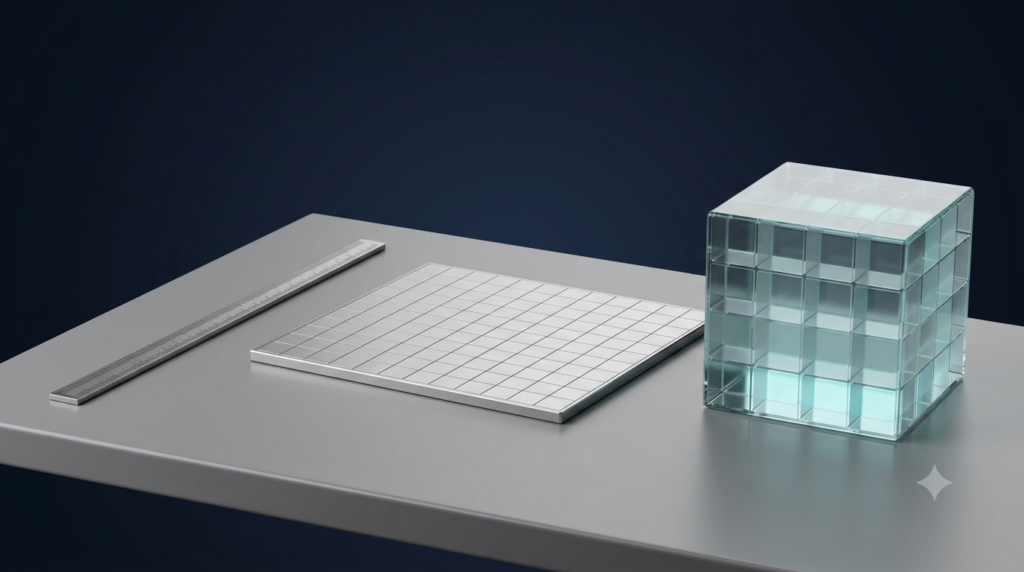
Length, area, and volume are connected, but they measure different properties. Their conversion factors depend on the number of dimensions involved.
Length measures one dimension, area measures two dimensions, and volume measures three dimensions. Therefore, the same basic length conversion factor produces different results when applied to area and volume.
The following comparison makes these differences easier to understand.
| Measurement | Dimensions | Example conversion |
|---|---|---|
| Length | One | 1 m = 100 cm |
| Area | Two | 1 m² = 10,000 cm² |
| Volume | Three | 1 m³ = 1,000,000 cm³ |
A common mistake is to use the length conversion factor directly for area or volume. For example, multiplying square metres by 100 to convert them into square centimetres is incorrect. The correct factor is 10,000.
Similarly, multiplying cubic metres by 100 to convert them into cubic centimetres is incorrect. The correct factor is 1,000,000.
Remembering the number of dimensions helps prevent these mistakes.
6. A General Method for Converting Units
You can follow a simple procedure to convert most metric measurements accurately.
Step 1: Identify the Original Unit
First, identify the unit in which the measurement is given. It might be metres, square centimetres, cubic metres, litres, or another unit.
For example, consider a measurement of 6.5 m². The original unit is square metres, so the measurement represents area.
Step 2: Identify the Required Unit
Determine the unit into which the measurement must be converted. For example, you might need to express 6.5 m² in square centimetres.
Step 3: Find the Conversion Factor
Identify the relationship between the original and target units. For area, remember to use the squared conversion factor.
In this example:
Text block — Conversion Factor
1 m² = 10,000 cm²Step 4: Decide Whether to Multiply or Divide
Multiply when converting from a larger unit to a smaller unit. Divide when converting from a smaller unit to a larger unit.
This rule applies when comparing units within the same measurement type.
Step 5: Calculate the Result
Apply the conversion factor to the original value.
Text block — Complete Conversion
6.5 m² = 6.5 × 10,000 cm²
Step 6: Write the Correct Unit
Always include the correct unit in the final answer. A numerical value without a unit may be incomplete or misleading.
For example, 65,000 cm² represents an area, whereas 65,000 cm represents a length. These quantities are not interchangeable.
7. Common Mistakes to Avoid
Even simple conversions can produce incorrect results when the conversion factor or unit symbol is used incorrectly. Understanding common mistakes can help improve accuracy.
Using the Length Factor for Area
One frequent error is treating one square metre as 100 square centimetres. The correct relationship is 1 m² = 10,000 cm².
Area involves two dimensions, so the conversion factor must be squared.
Using the Length Factor for Volume
Another common mistake is treating one cubic metre as 1,000 cubic centimetres. The correct relationship is 1 m³ = 1,000,000 cm³.
Volume involves three dimensions, so the conversion factor must be cubed.
Confusing Square and Cubic Units
Square units describe area, while cubic units describe volume. For example, cm² and cm³ represent different quantities.
Always check whether the measurement is a length, an area, or a volume before performing the calculation.
Multiplying Instead of Dividing
Choosing the wrong operation can make the result incorrect. When converting 500 centimetres into metres, divide by 100 rather than multiply by 100.
The answer is 5 metres, not 50,000 metres.
Forgetting to Change the Unit
A correct numerical calculation is not enough if the unit is incorrect. If you convert 4 litres into millilitres, the answer is 4,000 millilitres, not 4,000 litres.
Rounding Too Early
Avoid rounding intermediate values unless necessary. Keeping sufficient decimal places during calculations helps prevent small errors, especially when several conversions are required.
8. Practical Applications of Unit Conversion
Unit conversion is useful in many real-life situations, not just mathematics exercises.
Construction and Architecture
Builders and architects convert lengths when measuring walls, doors, windows, and other structures. They also convert areas when estimating flooring, painting, roofing, and land requirements.
For example, calculating the area of a room in square metres helps determine how much flooring material is needed.
Agriculture and Land Measurement
Farmers and land surveyors frequently use square metres, hectares, and square kilometres. Converting between these units makes it easier to compare plots of land and estimate the area available for cultivation.
For example, a field measuring 20,000 m² has an area of 2 hectares.
Science Laboratories
Scientists convert volume units when measuring liquids, preparing solutions, and recording experimental results. Litres and millilitres are common in laboratory work, while cubic centimetres may be used to describe small objects or sample volumes.
Accurate conversions are essential because incorrect quantities can affect experimental results.
Cooking and Everyday Activities
Cooking often involves converting litres into millilitres or measuring the dimensions of baking containers. Understanding these relationships helps people follow recipes and compare container capacities.
For example, 0.75 litres equals 750 millilitres.
Engineering and Manufacturing
Engineers work with precise dimensions, surface areas, and volumes. Unit conversion helps ensure that components are manufactured to the correct specifications and that materials are measured consistently.
Using the wrong unit can lead to errors in design, production, or construction.
9. Quick Practice Examples
Practising different types of conversions helps you remember the rules and apply them confidently.
Text block — Practice Questions
1. Convert 8 metres into centimetres.
Text block — Answers
1. 800 cm
Check each answer by identifying the original unit, finding the conversion factor, and deciding whether multiplication or division is required.
Conclusion
Converting units of length, area, and volume is an essential mathematical skill that helps us measure and compare quantities accurately. Length conversion uses the basic conversion factor, area conversion uses the square of that factor, and volume conversion uses its cube. For example, one metre equals 100 centimetres, one square metre equals 10,000 square centimetres, and one cubic metre equals 1,000,000 cubic centimetres.
The most effective way to master unit conversion is to understand why these factors differ rather than memorising every relationship separately. By identifying the measurement type, selecting the correct conversion factor, and multiplying or dividing carefully, you can solve conversion problems confidently. These skills are useful in mathematics, science, construction, agriculture, engineering, and everyday life.
FAQs
1. What is unit conversion in measurement?
Unit conversion is the process of changing a measurement from one unit to another without changing its actual value. It helps express the same quantity in different units according to the requirements of a problem or situation. For example, 2 metres can be expressed as 200 centimetres or 2,000 millimetres. Similarly, 1 square metre equals 10,000 square centimetres, and 1 cubic metre equals 1,000,000 cubic centimetres. Unit conversion is important in mathematics, science, construction, engineering, and everyday activities because it allows people to compare measurements and perform calculations using consistent units.
2. How do you convert units of length?
To convert units of length, identify the original unit, determine the target unit, and use the appropriate conversion factor. Multiply when converting from a larger unit to a smaller unit, and divide when converting from a smaller unit to a larger unit. For example, to convert 5 metres into centimetres, multiply 5 by 100 because 1 metre equals 100 centimetres. The result is 500 centimetres. Similarly, converting 3,000 metres into kilometres requires dividing by 1,000, giving 3 kilometres. Understanding these basic relationships makes length conversion straightforward and helps prevent calculation errors.
3. How do you convert square metres into square centimetres?
To convert square metres into square centimetres, multiply the given measurement by 10,000. This is because one metre equals 100 centimetres, and area involves two dimensions. Therefore, the conversion factor must be squared. For example, 1 square metre equals 100 centimetres multiplied by 100 centimetres, which gives 10,000 square centimetres. To convert 6 square metres into square centimetres, calculate 6 × 10,000. The result is 60,000 square centimetres. This method is useful when measuring room floors, land areas, walls, and other surfaces that require different units of area.
4. Why are area conversion factors squared?
Area conversion factors are squared because area measures a two-dimensional surface. It is calculated by multiplying two lengths, such as length and width. When converting metres into centimetres, the conversion factor is 100. However, when converting square metres into square centimetres, this factor applies to both dimensions. Therefore, 100 × 100 equals 10,000. This means 1 square metre is equal to 10,000 square centimetres, not 100 square centimetres. Understanding this relationship helps learners convert area measurements correctly and avoid mistakes when solving geometry problems or calculating the surface area of objects.
5. How do you convert cubic metres into cubic centimetres?
To convert cubic metres into cubic centimetres, multiply the measurement by 1,000,000. This conversion factor comes from the relationship that 1 metre equals 100 centimetres. Since volume involves three dimensions, the factor is applied three times: 100 × 100 × 100 = 1,000,000. Therefore, 1 cubic metre equals 1,000,000 cubic centimetres. For example, 2 cubic metres equal 2,000,000 cubic centimetres. This conversion is useful in science, engineering, and construction when measuring the volume of containers, solid objects, tanks, or other three-dimensional spaces.
6. Why are volume conversion factors cubed?
Volume conversion factors are cubed because volume measures three-dimensional space. It is calculated using length, width, and height. When converting metres into centimetres, each dimension is multiplied by 100. Consequently, the volume conversion factor becomes 100 × 100 × 100, which equals 1,000,000. Therefore, 1 cubic metre equals 1,000,000 cubic centimetres. Using only the length conversion factor would produce an incorrect result. Remembering that volume involves three dimensions helps learners understand why cubic units require different conversion factors from linear and square units.
7. What is the difference between cm, cm², and cm³?
The symbols cm, cm², and cm³ represent three different types of measurement. Centimetres (cm) measure length, such as the height of a book or the width of a table. Square centimetres (cm²) measure area, such as the surface of a small object. Cubic centimetres (cm³) measure volume, which describes the three-dimensional space occupied by an object. For example, a pencil may be 15 cm long, a surface may cover 20 cm², and a small object may occupy 30 cm³. Using the correct symbol is essential because length, area, and volume cannot be treated as interchangeable quantities.
8. How do you convert litres into millilitres?
To convert litres into millilitres, multiply the number of litres by 1,000 because 1 litre equals 1,000 millilitres. For example, 2.5 litres can be converted by calculating 2.5 × 1,000, giving 2,500 millilitres. To convert millilitres into litres, divide the number of millilitres by 1,000. For instance, 750 millilitres equals 0.75 litres. These conversions are commonly used in cooking, medicine, laboratory experiments, and everyday liquid measurements. Remember to write the correct unit after the final numerical value to communicate the measurement accurately.
9. What are the most common mistakes in unit conversion?
Common mistakes include using the wrong conversion factor, multiplying instead of dividing, confusing square units with cubic units, and forgetting to change the unit symbol. For example, 1 square metre equals 10,000 square centimetres, not 100 square centimetres. Similarly, 1 cubic metre equals 1,000,000 cubic centimetres, not 1,000 cubic centimetres. Another frequent mistake is confusing millilitres with litres or centimetres with square centimetres. To avoid these errors, identify the measurement type, write the conversion relationship, perform the correct calculation, and check whether the final answer is expressed in the required unit.
10. Why is converting units of length, area, and volume important in everyday life?
Converting units of length, area, and volume helps people measure objects, compare quantities, and solve practical problems accurately. In construction, length conversions help measure building materials, while area conversions determine flooring and land requirements. In agriculture, hectares and square metres are used to describe field sizes. In cooking, litres and millilitres help measure liquids. Scientists and engineers also depend on accurate volume conversions when conducting experiments or designing equipment. Learning these conversions makes mathematical calculations easier and reduces measurement errors. It also builds a strong foundation for studying geometry, mensuration, physics, chemistry, and other scientific subjects.