The coordinate plane is an important concept in mathematics that helps us describe the exact position of points using numbers. It is widely used in geometry, algebra, graphing, and many real-life applications. A coordinate plane consists of two number lines that intersect at a point called the origin. These number lines divide the plane into four separate regions known as quadrants.
Understanding the four quadrants makes it easier to locate points, read graphs, plot ordered pairs, and solve mathematical problems. Each quadrant has a particular combination of positive and negative coordinates. Once you understand how the signs of coordinates determine the position of a point, identifying quadrants becomes a simple process.
In this article, we will explore the structure of the coordinate plane, the meaning of each quadrant, the sign rules for coordinates, and practical examples to help you understand how quadrants work.
What Is a Coordinate Plane?
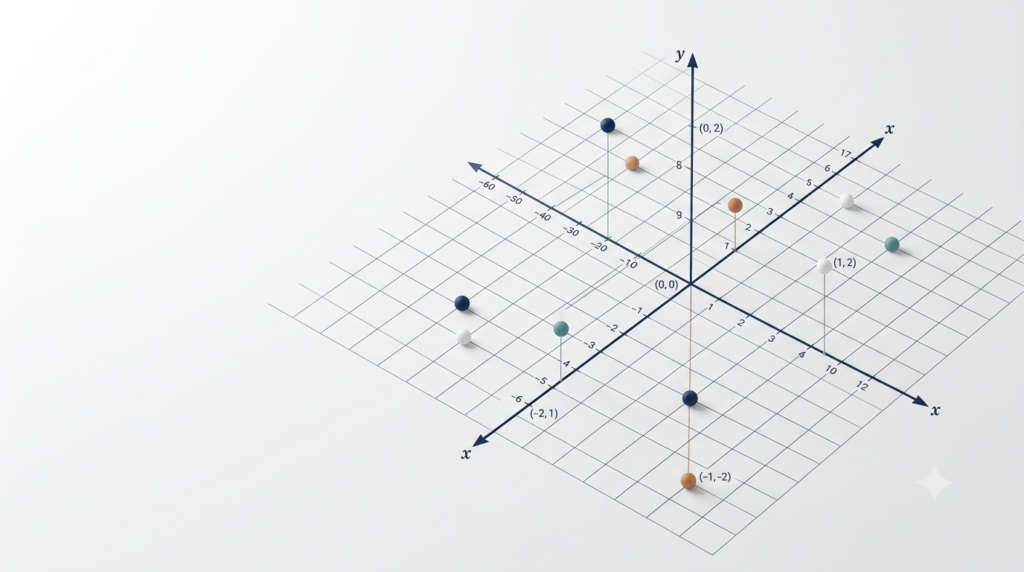
A coordinate plane is a two-dimensional mathematical system used to represent points with the help of two perpendicular number lines. These number lines are called the x-axis and the y-axis.
The x-axis runs horizontally, while the y-axis runs vertically. They intersect at a point called the origin, which has the coordinates (0, 0).
Every point on the coordinate plane can be represented by an ordered pair written as (x, y). The first number indicates the horizontal position of the point, and the second number indicates its vertical position.
For example, the point (3, 2) is located three units to the right of the origin and two units above it. Similarly, the point (−3, 2) is three units to the left of the origin and two units above it.
The coordinate plane allows us to describe positions accurately instead of relying on vague directions such as left, right, above, or below.
The Two Axes of the Coordinate Plane
The coordinate plane has two main axes.
1. The x-axis
The x-axis is the horizontal number line. Positive x-values extend to the right of the origin, while negative x-values extend to the left. Any point on the x-axis has a y-coordinate equal to zero.
Examples include (4, 0), (−2, 0), and (7, 0).
2. The y-axis
The y-axis is the vertical number line. Positive y-values extend upward from the origin, while negative y-values extend downward. Any point on the y-axis has an x-coordinate equal to zero.
Examples include (0, 3), (0, −5), and (0, 8).
The two axes divide the coordinate plane into four regions. These regions are called the first, second, third, and fourth quadrants.
What Is the Origin?
The origin is the point where the x-axis and y-axis intersect. Its coordinates are always (0, 0).
The origin serves as the reference point for locating every other point on the coordinate plane. Horizontal and vertical distances are measured from this point.
The origin does not belong to any of the four quadrants because both of its coordinates are zero.
What Are the Four Quadrants of the Coordinate Plane?
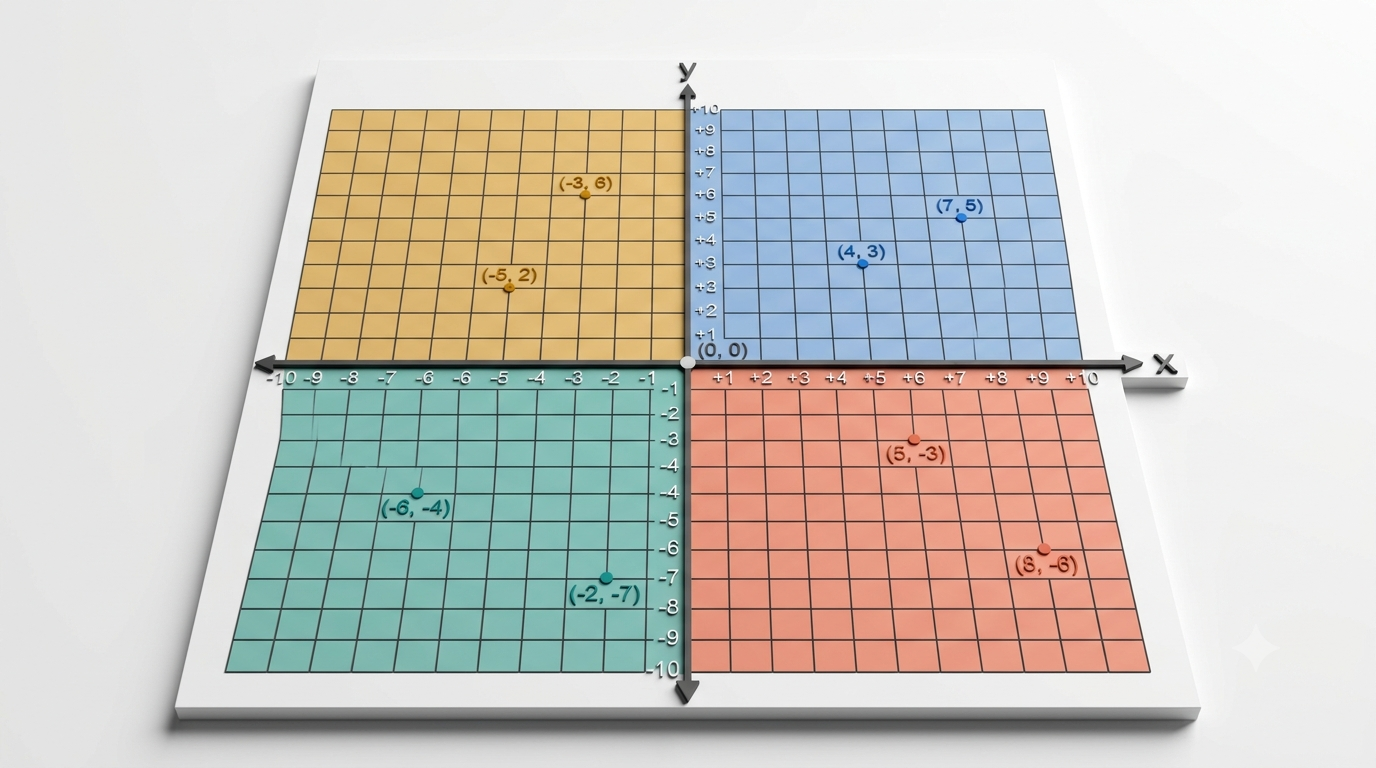
The four quadrants are the four regions formed when the x-axis and y-axis divide the coordinate plane. They are numbered counterclockwise, beginning with the region in the upper-right corner.
Each quadrant is identified by the signs of its x-coordinate and y-coordinate.
The four quadrants are:
First quadrant: positive x-coordinate and positive y-coordinate.
Second quadrant: negative x-coordinate and positive y-coordinate.
Third quadrant: negative x-coordinate and negative y-coordinate.
Fourth quadrant: positive x-coordinate and negative y-coordinate.
Remember that the x-coordinate comes first in an ordered pair, followed by the y-coordinate. This order is essential when identifying the correct quadrant.
The First Quadrant
The first quadrant is located in the upper-right region of the coordinate plane. Both coordinates of a point in this quadrant are positive.
The x-coordinate is positive because the point lies to the right of the y-axis. The y-coordinate is positive because the point lies above the x-axis.
Sign rule for the first quadrant:
Text block:
x > 0 and y > 0
This means that both coordinates must be greater than zero.
Examples of Points in the First Quadrant
Consider the point (2, 3). Starting at the origin, move two units to the right and three units upward. The point lies in the first quadrant.
Other examples include:
(1, 4)
(5, 2)
(3, 6)
(7, 1)
All these points have positive x-coordinates and positive y-coordinates.
How to Identify the First Quadrant
To identify a point in the first quadrant, check both coordinates.
If the first number is positive and the second number is also positive, the point belongs to the first quadrant.
For example, the point (6, 4) belongs to the first quadrant because both 6 and 4 are positive.
The first quadrant is commonly used when graphing relationships in which both variables have positive values, such as the relationship between the number of items purchased and their total cost.
The Second Quadrant
The second quadrant is located in the upper-left region of the coordinate plane. Points in this quadrant have a negative x-coordinate and a positive y-coordinate.
The x-coordinate is negative because the point lies to the left of the y-axis. The y-coordinate is positive because the point lies above the x-axis.
Sign rule for the second quadrant:
Text block:
x < 0 and y > 0
This means that the x-coordinate is less than zero, while the y-coordinate is greater than zero.
Examples of Points in the Second Quadrant
Consider the point (−3, 4). From the origin, move three units to the left and four units upward. The resulting point lies in the second quadrant.
Other examples include:
(−1, 5)
(−4, 2)
(−6, 3)
(−2, 7)
Each point has a negative first coordinate and a positive second coordinate.
How to Identify the Second Quadrant
Look at the signs of the two coordinates. If the x-coordinate is negative and the y-coordinate is positive, the point belongs to the second quadrant.
For example, (−5, 6) is in the second quadrant because −5 is negative and 6 is positive.
The second quadrant is useful for representing positions to the left of a vertical reference line and above a horizontal reference line. It also appears frequently in graphs involving negative and positive values of variables.
The Third Quadrant
The third quadrant is located in the lower-left region of the coordinate plane. Both coordinates of a point in this quadrant are negative.
The x-coordinate is negative because the point lies to the left of the y-axis. The y-coordinate is negative because the point lies below the x-axis.
Sign rule for the third quadrant:
Text block:
x < 0 and y < 0
Both coordinates must be less than zero for a point to lie in the third quadrant.
Examples of Points in the Third Quadrant
Consider the point (−4, −3). Starting from the origin, move four units to the left and three units downward. The point is located in the third quadrant.
Other examples include:
(−2, −5)
(−6, −1)
(−3, −7)
(−8, −4)
Both numbers in each ordered pair are negative.
How to Identify the Third Quadrant
Check whether both coordinates have negative signs. If they do, the point belongs to the third quadrant.
For example, the point (−7, −2) lies in the third quadrant because both −7 and −2 are negative.
This quadrant is important when working with graphs that include negative values for both variables. Such situations can occur in mathematical models, financial calculations involving losses, and coordinate-based representations of direction or position.
The Fourth Quadrant
The fourth quadrant is located in the lower-right region of the coordinate plane. Points in this quadrant have a positive x-coordinate and a negative y-coordinate.
The x-coordinate is positive because the point lies to the right of the y-axis. The y-coordinate is negative because the point lies below the x-axis.
Sign rule for the fourth quadrant:
Text block:
x > 0 and y < 0
This means that the x-coordinate is greater than zero and the y-coordinate is less than zero.
Examples of Points in the Fourth Quadrant
Consider the point (5, −3). From the origin, move five units to the right and three units downward. The point lies in the fourth quadrant.
Other examples include:
(2, −4)
(6, −2)
(3, −7)
(8, −1)
Each point has a positive x-coordinate and a negative y-coordinate.
How to Identify the Fourth Quadrant
If the first coordinate is positive and the second coordinate is negative, the point belongs to the fourth quadrant.
For example, (4, −6) lies in the fourth quadrant because 4 is positive and −6 is negative.
This quadrant is useful when representing situations in which one variable is positive and another is negative. The exact interpretation depends on what the axes represent in a particular problem.
Sign Rules for All Four Quadrants
The signs of the coordinates provide the quickest way to identify a point’s quadrant. Instead of counting squares on a graph, you can often determine the answer by examining the ordered pair.
The complete sign rules are given below.
| Quadrant | Sign of x-coordinate | Sign of y-coordinate | Example |
|---|---|---|---|
| First (I) | Positive (+) | Positive (+) | (3, 4) |
| Second (II) | Negative (−) | Positive (+) | (−3, 4) |
| Third (III) | Negative (−) | Negative (−) | (−3, −4) |
| Fourth (IV) | Positive (+) | Negative (−) | (3, −4) |
A useful way to remember the pattern is to begin in the first quadrant and move counterclockwise:
First: (+, +)
Second: (−, +)
Third: (−, −)
Fourth: (+, −)
This pattern makes quadrant identification easier and reduces mistakes when working with ordered pairs.
How to Plot Points in the Four Quadrants
Plotting points means locating their positions on the coordinate plane using their coordinates. The process becomes straightforward when you follow the same steps for every point.
Step 1: Locate the Origin
Find the point where the x-axis and y-axis intersect. This is the origin, represented by (0, 0).
Step 2: Read the x-coordinate
The first number in the ordered pair tells you how far to move horizontally.
A positive x-coordinate means move right.
A negative x-coordinate means move left.
Step 3: Read the y-coordinate
The second number tells you how far to move vertically.
A positive y-coordinate means move up.
A negative y-coordinate means move down.
Step 4: Mark the Point
After moving the required number of units horizontally and vertically, mark the location and label it with the ordered pair.
Example: Plotting the Point (−4, 2)
Begin at the origin. Move four units to the left because the x-coordinate is −4. Then move two units upward because the y-coordinate is 2.
The point lies in the second quadrant.
Example: Plotting the Point (3, −5)
Begin at the origin. Move three units to the right and five units downward. The point lies in the fourth quadrant.
Following these steps helps you plot points correctly, even when the coordinates contain negative values.
Points That Do Not Belong to Any Quadrant
Not every point on the coordinate plane belongs to one of the four quadrants. Points located directly on either axis are outside the quadrants.
Points on the x-axis
Every point on the x-axis has a y-coordinate equal to zero.
Examples:
(4, 0)
(−6, 0)
(8, 0)
These points lie on the horizontal axis and do not belong to any quadrant.
Points on the y-axis
Every point on the y-axis has an x-coordinate equal to zero.
Examples:
(0, 3)
(0, −5)
(0, 7)
These points lie on the vertical axis and also do not belong to any quadrant.
The Origin
The origin is represented by (0, 0). It is the point where both axes intersect.
Because both coordinates are zero, the origin does not belong to any quadrant.
An important rule to remember is that a point must have two nonzero coordinates to belong to a quadrant.
The Four Quadrants in Real-Life Applications
The coordinate plane is not limited to classroom exercises. It is used in many fields to represent positions, compare values, and understand relationships between quantities.
Maps and Navigation
Coordinate systems help identify locations and describe movement. In a simple local coordinate grid, one axis may represent east-west movement and the other may represent north-south movement.
Depending on the chosen reference point and direction convention, positions can have positive or negative coordinates. This makes it possible to describe locations relative to a starting point.
Physics
In physics, coordinate systems are used to represent displacement, velocity, and force. For example, horizontal and vertical components of a force may be positive or negative depending on the chosen directions.
Understanding quadrants helps students interpret vectors and graphs correctly.
Economics and Business
Graphs can compare quantities such as income, expenses, profit, and loss. When axes represent quantities that may be positive or negative, points in different quadrants can illustrate different combinations of values.
However, the meaning of each quadrant depends on the variables and sign conventions used in the graph.
Computer Graphics and Game Development
Computer graphics use coordinate systems to position objects on screens and within virtual environments. Two-dimensional systems often use horizontal and vertical coordinates to determine where shapes, characters, and other objects appear.
The direction of increasing coordinates can vary between systems. Therefore, it is important to check how a particular system defines its axes.
Common Mistakes When Identifying Quadrants
Students sometimes make simple errors when identifying the quadrant of a point. Understanding these mistakes can help you avoid them.
Confusing the Order of Coordinates
In an ordered pair, the x-coordinate always comes first, followed by the y-coordinate.
For example, (−2, 5) is in the second quadrant, whereas (5, −2) is in the fourth quadrant.
Although the same numbers appear in both points, switching their order changes the location.
Ignoring Negative Signs
A negative sign changes the direction in which you move from the origin. Always check the sign of each coordinate before identifying the quadrant.
For example, (−3, 4) and (3, 4) lie in different quadrants.
Assuming Every Point Belongs to a Quadrant
Points on the axes do not belong to any quadrant. For example, (5, 0) lies on the x-axis, and (0, −3) lies on the y-axis.
Numbering the Quadrants Incorrectly
The quadrants are numbered counterclockwise, beginning in the upper-right region. The first quadrant is followed by the second in the upper-left, the third in the lower-left, and the fourth in the lower-right.
Remembering this order helps prevent confusion.
Practice Examples
Use the sign rules to identify the quadrant of each point. Remember that points on the axes do not belong to any quadrant.
Example 1: (4, 6)
Both coordinates are positive. Therefore, the point lies in the first quadrant.
Example 2: (−5, 3)
The x-coordinate is negative and the y-coordinate is positive. Therefore, the point lies in the second quadrant.
Example 3: (−2, −7)
Both coordinates are negative. Therefore, the point lies in the third quadrant.
Example 4: (6, −4)
The x-coordinate is positive and the y-coordinate is negative. Therefore, the point lies in the fourth quadrant.
Example 5: (0, 5)
The x-coordinate is zero. Therefore, the point lies on the y-axis and does not belong to any quadrant.
Example 6: (−8, 0)
The y-coordinate is zero. Therefore, the point lies on the x-axis and does not belong to any quadrant.
Practising examples like these will help you recognize the relationship between coordinate signs and quadrant positions quickly.
Conclusion
The four quadrants of the coordinate plane are the four regions formed by the intersection of the horizontal x-axis and the vertical y-axis. Each quadrant has a unique combination of positive and negative coordinates. The first quadrant contains points with two positive coordinates, the second has a negative x-coordinate and a positive y-coordinate, the third contains two negative coordinates, and the fourth has a positive x-coordinate and a negative y-coordinate.
The most effective way to identify a quadrant is to examine the signs of the ordered pair, remembering that the x-coordinate comes first and the y-coordinate comes second. Points on either axis, including the origin, do not belong to any quadrant.
Once you understand these rules, plotting points and interpreting coordinate graphs becomes much easier. This knowledge also provides a foundation for learning graphing, algebra, geometry, and other mathematical topics that use coordinate systems.
FAQs
1. What are the four quadrants of the coordinate plane?
The four quadrants of the coordinate plane are the four regions formed by the intersection of the horizontal x-axis and the vertical y-axis. They are numbered counterclockwise, beginning with the upper-right region. The first quadrant contains points with positive x- and y-coordinates. The second quadrant contains points with a negative x-coordinate and a positive y-coordinate. The third quadrant contains points with two negative coordinates, while the fourth quadrant contains points with a positive x-coordinate and a negative y-coordinate. Understanding these regions helps you locate points, plot ordered pairs, and interpret mathematical graphs accurately.
2. How are the four quadrants numbered on the coordinate plane?
The four quadrants are numbered in a counterclockwise direction, starting from the upper-right region of the coordinate plane. The upper-right region is the first quadrant, followed by the upper-left second quadrant. The lower-left region is the third quadrant, and the lower-right region is the fourth quadrant. This numbering system is standard in coordinate geometry and helps students identify locations consistently. Remembering the order is useful when plotting points, studying graphs, and solving algebraic problems. A simple way to recall it is to start at the upper right and move counterclockwise around the origin.
3. What are the signs of coordinates in each quadrant?
Each quadrant has a specific combination of positive and negative coordinates. In the first quadrant, both x and y are positive. In the second quadrant, x is negative and y is positive. In the third quadrant, both coordinates are negative. In the fourth quadrant, x is positive and y is negative. These sign combinations help determine the location of a point without drawing the entire graph. For example, the point (−3, 5) belongs to the second quadrant, while (4, −2) belongs to the fourth quadrant. Learning these patterns makes coordinate geometry easier to understand.
4. How can you identify the quadrant of a point?
You can identify the quadrant of a point by examining the signs of its x- and y-coordinates. The first number in an ordered pair represents the horizontal position, while the second represents the vertical position. If both numbers are positive, the point lies in the first quadrant. A negative x-coordinate and positive y-coordinate indicate the second quadrant. Two negative coordinates indicate the third quadrant, while a positive x-coordinate and negative y-coordinate indicate the fourth quadrant. If either coordinate is zero, the point lies on an axis and does not belong to any quadrant.
5. What is the difference between the x-axis and the y-axis?
The x-axis is the horizontal number line on the coordinate plane, while the y-axis is the vertical number line. Both axes intersect at the origin, represented by (0, 0). Positive x-values extend to the right, and negative x-values extend to the left. Positive y-values extend upward, while negative y-values extend downward. Every point on the x-axis has a y-coordinate of zero, whereas every point on the y-axis has an x-coordinate of zero. These axes provide the reference system needed to locate points and divide the coordinate plane into four quadrants.
6. Does the origin belong to any of the four quadrants?
No, the origin does not belong to any of the four quadrants. It is the point where the x-axis and y-axis intersect, and its coordinates are (0, 0). Since both coordinates are zero, the origin is not located inside any quadrant. Instead, it serves as the central reference point from which horizontal and vertical distances are measured. Every other point can be described by its position relative to the origin. Understanding the origin is essential because it helps you plot ordered pairs, interpret coordinate graphs, and determine whether a point lies within a quadrant or directly on an axis.
7. Do points on the coordinate axes belong to any quadrant?
No, points located directly on the coordinate axes do not belong to any quadrant. A point on the x-axis has a y-coordinate equal to zero, such as (4, 0) or (−3, 0). A point on the y-axis has an x-coordinate equal to zero, such as (0, 5) or (0, −2). The origin, (0, 0), lies on both axes. The four quadrants contain points located between the axes, where both coordinates are nonzero. Recognizing this distinction helps prevent mistakes when identifying quadrants and interpreting coordinate-plane diagrams.
8. How do you plot a point in a particular quadrant?
To plot a point, first locate the origin where the x-axis and y-axis intersect. Read the first number in the ordered pair and move horizontally: move right for a positive x-coordinate or left for a negative one. Next, read the second number and move vertically: move up for a positive y-coordinate or down for a negative one. Mark the final position and label the point. For example, to plot (−3, 2), move three units left and two units up. The point lies in the second quadrant. Following these steps helps you plot coordinates accurately.
9. Why are the four quadrants important in mathematics?
The four quadrants are important because they provide a systematic way to locate points and interpret relationships on a coordinate plane. They are used in algebra, geometry, graphing, and coordinate geometry. Students use quadrants to plot ordered pairs, understand graphs of equations, and study how positive and negative values relate to one another. Coordinate systems are also useful in physics, computer graphics, navigation, and other technical fields. Knowing which quadrant contains a point makes it easier to analyze mathematical information and understand graphical representations. These basic skills provide a foundation for more advanced topics involving functions, lines, and curves.
10. What is an easy way to remember the four quadrants?
An easy way to remember the four quadrants is to learn their counterclockwise order and coordinate signs. Begin in the upper-right region, which is the first quadrant, where both coordinates are positive. Move to the upper-left second quadrant, where x is negative and y is positive. Next is the lower-left third quadrant, where both coordinates are negative. Finally, reach the lower-right fourth quadrant, where x is positive and y is negative. You can also practise identifying points such as (2, 3), (−2, 3), (−2, −3), and (2, −3) to reinforce the pattern.