Decimal to Fraction Converter
Convert any terminating decimal into its simplest fraction form. View the improper fraction and mixed number instantly.
Conversion Result
Try an example
A Decimal to Fraction Converter is a useful mathematical tool that converts decimal numbers into fractions in their simplest form. It helps students, teachers, and anyone working with numbers understand the relationship between decimals and fractions. For example, the decimal 0.5 can be written as 1/2, while 0.75 can be written as 3/4. Although these numbers look different, they represent the same values.
Converting decimals into fractions is an important mathematical skill used in arithmetic, algebra, measurements, percentages, ratios, and everyday calculations. Instead of performing the conversion manually, you can use an online Decimal to Fraction Converter to obtain the result quickly and accurately.
This guide explains how a Decimal to Fraction Converter works, how to use it, how decimal numbers are converted into fractions, and how to simplify fractions into their lowest terms. It also covers different types of decimal numbers, practical examples, and common mistakes to avoid.
What Is a Decimal to Fraction Converter?
A Decimal to Fraction Converter is an online calculator that changes a decimal number into an equivalent fraction. A decimal represents a number using a decimal point, while a fraction represents a number as the ratio of a numerator to a denominator.
For example:
0.5 = 1/2
0.25 = 1/4
0.75 = 3/4
1.5 = 3/2
2.25 = 9/4
In a fraction, the numerator is the number written above the fraction line, and the denominator is the number written below it. The numerator represents the number of parts being considered, while the denominator indicates the total number of equal parts.
A Decimal to Fraction Converter performs the conversion automatically. You enter a decimal number, and the tool calculates its equivalent fraction. Many converters also simplify the fraction and display a mixed number when appropriate.
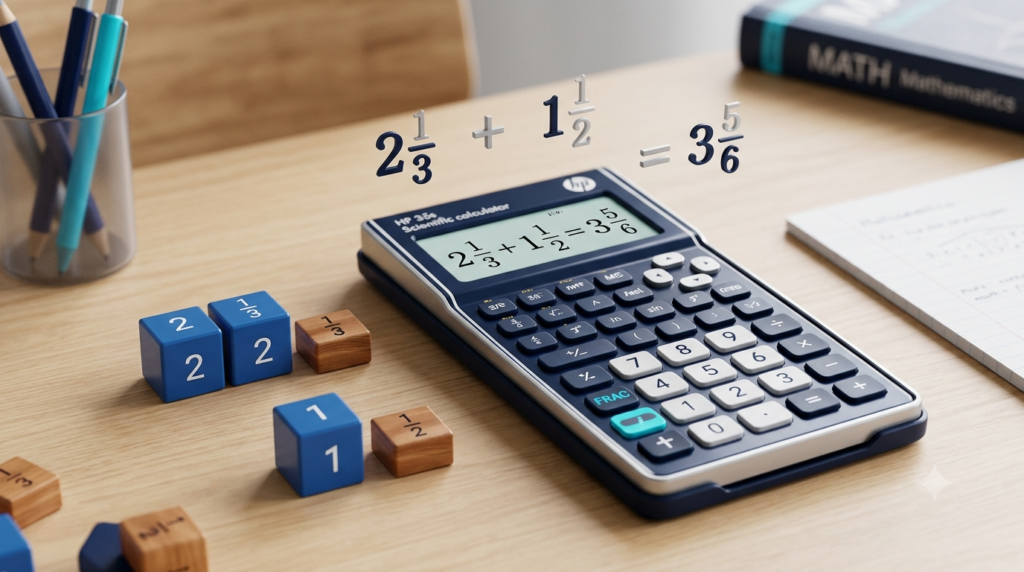
For example, entering 1.25 into the converter produces 5/4 as the simplified fraction. The same value can also be expressed as the mixed number 1 1/4.
How to Use the Decimal to Fraction Converter
Using an online Decimal to Fraction Converter is straightforward. You do not need advanced mathematical knowledge to convert decimal numbers into fractions.
Follow these steps to obtain your result.
Step 1: Enter the Decimal Number
Type the decimal number you want to convert into the input field. You can enter numbers such as 0.5, 0.75, 1.25, or 2.5.
Make sure that the number is entered correctly and contains a valid decimal point when necessary.
Step 2: Click the Convert Button
After entering the decimal, click the Convert to Fraction button. The calculator processes the number and determines its equivalent fraction.
Step 3: View the Simplified Fraction
The result displays the fraction in its simplest form. For example, entering 0.75 gives the result 3/4.
The calculator may also display the original decimal and its equivalent mixed number.
Step 4: Copy Your Result
If you need the answer for homework, notes, calculations, or other mathematical work, use the Copy Result button when available.
The copied result can then be pasted into your document or notes.
Step 5: Try Another Decimal
You can clear the current entry and convert another decimal number. This makes the tool useful for solving multiple conversion problems without repeating the calculation manually.
How to Convert a Decimal into a Fraction
A decimal can be converted into a fraction by expressing it over a power of 10 and then simplifying it.
The number of digits after the decimal point determines the initial denominator.
One digit after the decimal point: use 10.
Two digits after the decimal point: use 100.
Three digits after the decimal point: use 1,000.
Four digits after the decimal point: use 10,000.
Once the decimal has been written as a fraction, simplify it by dividing the numerator and denominator by their greatest common divisor.
Example 1: Convert 0.5 into a Fraction
The decimal 0.5 has one digit after the decimal point. Therefore, it can be written as:
0.5 = 5/10
Both 5 and 10 can be divided by 5.
5 ÷ 5 = 1
10 ÷ 5 = 2
Therefore:
0.5 = 1/2
The fraction 1/2 is the simplest form of 0.5.
Example 2: Convert 0.75 into a Fraction
The decimal 0.75 has two digits after the decimal point. Write it over 100:
0.75 = 75/100
The greatest common divisor of 75 and 100 is 25.
Divide both numbers by 25:
75 ÷ 25 = 3
100 ÷ 25 = 4
Therefore:
0.75 = 3/4
This means that 0.75 represents three-quarters of a whole.
Example 3: Convert 1.25 into a Fraction
The decimal 1.25 can be written as:
1.25 = 125/100
Divide the numerator and denominator by 25:
125 ÷ 25 = 5
100 ÷ 25 = 4
Therefore:
1.25 = 5/4
Since 5/4 is an improper fraction, it can also be expressed as a mixed number.
5 ÷ 4 = 1 remainder 1
Therefore:
5/4 = 1 1/4
Both forms represent the same value.
Understanding Different Types of Decimal Numbers
Not all decimal numbers have the same structure. Understanding the different types of decimals helps you choose the correct conversion method.
1. Terminating Decimals
A terminating decimal is a decimal number that has a finite number of digits after the decimal point.
Examples include:
0.5
0.25
0.125
1.75
2.625
These decimals can be converted into fractions by using powers of 10 as the initial denominator.
For example:
0.125 = 125/1000
Dividing the numerator and denominator by 125 gives:
0.125 = 1/8
Terminating decimals are generally straightforward to convert because their decimal expansions end.
2. Repeating Decimals
A repeating decimal contains one or more digits that continue repeating indefinitely.
Examples include:
0.3333…
0.6666…
0.121212…
Repeating decimals can also be represented as fractions, but their conversion requires a different method when the repeating pattern is intended to continue forever.
For example:
0.3333… = 1/3
Similarly:
0.6666… = 2/3
However, entering 0.333333 into a standard decimal converter represents a finite decimal, not an infinitely repeating decimal. It converts to 333333/1000000, which is not exactly equal to 1/3.
To convert an exact repeating decimal, use a calculator or method that specifically supports repeating decimal notation.
3. Whole Numbers Written as Decimals
A whole number can be written with a decimal point followed by zeros.
Examples include:
2.0
5.00
12.000
These numbers have the same values as the corresponding whole numbers.
For example:
2.0 = 2/1
5.00 = 5/1
A whole number can always be represented as a fraction by placing it over 1.
4. Negative Decimals
Negative decimals can also be converted into fractions. The negative sign remains part of the result.
For example:
-0.5 = -5/10
After simplification:
-0.5 = -1/2
Similarly:
-1.25 = -125/100
After simplification:
-1.25 = -5/4
A negative fraction represents a value below zero. The negative sign can be written before the fraction or attached to the numerator.
How to Simplify a Fraction
Simplifying a fraction means reducing its numerator and denominator to the smallest possible whole numbers without changing its value.
A fraction is in its simplest form when its numerator and denominator have no common factor greater than 1.
For example, 6/8 can be simplified to 3/4 because both 6 and 8 are divisible by 2.
Method of Simplification
Follow these steps:
Identify the numerator and denominator.
Find their greatest common divisor (GCD).
Divide the numerator by the GCD.
Divide the denominator by the same GCD.
Write the resulting fraction in its simplest form.
Consider the fraction 18/24.
The greatest common divisor of 18 and 24 is 6.
18 ÷ 6 = 3
24 ÷ 6 = 4
Therefore:
18/24 = 3/4
This method is used by decimal conversion calculators to produce simplified fractions.
Decimal to Fraction Conversion Table
The following table provides common decimal values and their equivalent fractions in simplest form.
| Decimal | Fraction | Simplified Result |
|---|---|---|
| 0.1 | 1/10 | 1/10 |
| 0.2 | 2/10 | 1/5 |
| 0.25 | 25/100 | 1/4 |
| 0.3 | 3/10 | 3/10 |
| 0.4 | 4/10 | 2/5 |
| 0.5 | 5/10 | 1/2 |
| 0.6 | 6/10 | 3/5 |
| 0.625 | 625/1000 | 5/8 |
| 0.75 | 75/100 | 3/4 |
| 0.8 | 8/10 | 4/5 |
| 0.875 | 875/1000 | 7/8 |
| 1.25 | 125/100 | 5/4 |
| 1.5 | 150/100 | 3/2 |
| 1.75 | 175/100 | 7/4 |
| 2.5 | 250/100 | 5/2 |
These examples demonstrate that different decimal numbers can be expressed as fractions, and many fractions can be reduced to simpler forms.
Decimal to Fraction Conversion Formula
The basic method for converting a terminating decimal into a fraction follows a simple mathematical principle.
Fraction = Decimal written as an integer / Corresponding power of 10
The numerator is obtained by removing the decimal point while retaining the number’s value through the denominator. The denominator depends on the number of decimal places.
For example, consider 0.36.
There are two digits after the decimal point, so the denominator is 100.
0.36 = 36/100
The greatest common divisor of 36 and 100 is 4.
36 ÷ 4 = 9
100 ÷ 4 = 25
Therefore:
0.36 = 9/25
For a decimal such as 3.125, there are three digits after the decimal point.
3.125 = 3125/1000
Dividing both numbers by 125 gives:
3.125 = 25/8
This formula works for terminating decimal numbers. Exact repeating decimals require a method that accounts for the repeating pattern.
Improper Fractions and Mixed Numbers
A decimal number greater than 1 may produce an improper fraction. An improper fraction has a numerator greater than or equal to its denominator.
For example:
1.5 = 3/2
2.25 = 9/4
3.75 = 15/4
These fractions can also be written as mixed numbers.
A mixed number contains a whole number and a proper fraction.
For example:
3/2 = 1 1/2
9/4 = 2 1/4
15/4 = 3 3/4
To convert an improper fraction into a mixed number, divide the numerator by the denominator. The quotient becomes the whole-number part, and the remainder becomes the numerator of the fractional part. Keep the original denominator.
A mixed number is often easier to understand in everyday situations, such as measuring ingredients, cutting materials, or describing distances.
Common Mistakes to Avoid
Although decimal-to-fraction conversion is relatively simple, some common mistakes can lead to incorrect answers.
Using the Wrong Denominator
The denominator must match the number of decimal places. For example, 0.25 must initially be written as 25/100, not 25/10.
Forgetting to Simplify
A fraction such as 50/100 represents the same value as 1/2, but it is not in its simplest form. Always check whether the numerator and denominator share a common factor.
Removing the Decimal Point Incorrectly
When converting 1.25, removing the decimal point gives 125. However, the corresponding denominator must be 100, resulting in 125/100.
Writing 125/10 would produce 12.5, which is incorrect.
Losing the Negative Sign
If the original decimal is negative, the resulting fraction must also be negative. For example, -0.75 equals -3/4, not 3/4.
Confusing Finite and Repeating Decimals
The decimal 0.333333 is not exactly the same as 0.3333… with infinitely repeating threes. The first is a terminating decimal, while the second is a repeating decimal. This distinction matters when obtaining an exact fraction.
Applications of a Decimal to Fraction Converter
Decimal-to-fraction conversion is useful in many areas of mathematics and everyday life.
Education and Homework
Students use fractions to solve arithmetic problems, understand ratios, compare values, and learn basic algebra. A converter helps verify answers and understand how decimals and fractions are related.
Cooking and Measurements
Recipes frequently use fractional measurements such as 1/2 cup or 3/4 teaspoon. Converting decimals into fractions makes it easier to interpret quantities and adjust recipes.
For example, 0.5 cup equals 1/2 cup.
Construction and Engineering
Measurements may be expressed as decimals or fractions depending on the tools, drawings, or measurement systems being used. Converting between these formats helps users compare measurements accurately.
Finance and Data Analysis
Fractions can represent parts of a whole, proportions, and ratios. Converting decimal values into fractions may make certain mathematical relationships easier to interpret.
Science and Mathematics
Decimals and fractions are used in physics, chemistry, statistics, and other scientific subjects. Converting between the two formats helps with calculations, measurements, and mathematical problem-solving.
Advantages of Using an Online Decimal to Fraction Converter
An online converter offers several practical benefits.
Speed: It converts decimal numbers into fractions in seconds.
Accuracy: It reduces common calculation errors when the input is valid.
Simplification: It provides fractions in their lowest terms.
Convenience: It can be used on computers, tablets, and mobile phones.
Ease of use: No advanced mathematical knowledge is required.
Learning support: Students can compare their manual calculations with the calculator’s results.
Mixed-number conversion: Some tools also display the equivalent mixed number for improper fractions.
These features make an online Decimal to Fraction Converter useful for learning, teaching, and everyday mathematical calculations.
Conclusion
A Decimal to Fraction Converter is a practical tool for converting decimal numbers into equivalent fractions quickly and accurately. It simplifies the conversion process by expressing decimals as fractions and reducing them to their lowest terms. Whether you are working with simple decimals such as 0.5 and 0.75 or larger values such as 2.625, the converter can help you obtain the correct fractional representation.
Understanding the basic conversion method is also valuable. By identifying the number of decimal places, choosing the appropriate power of 10, and simplifying the resulting fraction, you can perform many conversions manually. Use the online Decimal to Fraction Converter whenever you need a quick result, and practise the underlying steps to strengthen your mathematical skills.
FAQs
1. What is a Decimal to Fraction Converter?
A Decimal to Fraction Converter is an online tool that changes decimal numbers into equivalent fractions. For example, it converts 0.5 into 1/2 and 0.75 into 3/4. The calculator typically simplifies the resulting fraction to its lowest terms, making the answer easier to understand and use. Some converters also display mixed numbers for improper fractions. This tool is useful for students, teachers, and anyone working with mathematical calculations, measurements, or ratios. You simply enter a decimal number and click the convert button to obtain its fractional equivalent without performing the entire calculation manually.
2. How do you convert a decimal into a fraction?
To convert a decimal into a fraction, first count the digits after the decimal point. Write the number without the decimal point as the numerator and use 10, 100, 1,000, or another appropriate power of 10 as the denominator. For example, 0.75 becomes 75/100 because it has two decimal places. Next, divide the numerator and denominator by their greatest common divisor. Dividing both numbers by 25 gives 3/4. The fraction 3/4 is the simplified equivalent of 0.75. An online converter performs these steps automatically and displays the result quickly.
3. How do you convert 0.5 into a fraction?
Converting 0.5 into a fraction is straightforward because the number has one digit after the decimal point. First, write 0.5 as 5/10. Both the numerator and denominator are divisible by 5. Divide 5 by 5 to obtain 1, and divide 10 by 5 to obtain 2. Therefore, 0.5 equals 1/2 in its simplest form. This fraction represents one part out of two equal parts of a whole. You can use a Decimal to Fraction Converter to obtain the same answer instantly or practise the calculation manually to understand the conversion process.
4. How do you convert 0.75 into a fraction?
To convert 0.75 into a fraction, write the decimal as 75/100 because it contains two digits after the decimal point. Next, find the greatest common divisor of 75 and 100, which is 25. Divide both numbers by 25. The numerator becomes 3, and the denominator becomes 4. Therefore, 0.75 equals 3/4. This fraction represents three out of four equal parts of a whole. The same method works for many other terminating decimals. An online Decimal to Fraction Converter simplifies the fraction automatically, saving time and helping you check your calculations.
5. Can a Decimal to Fraction Converter simplify fractions?
Yes, a Decimal to Fraction Converter can simplify fractions automatically. After converting a decimal into an initial fraction, the calculator finds a common factor of the numerator and denominator and reduces both numbers accordingly. For example, 0.80 becomes 80/100. Dividing both numbers by 20 produces 4/5. The simplified fraction represents exactly the same value as the original decimal and the unsimplified fraction. Simplification makes fractions easier to read, compare, and use in mathematical calculations. However, the result depends on the converter’s calculation method and the number entered. Always enter the decimal carefully to obtain an accurate answer.
6. How do you convert a decimal greater than 1 into a fraction?
A decimal greater than 1 can be converted into an improper fraction by following the same method used for smaller decimals. For example, 1.25 becomes 125/100 because there are two digits after the decimal point. Dividing the numerator and denominator by 25 gives 5/4. This is an improper fraction because its numerator is greater than its denominator. It can also be expressed as the mixed number 1 1/4. Similarly, 2.5 equals 5/2 or 2 1/2. A Decimal to Fraction Converter can display the simplified improper fraction and, when supported, its equivalent mixed number.
7. Can I convert negative decimals into fractions?
Yes, negative decimals can be converted into fractions in the same way as positive decimals. The negative sign remains part of the result. For example, -0.5 can initially be written as -5/10. Dividing the numerator and denominator by 5 gives -1/2. Similarly, -0.75 equals -3/4. These fractions represent values below zero. When converting a negative decimal, make sure you do not accidentally remove its negative sign. Most online Decimal to Fraction Converters accept negative decimal inputs and simplify the resulting fraction automatically, making them useful for arithmetic, algebra, and other mathematical problems involving negative numbers.
8. What is the difference between a terminating decimal and a repeating decimal?
A terminating decimal has a finite number of digits after the decimal point. Examples include 0.5, 0.25, and 1.125. These numbers can be converted into fractions by using powers of 10 as denominators and then simplifying. A repeating decimal contains a digit or pattern that continues indefinitely, such as 0.3333… or 0.121212… . Exact repeating decimals can also be expressed as fractions, but their conversion requires a method that accounts for the repeating pattern. A standard converter treats an entry such as 0.333333 as a finite decimal, which is not exactly equal to 1/3.
9. Can a decimal be converted into a mixed number?
Yes, a decimal can be converted into a mixed number when its fractional representation contains a whole-number part and a remaining fraction. For example, 1.5 equals 3/2, which can be written as 1 1/2. Similarly, 2.75 equals 11/4 or 2 3/4. To convert an improper fraction into a mixed number, divide the numerator by the denominator. The quotient becomes the whole number, while the remainder becomes the numerator of the fractional part. The denominator stays the same. Some Decimal to Fraction Converters display mixed numbers automatically alongside the simplified fraction.
10. Is an online Decimal to Fraction Converter accurate?
An online Decimal to Fraction Converter can provide accurate results when the input is valid and the calculator uses a reliable conversion method. It converts the entered decimal into an equivalent fraction and simplifies the result where possible. For example, entering 0.625 produces 5/8. However, a finite decimal and an infinitely repeating decimal are different values, so entering a rounded decimal may not produce the exact fraction you expect. Always check the input and understand whether the decimal terminates or repeats. These tools are useful for homework, measurements, and everyday calculations, while learning the manual method helps you verify results independently.