Computer science is often associated with programming languages, software, computers, and digital technologies. However, mathematics and formulas are also an important part of computer science. From calculating how much memory a program needs to measuring the efficiency of an algorithm, formulas help computer scientists understand, analyze, and solve problems in a systematic way.
Computer science formulas are mathematical expressions used to describe relationships between different quantities, processes, and computational operations. Some formulas are simple, such as calculating storage capacity or converting between units. Others are more advanced and are used in algorithms, data structures, databases, computer networks, artificial intelligence, cryptography, and theoretical computer science.
You do not need to be an advanced mathematician to understand the basic role of formulas in computer science. Learning the foundational formulas helps you understand why computer programs behave in certain ways and how computers process information efficiently.
What Are Computer Science Formulas?
Computer science formulas are mathematical expressions used to represent, calculate, or analyze concepts related to computing.
A formula provides a structured way to describe a problem or relationship. Instead of explaining a calculation entirely with words, a formula expresses the same relationship using numbers, variables, symbols, and mathematical operations.
For example, the amount of data stored in a computer can be estimated using:
Storage = Number of items × Size of each item
Similarly, the average time required to perform a set of operations can be expressed as:
Average time = Total time ÷ Number of operations
These formulas are simple, but they demonstrate an important idea: computer science uses mathematics to represent computational problems clearly.
Computer science formulas can range from basic arithmetic expressions to formulas involving logarithms, probability, matrices, Boolean algebra, and complex mathematical functions.
Why Are Formulas Important in Computer Science?
Formulas make it easier to analyze problems that involve large amounts of data, repeated operations, limited resources, or complex relationships.
One of the most important uses of formulas is efficiency analysis. Suppose two algorithms can solve the same problem. One algorithm may require only a small number of operations as the input grows, while another may require many more. Mathematical formulas help compare their performance.
Formulas are also useful for:
Measuring algorithm efficiency
Calculating memory requirements
Analyzing data structures
Working with binary numbers
Calculating storage capacity
Understanding probability
Designing computer networks
Processing digital signals
Developing encryption systems
Building artificial intelligence models
Analyzing databases
Representing logical operations
Working with graphics and images
In this way, formulas provide a mathematical foundation for many areas of computer science.
How Are Computer Science Formulas Used?
Computer science formulas are used in different ways depending on the problem being solved. Some formulas are used for direct calculations, while others are used to describe how a system behaves.
Calculating Storage Capacity
Computers store information using bits and bytes. A bit can represent a binary value of 0 or 1, while a group of 8 bits forms one byte.
Storage calculations often use relationships such as:
1 byte = 8 bits
For example, if a file contains 800 bits of information, its size in bytes can be calculated as:
800 ÷ 8 = 100 bytes
Storage formulas become increasingly important when working with large files, databases, memory systems, and cloud storage.
Working With Binary Numbers
Computers fundamentally represent digital information using binary numbers. Binary uses only two digits:
0 and 1
The value of a binary number can be calculated using powers of 2.
For example:
1011₂ = 1 × 2³ + 0 × 2² + 1 × 2¹ + 1 × 2⁰
Therefore:
1011₂ = 8 + 0 + 2 + 1 = 11₁₀
This type of formula is useful for understanding how computers represent numbers and process digital information.
Binary formulas are important in computer architecture, programming, networking, digital electronics, and data representation.
Analyzing Algorithms
Algorithms are step-by-step procedures used to solve computational problems. When an algorithm is designed, one important question is:
How efficiently does it solve the problem?
Mathematical formulas help answer this question.
A common way to describe algorithm efficiency is Big O notation. Some common complexity classes include:
O(1) — constant time
O(log n) — logarithmic time
O(n) — linear time
O(n log n) — linearithmic time
O(n²) — quadratic time
Here, n generally represents the size of the input.
For example, if an algorithm examines every item in a list once, its running time may be represented as:
O(n)
If the number of operations grows approximately with the square of the input size, the complexity may be:
O(n²)
These mathematical representations allow programmers and computer scientists to compare algorithms without depending on a particular computer or programming language.
Calculating Average and Total Performance
Formulas can also be used to measure computational performance.
For example, if a program performs 10,000 operations in 2 seconds, the average time per operation can be estimated as:
Average time per operation = Total time ÷ Number of operations
Therefore:
2 ÷ 10,000 = 0.0002 seconds per operation
Performance calculations can help developers identify inefficient parts of a program and determine whether an application can handle a larger workload.
Using Logarithms in Computer Science
Logarithms appear frequently in computer science because many computing processes repeatedly divide a problem into smaller parts.
For example, binary search repeatedly divides a sorted collection into smaller sections. Its time complexity is:
O(log₂ n)
The logarithm helps describe how many divisions are required before the search reaches the desired element.
Logarithms are also used in:
Searching algorithms
Tree data structures
Data compression
Information theory
Computer security
Algorithm analysis
Understanding basic logarithms is therefore useful for anyone studying computer science.
Using Probability and Statistics
Probability formulas are important whenever computer systems deal with uncertainty.
For example, probability can be expressed as:
Probability = Favorable outcomes ÷ Total possible outcomes
Probability is used in many areas of computer science, including:
Artificial intelligence
Machine learning
Computer networks
Randomized algorithms
Cryptography
Data analysis
Information security
Statistics is also important when analyzing datasets and evaluating the performance of machine learning models.
For example, an average or mean can be calculated as:
Mean = Sum of values ÷ Number of values
These basic formulas provide the foundation for more advanced statistical methods.
Using Boolean Algebra
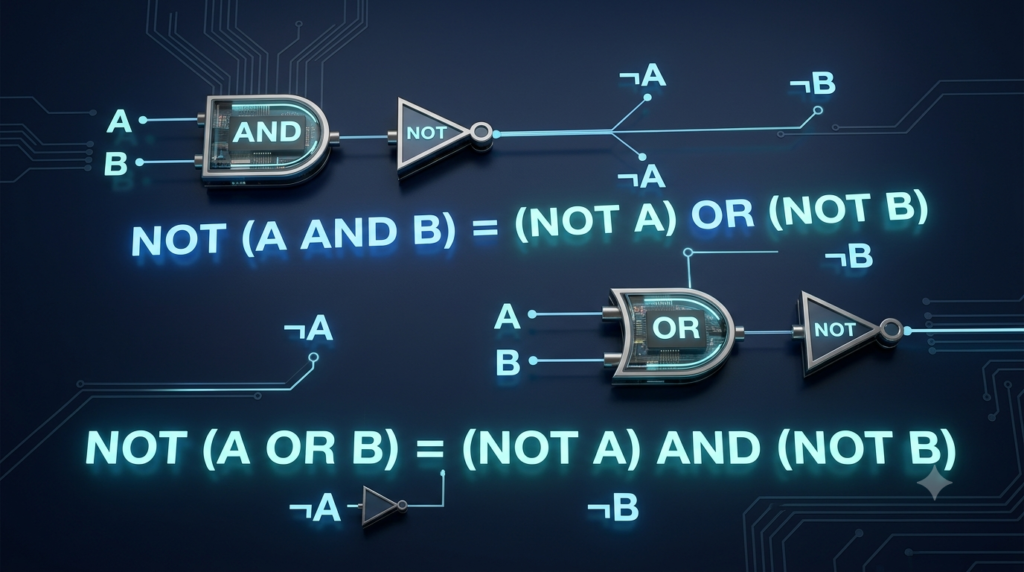
Computers frequently make decisions using logical values such as true and false, or their digital equivalents 1 and 0.
Boolean algebra provides mathematical rules for working with these values.
Three basic logical operations are:
AND
OR
NOT
For example, an AND operation produces 1 only when both inputs are 1.
1 AND 1 = 1
1 AND 0 = 0
An OR operation produces 1 when at least one input is 1.
1 OR 0 = 1
Boolean formulas are fundamental to programming conditions, digital circuits, computer architecture, search systems, and database queries.
Formulas in Data Structures
Data structures organize and store information so that it can be accessed and processed efficiently.
Formulas help analyze the amount of memory used by data structures and the time required to perform operations.
For example, an array containing n elements may require memory related to:
Memory = Number of elements × Size of each element
Trees and graphs can also be analyzed using mathematical relationships involving nodes and edges.
In a simple tree with n nodes, the number of edges is:
Edges = n − 1
Such relationships help computer scientists understand the structure and behavior of data.
Formulas in Computer Networks
Computer networks use formulas to analyze communication between devices.
For example, data transmission time can be estimated using:
Transmission time = Data size ÷ Data rate
Suppose a 100-megabit file is transmitted at a rate of 20 megabits per second:
Transmission time = 100 ÷ 20 = 5 seconds
Real-world transmission can take longer because of factors such as network congestion, latency, protocol overhead, and transmission errors. Nevertheless, the basic formula provides a useful starting point for understanding network performance.
Other formulas are used to study bandwidth, latency, throughput, packet transmission, and network reliability.
Formulas in Databases
Databases store and organize large amounts of information. Mathematical concepts help database systems perform calculations, comparisons, searches, and statistical analysis.
For example, SQL queries can calculate:
Total values
Averages
Minimum and maximum values
Counts
Percentages
Frequencies
A simple average follows the formula:
Average = Total value ÷ Number of values
Database systems also use mathematical concepts in indexing, query optimization, data modeling, and performance analysis.
Formulas in Artificial Intelligence and Machine Learning
Artificial intelligence and machine learning rely heavily on mathematics.
Machine learning systems often work with large datasets and use formulas to identify patterns and make predictions.
Important mathematical concepts include:
Probability
Statistics
Functions
Vectors
Matrices
Linear algebra
Calculus
Optimization
For example, a simple linear relationship can be represented as:
y = mx + b
Here, x is the input, y is the output, m represents the slope, and b represents the intercept.
More advanced machine learning models use much more complex mathematical expressions, but they are often built from these basic concepts.
Formulas in Cryptography
Cryptography uses mathematics to protect information.
Encryption transforms readable information into a protected form, while decryption converts it back into a readable form for an authorized user.
Modern cryptographic systems use mathematical concepts involving:
Prime numbers
Modular arithmetic
Probability
Number theory
Exponentiation
Mathematical functions
For example, modular arithmetic can be expressed as:
a mod n = remainder when a is divided by n
This simple concept plays an important role in many cryptographic algorithms.
Formulas in Computer Graphics
Computer graphics also depend on mathematics.
Images, animations, games, simulations, and 3D environments use mathematical formulas to represent positions, movements, shapes, lighting, and transformations.
Coordinates can be represented using values such as:
(x, y)
In three-dimensional graphics, a point may be represented as:
(x, y, z)
Matrices are also commonly used for transformations such as rotation, scaling, and translation.
This allows a computer to mathematically manipulate objects and display them on a screen.
Common Types of Computer Science Formulas
Computer science formulas can be grouped into several broad categories.
1. Arithmetic Formulas
These use basic operations such as addition, subtraction, multiplication, and division.
They are used for calculations involving data, memory, time, and resources.
2. Algebraic Formulas
Algebra uses variables and mathematical relationships.
Examples include:
y = mx + b
and
a + b = c
Algebra provides a foundation for many areas of computer science.
3. Logarithmic Formulas
Logarithms are commonly used in algorithm analysis and data structures.
An example is:
log₂ n
4. Probability Formulas
Probability helps computer systems model uncertainty and random events.
5. Statistical Formulas
Statistics is used to summarize and analyze data.
6. Boolean Formulas
Boolean algebra represents logical relationships using values such as 0 and 1.
7. Graph and Network Formulas
These formulas describe relationships between nodes, edges, and connected systems.
8. Matrix and Vector Formulas
Vectors and matrices are widely used in computer graphics, machine learning, scientific computing, and data analysis.
Are Computer Science Formulas the Same as Programming Code?
No. A formula and a programming statement are related, but they are not the same thing.
A mathematical formula describes a relationship or calculation.
For example:
Area = length × width
A programming language can then implement that calculation:
area = length * width
The formula explains the mathematical relationship, while the code tells the computer how to perform the calculation.
Understanding formulas can therefore make it easier to understand the logic behind programs.
Do You Need Mathematics to Learn Computer Science?
You do not need to master advanced mathematics before beginning computer science.
Basic arithmetic, algebra, logical reasoning, and an understanding of numbers are enough to begin learning many programming concepts.
However, mathematics becomes increasingly important in specialized areas.
For example, algorithm analysis may require logarithms and algebra. Artificial intelligence may require statistics, probability, linear algebra, and calculus. Cryptography may require number theory and modular arithmetic. Computer graphics may require geometry, vectors, and matrices.
The amount of mathematics required therefore depends on the area of computer science you choose to study.
How to Learn Computer Science Formulas Effectively
The best way to learn computer science formulas is to understand what each formula represents instead of memorizing it without context.
Start with the meaning of every symbol. Then understand what the formula calculates and why the relationship exists.
A useful learning process is:
Learn the concept behind the formula.
Understand each variable and symbol.
Study the units involved, when applicable.
Work through a simple example.
Try the formula with different values.
Apply it to a practical computer science problem.
Compare the result with other methods when possible.
For example, when learning the formula for transmission time, do not simply memorize:
Transmission time = Data size ÷ Data rate
Understand that a larger amount of data takes more time to transmit, while a faster data rate reduces the required time.
This approach makes formulas easier to remember and much more useful.
Why Understanding Formulas Is Better Than Memorizing Them
Memorizing a formula may help you solve one particular question, but understanding the formula allows you to apply it to many different situations.
Suppose you understand that:
Average = Total ÷ Number of values
You can use the same principle for average processing time, average network speed, average data size, or statistical calculations.
Understanding also helps you recognize when a formula should not be used. A formula may depend on certain assumptions, units, or conditions. Knowing the underlying concept helps prevent incorrect calculations.
Conclusion
Computer science formulas provide a mathematical way to describe, calculate, and analyze computational problems. They are used throughout computer science, from simple storage calculations and binary number systems to algorithm analysis, computer networks, databases, artificial intelligence, cryptography, and computer graphics.
Some formulas are very simple, while others require advanced mathematics. However, the basic purpose remains the same: formulas help turn complex relationships into clear and structured mathematical expressions.
Learning foundational computer science formulas can make many technical concepts easier to understand. Instead of treating formulas as isolated mathematical rules, it is more useful to understand what they represent, what each variable means, and how they can be applied to real computational problems.
As you progress through computer science, these foundational formulas provide the mathematical building blocks needed to understand more advanced algorithms, technologies, and systems.
FAQs
1. What are computer science formulas?
Computer science formulas are mathematical expressions used to describe, calculate, and analyze different concepts in computing. They help represent relationships between values, variables, operations, and computational processes. Some formulas are simple, such as calculating storage capacity or transmission time, while others involve logarithms, probability, statistics, matrices, and Boolean algebra. Computer science formulas are used in areas such as algorithms, data structures, computer networks, databases, artificial intelligence, cryptography, and computer graphics. Understanding these formulas helps learners see how mathematical concepts are applied to real computing problems. They also provide a foundation for analyzing performance, efficiency, memory usage, data, and computational processes.
2. Why are formulas important in computer science?
Formulas are important because they provide a precise way to describe and solve computational problems. They allow computer scientists and programmers to calculate values, analyze algorithms, estimate resource requirements, and understand relationships between different quantities. For example, formulas can help determine how much storage a file requires or how long it may take to transmit data over a network. They are also essential for understanding algorithm complexity, probability, artificial intelligence, cryptography, and computer graphics. Instead of explaining every relationship using words, formulas provide a compact mathematical representation. This makes complex computational concepts easier to analyze, compare, and apply systematically.
3. What are some common computer science formulas?
Common computer science formulas include formulas for storage, data transmission, averages, probability, algorithm complexity, binary numbers, and mathematical relationships. For example, transmission time can be estimated using Transmission time = Data size ÷ Data rate. The average can be calculated using Average = Total value ÷ Number of values. Binary numbers can be evaluated using powers of 2. Algorithm efficiency is often represented using Big O notation, such as O(1), O(log₂ n), O(n), and O(n²). Other formulas involving matrices, vectors, Boolean algebra, statistics, and probability are used in specialized areas of computer science.
4. How are formulas used in algorithms?
Formulas are used in algorithms to analyze how efficiently a solution performs as the input size increases. A major example is Big O notation, which describes the growth of an algorithm’s resource requirements. For instance, an algorithm that examines every element in a list once may have a time complexity of O(n). An algorithm that repeatedly divides a problem into smaller parts may have complexity such as O(log₂ n). These mathematical representations help programmers compare algorithms and select efficient solutions. Formulas can also help estimate the number of operations, memory requirements, processing time, and other resources needed by an algorithm.
5. How are formulas used to calculate computer storage?
Computer storage formulas help determine how much space is required to store digital information. A basic relationship is Storage = Number of items × Size of each item. Computer storage is commonly measured using bits and bytes. Since 1 byte = 8 bits, converting between bits and bytes is another common calculation. For example, 800 bits of information equals 100 bytes. Similar calculations can be applied to files, images, databases, memory, and other digital data. Understanding storage formulas helps users estimate how much space a program or dataset requires and makes it easier to understand memory capacity and data storage systems.
6. Are logarithms used in computer science formulas?
Yes, logarithms are widely used in computer science. They are particularly important when analyzing algorithms and data structures. Logarithmic expressions describe situations where a problem becomes smaller through repeated division. For example, binary search divides a sorted collection into smaller sections during each step, resulting in a time complexity of O(log₂ n). Logarithms are also used in areas such as information theory, data compression, computer security, tree structures, and algorithm analysis. Understanding basic logarithms can therefore make many computer science concepts easier to understand. The base of a logarithm can vary depending on the mathematical or computational context.
7. How are probability formulas used in computer science?
Probability formulas are used when computer systems need to deal with uncertainty, randomness, or possible outcomes. A basic probability formula is Probability = Favorable outcomes ÷ Total possible outcomes. Probability is important in artificial intelligence, machine learning, randomized algorithms, computer networks, cryptography, data analysis, and information security. For example, machine learning systems may use probability to estimate the likelihood of different outcomes based on available data. Probability can also help analyze network failures, random events, and algorithm behavior. Learning basic probability provides an important foundation for understanding more advanced computational methods that involve uncertainty and statistical decision-making.
8. What role does Boolean algebra play in computer science?
Boolean algebra provides mathematical rules for working with logical values, usually represented as 0 and 1 or false and true. It is fundamental to computer science because computers use logical operations to make decisions and process information. The basic Boolean operations are AND, OR, and NOT. For example, 1 AND 1 = 1, while 1 AND 0 = 0. Boolean expressions are used in programming conditions, digital circuits, computer architecture, database queries, and search systems. Understanding Boolean algebra helps learners understand how computers evaluate conditions and how multiple logical statements can be combined to produce a specific result.
9. Do you need advanced mathematics to understand computer science formulas?
No, advanced mathematics is not necessary to begin learning computer science formulas. Basic arithmetic, algebra, logical reasoning, and an understanding of numbers are enough for many foundational concepts. However, specialized areas of computer science may require more advanced mathematics. Algorithm analysis may involve logarithms and algebra, while artificial intelligence can require probability, statistics, linear algebra, and calculus. Cryptography may involve number theory and modular arithmetic, while computer graphics often uses geometry, vectors, and matrices. The mathematics you need depends largely on the area you want to study. Starting with basic formulas provides a strong foundation for learning more advanced concepts later.
10. How can I learn computer science formulas effectively?
The most effective way to learn computer science formulas is to understand their meaning instead of memorizing them without context. First, identify what the formula calculates and understand what each symbol represents. Then work through a simple example using real values. After that, try applying the same formula to a different problem. It is also useful to understand the assumptions and conditions under which a formula works. Practicing formulas in programming, algorithms, networking, data structures, or other practical situations can strengthen understanding. Learning concepts step by step makes formulas easier to remember and helps you apply them correctly to new problems.