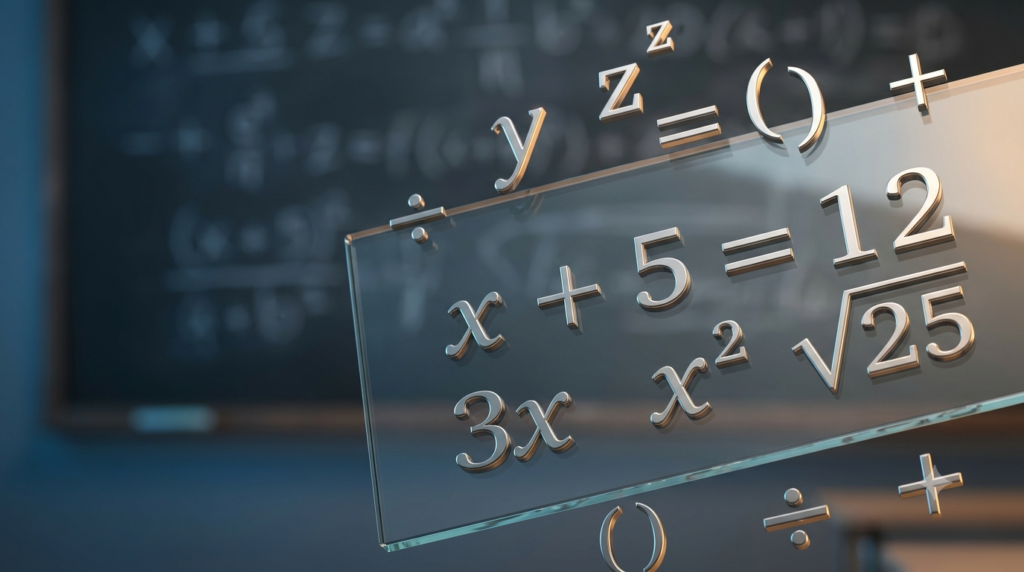
Algebra is an important branch of mathematics that helps us understand relationships between numbers, quantities, and mathematical operations. One of its most fundamental concepts is the variable. Variables allow us to represent unknown values, describe changing quantities, and express mathematical relationships in a simple and organized way. Instead of writing separate calculations for every possible number, we can use letters to represent values and develop general mathematical expressions.
For example, when we write (x + 5 = 12), the letter (x) represents an unknown number that can be found by solving the equation. Variables are also useful in everyday situations, such as calculating the cost of multiple products, measuring distances, and determining how quantities change over time. Understanding variables is essential for learning algebraic expressions, equations, formulas, graphs, and more advanced mathematical concepts. This article explains what variables are, how they work, their different types, and why they play such an important role in algebra.
What Is a Variable in Algebra?
A variable is a letter or symbol used to represent a number or quantity. Its value may be unknown, may change depending on a situation, or may be restricted to a particular set of values.
In algebra, common variable symbols include (x), (y), (z), (a), (b), and (n). Mathematicians use letters because they make it possible to describe mathematical relationships without knowing every numerical value in advance.
For example, consider the expression:
Formula Text Block
x + 4
End Formula Text Block
This expression means that four is added to the value represented by (x). If (x) is 3, the expression equals 7. If (x) is 8, the expression equals 12.
The letter (x) does not represent one permanently fixed number in every situation. Its meaning depends on the mathematical problem in which it appears.
Variables are especially useful because they help us work with unknown numbers and general rules. Rather than writing separate statements for many different values, we can use one algebraic expression to represent them all.
Why Are Variables Used in Algebra?
Variables make mathematical reasoning more flexible. They help us represent information, solve problems, and describe relationships that would be difficult to express using numbers alone.
1. Representing Unknown Values
One of the most common uses of a variable is to represent a number that is not yet known.
Suppose a number is increased by 6, giving a result of 15. We can represent the unknown number using (x).
Formula Text Block
x + 6 = 15
End Formula Text Block
To find the value of (x), subtract 6 from both sides.
Formula Text Block
x = 15 – 6
x = 9
End Formula Text Block
Therefore, the unknown number is 9.
Without variables, we could still solve this particular problem using arithmetic. However, variables provide a consistent method for solving more complicated problems involving several unknown quantities.
2. Representing Changing Quantities
Variables can represent quantities that change according to a situation.
For example, imagine purchasing notebooks that cost ₹30 each. The total cost depends on how many notebooks you purchase. If (n) represents the number of notebooks and (C) represents the total cost, their relationship can be written as follows.
Formula Text Block
C = 30n
End Formula Text Block
If you purchase 2 notebooks, the total cost is ₹60. If you purchase 5 notebooks, the total cost is ₹150.
The variables (C) and (n) allow us to express the relationship between the number of notebooks and the total cost without writing a new rule for every purchase.
3. Expressing General Mathematical Rules
Variables allow mathematical rules to apply to many different numbers.
For example, the perimeter of a square is four times the length of one side. If (s) represents the side length and (P) represents the perimeter, the rule becomes:
Formula Text Block
P = 4s
End Formula Text Block
This formula works for a square with a side length of 2 cm, 5 cm, 10 cm, or any other positive side length.
Variables therefore help us express general mathematical relationships in a compact form.
4. Simplifying Problem-Solving
Variables help organize information when a problem contains several quantities.
Suppose one person has (x) rupees and another person has ₹50 more. The second person’s amount can be represented as:
Formula Text Block
x + 50
End Formula Text Block
If their combined money is ₹450, we can write an equation to determine how much the first person has.
Formula Text Block
x + (x + 50) = 450
End Formula Text Block
This representation turns a word problem into a mathematical equation that can be solved systematically.
Variables, Constants, and Coefficients
To understand variables properly, it is important to distinguish them from constants and coefficients. These three terms describe different parts of an algebraic expression.
Variables
A variable represents a quantity whose value is unknown or may change.
For example, in the expression below, (x) is the variable.
Formula Text Block
5x + 3
End Formula Text Block
The value of the expression depends on the value assigned to (x).
Constants
A constant is a fixed numerical value in a given expression or mathematical context.
In the expression below, 3 is the constant term.
Formula Text Block
5x + 3
End Formula Text Block
The number 3 remains unchanged when the value of (x) changes.
Coefficients
A coefficient is a numerical factor that multiplies a variable.
In the expression below, 5 is the coefficient of (x).
Formula Text Block
5x
End Formula Text Block
The expression means that the value of (x) is multiplied by 5.
For example, if (x = 4), the expression (5x) equals 20.
Understanding these distinctions makes it easier to read algebraic expressions and identify the role of each part.
Different Types of Variables in Algebra
Variables can serve different purposes depending on the mathematical context. Although the same letter may be used in different ways, its role is determined by the problem.
1. Independent Variables
An independent variable is a quantity whose value can be selected or changed independently within the conditions of a mathematical model.
For example, consider the distance travelled by a vehicle moving at a constant speed of 60 kilometres per hour. If (t) represents travel time in hours and (d) represents distance in kilometres, the relationship is:
Formula Text Block
d = 60t
End Formula Text Block
The travel time (t) is the independent variable. We can choose a travel time and calculate the corresponding distance.
If the vehicle travels for 3 hours, the distance is 180 kilometres.
2. Dependent Variables
A dependent variable is a quantity whose value depends on another variable.
In the same example, distance (d) depends on travel time (t), assuming the speed remains constant.
Formula Text Block
d = 60t
End Formula Text Block
When the travel time changes, the distance changes accordingly.
Independent and dependent variables are commonly used in algebra, graphs, scientific experiments, and mathematical modelling.
3. Unknown Variables
An unknown variable represents a value that must be determined by solving a mathematical problem.
For example:
Formula Text Block
x – 7 = 11
End Formula Text Block
Adding 7 to both sides gives:
Formula Text Block
x = 11 + 7
x = 18
End Formula Text Block
Here, (x) is the unknown value we need to find.
Unknown variables appear frequently in algebraic equations, word problems, and practical calculations.
4. Variables That Can Take Different Values
In some mathematical expressions, a variable can represent several possible values rather than one specific unknown.
For example:
Formula Text Block
y = x + 2
End Formula Text Block
If (x = 1), then (y = 3). If (x = 4), then (y = 6).
Each permitted value of (x) produces a corresponding value of (y). Such relationships are important when studying functions, tables, and graphs.
How Variables Are Used in Algebraic Expressions
An algebraic expression combines variables, numbers, and mathematical operations. It represents a mathematical quantity but does not necessarily include an equality sign.
Examples include:
Formula Text Block
x + 8
3y – 4
2a + 5b
m² + 2m + 1
End Formula Text Block
Each expression has a different structure.
The expression (x + 8) represents a variable increased by 8. The expression (3y – 4) represents three times (y), minus 4. The expression (2a + 5b) contains two variables, while (m² + 2m + 1) includes a squared variable.
Variables make it possible to represent these relationships without assigning numerical values immediately.
Evaluating an Algebraic Expression
Evaluating an expression means substituting a variable with a given number and calculating the result.
Consider the expression:
Formula Text Block
3x + 4
End Formula Text Block
Suppose (x = 5). Replace (x) with 5.
Formula Text Block
3(5) + 4 = 15 + 4 = 19
End Formula Text Block
Therefore, the value of the expression is 19.
The order of operations must be followed when evaluating expressions. Multiplication and division are performed before addition and subtraction, unless parentheses or other grouping symbols change the order.
The Role of Variables in Algebraic Equations
An algebraic equation is a mathematical statement showing that two expressions are equal. It usually contains an equals sign and may include one or more variables.
For example:
Formula Text Block
2x + 3 = 13
End Formula Text Block
This equation states that twice the value of (x), increased by 3, equals 13.
To solve the equation, we must find the value of (x) that makes both sides equal.
First, subtract 3 from both sides.
Formula Text Block
2x = 13 – 3
2x = 10
End Formula Text Block
Next, divide both sides by 2.
Formula Text Block
x = 10 ÷ 2
x = 5
End Formula Text Block
The solution is (x = 5).
We can check the answer by substituting 5 into the original equation.
Formula Text Block
2(5) + 3 = 13
10 + 3 = 13
13 = 13
End Formula Text Block
Both sides are equal, so the solution is correct.
This example demonstrates how variables turn mathematical relationships into equations that can be solved using logical steps.
Using Variables on Both Sides of an Equation
Some equations contain variables on both sides of the equals sign. In these cases, we use the properties of equality to collect variable terms and constants appropriately.
Consider the equation:
Formula Text Block
3x + 4 = x + 12
End Formula Text Block
First, subtract (x) from both sides.
Formula Text Block
3x – x + 4 = 12
2x + 4 = 12
End Formula Text Block
Next, subtract 4 from both sides.
Formula Text Block
2x = 8
End Formula Text Block
Divide both sides by 2.
Formula Text Block
x = 4
End Formula Text Block
The solution is (x = 4).
Variables on both sides are common in algebra. Learning to simplify such equations prepares learners for more advanced topics, including simultaneous equations and algebraic modelling.
Using More Than One Variable
Many mathematical problems involve multiple unknown or changing quantities. In these situations, different letters are used to represent different variables.
For example, the perimeter of a rectangle depends on its length and width. If (l) represents the length and (w) represents the width, the perimeter is:
Formula Text Block
P = 2l + 2w
End Formula Text Block
Suppose the length is 8 cm and the width is 5 cm.
Formula Text Block
P = 2(8) + 2(5)
P = 16 + 10
P = 26 cm
End Formula Text Block
The perimeter is 26 cm.
Using separate variables for length and width makes the formula useful for rectangles of different dimensions.
Multiple variables also appear in science. For example, a simple relationship between force, mass, and acceleration is expressed using the formula:
Formula Text Block
F = ma
End Formula Text Block
Here, (F) represents force, (m) represents mass, and (a) represents acceleration. In this relationship, changing the mass or acceleration changes the force when the other quantity is held constant.
Such formulas demonstrate how algebra connects mathematics with scientific principles.
Variables in Word Problems and Everyday Life
Variables are particularly valuable when mathematical information is presented in words rather than equations. They help translate everyday situations into mathematical language.
Consider the following examples.
Shopping and Budgeting
Suppose a pen costs ₹15 and you want to purchase (n) pens. The total cost can be expressed as:
Formula Text Block
C = 15n
End Formula Text Block
If your budget is ₹120, you can determine the maximum number of pens you can purchase by solving:
Formula Text Block
15n = 120
n = 120 ÷ 15
n = 8
End Formula Text Block
You can purchase 8 pens, assuming there are no additional charges.
Age-Related Problems
Suppose a person is (x) years old and their sibling is 4 years older. The sibling’s age is represented by:
Formula Text Block
x + 4
End Formula Text Block
If the first person is 12 years old, the sibling is 16 years old.
Distance and Travel
When speed is constant, the distance travelled depends on speed and time.
Formula Text Block
d = vt
End Formula Text Block
Here, (d) represents distance, (v) represents speed, and (t) represents time.
If a vehicle travels at 50 kilometres per hour for 4 hours, the distance is 200 kilometres.
These examples show that variables are not limited to classroom exercises. They are useful tools for calculations, planning, comparisons, and decision-making.
Variables in Graphs and Functions
Variables are essential for understanding functions and graphs. A function describes a relationship in which each permitted input has exactly one output.
For example:
Formula Text Block
y = 2x + 1
End Formula Text Block
This equation defines a relationship between (x) and (y). For each selected value of (x), we can calculate the corresponding value of (y).
When (x = 0), (y = 1). When (x = 1), (y = 3). When (x = 2), (y = 5).
These values can be organized into a table and plotted on a coordinate plane. The resulting graph is a straight line.
Graphs help us understand how one variable changes in relation to another. They are widely used in physics, economics, statistics, engineering, and other fields.
By learning how variables work in equations and functions, learners develop the foundation needed to interpret mathematical graphs and understand quantitative relationships.
Common Mistakes When Using Variables
Beginners sometimes make mistakes when working with variables. Understanding these errors helps build stronger algebraic skills.
Confusing a Variable With a Fixed Number
A variable does not always represent the same number. Its value depends on the equation or situation. For example, (x) may equal 4 in one equation and 10 in another.
Forgetting the Meaning of Multiplication
In algebra, writing (5x) means that 5 is multiplied by (x). It does not mean that the number 5 and the letter (x) are separate terms.
Formula Text Block
5x = 5 × x
End Formula Text Block
Combining Unlike Terms
Only like terms can be combined directly. For example, (3x + 2x) can be simplified because both terms contain the same variable raised to the same power.
Formula Text Block
3x + 2x = 5x
End Formula Text Block
However, (3x + 2y) cannot be simplified to (5xy) or (5x), because the terms contain different variables.
Performing an Operation on Only One Side
When solving an equation, the same operation must be applied to both sides to preserve equality.
For example, if 4 is subtracted from the left side, 4 must also be subtracted from the right side. This principle is essential for finding correct solutions.
Ignoring Negative Signs
Negative values and subtraction signs must be handled carefully. For example, if (x = -3), then (2x = -6), not 6.
Practising these concepts and checking solutions by substitution can help prevent common mistakes.
How to Improve Your Understanding of Variables
The best way to become comfortable with variables is to practise using them in different mathematical situations.
Start by replacing variables with given numbers and evaluating simple expressions. Next, practise translating sentences into algebraic expressions. For example, the phrase “a number increased by 7” can be written as (x + 7).
After learning expressions, move on to simple equations and solve them using inverse operations. Gradually practise equations containing variables on both sides and problems involving multiple variables.
It is also helpful to create your own examples from everyday situations, such as shopping expenses, travel distances, ages, and geometric measurements.
Whenever possible, check your answers by substituting the calculated values into the original equations. If both sides of an equation produce the same value, the solution satisfies that equation.
Regular practice will make variables easier to understand and prepare you for more advanced algebraic concepts.
Conclusion
Variables are among the most important building blocks of algebra. They allow us to represent unknown numbers, describe changing quantities, express general mathematical rules, and solve equations systematically. By using letters such as (x), (y), and (n), we can turn everyday situations into mathematical expressions and equations that are easier to understand and solve.
Variables also connect algebra with functions, graphs, geometry, physics, and many other fields. Learning to distinguish variables from constants and coefficients, evaluate expressions, and solve equations provides a strong foundation for further mathematical study. With regular practice and careful attention to mathematical operations, anyone can develop confidence in using variables. Once this fundamental concept becomes clear, many other areas of algebra become easier to learn.
FAQs
1. What is a variable in algebra?
A variable in algebra is a letter or symbol that represents a number or quantity. Its value may be unknown, may change depending on a situation, or may be restricted by mathematical conditions. Common variable symbols include x, y, z, a, and n. For example, in the expression x + 5, the letter x represents a number to which 5 is added. If x equals 3, the expression equals 8. Variables help mathematicians describe relationships, solve equations, and develop general formulas. They are fundamental to understanding algebraic expressions, functions, graphs, and many other mathematical concepts.
2. Why are variables important in algebra?
Variables are important because they allow us to represent unknown values, describe changing quantities, and express mathematical relationships efficiently. Without variables, we would need separate numerical calculations for different situations. For example, the formula C = 20n represents the total cost of n items priced at ₹20 each. This relationship works for any permitted number of items. Variables also help solve equations, simplify mathematical expressions, and represent scientific relationships. They are widely used in geometry, physics, economics, engineering, and everyday calculations. Understanding variables provides a strong foundation for learning more advanced mathematical concepts.
3. What is the difference between a variable and a constant?
A variable represents a quantity whose value can be unknown or change, whereas a constant represents a fixed numerical value within a particular mathematical expression or context. For example, in the expression 4x + 7, x is the variable, 4 is its coefficient, and 7 is the constant term. If x changes, the value of the expression changes, but the numbers 4 and 7 remain fixed. Variables allow mathematical relationships to be expressed generally, while constants provide fixed values within those relationships. Recognizing the difference makes it easier to understand, simplify, and solve algebraic expressions and equations.
4. What is the difference between a variable and a coefficient?
A variable represents a quantity, while a coefficient is the numerical factor multiplying that variable. For example, in the expression 6x, x is the variable and 6 is its coefficient. The expression means that the value of x is multiplied by 6. If x equals 4, then 6x equals 24. Coefficients can be positive, negative, whole numbers, fractions, or decimals. In an expression such as 3x + 2y, the coefficients are 3 and 2. Understanding coefficients helps learners simplify algebraic expressions, combine like terms, and solve equations accurately.
5. How do you find the value of a variable in an equation?
To find the value of a variable, solve the equation by performing appropriate mathematical operations on both sides while maintaining equality. For example, consider x + 8 = 20. Subtract 8 from both sides to obtain x = 20 − 8, giving x = 12. For an equation such as 3x = 18, divide both sides by 3 to obtain x = 6. These operations are called inverse operations because they reverse addition, subtraction, multiplication, or division. After solving, substitute the answer into the original equation to verify that both sides are equal.
6. Can an algebraic equation contain more than one variable?
Yes, an algebraic equation can contain two or more variables. Different variables represent different quantities or values that may be related to one another. For example, the formula P = 2l + 2w calculates the perimeter of a rectangle using its length l and width w. Another example is d = vt, where distance d depends on speed v and time t. Equations with multiple variables are useful in mathematics, physics, engineering, and economics. Depending on the problem, some variables may be known while others are unknown. Additional information or equations may be needed to determine their values.
7. What are independent and dependent variables?
An independent variable is a quantity that can be selected or changed within a mathematical model, while a dependent variable is a quantity whose value depends on another variable. For example, consider the equation d = 50t, where distance d is measured in kilometres and time t is measured in hours. If a vehicle travels at a constant speed of 50 kilometres per hour, time is the independent variable and distance is the dependent variable. Choosing a travel time determines the distance travelled. These variables are commonly used in algebra, graphs, scientific experiments, and mathematical models to study relationships between quantities.
8. How are variables used in everyday life?
Variables help represent quantities in everyday situations, including shopping, budgeting, travelling, and measuring objects. For example, if one notebook costs ₹25, the total cost of n notebooks can be represented by C = 25n. If you purchase four notebooks, the total cost is ₹100. Variables are also useful for calculating travel distances, comparing expenses, estimating savings, and determining dimensions. In science, they help describe relationships between measurements such as time, speed, mass, and temperature. By representing quantities with letters, variables make it easier to solve practical problems and develop formulas that work for different situations.
9. What is the difference between an algebraic expression and an equation?
An algebraic expression combines numbers, variables, and mathematical operations but does not contain an equality statement. For example, 3x + 5 is an expression. An equation states that two mathematical expressions are equal and includes an equals sign. For example, 3x + 5 = 20 is an equation. Expressions can be evaluated or simplified when appropriate information is available, while equations can be solved to find values that satisfy the equality. Both concepts are important in algebra because expressions represent mathematical quantities, whereas equations describe relationships between quantities and help determine unknown values.
10. How can beginners improve their understanding of variables?
Beginners can improve their understanding of variables through regular practice with simple expressions, equations, and real-life examples. Start by substituting numbers into expressions such as 2x + 3 and calculating the results. Then practise translating sentences into algebraic expressions, such as writing x + 7 for a number increased by seven. Next, solve basic equations using inverse operations and check each answer by substitution. Learning the difference between variables, constants, and coefficients is also important. Gradually practise equations containing multiple variables and explore how variables represent relationships in graphs, geometry, and science. Consistent practice builds confidence and accuracy.