
How Do Physicists Know Whether a Formula Is Correct?

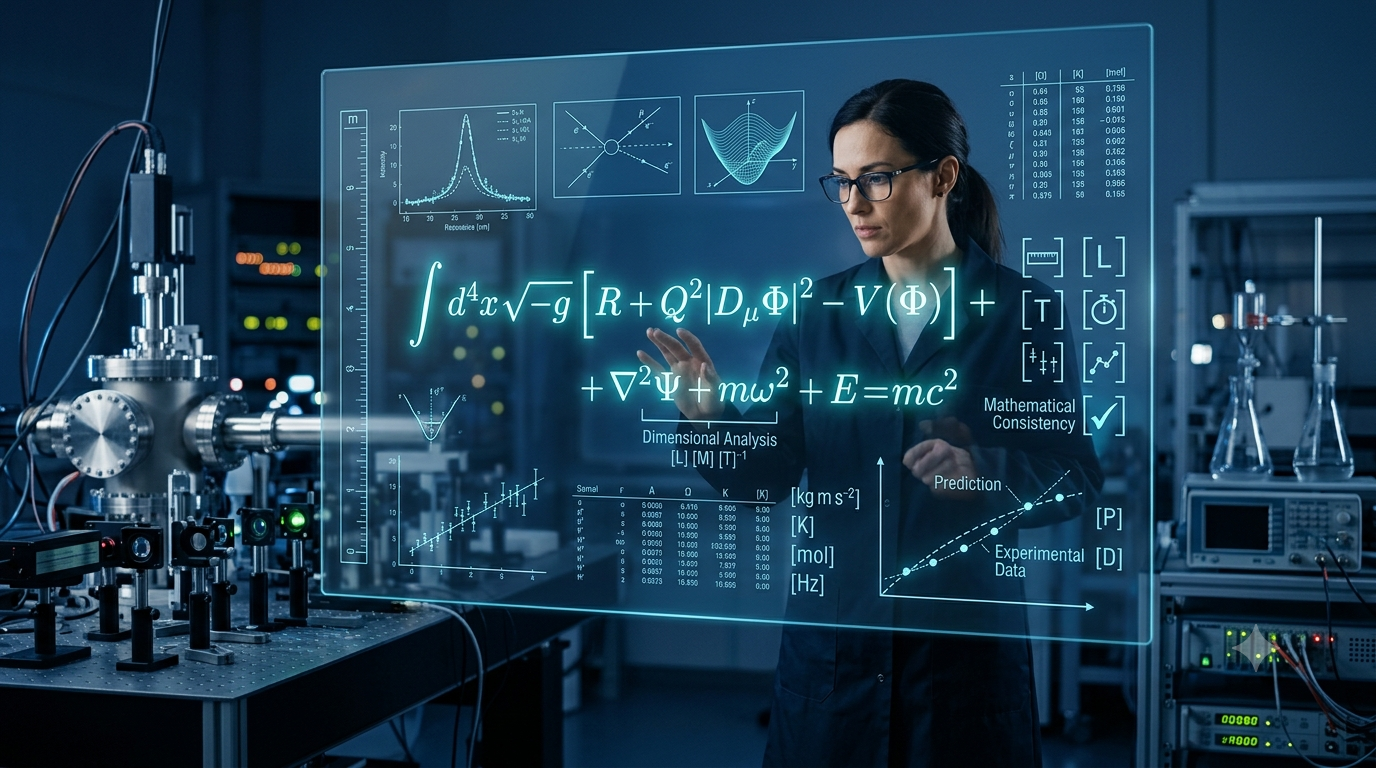
A female physicist standing in a dark laboratory, analyzing physics equations and data graphs flashing on a transparent digital screen.

A formula can look simple on paper, but how do physicists know that it actually describes nature? After all, anyone can write an equation that seems mathematically reasonable. The real challenge is determining whether that equation represents something that happens in the physical world.

Physicists do not accept a formula simply because the mathematics works. They test it against observations, experiments, established principles, units, limiting cases, and predictions. A formula becomes trustworthy when it repeatedly agrees with nature within the conditions where it is supposed to apply.

A Formula Must Have a Physical Meaning

The first question physicists ask is not always “Can we solve this equation?” Instead, they ask what the quantities in the formula represent.

Consider Newton’s second law:

F = ma

Here, F represents force, m represents mass, and a represents acceleration. The equation connects measurable physical quantities in a meaningful way.

A formula that combines quantities without a clear physical interpretation may still be mathematically valid, but that does not make it a useful physical law. Physics is concerned with relationships that can be connected to measurable properties of the real world.

Units Provide an Important Check

One of the quickest ways to test a formula is through dimensional analysis. Every physical quantity has dimensions, such as length, time, mass, or combinations of them.

For example, consider the equation:

v = d/t

Velocity has units of metres per second, distance has units of metres, and time has units of seconds. Therefore,

m/s = m/s

The units match, which supports the formula.

Now imagine someone proposes:

v = d + t

The units on the right side would be metres plus seconds. These are different physical dimensions and cannot normally be added. The equation therefore cannot represent velocity in a physically meaningful way.

Dimensional analysis cannot prove that a formula is completely correct, but it can quickly reveal many incorrect formulas.

Physicists Compare Formulas With Experiments

The strongest test of a physical formula is experimental evidence.

Suppose a physicist develops a formula that predicts how far an object will travel under certain conditions. The physicist can perform experiments, measure the object’s motion, and compare the measurements with the formula’s predictions.

If the predictions consistently agree with accurate measurements, confidence in the formula increases.

If the results disagree, physicists investigate why. Perhaps the formula was derived incorrectly. Perhaps an important effect was ignored. Or perhaps the formula only works under certain conditions.

This is why experiments are so important in physics. A beautiful mathematical equation is not enough. Nature gets the final vote.

Formulas Must Make Correct Predictions

A good physical formula does more than describe measurements that have already been made. It should also make predictions that can be tested.

For example, Einstein’s theory of general relativity predicted effects such as the bending of light by gravity and gravitational time dilation. These predictions could be compared with observations and experiments.

When a formula successfully predicts previously unknown or unexpected phenomena, it provides especially strong evidence that the underlying theory is capturing something real.

Prediction is therefore one of the most powerful ways physicists distinguish useful physical theories from mathematical speculation.

Scientists Check Special and Limiting Cases

Physicists also examine what happens to a formula under special conditions.

Imagine a formula describing the motion of an object. What happens if the object’s mass becomes extremely small? What happens if its velocity approaches zero? What happens when a particular force disappears?

A reasonable formula should behave sensibly in situations where its behavior is already understood.

For example, Einstein’s special relativity reduces to classical mechanics in situations where speeds are much smaller than the speed of light. This is important because Newtonian mechanics works extremely well in everyday situations.

A new theory does not necessarily have to replace every successful older theory. In many cases, it must reproduce the older theory under the conditions where the older theory is known to work.

Physicists Look for Conservation Laws

Another important check involves conservation principles.

Physics contains several powerful conservation laws, including conservation of energy, momentum, and electric charge. A proposed formula or theory must be consistent with these principles when they apply.

For example, if a calculation predicts that energy suddenly appears or disappears without an appropriate physical mechanism, physicists would immediately question the result.

Conservation laws act like powerful consistency checks. They help physicists identify equations that may contain hidden mistakes or assumptions.

Mathematical Consistency Matters Too

A physical formula must also be mathematically consistent.

Physicists carefully examine how an equation is derived and whether the mathematical steps are valid. A small algebraic mistake can produce a completely incorrect result.

This is particularly important in advanced physics, where formulas may involve calculus, differential equations, vectors, matrices, probability, or more sophisticated mathematical structures.

However, mathematical correctness and physical correctness are not the same thing. An equation can be mathematically flawless but still fail to describe nature.

That distinction is essential: mathematics provides the language, while experiments tell us whether that language is describing the physical world correctly.

Different Formulas Can Describe the Same Physics

Sometimes two formulas look completely different but actually express the same physical relationship.

For example, the equation

F = ma

can be rearranged to give

a = F/m

The two equations are mathematically equivalent and therefore make exactly the same predictions when used under the same conditions.

More complicated physical theories can contain several equivalent mathematical forms. Physicists therefore check whether different approaches produce the same observable results.

What matters most is not the appearance of an equation but what it predicts about measurable quantities.

Accuracy and Experimental Uncertainty Matter

Real measurements are never perfectly exact. Every experiment has some degree of uncertainty.

Suppose a formula predicts a value of 10.0 metres, while an experiment measures 10.1 metres with a known measurement uncertainty. That small difference does not automatically mean the formula is wrong.

Physicists ask whether the difference falls within the expected experimental uncertainty.

This is why scientific testing involves statistics, error analysis, repeated measurements, and careful estimates of uncertainty. A formula is judged against the quality and precision of the available evidence.

Formulas Have Limits

A formula can be correct within one range of conditions and fail outside that range.

Newton’s laws are an excellent example. They describe ordinary motion extremely well, but when objects move close to the speed of light, relativistic effects become important. At very small scales, quantum mechanics becomes necessary.

This does not mean Newton’s laws were simply “wrong.” They are highly successful within their domain of applicability.

Physicists therefore ask an important question whenever they use a formula: Under what conditions is this formula valid?

Understanding the limits of an equation is just as important as knowing the equation itself.

Independent Tests Increase Confidence

A formula becomes much more convincing when it survives many different tests.

Scientists may test it using different experiments, instruments, environments, and measurement techniques. If independent investigations repeatedly produce results consistent with the formula, confidence grows.

This process also helps reveal hidden errors. A formula that works in one carefully controlled situation but fails elsewhere may need to be modified or replaced.

Scientific knowledge therefore develops through repeated testing rather than through a single successful experiment.

The Real Test Is Agreement With Nature

Physicists know that a formula is reliable not because it looks elegant, complicated, or convincing, but because it successfully describes measurable aspects of nature.

They check its units and dimensions, derive it using valid mathematics, compare its predictions with experiments, examine special cases, test conservation laws, consider uncertainties, and determine its limits.

Even then, scientists remain open to improvement. A formula can be extremely successful while still being part of a deeper theory that has not yet been discovered.

That is one of the most fascinating features of physics. Equations are not accepted merely because humans create them. They earn credibility by surviving repeated attempts to compare them with the universe.

In the end, the question is simple: Does the formula agree with what nature does? When the answer remains yes across many precise tests, physicists gain confidence that the formula is describing something real.

FAQs

How do physicists know if a formula is correct?

Physicists test formulas by comparing their predictions with observations and experimental measurements. A formula must describe measurable relationships between physical quantities and produce results that agree with reliable experiments. Scientists also check whether its units and dimensions are consistent, whether it follows established physical principles, and whether it behaves sensibly under special conditions. A formula that repeatedly matches experimental results gains scientific support. However, physicists usually avoid saying that a formula is permanently proven correct. Instead, they consider it well supported within a particular range of conditions. New experiments can always reveal limitations or show that a better theory is needed.

Why are units important when checking a physics formula?

Units provide a quick way to identify many incorrect formulas. Physical quantities have specific units, and quantities being added or compared must have compatible dimensions. For example, distance divided by time produces units of metres per second, which is appropriate for velocity. However, adding metres to seconds would not produce a meaningful physical quantity. Physicists use dimensional analysis to check whether both sides of an equation have the same dimensions. A formula that fails this test cannot normally be physically correct. However, matching dimensions alone does not prove that the formula is correct because different formulas can have identical dimensions.

Can a mathematically correct formula still be physically wrong?

Yes. Mathematical correctness and physical correctness are different things. An equation can be solved perfectly and follow every mathematical rule while still failing to describe nature. For example, a mathematical expression may produce reasonable-looking numbers but have no physical basis or make predictions that disagree with experiments. Physics therefore combines mathematics with observation. Mathematics helps physicists develop, manipulate, and analyze formulas, while experiments determine whether those formulas actually describe physical reality. A physically useful formula must connect mathematical relationships with measurable quantities and successfully predict what happens under clearly defined conditions.

How do experiments test physics formulas?

Experiments test formulas by measuring physical quantities and comparing the results with theoretical predictions. First, physicists identify the conditions under which the formula should apply. They then measure relevant quantities using suitable instruments and calculate what the formula predicts. The predicted and measured values are compared while considering experimental uncertainty. If repeated measurements consistently agree with the predictions, the formula gains support. If they disagree significantly, scientists investigate possible errors, missing effects, or incorrect assumptions. A single experiment is rarely enough to establish broad confidence. Repeated tests using different methods provide stronger evidence that a formula accurately describes nature.

What is dimensional analysis in physics?

Dimensional analysis is a method physicists use to examine the dimensions of quantities in an equation. Instead of focusing only on numerical values, it considers fundamental dimensions such as mass, length, and time. For example, velocity has dimensions of length divided by time, while acceleration has dimensions of length divided by time squared. In a physically meaningful equation, both sides must have the same dimensions. Dimensional analysis can therefore expose many algebraic or conceptual mistakes quickly. It is also useful for estimating relationships and deriving possible forms of equations. However, it cannot determine numerical constants or completely prove a formula.

Why do physicists check limiting cases?

Physicists check limiting cases to see whether a formula behaves sensibly when physical conditions become very large, very small, or approach a special value. For example, a formula describing motion should give reasonable behavior when velocity approaches zero or when a particular force becomes negligible. Limiting-case analysis can reveal hidden mathematical errors or unrealistic assumptions. It can also show how a newer theory connects with an older, successful theory. For instance, relativistic mechanics approaches classical mechanics when speeds are much smaller than the speed of light. This connection helps physicists understand when different formulas should be used.

Do physicists ever prove a formula is completely correct?

In science, physicists generally do not regard a physical formula as permanently proven in the mathematical sense. Instead, a formula can become extremely well supported by repeated experimental evidence. Scientists test it under many different conditions and compare its predictions with increasingly precise measurements. If it continues to succeed, confidence in the formula increases. However, future experiments may reveal situations where the formula becomes inaccurate or requires modification. This is different from a mathematical theorem, which can be proven from accepted axioms. Physical knowledge depends on evidence from nature, so scientific conclusions always remain open to further testing.

Why do physics formulas have limits?

Physics formulas are often based on particular assumptions and conditions. A formula may accurately describe nature within one range but become less accurate when those conditions change. Newtonian mechanics, for example, works extremely well for ordinary speeds and everyday objects, but relativistic effects become important when speeds approach the speed of light. Similarly, classical physics does not adequately describe many microscopic phenomena, where quantum mechanics is needed. Knowing a formula’s limitations prevents scientists from applying it incorrectly. Therefore, physicists do not ask only whether a formula works; they also ask where, when, and under what conditions it works.

How do conservation laws help check formulas?

Conservation laws provide important consistency checks for physical formulas. Principles such as conservation of energy, momentum, and electric charge describe quantities that remain conserved in appropriate physical processes. When physicists derive or evaluate a formula, they can examine whether its predictions are compatible with these laws. If an equation predicts an unexplained creation or disappearance of conserved quantities, scientists have reason to investigate the model. Conservation laws are especially useful because they connect many different physical systems and experiments. They do not automatically prove every formula, but they can rule out relationships that conflict with fundamental physical principles.

What makes a physics formula reliable?

A reliable physics formula has strong experimental support, clear physical meaning, mathematically sound derivation, consistent dimensions, and a well-defined range of validity. It should make accurate predictions that can be tested independently. Scientists also examine whether it agrees with established conservation laws and behaves sensibly in limiting cases. Repeated experiments using different techniques can provide additional confidence. Importantly, reliability does not mean that a formula will work under every imaginable condition. Its usefulness depends on the assumptions and physical regime for which it was developed. A formula becomes scientifically valuable when it consistently connects mathematical predictions with observations of nature.

Leave a Comment

Your email address will not be published. Required fields are marked *

Scroll to Top