Astronomy is one of the oldest branches of science. Since ancient times, people have looked at the night sky to observe the Moon, stars, planets, and other celestial objects. These observations helped early civilizations understand the changing seasons, measure time, navigate across oceans, and develop explanations for events in the sky. Over thousands of years, astronomy gradually developed from simple observations and traditional beliefs into a modern scientific discipline supported by mathematics, physics, advanced telescopes, and space exploration.
The history of astronomy is closely connected to the development of human knowledge. Every major improvement in observation and technology has helped scientists discover something new about the universe. From ancient star maps to powerful space telescopes, astronomy has continually changed our understanding of Earth and its place in space. This beginner’s guide explores the history of astronomy, its major developments, the scientists who transformed it, and the technologies that continue to expand our knowledge of the universe.
What Is Astronomy?
Astronomy is the scientific study of celestial objects, space, and the universe as a whole. It examines objects such as stars, planets, moons, asteroids, comets, galaxies, and black holes. Astronomers also investigate the origin, structure, evolution, and possible future of the universe.
Astronomy uses several other scientific fields, particularly physics, mathematics, chemistry, and computer science. For example, physics helps scientists understand the forces that control planetary motion, while mathematics allows them to calculate the distances, speeds, and orbits of celestial objects.
Astronomy is different from astrology, which attempts to connect the positions of celestial objects with human personalities or future events. Astronomy relies on observations, scientific evidence, mathematical models, and testable explanations.
Although modern astronomy uses sophisticated instruments, its basic purpose remains similar to that of ancient sky-watchers: to understand what exists beyond Earth and how the universe works.
1. The Earliest Beginnings of Astronomy
Early Humans and Sky Observation
The earliest history of astronomy began long before written records existed. Early humans observed the regular movement of the Sun, the changing appearance of the Moon, and the patterns formed by stars. These observations helped them recognize natural cycles and understand changes in their surroundings.
The rising and setting of the Sun provided a way to measure the day. The phases of the Moon offered a repeating pattern that could be used to track longer periods. Seasonal changes in the position of the Sun and the appearance of certain stars helped communities recognize the best times for planting, harvesting, hunting, and migration.
At this stage, astronomy was not a separate scientific discipline. It was closely connected to survival, religious traditions, cultural practices, and the interpretation of natural events.
Ancient Monuments and Astronomical Alignments
Some prehistoric structures appear to have been designed to align with particular solar or lunar events. These include monuments associated with solstices, seasonal changes, and important directions in the sky.
Stonehenge in England is one well-known example. Its arrangement is associated with the positions of the Sun during the solstices. However, the exact purposes of ancient monuments can be difficult to establish, and researchers continue to investigate their original functions.
Such structures demonstrate that people in prehistoric societies paid careful attention to the sky. Although their observations were not always recorded in written form, they contributed to the early development of astronomical knowledge.
2. Astronomy in Ancient Civilizations
As human societies developed agriculture, cities, writing systems, and organized governments, the study of the sky became more systematic. Several ancient civilizations made important contributions to astronomy.
Mesopotamian Astronomy
The people of ancient Mesopotamia, particularly the Babylonians, made significant progress in recording celestial events. They maintained detailed observations of the Moon, planets, eclipses, and stars.
By studying repeating patterns, Babylonian astronomers developed methods for predicting certain celestial events. Their mathematical techniques helped them identify cycles in planetary motion and improve calendar systems.
They also contributed to the development of the zodiac, a band of the sky through which the Sun, Moon, and planets appear to move from Earth’s perspective. Babylonian records later influenced Greek astronomy and other astronomical traditions.
Egyptian Astronomy
Ancient Egyptians closely observed the Sun and stars because astronomical cycles were important for timekeeping, religious ceremonies, and agriculture.
The annual appearance of the star Sirius before sunrise was associated with the seasonal flooding of the Nile River. This relationship helped Egyptians connect observations of the sky with changes in their environment.
Egyptians also developed calendar systems and used observations of celestial objects to organize daily life and religious activities. Their knowledge of timekeeping and the movement of the Sun contributed to the development of early calendars.
Indian Astronomy
Ancient India developed a rich astronomical tradition that combined mathematical reasoning with systematic observations of celestial objects.
Early Indian astronomical knowledge appeared in texts associated with calendars, rituals, and the measurement of time. Over centuries, Indian scholars developed increasingly sophisticated methods for calculating planetary positions, predicting eclipses, and understanding the relationships between celestial cycles.
Aryabhata, a major Indian mathematician and astronomer who lived in the fifth and sixth centuries CE, made important contributions to mathematical astronomy. In his work, the Aryabhatiya, he explained that the apparent daily movement of the stars could be understood through Earth’s rotation. He also developed methods for calculating astronomical quantities and explaining eclipses.
Later scholars, including Brahmagupta and Bhaskara II, further advanced mathematical techniques used in astronomy. Indian astronomy played an important role in the broader history of mathematics and scientific thought.
Chinese Astronomy
Ancient Chinese astronomers maintained detailed records of celestial events, including eclipses, comets, planetary appearances, and unusual stars.
These records are especially valuable because observations were often documented over long periods. Some historical records help modern researchers investigate astronomical events that occurred centuries ago.
Chinese astronomers also developed calendars, constructed observational instruments, and studied the regular movement of celestial objects. Their work supported agriculture, timekeeping, and government administration.
Astronomy in the Ancient Americas
Several civilizations in the Americas developed sophisticated systems for observing celestial objects. The Maya, for example, carefully tracked the movements of the Sun, Moon, and planets, particularly Venus.
Maya scholars created complex calendar systems and used astronomical cycles to organize ceremonies and agricultural activities. Their observations of Venus demonstrate a high level of mathematical and observational skill.
Other societies, including the Inca, also connected observations of the Sun and stars with calendars, agriculture, and the organization of their communities.
These independent astronomical traditions show that the study of the sky developed in many parts of the world rather than originating from a single civilization.
3. The Development of Astronomy in Ancient Greece
Ancient Greek thinkers helped establish astronomy as a field that used geometry, logical reasoning, and mathematical models to explain celestial movements.
Early Ideas About the Universe
Some early Greek philosophers proposed that natural phenomena could be explained through reason rather than through stories about supernatural beings.
They debated the shape of Earth, the arrangement of celestial objects, and the causes of planetary movement. Although many early explanations were incorrect, the effort to develop logical models was an important step in the history of science.
Aristotle and the Geocentric Model
Aristotle, who lived in the fourth century BCE, supported a model in which Earth remained stationary at the center of the universe. In this geocentric model, the Sun, Moon, planets, and stars moved around Earth.
Aristotle argued that Earth was spherical, drawing on observations such as the curved shadow Earth casts on the Moon during a lunar eclipse.
The geocentric model became influential for many centuries. However, it could not easily explain all the observed details of planetary motion without adding increasingly complicated assumptions.
Aristarchus and the Heliocentric Idea
Aristarchus of Samos, a Greek astronomer who lived in the third century BCE, proposed that Earth rotates on its axis and revolves around the Sun.
This heliocentric idea was a remarkable departure from the widely accepted Earth-centered model. However, it did not become the dominant view in the ancient world, partly because the available observations and physical explanations did not convincingly establish Earth’s motion.
The proposal nevertheless illustrates that ideas resembling the modern understanding of the solar system appeared long before the invention of the telescope.
Ptolemy and the Geocentric System
In the second century CE, Claudius Ptolemy developed a detailed mathematical model of planetary motion in his work commonly known as the Almagest.
Ptolemy used combinations of circular motions, including epicycles, to explain the observed paths of planets against the background of stars. Although the model was complex, it allowed astronomers to calculate and predict planetary positions with useful accuracy for its time.
Ptolemy’s system became highly influential in Europe and the Middle East. Its long history demonstrates that a scientific model can remain widely accepted for centuries when it provides practical predictions and no better-supported alternative has replaced it.
4. Astronomy During the Medieval Period
Astronomical knowledge continued to develop after the decline of the Western Roman Empire. Scholars in the Islamic world, India, China, and other regions preserved earlier knowledge while improving observations, instruments, and mathematical methods.
Contributions of Islamic Astronomers
From approximately the eighth century onward, scholars working in major intellectual centers such as Baghdad translated and studied Greek astronomical works. They also examined Indian and Persian astronomical traditions.
Rather than simply preserving earlier ideas, many astronomers critically evaluated existing models and developed new calculations.
Al-Battani improved measurements of important astronomical quantities and refined methods for calculating solar and lunar motion. Other scholars developed astronomical tables, studied planetary positions, and constructed instruments for measuring angles in the sky.
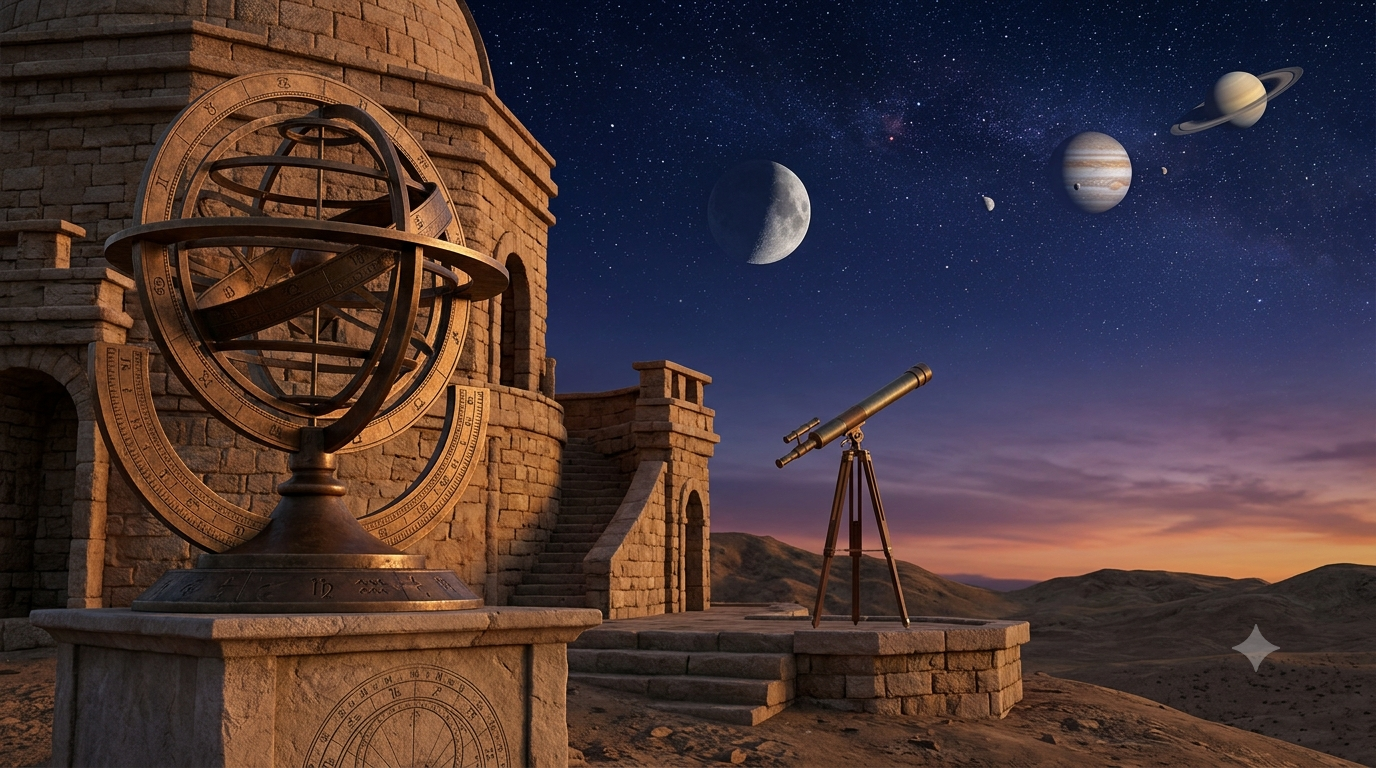
Observatories became important centers for systematic research. Instruments such as the astrolabe helped astronomers measure the positions of celestial objects and supported timekeeping and navigation.
Astronomical knowledge later traveled through translation and scholarly exchange into Europe, contributing to the development of astronomy during the Renaissance.
Astronomy in Medieval India
Indian astronomers continued to refine mathematical models, calendars, and methods for predicting eclipses. Their work drew on earlier traditions while incorporating new calculations and approaches.
Astronomical tables and mathematical techniques circulated through wider networks of scholarly exchange. These developments helped maintain astronomy as an active field of mathematical investigation.
Astronomy in Medieval Europe
During the medieval period, European scholars studied astronomy through religious institutions, universities, translated texts, and calendar-making.
The geocentric model remained dominant, but scholars continued to calculate planetary positions and investigate mathematical problems. Astronomy was also closely connected to timekeeping and the determination of important dates in the calendar.
By the later Middle Ages, access to translated scientific works and improvements in mathematical education helped prepare the way for major changes during the Renaissance.
5. The Scientific Revolution and the Rise of Modern Astronomy
The sixteenth and seventeenth centuries brought a major transformation in astronomy. New mathematical models and improved observations challenged traditional explanations of the universe.
Nicolaus Copernicus and the Heliocentric Model
In 1543, Nicolaus Copernicus published On the Revolutions of the Heavenly Spheres. He proposed a system in which Earth and the other planets revolved around the Sun.
In this model, Earth also rotated on its axis. The apparent daily movement of the stars could therefore be explained by Earth’s rotation rather than by the entire universe revolving around Earth.
Copernicus’s model provided a different way to organize planetary motion. However, it still relied on circular orbits and did not immediately provide a simpler or more accurate explanation for every observation.
Its greatest significance was that it changed Earth’s role in the cosmic picture and encouraged astronomers to reconsider long-established assumptions.
Tycho Brahe and Accurate Observations
Tycho Brahe, a Danish astronomer, made exceptionally precise measurements of planetary and stellar positions before the widespread use of telescopes.
His observations were especially important because scientific theories could be tested against reliable measurements. Brahe also proposed a model that combined features of geocentric and heliocentric systems.
Although he did not accept the Copernican model in its original form, his detailed observations later enabled Johannes Kepler to discover the mathematical rules governing planetary orbits.
Johannes Kepler and the Laws of Planetary Motion
Johannes Kepler used Brahe’s observations to improve the heliocentric model. He discovered that planets move around the Sun in elliptical orbits rather than perfect circles.
Kepler established three laws of planetary motion:
First law: Planets move in elliptical orbits, with the Sun at one focus.
Second law: A line connecting a planet to the Sun sweeps out equal areas in equal periods of time.
Third law: The square of a planet’s orbital period is proportional to the cube of the semimajor axis of its orbit.
These laws provided a much more accurate mathematical description of planetary movement. They later became an essential foundation for Isaac Newton’s theory of gravity.
Galileo Galilei and the Telescope
In 1609, Galileo Galilei began using an improved telescope to investigate the sky. His observations provided powerful evidence against important features of the traditional Earth-centered worldview.
Galileo observed mountains and craters on the Moon, showing that its surface was not perfectly smooth. He discovered four large moons orbiting Jupiter, demonstrating that not every celestial object revolved directly around Earth.
He also observed the phases of Venus, which were difficult to reconcile with the traditional Ptolemaic arrangement. These observations supported the emerging heliocentric understanding of the solar system.
Galileo’s work demonstrated the importance of using instruments to investigate nature. The telescope transformed astronomy by revealing objects and details that could not be seen with the unaided eye.
Isaac Newton and Universal Gravitation
In 1687, Isaac Newton published Philosophiæ Naturalis Principia Mathematica. He presented laws of motion and the law of universal gravitation.
Newton explained that the same gravitational force that causes objects to fall toward Earth also governs the motion of the Moon, planets, and other celestial bodies.
His work connected terrestrial physics with celestial mechanics. Kepler’s laws could be understood through Newtonian mechanics and gravity, providing a unified explanation for many astronomical observations.
This was a major turning point because astronomy could now explain not only how celestial objects moved but also why they followed particular paths.
6. Astronomy in the Eighteenth and Nineteenth Centuries
During the eighteenth and nineteenth centuries, astronomy expanded through improved telescopes, more precise instruments, mathematical calculations, and new methods for studying starlight.
Discovering New Planets and Celestial Objects
In 1781, William Herschel discovered Uranus using a telescope. This discovery showed that the solar system extended beyond the planets known since ancient times.
Astronomers later identified Neptune in 1846 after mathematical calculations helped predict where another planet might be found. Its discovery demonstrated the power of combining theoretical predictions with observation.
Astronomers also cataloged comets, star clusters, nebulae, and double stars. Their work revealed that the night sky contained far more variety than earlier observers had recognized.
The Development of Astrophysics
Traditional astronomy often concentrated on the positions and movements of celestial objects. During the nineteenth century, scientists increasingly began investigating their physical properties.
One important development was spectroscopy, the study of light separated into its component wavelengths. By analyzing the spectrum of an object, astronomers could identify chemical elements and learn about temperature, motion, and other physical conditions.
Photography also became increasingly important. It allowed astronomers to record faint objects and preserve observations for later analysis.
These developments helped establish astrophysics, a branch of astronomy that applies the laws of physics to understand stars, galaxies, and other celestial objects.
Understanding the Sun and Stars
As techniques for studying light improved, astronomers discovered that stars were not merely points of light with different brightness levels. They had measurable temperatures, different chemical compositions, and distinct stages of development.
Scientists also began investigating how the Sun produces energy. Over time, advances in atomic physics helped establish that nuclear fusion powers the Sun and other stars.
This understanding transformed the study of stars from a largely descriptive science into a physical investigation of how celestial objects form, change, and release energy.
7. Astronomy in the Twentieth Century
The twentieth century brought some of the most important discoveries in astronomical history. New theories, powerful telescopes, and developments in physics revealed that the universe was much larger and more dynamic than many scientists had previously imagined.
The Expanding Universe
At the beginning of the twentieth century, many people thought of the universe mainly in terms of the Milky Way, the galaxy containing our solar system.
Astronomers later established that many objects previously classified as nebulae were actually separate galaxies far beyond the Milky Way.
Edwin Hubble’s observations in the 1920s provided important evidence that the universe contains numerous galaxies. His work, combined with measurements of their redshifts, helped establish that the universe is expanding.
The expanding-universe picture became central to modern cosmology, the scientific study of the origin, structure, evolution, and large-scale properties of the universe.
The Big Bang Theory
The Big Bang theory describes the evolution of the universe from an early, extremely hot and dense state. It does not simply describe an explosion into empty space; rather, it explains how space itself has expanded over time.
Several important discoveries strengthened the theory. These include the observed expansion of the universe, the measured abundance of light elements, and the discovery of the cosmic microwave background radiation in 1965.
The cosmic microwave background is faint radiation left over from the early universe, released when the universe became cool enough for light to travel relatively freely through space.
Modern cosmology continues to investigate the early universe, the formation of galaxies, dark matter, dark energy, and the fundamental laws governing cosmic evolution.
Radio Astronomy
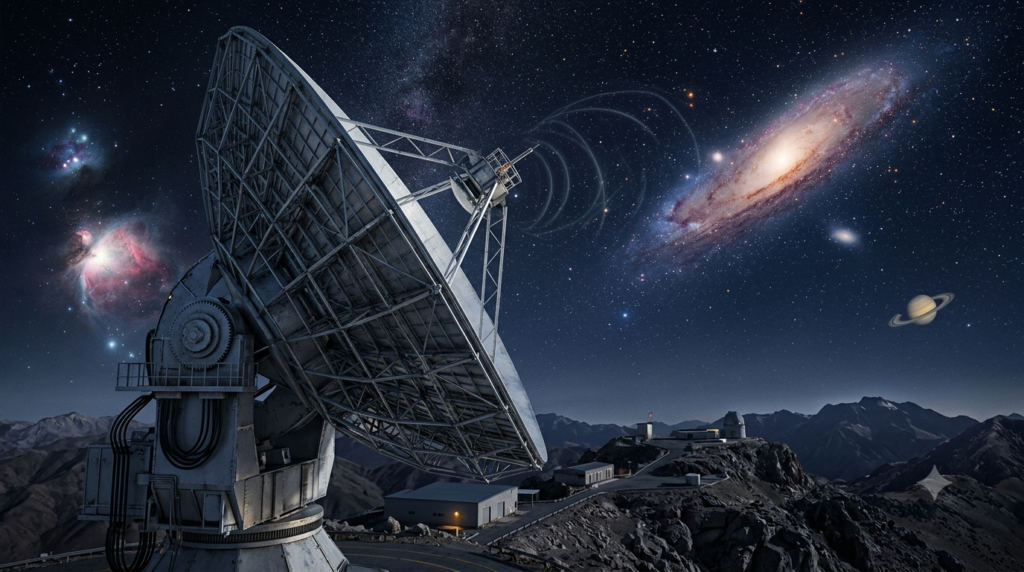
Radio astronomy developed significantly during the twentieth century. Instead of studying only visible light, astronomers began detecting radio waves emitted by celestial objects.
Radio telescopes revealed phenomena that ordinary optical telescopes could not investigate in the same way. They helped scientists study pulsars, gas clouds, active galaxies, and the structure of the Milky Way.
Radio observations also became important for investigating the cosmic microwave background and understanding energetic processes in distant parts of the universe.
Space Exploration and Astronomy
The beginning of the Space Age in 1957, when the Soviet Union launched Sputnik 1, opened new opportunities for astronomical research beyond Earth’s atmosphere.
Atmospheric gases, clouds, and turbulence can block or distort certain wavelengths of light. Space-based instruments can observe many of these wavelengths more effectively.
Human spaceflight and robotic missions also transformed our knowledge of the solar system. Spacecraft explored the Moon, visited planets, studied comets, and collected data about distant planetary environments.
The Apollo 11 mission landed the first humans on the Moon in 1969. Although human exploration and astronomical research are not identical activities, both have contributed to a broader understanding of our place in space.
8. Modern Astronomy in the Twenty-First Century
Today, astronomy combines advanced instruments, powerful computing systems, international collaboration, and observations across the electromagnetic spectrum.
Space Telescopes
Space telescopes have made it possible to investigate the universe without many of the limitations imposed by Earth’s atmosphere.
The Hubble Space Telescope, launched in 1990, has contributed to research on galaxies, star formation, planetary systems, and the expansion of the universe.
The James Webb Space Telescope, launched in 2021, began scientific operations in 2022. It observes primarily infrared light, allowing astronomers to study distant galaxies, star-forming regions, and the atmospheres of some exoplanets.
These observatories do more than produce remarkable images. Their measurements help scientists test theories about how stars, planets, and galaxies form and evolve.
The Discovery of Exoplanets
Exoplanets are planets that orbit stars beyond our solar system. Their discovery has become one of the major achievements of modern astronomy.
Astronomers use several methods to find them. The transit method detects small decreases in a star’s brightness when a planet passes in front of it. The radial velocity method measures changes in a star’s motion caused by the gravitational pull of an orbiting planet.
Thousands of exoplanets have been confirmed, revealing a remarkable diversity of planetary systems. Some are large gas giants close to their stars, while others are smaller rocky worlds.
Scientists are investigating which planets might have conditions suitable for life. However, finding a planet in a potentially habitable region does not prove that life exists there.
Black Holes and Gravitational Waves
Black holes are regions of space where gravity is so strong that nothing, not even light, can escape from within the event horizon.
Astronomers study black holes by observing their effects on nearby matter, the movement of stars, and the radiation produced by hot gas surrounding them.
In 2019, scientists released the first image of a black hole’s shadow, produced using the Event Horizon Telescope collaboration. In 2022, the collaboration released an image of the supermassive black hole at the center of the Milky Way.
Another major achievement was the first direct detection of gravitational waves in 2015, announced in 2016. These ripples in spacetime had been predicted by Einstein’s general theory of relativity. Their detection opened a new way to study events such as the mergers of black holes and neutron stars.
Artificial Intelligence and Big Data
Modern observatories generate enormous quantities of data. Researchers use computers, statistical techniques, and increasingly artificial intelligence to identify patterns, classify galaxies, detect unusual events, and search for possible planets.
Automated systems can examine observations far more quickly than humans could manually inspect every measurement. However, scientific interpretation still requires careful testing, validation, and expert judgment.
Computational tools are becoming essential to modern astronomy because they help researchers work with large surveys and complex datasets.
9. Important Technologies That Changed Astronomy
The development of astronomy has been closely connected to improvements in technology. Each new instrument has expanded the range of questions scientists can investigate.
Naked-eye observations: Early astronomers tracked the positions of the Sun, Moon, planets, and stars without optical instruments.
Mathematical models and calendars: Calculations helped astronomers predict celestial events, organize time, and describe planetary motion.
Optical telescopes: Telescopes revealed moons, planetary details, distant stars, and objects too faint to see with the unaided eye.
Photography and spectroscopy: These methods allowed astronomers to record observations and investigate the physical properties of celestial objects.
Radio telescopes: Radio observations opened a new window into the universe and revealed phenomena that were difficult to study using visible light alone.
Space telescopes and spacecraft: These technologies made it possible to observe the universe across additional wavelengths and explore planets and moons directly.
Computers and artificial intelligence: Modern computational tools help process enormous datasets, simulate cosmic processes, and identify astronomical events.
Together, these technologies have transformed astronomy from a science based mainly on visual observation into a broad discipline that investigates the universe using many forms of evidence.
10. Why Is the History of Astronomy Important?
Learning about the history of astronomy is important because it shows how scientific knowledge develops over time. Scientific understanding does not usually appear in a single moment. It grows through observation, experimentation, mathematical reasoning, debate, and the correction of earlier ideas.
The shift from the geocentric model to the heliocentric model is a clear example. For centuries, Earth-centered explanations shaped people’s understanding of the universe. Improved observations and mathematical models eventually provided stronger support for a different explanation.
The history of astronomy also demonstrates the value of collaboration across cultures. Babylonian, Egyptian, Indian, Chinese, Greek, Islamic, European, and American civilizations all contributed to humanity’s knowledge of the sky.
Furthermore, astronomical discoveries have influenced other fields. The development of precise instruments, mathematical methods, imaging technologies, and computational techniques has contributed to advances beyond astronomy itself.
Most importantly, studying astronomy encourages curiosity. It helps people understand that Earth is part of a much larger universe and that many fundamental questions remain unanswered.
11. The Future of Astronomy
Astronomy continues to develop as scientists build more powerful observatories and improve their methods of analyzing data.
Future research will investigate the atmospheres of exoplanets, the formation of the earliest galaxies, the nature of dark matter, the cause of cosmic acceleration, and the extreme environments surrounding black holes.
New ground-based telescopes will provide increasingly detailed observations of distant objects. Space missions will continue exploring planets, moons, asteroids, and other bodies in our solar system. Gravitational-wave observatories and other specialized instruments will allow researchers to study cosmic events through different types of signals.
Astronomers are also investigating whether signs of life might exist beyond Earth. Researchers may search for chemical patterns in planetary atmospheres, study environments that could support microbial life, or investigate other possible indicators. Such discoveries would require careful verification before any conclusion about extraterrestrial life could be accepted.
Although technology will continue to improve, the basic scientific process will remain important. Astronomers must collect reliable evidence, compare observations with predictions, and revise explanations when new findings require it.
The future of astronomy will likely bring discoveries that challenge current theories, just as earlier breakthroughs transformed our understanding of the universe.
Conclusion
The history and development of astronomy reveal how humanity’s understanding of the universe has changed over thousands of years. Early civilizations observed celestial cycles to measure time and organize agriculture. Ancient scholars developed mathematical models, while astronomers during the Scientific Revolution used improved observations and new theories to transform our understanding of planetary motion and gravity.
Later discoveries involving spectroscopy, radio waves, galaxies, cosmic expansion, and space telescopes expanded astronomy far beyond the limits of the naked eye. Today, astronomers investigate distant planetary systems, black holes, gravitational waves, and the evolution of the universe using advanced instruments and computing technologies.
Astronomy is more than the study of stars and planets. It is an ongoing effort to understand the laws of nature and our place in the cosmos. By learning how this science developed, beginners can appreciate both the achievements of earlier civilizations and the exciting discoveries that future generations may make.
FAQs
1. What is the history of astronomy?
The history of astronomy is the study of how humans have observed and understood the universe throughout time. It began with early observations of the Sun, Moon, stars, and seasonal changes. Ancient civilizations, including the Babylonians, Egyptians, Indians, Chinese, and Greeks, developed calendars and mathematical methods to predict celestial events. During the Scientific Revolution, scientists such as Nicolaus Copernicus, Galileo Galilei, Johannes Kepler, and Isaac Newton transformed astronomy through new theories and observations. Later, telescopes, space missions, and modern technology expanded our knowledge of galaxies, black holes, distant planets, and the evolution of the universe.
2. Who first developed astronomy?
Astronomy was not developed by a single person or civilization. It emerged gradually as early humans observed the sky and recognized repeating celestial patterns. Ancient Mesopotamians, Egyptians, Indians, Chinese, and other societies developed their own astronomical traditions. Babylonian astronomers recorded planetary movements and eclipses, while Egyptian observers connected celestial events with seasonal changes. Ancient Greek thinkers contributed mathematical models to explain the universe. Later, scholars in India, the Islamic world, Europe, and other regions improved astronomical calculations and observations. Modern astronomy is the result of contributions from many civilizations and generations of scientists.
3. How did ancient civilizations use astronomy?
Ancient civilizations used astronomy for practical, cultural, and religious purposes. Observations of the Sun and stars helped people identify seasonal changes, plan agricultural activities, and develop calendars. The Moon’s phases provided a way to measure longer periods of time. Sailors and travelers used celestial objects for navigation, while religious communities connected astronomical events with ceremonies and traditions. Babylonian astronomers recorded planetary movements, Egyptian observers studied the relationship between Sirius and the Nile’s seasonal flooding, and Maya astronomers carefully tracked Venus. These activities encouraged systematic observation and laid important foundations for the development of astronomy as a scientific discipline.
4. What is the difference between geocentric and heliocentric models?
The geocentric model places Earth at the center of the universe, with the Sun, Moon, planets, and stars moving around it. This model was developed in different forms in ancient times and was influential in the work of Claudius Ptolemy. In contrast, the heliocentric model places the Sun at the center of the solar system, with Earth and the other planets orbiting it. Nicolaus Copernicus presented a major mathematical version of this model in the sixteenth century. Observations by Galileo and the planetary-motion laws developed by Kepler helped strengthen the heliocentric understanding of the solar system.
5. How did Galileo Galilei change astronomy?
Galileo Galilei transformed astronomy by using a telescope to observe celestial objects in greater detail. In 1609, he began making important telescopic observations that challenged traditional ideas about the universe. He discovered four large moons orbiting Jupiter, observed mountains and craters on the Moon, and studied the phases of Venus. These findings showed that celestial objects did not behave exactly as many traditional models suggested. His observations supported the developing heliocentric model and demonstrated the importance of using instruments and evidence to investigate nature. Galileo’s work helped establish observation as a central part of modern astronomical research.
6. What role did Isaac Newton play in the development of astronomy?
Isaac Newton made a major contribution to astronomy by developing the laws of motion and the law of universal gravitation. Published in 1687, his work explained that gravity governs both falling objects on Earth and the motion of celestial bodies. Newton’s theory provided a physical explanation for Kepler’s laws of planetary motion and helped scientists understand why planets follow their orbits. It also allowed astronomers to make more accurate calculations about celestial movements. By connecting events on Earth with the behavior of objects in space, Newton established a powerful foundation for celestial mechanics and influenced the development of modern physics and astronomy.
7. How did telescopes change the study of astronomy?
Telescopes transformed astronomy by allowing scientists to observe objects and details that cannot be seen with the unaided eye. Early telescopes revealed lunar surface features, moons orbiting other planets, and details of planetary motion. As telescope technology improved, astronomers discovered additional planets and studied distant stars, galaxies, and nebulae. Modern observatories detect more than visible light, including radio waves, infrared radiation, ultraviolet light, X-rays, and gamma rays. Space telescopes avoid many limitations caused by Earth’s atmosphere. These technological developments have greatly expanded our understanding of celestial objects, their physical properties, and the structure and evolution of the universe.
8. What is the importance of the Scientific Revolution in astronomy?
The Scientific Revolution was a period of major intellectual and scientific change, particularly during the sixteenth and seventeenth centuries. It transformed astronomy by encouraging scientists to test established ideas through observation, mathematics, and evidence. Copernicus proposed a Sun-centered model of the solar system, Tycho Brahe collected precise astronomical measurements, Kepler established the laws of planetary motion, and Galileo used telescopic observations to challenge traditional beliefs. Newton later explained planetary motion through universal gravitation. Together, these developments replaced important aspects of older astronomical models with more accurate explanations and established methods that continue to guide scientific research today.
9. What are the major achievements of modern astronomy?
Modern astronomy has produced many important discoveries about the universe. Scientists have established that the universe is expanding and developed the Big Bang theory to explain its evolution from an early hot, dense state. Astronomers have discovered thousands of exoplanets orbiting distant stars and obtained observations of black holes and gravitational waves. Space telescopes such as Hubble and James Webb have revealed distant galaxies, star-forming regions, and planetary environments. Radio astronomy has also expanded our understanding of cosmic phenomena. Together, these achievements help scientists investigate how the universe began evolving, how celestial objects form, and whether other worlds might have conditions suitable for life.
10. What is the future of astronomy?
The future of astronomy will involve more powerful telescopes, advanced space missions, improved computer simulations, and new methods of analyzing astronomical data. Scientists aim to understand dark matter, dark energy, black holes, the earliest galaxies, and the formation of planetary systems. Researchers are also studying exoplanet atmospheres to identify chemical patterns that could provide clues about planetary conditions and potential signs of life. Gravitational-wave observatories and other advanced instruments will help scientists investigate energetic cosmic events. Although many questions remain unanswered, continuing technological improvements and international scientific collaboration will expand our knowledge of the universe and may lead to discoveries that reshape current theories.