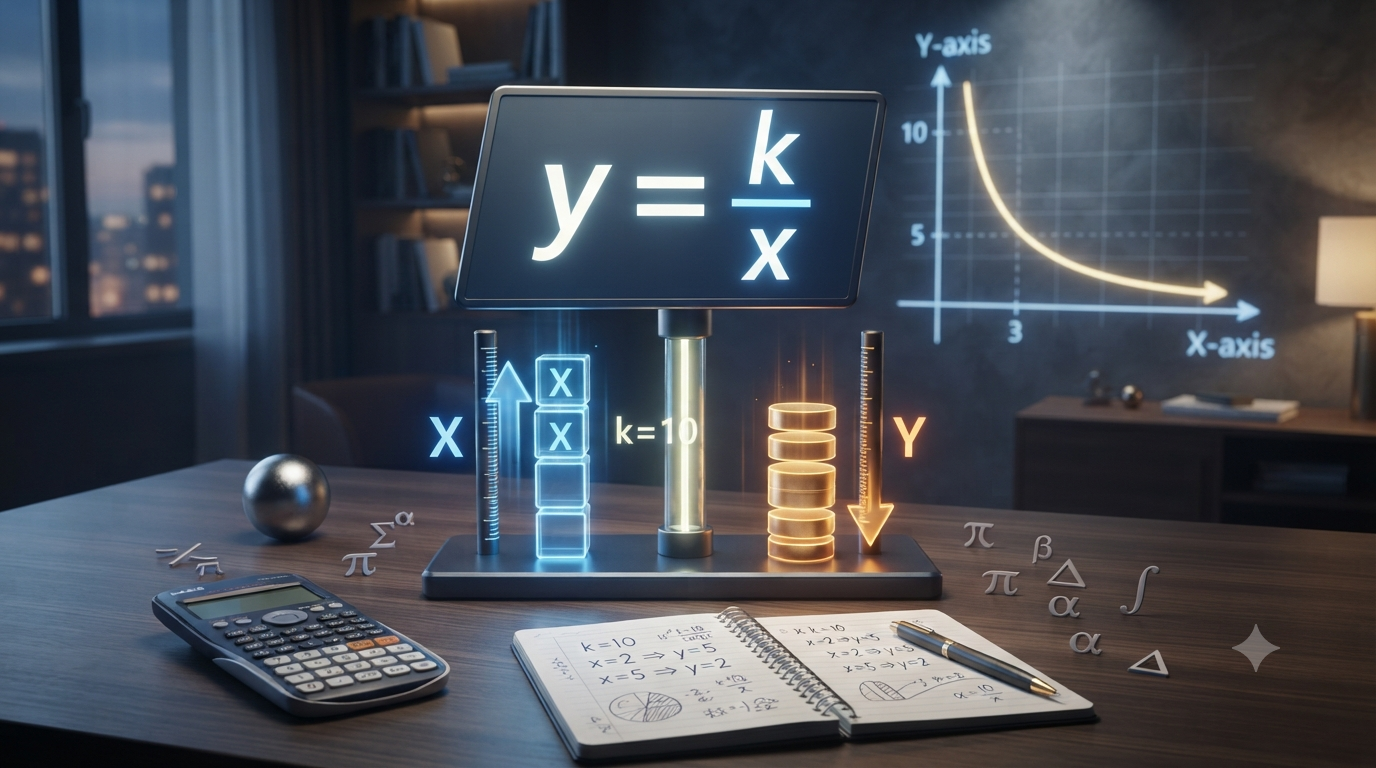
An inverse relationship occurs when one quantity changes in the opposite way to another quantity. In simple terms, when one variable increases, the other decreases, provided the relationship follows an inverse pattern. In mathematics, inverse relationships are especially useful for describing situations where a fixed quantity is shared between two changing variables. They appear in physics, science, economics, engineering, and everyday calculations.
A mathematical formula can often reveal an inverse relationship directly. The most common form is y = k/x, where k is a constant. In this relationship, the product of the two variables remains constant. However, not every formula in which one variable appears in a denominator is automatically an inverse relationship. It is important to rearrange the formula, identify the variables being compared, and check whether their product remains constant.
This article explains how to identify inverse relationships from mathematical formulas, how to recognize their different forms, and how to distinguish them from direct relationships.
What Is an Inverse Relationship?
An inverse relationship exists when two variables change in opposite directions in such a way that their product remains constant.
Suppose two variables are represented by x and y. If their relationship can be written as:
y = k/x
where k is a constant, then y is inversely proportional to x.
The same relationship can also be written as:
xy = k
This form makes the key feature of an inverse relationship clear: the product of the two variables does not change.
For example, suppose:
xy = 24
If x is 2, then:
y = 24/2 = 12
If x increases to 4:
y = 24/4 = 6
When x increases, y decreases. The product remains 24 in both cases.
2 × 12 = 24
Therefore, x and y have an inverse relationship.
The Basic Formula for an Inverse Relationship
The standard mathematical form of an inverse relationship is:
y = k/x
Here:
x is one variable.
y is the other variable.
k is the constant of proportionality.
x cannot be zero because division by zero is undefined.
Multiplying both sides by x gives:
xy = k
This is one of the easiest ways to recognize an inverse relationship.
If a formula can be rearranged into either of these forms:
y = k/x
or
xy = k
then y is inversely proportional to x, assuming k is constant.
How to Identify an Inverse Relationship from a Formula
There are several useful steps for identifying an inverse relationship.
Step 1: Identify the Two Variables
First, determine which two quantities you are comparing.
For example, consider:
P = 60/t
Here, P and t are the changing variables, while 60 is a constant.
Therefore, we are interested in the relationship between P and t.
Step 2: Look for a Variable in the Denominator
A variable appearing in the denominator is often a strong indication of an inverse relationship.
For example:
y = 20/x
Here, x is in the denominator, and 20 is constant. The formula has the standard inverse form:
y = k/x
with:
k = 20
Therefore, y is inversely proportional to x.
However, simply seeing a variable in a denominator is not always enough. The entire formula should be examined.
Step 3: Rearrange the Formula if Necessary
Some inverse relationships are not immediately written as:
y = k/x
For example:
xy = 50
This can be rearranged as:
y = 50/x
Now the inverse relationship is clear.
Similarly, consider:
x = 100/y
Rearranging gives:
xy = 100
Therefore, x and y have an inverse relationship.
Step 4: Check Whether the Product Is Constant
Another reliable method is to multiply the two variables.
If:
xy = k
and k is constant, then the relationship is inverse.
For example:
y = 15/x
Multiplying by x gives:
xy = 15
Since the product is always 15, the relationship is inverse.
Examples of Inverse Relationships in Mathematical Formulas
Example 1: Simple Inverse Formula
Consider:
y = 12/x
The formula already has the standard inverse form:
y = k/x
where:
k = 12
Therefore, y is inversely proportional to x.
If x increases from 2 to 4:
When x = 2, y = 12/2 = 6
and:
When x = 4, y = 12/4 = 3
As x doubles, y becomes half as large.
Example 2: Formula Written as a Product
Consider:
xy = 80
This can be rearranged:
y = 80/x
Therefore, y is inversely proportional to x.
The constant of proportionality is 80.
Example 3: Speed and Time
Suppose a fixed distance d is covered at speed v in time t.
The relationship is:
t = d/v
If the distance is fixed, then d is a constant. Therefore:
t = k/v
This means time is inversely proportional to speed for a fixed distance.
If speed increases, the time required decreases.
For example, for a fixed distance of 120 km:
t = 120/v
At 40 km/h:
t = 120/40 = 3 hours
At 60 km/h:
t = 120/60 = 2 hours
The increase in speed causes a decrease in travel time.
Inverse Relationships with Constants
A formula may contain additional constants and still represent an inverse relationship.
Consider:
F = 100/r²
This does not represent a simple inverse relationship between F and r. Instead, F is inversely proportional to the square of r.
The relationship can be written as:
F ∝ 1/r²
This is called an inverse-square relationship.
For example, if r doubles, r² becomes four times larger. Therefore, F becomes four times smaller.
This is different from the simple inverse relationship:
F = k/r
where doubling r would make F half as large.
Inverse Relationships with Powers
Inverse relationships can involve powers of a variable.
A general inverse-power relationship can be written as:
y = k/xⁿ
where n is a positive constant.
For n = 1:
y = k/x
This is a simple inverse relationship.
For n = 2:
y = k/x²
This is an inverse-square relationship.
For n = 3:
y = k/x³
This is an inverse-cube relationship.
The important idea is that the variable is raised to a power in the denominator. The value of the exponent determines how quickly the dependent variable changes.
How Rearranging a Formula Helps
Some formulas hide the inverse relationship until they are rearranged.
For example:
A = kx/y
Suppose A and x are constant. We can rearrange the formula to make y the subject:
y = kx/A
Since k, x, and A are constant:
y = C
This does not represent an inverse relationship between x and y under those assumptions.
This example shows why it is important to identify which quantities are held constant before deciding whether two variables have an inverse relationship.
Consider instead:
A = xy
If A is constant, then:
y = A/x
Therefore:
y = k/x
Now the inverse relationship between x and y is clear.
Direct Relationship vs Inverse Relationship
It is important not to confuse direct and inverse relationships.
A direct relationship has the form:
y = kx
An inverse relationship has the form:
y = k/x
In a direct relationship, increasing x causes y to increase proportionally.
In an inverse relationship, increasing x causes y to decrease proportionally.
For example, compare:
y = 5x
and:
y = 5/x
For the direct relationship:
x = 2 → y = 10
When x doubles, y doubles.
For the inverse relationship:
x = 2 → y = 2.5
When x doubles, y becomes half as large.
Using the Constant of Proportionality
The constant of proportionality provides another way to test for an inverse relationship.
For an inverse relationship:
y = k/x
Multiplying both sides by x gives:
xy = k
Therefore:
k = xy
If different pairs of x and y values produce the same value of k, the variables follow an inverse relationship.
For example:
x = 3, y = 20
Check the products:
3 × 20 = 60
The product is always 60.
Therefore:
xy = 60
and the relationship is inverse.
How Graphs Can Confirm an Inverse Relationship
A formula can identify an inverse relationship, but a graph can also provide useful confirmation.
For a simple inverse relationship:
y = k/x
the graph is a curved line called a rectangular hyperbola.
For positive values of x and y, the curve generally decreases as x increases.
The graph does not form a straight line because y does not change by the same amount for every equal increase in x.
For example, consider:
y = 12/x
Some values are:
x = 1 → y = 12
The curve becomes less steep as x increases.
The graph is useful for visualizing the inverse relationship, but the formula provides the mathematical test.
Common Mistakes When Identifying Inverse Relationships
One common mistake is assuming that every formula containing division represents an inverse relationship.
For example:
y = x/5
contains division, but it can be rewritten as:
y = (1/5)x
This is a direct relationship, not an inverse relationship.
Another mistake is ignoring constants that may change the relationship.
Consider:
y = 3/x + 2
This is not a simple inverse proportional relationship between y and x because of the additional 2.
It is a transformed reciprocal function, but it does not have the basic proportional form:
y = k/x
Therefore, when identifying inverse proportionality, the formula must be examined as a whole.
A Quick Test for an Inverse Relationship
When given a mathematical formula, use this simple checklist:
Identify the two variables being compared.
Determine which quantities are constant.
Rearrange the formula if necessary.
Check whether it can be written as
y = k/x.Alternatively, check whether
xy = k.Confirm that k remains constant.
Check whether an exponent appears on the variable in the denominator.
Distinguish simple inverse relationships from inverse-square or other inverse-power relationships.
Make sure additional terms do not change the proportional relationship.
Test a few values if necessary.
If the formula passes these checks, you can confidently identify the inverse relationship.
Why Inverse Relationships Are Important
Inverse relationships are important because they describe many real-world situations in which increasing one quantity reduces another.
In physics, examples include relationships between speed and travel time for a fixed distance, and certain inverse-square relationships involving force, intensity, and distance.
In mathematics, inverse relationships help explain proportional reasoning and functions.
In science and engineering, recognizing an inverse relationship can make it easier to predict how a system will respond when one variable changes.
For example, if a formula shows:
y = 100/x
you immediately know that increasing x will decrease y. You do not need to calculate every possible value to understand the general behavior of the relationship.
Conclusion
An inverse relationship can usually be identified from a mathematical formula by checking whether one variable is proportional to the reciprocal of another. The standard form is:
y = k/x
or equivalently:
xy = k
where k is a constant.
The most reliable approach is to identify the variables, rearrange the formula when necessary, and check whether their product remains constant. A variable in the denominator is often an important clue, but the complete formula must be considered because additional terms or factors can change the type of relationship.
Inverse relationships may also involve powers, such as inverse-square relationships represented by:
y = k/x²
Understanding these patterns makes mathematical formulas easier to interpret and helps connect equations with real-world behavior. Once you learn to recognize the reciprocal form and constant-product property, identifying inverse relationships becomes a straightforward part of mathematical reasoning.
FAQs
1. How can you identify an inverse relationship from a mathematical formula?
An inverse relationship can usually be identified when one variable is equal to a constant divided by another variable. The standard form is y = k/x, where k is a constant. It can also be written as xy = k. In this relationship, when one variable increases, the other decreases in a proportional way. For example, if y = 20/x, then the product xy is always 20. If x increases from 2 to 4, y decreases from 10 to 5. Therefore, checking for the form y = k/x or a constant product is a reliable way to identify an inverse relationship.
2. What is the standard formula for an inverse relationship?
The standard formula for an inverse relationship is y = k/x, where x and y are variables and k is a constant of proportionality. Multiplying both sides by x gives xy = k. This means the product of the two variables always remains constant. For example, if y = 30/x, then xy = 30. When x increases, y must decrease to keep the product equal to 30. The value of k determines the strength of the relationship. This formula is one of the simplest and most useful ways to recognize inverse proportionality in mathematics.
3. Does a variable in the denominator always indicate an inverse relationship?
No, a variable in the denominator does not always mean that two variables have a simple inverse proportional relationship. For example, y = 10/x is an inverse relationship because it has the form y = k/x. However, a formula such as y = 10/x + 3 is not a simple inverse proportional relationship because of the additional constant term. Similarly, y = x/10 is a direct relationship even though division appears in the formula. Therefore, the entire formula should be examined rather than focusing only on whether a variable appears in a denominator.
4. How does the constant of proportionality help identify an inverse relationship?
The constant of proportionality provides a useful test for an inverse relationship. In an inverse relationship, the formula is y = k/x. Multiplying both sides by x gives xy = k. Therefore, the product of x and y must remain constant. For example, suppose x = 4 and y = 15. Their product is 60. If another pair is x = 10 and y = 6, the product is also 60. Since the product remains unchanged, the variables have an inverse relationship. Thus, calculating xy for different values is an effective way to verify inverse proportionality.
5. What happens to one variable when the other variable increases in an inverse relationship?
When one variable increases in an inverse relationship, the other variable decreases. The decrease occurs in such a way that their product remains constant. For example, consider y = 24/x. If x = 2, then y = 12. If x increases to 4, y becomes 6. If x increases to 8, y becomes 3. In each case, the product remains 24. This is different from a direct relationship, where both variables increase or decrease together. The opposite movement of the variables is one of the main characteristics used to recognize an inverse relationship.
6. How can you distinguish a direct relationship from an inverse relationship?
A direct relationship generally has the form y = kx, while an inverse relationship has the form y = k/x. In a direct relationship, increasing x causes y to increase proportionally. In an inverse relationship, increasing x causes y to decrease proportionally. For example, y = 5x represents a direct relationship, whereas y = 5/x represents an inverse relationship. Another useful test is that y/x remains constant for a direct relationship, while xy remains constant for an inverse relationship. Looking at the formula and checking the appropriate constant provides a reliable way to distinguish the two.
7. Can an inverse relationship involve a square or another power?
Yes. Inverse relationships can involve powers of a variable. A general inverse-power relationship can be written as y = k/xⁿ, where n is a positive number. When n = 1, the relationship is a simple inverse relationship. When n = 2, it is an inverse-square relationship, written as y = k/x². When n = 3, it is an inverse-cube relationship. These relationships do not change at the same rate. For example, if y is inversely proportional to x² and x doubles, y becomes four times smaller. The exponent determines how rapidly the dependent variable changes.
8. How can rearranging a formula reveal an inverse relationship?
Rearranging a formula can make an inverse relationship easier to recognize. Some equations do not initially appear in the standard inverse form. For example, consider xy = 50. Solving for y gives y = 50/x, which clearly matches the inverse form y = k/x. Similarly, if a formula is given as x = 100/y, multiplying both sides by y gives xy = 100. This shows that the product is constant. Therefore, when an inverse relationship is not immediately obvious, rearranging the equation so that one variable is isolated can help reveal whether it follows an inverse pattern.
9. How can values be used to confirm an inverse relationship?
Values can be used to confirm an inverse relationship by checking whether the product of the two variables remains constant. Suppose the values are x = 2, y = 12, x = 3, y = 8, and x = 6, y = 4. Calculate each product: 2 × 12 = 24, 3 × 8 = 24, and 6 × 4 = 24. Since the product is always 24, the relationship is inverse. You can also observe that when x increases, y decreases. However, checking the constant product gives a stronger mathematical test than simply observing that the variables move in opposite directions.
10. Why is it important to identify inverse relationships in mathematical formulas?
Identifying inverse relationships helps you understand how quantities change in relation to each other without calculating every possible value. Once you recognize a formula such as y = k/x, you immediately know that increasing x will cause y to decrease while their product remains constant. This is useful in mathematics, physics, engineering, and many scientific applications. Inverse relationships also help with predictions, graphs, proportional reasoning, and interpreting equations. Recognizing forms such as y = k/x and y = k/x² allows you to understand the behavior of a mathematical model quickly and apply the formula correctly in different situations.